
Dialing in aluminum MIG settings can be a whole different challenge compared to welding steel. The first time I ran aluminum wire through a MIG gun, I struggled with burn-back, bird-nesting, and a puddle that felt way hotter and faster than I expected. That’s when I realized how important a solid aluminum MIG welding wire speed and voltage chart really is.
Aluminum needs higher voltage, faster wire feed speeds, and cleaner joint prep to keep the puddle stable and avoid cold starts or incomplete fusion. Whether you’re running 4043 or 5356 wire, using a spool gun, or adjusting for different metal thicknesses, the right chart can save you from wasting time, wire, and gas.
I’ll walk you through the settings that actually work in real-world shop conditions so you can get smooth, strong aluminum MIG welds without all the trial and error.
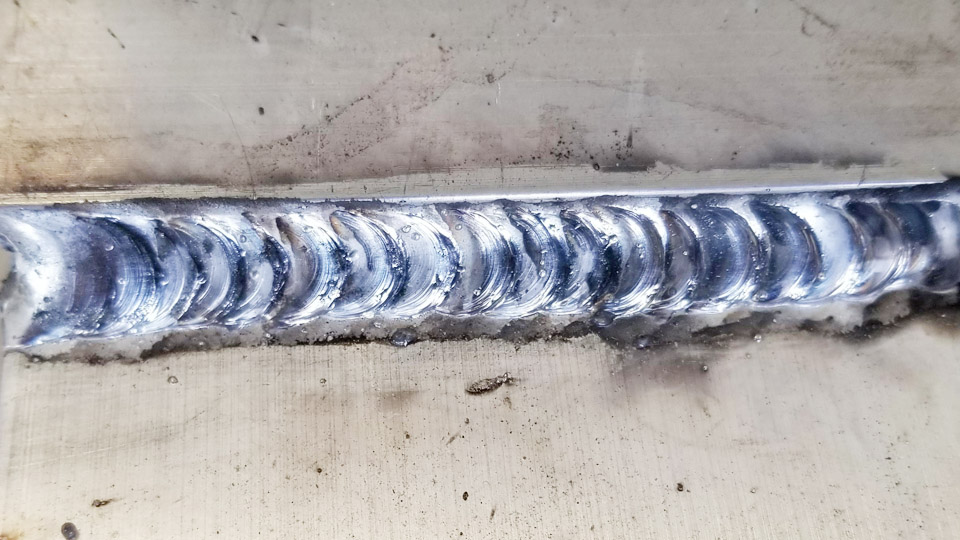
Image by reddit
Why Aluminum MIG Settings Are So Much Pickier Than Steel
Steel forgives a lot. Spray a little high on wire speed with ER70S-6 and you usually just get a taller crown. Do the same thing with ER4043 or ER5356 and the puddle turns to soup, you lose shielding gas coverage, and you end up with black soot and wormholes.
Aluminum forms an oxide layer instantly, melts at roughly half the temperature of steel, and expands like crazy when it gets hot. That means your arc length, travel speed, and heat input have to live in a much tighter window. The charts we all lean on aren’t just suggestions — they’re the map that keeps you out of the ditch.
How Aluminum MIG Wire Speed and Voltage Actually Work Together
Think of voltage as how “hot” your arc is and wire speed as how much filler metal you’re shoving into that heat. Raise the voltage and you lengthen the arc — more heat, flatter bead, but you can lose gas coverage if you go too far.
Crank the wire speed and you shorten the arc, push more metal in, and cool the puddle down a little. The sweet spot is where the arc is stable, the bead wets out nicely on both toes, and you hear that steady bacon-fry sizzle instead of popping or stuttering.
Base Charts I Actually Use in the Shop (4043 and 5356)
I keep two laminated cards zip-tied to my Miller 252 and Lincoln Power MIG 260MP — one for each alloy. Here’s what’s on them. Copy it, print it, tape it to your bottle. These are averaged from Lincoln Electric, Miller, Hobart, and my own travel-speed testing on 1/8″, 3/16″, and 1/4″ 6061.
ER4043 – Good for 6061, 6063, 5000 series, castings
| Material Thickness | Amperage Range | Wire Speed (ipm) | Voltage | Argon Flow (cfh) | Typical Travel Speed |
|---|---|---|---|---|---|
| 1/16″ (0.062) | 90–120 | 280–380 | 18–20 | 25–30 | 22–28 ipm |
| 3/32″ (0.094) | 120–150 | 350–450 | 19–21 | 30–35 | 20–26 ipm |
| 1/8″ (0.125) | 140–180 | 420–520 | 20–23 | 30–40 | 18–24 ipm |
| 3/16″ (0.187) | 180–220 | 480–620 | 22–25 | 35–45 | 16–20 ipm |
| 1/4″ (0.250) | 200–260 | 550–750 | 24–27 | 40–50 | 14–18 ipm |
ER5356 – Better for 5000 series and when you need higher strength
| Material Thickness | Amperage Range | Wire Speed (ipm) | Voltage | Argon Flow (cfh) |
|---|---|---|---|---|
| 1/8″ | 150–190 | 380–480 | 21–24 | 30–40 |
| 3/16″ | 190–240 | 450–580 | 23–26 | 35–45 |
| 1/4″ | 220–280 | 520–680 | 25–28 | 40–50 |
These numbers are for pure argon and 0.035″ wire — by far the most common setup in US shops. If you run 0.030″ drop everything 15–20%, and if you jump to 3/64″ add about 20–25%.
Machine-Specific Sweet Spots I’ve Found
Miller Multimatic 215 / 220: Start at 21 volts and 420 ipm on 1/8″ 6061 with 0.035″ 4043 — then creep the wire speed up until the arc tightens and the spatter disappears.
Lincoln Power MIG 210MP / 260MP: Lincoln likes a hair more voltage. 22–23 volts and 480–520 ipm is usually money on the same joint.
Hobart Handler 210MVP: These run a little cooler. I’m usually 23 volts and 500 ipm for 1/8″ material.
YesWelder MIG-205DS and all the Amazon specials: They read high on the meters. Trust your eyes and ears more than the numbers — back the voltage down half a volt from what the chart says and sneak up on it.
When to Choose 4043 vs 5356 (The Real Answer)
Everybody argues this one in the break room. Here’s what I tell the new guys:
Run 4043 if:
- You’re welding 6061 or 6063
- You’re filling gaps or fixing castings
- You want the weld to anodize bright (5356 turns black)
- Ductility isn’t critical
Run 5356 if:
- You’re on 5000-series (5083, 5086, 5454)
- The part sees any real load or fatigue (bike frames, pressure vessels)
- You’re matching base metal strength on structural stuff
- You’re TIG’ing afterward (5356 TIGs nicer)
I keep both spools loaded on a dual-torch cart. Takes ten seconds to swap guns.
Joint Prep and Gun Technique That Save Your Settings
Even perfect voltage and wire speed won’t save a dirty joint. I wipe every piece with acetone, then hit it with a dedicated stainless brush — never the carbon steel one. Bevel anything over 3/16″ to 60° with a 1/16″ land. Push angle 10–15°, travel steady, and pause half a second on the toes. If you’re getting that black soot ring, you’re either too cold or your gun angle is letting the wind steal your gas.
Common Mistakes I Still See Pros Make
Going straight off the door chart without trimming for your specific bottle pressure and hose length. A 50-foot lead drops 5–8 cfh by the time it gets to the cup.
Leaving the plastic spool cover on and wondering why you’re bird-nesting every five minutes.
Trying to weld outdoors with anything less than 40 cfh and no windscreen.
Running straight CO² or 75/25 — instant porosity disaster.
Fine-Tuning on the Fly When the Chart Isn’t Perfect
Here’s my 30-second test: Lay a 4-inch bead on scrap the same thickness and alloy. Look for:
- Bead wet out clean on both sides → good
- Slight crown, no undercutting → perfect heat
- Steady sizzle, no popping → gas coverage good
- No black soot → you’re not too cold
Too much spatter or ropey bead? Back voltage down half a volt. Puddle too runny and burning through? Drop wire speed 30–40 ipm. You’ll feel it click in.
Running Thicker Than 1/4″ — When to Switch to Pulse or AC TIG
Once you get past 3/8″ on 6061, standard short-circuit or basic spray just dumps too much heat. I switch to a Lincoln Power Wave or Miller Dynasty with pulse MIG — drops your heat input 30% and keeps the weld from cracking on cool-down. If the job has to look pretty or pass X-ray, I just grab the TIG torch and walk it with 5356.
Safety Stuff Nobody Should Have to Tell You Twice
100% argon bottles tip easier than steel bottles — strap them twice. Aluminum spatter is hotter and sticks worse — full leathers, not just a cotton shirt. UV from aluminum arc is brutal — shade 10 minimum, shade 12 if you’re running 200+ amps. And keep a fire extinguisher that’s rated for Class D right next to the bench — magnesium in some alloys burns like the sun.
Conclusion
Print the charts, laminate them, and spend one Saturday morning running test beads at different settings on scrap. Mark what looks best with a Sharpie right on the metal. In a month you’ll be dialing in perfect aluminum MIG welds faster than the old timers who claim they “just feel it.” The truth is they felt it a thousand times and wrote the numbers down — now you’ve got their cheat sheet and my real-world tweaks.
When in doubt, run one volt higher and 50 ipm slower than you think you need. It’s way easier to speed up and cool it down than it is to fix a puddle that’s already burned through.
FAQ
What wire speed for 0.035 aluminum wire on 1/8″ 6061?
Start around 450–480 inches per minute with 21–22 volts and pure argon at 35 cfh. Adjust from there until the bead lays flat and the arc sounds steady.
Can I use my steel MIG settings for aluminum?
Absolutely not. Steel runs 75/25 or CO² mix and way higher voltage. Aluminum needs 100% argon and much tighter parameters or you’ll get porosity city.
Why does my aluminum weld look black and sooty?
You’re either too cold (not enough voltage/wire speed) or losing gas coverage. Increase voltage half a volt, check for drafts, and make sure your nozzle isn’t clogged.
Is 4043 or 5356 better for boat repairs?
4043 flows better, fills pits in castings easier, and anodizes clear afterward. That’s what 90% of marine shops run for patches and props.
Do I need a spool gun or can I push-pull with a regular MIG gun?
For anything under 50 ft of welding a year, a good spool gun (Miller Spoolmate or Lincoln Magnum 100SG) is simpler and cheaper. Over that, invest in a push-pull setup or a machine with built-in pulse.