
To become an aerospace welder, complete formal welding education, obtain AWS D17.1 certification, master TIG and electron beam welding techniques, and gain specialized training in aerospace materials like titanium and Inconel alloys. The process typically requires 6-24 months of dedicated training plus years of experience.
Aerospace welding represents the pinnacle of precision metalworking, demanding exceptional skill, unwavering attention to detail, and mastery of advanced techniques that standard welders never encounter. Unlike conventional welding applications, aerospace welding operates under zero-defect tolerances where a single flawed joint could result in catastrophic failure at 35,000 feet.
The aerospace industry requires welders who understand the unique challenges of joining exotic materials under extreme conditions. These professionals work with titanium alloys, Inconel superalloys, and aluminum-lithium composites that behave differently than standard steel. They must execute welds that maintain structural integrity through temperature swings from -65°F to 180°F while withstanding vibrations, pressure differentials, and corrosive environments.
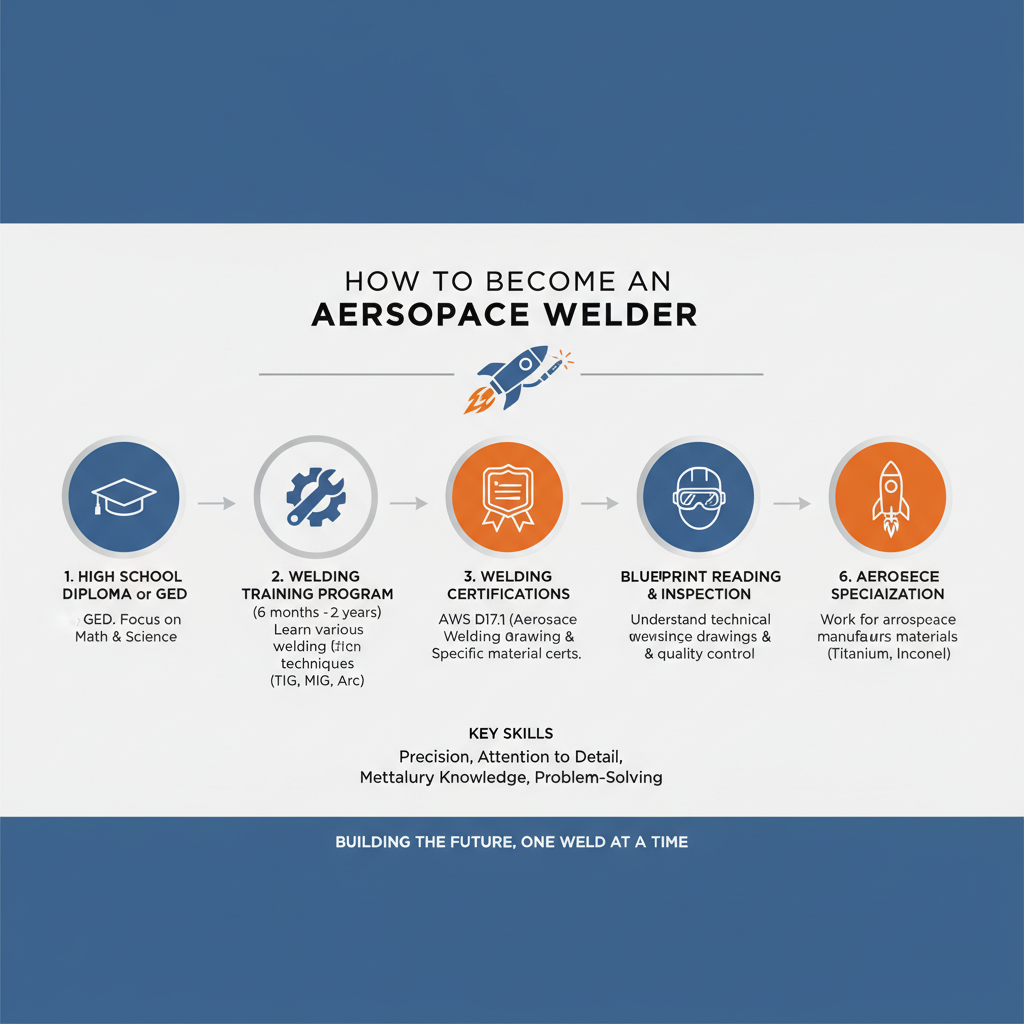
Essential Educational Foundation for Aerospace Welding
Begin your aerospace welding journey with comprehensive formal education. Community colleges and technical schools offer welding programs, but aerospace-specific training requires specialized curricula that address aviation industry standards.
Enroll in programs that cover metallurgy fundamentals, blueprint reading, and quality control procedures. Standard welding programs teach basic MIG, TIG, and stick welding, but aerospace applications demand advanced TIG (GTAW) proficiency and exposure to specialized processes like electron beam welding and friction stir welding.
Mathematics becomes critical in aerospace welding calculations. You’ll need to understand heat input formulas: Heat Input = (Voltage × Amperage × 60) / Travel Speed (inches per minute). This calculation determines penetration depth and heat-affected zone characteristics, both crucial for maintaining material properties in aerospace alloys.
Physics knowledge helps you understand why certain welding parameters work. For titanium welding, you must comprehend how atmospheric contamination occurs and why argon shielding gas purity must exceed 99.995%. Standard welding uses 99.9% pure argon, but aerospace titanium work requires ultra-high purity to prevent alpha case formation.
Specialized Coursework Requirements
Complete courses in non-destructive testing (NDT) methods including radiographic, ultrasonic, and penetrant testing. Aerospace welders must understand how their work will be inspected and what defects inspectors seek.
Study corrosion science and material compatibility. Aerospace welders work with dissimilar metals, requiring knowledge of galvanic corrosion potential and proper filler metal selection. When welding 6061-T6 aluminum to 7075-T6, use 4043 filler for strength or 5356 for corrosion resistance, depending on application requirements.
Learn computer-aided design (CAD) software. Modern aerospace welding increasingly involves automated systems and robotic welding cells. Understanding CAD helps you interpret complex joint geometries and welding sequences.
Critical Certifications and Industry Standards
Aerospace welding certification differs significantly from standard AWS certifications. The primary standard, AWS D17.1 “Specification for Fusion Welding for Aerospace Applications,” establishes requirements far exceeding typical welding codes.
AWS D17.1 certification requires demonstration of specific welding positions, joint configurations, and material combinations. Unlike standard certifications that may allow 1/8-inch reinforcement, aerospace welds often require flush profiles with zero reinforcement tolerance.
Obtain multiple position certifications including 1G (flat), 2G (horizontal), 3G (vertical), and 4G (overhead) for each material type you’ll weld. Aerospace work frequently occurs in confined spaces with limited access, making all-position capability essential.
Material-Specific Certification Requirements
Titanium certification demands specialized procedures. Test welds undergo rigorous inspection including bend tests, tensile tests, and metallographic examination. The heat-affected zone must show no evidence of alpha case formation, which appears as a brittle, oxygen-contaminated layer.
Inconel and other superalloy certifications require hot crack susceptibility testing. These materials are prone to solidification cracking, requiring specific welding techniques and filler metal selection. Inconel 625 filler provides excellent crack resistance when welding Inconel 718 base material.
Aluminum-lithium alloy certification presents unique challenges. These advanced materials offer superior strength-to-weight ratios but require modified welding parameters. Standard 4043 aluminum filler may cause porosity in lithium-containing alloys, necessitating specialized 2319 filler metal.
Advanced Welding Techniques for Aerospace Applications
Master tungsten inert gas (TIG) welding with exceptional precision. Aerospace TIG welding requires consistent penetration within ±0.005 inches and uniform bead appearance. Practice maintaining steady arc length between 0.040-0.080 inches while controlling heat input precisely.
Develop electron beam welding competency for critical applications. This high-energy process creates deep, narrow welds with minimal heat-affected zones. Electron beam welding operates in vacuum chambers, requiring understanding of vacuum technology and beam focusing principles.
Learn friction stir welding for aluminum applications. This solid-state process eliminates fusion-related defects like porosity and hot cracking. Boeing extensively uses friction stir welding for fuselage panels, making this skill increasingly valuable.
Orbital Welding Mastery
Orbital welding systems provide consistent, repeatable results for tube and pipe welding. These automated systems control all welding parameters electronically, ensuring uniform penetration and appearance. Learn to program welding schedules and maintain orbital welding equipment.
Understand pulsed welding techniques for thin materials. Aerospace applications often involve sheet metal as thin as 0.020 inches. Pulsed TIG welding alternates between high peak current for penetration and low background current for cooling, preventing burn-through while maintaining fusion.
Practice keyhole welding for full penetration joints. This technique maintains a molten keyhole through the material thickness, ensuring complete joint penetration without backing bars. Keyhole welding requires precise torch manipulation and constant travel speed.
Material Science and Metallurgy Knowledge
Aerospace materials present unique welding challenges requiring deep metallurgical understanding. Each material family responds differently to welding heat cycles, demanding specific techniques and procedures.
Titanium alloys require inert atmosphere protection during welding and cooling. Titanium readily absorbs oxygen, nitrogen, and hydrogen at elevated temperatures, forming brittle compounds that compromise joint integrity. Maintain argon trailing shields until weld metal temperature drops below 800°F.
Inconel superalloys resist high temperatures but are susceptible to hot cracking. These materials have high thermal expansion coefficients and low thermal conductivity, creating residual stresses during cooling. Use low heat input and proper joint design to minimize cracking susceptibility.
Heat Treatment Considerations
Understand post-weld heat treatment requirements for different materials. Many aerospace alloys require solution treatment and aging after welding to restore optimal mechanical properties.
6061-T6 aluminum loses strength in the heat-affected zone during welding. Post-weld solution treatment at 990°F followed by artificial aging at 350°F for 8 hours restores T6 properties. However, this process requires furnace capabilities and may not be practical for large assemblies.
Inconel 718 requires post-weld solution treatment at 1750°F followed by double aging: 1325°F for 8 hours, furnace cool to 1150°F, hold 8 hours, then air cool. This complex heat treatment develops the strengthening gamma-prime and gamma-double-prime phases.
Quality Control and Inspection Procedures
Aerospace welding operates under stringent quality control requirements. Every weld undergoes multiple inspection stages, from pre-weld preparation through final acceptance testing.
Visual inspection precedes all other testing methods. Develop skills to identify surface defects including cracks, porosity, incomplete fusion, and contamination. Use proper lighting and magnification tools to detect defects as small as 0.005 inches.
Learn penetrant testing procedures for detecting surface-breaking defects. Apply penetrant, allow dwell time, remove excess, apply developer, and interpret indications. Different penetrant systems have varying sensitivity levels, with aerospace applications typically requiring Type I, Method A penetrants.
Non-Destructive Testing Integration
Understand radiographic testing principles and image interpretation. X-ray and gamma-ray radiography reveal internal defects including porosity, inclusions, and lack of penetration. Learn to identify different defect types on radiographic film and digital images.
Ultrasonic testing provides detailed information about internal discontinuities. Pulse-echo techniques can measure defect size, location, and orientation. Learn to operate ultrasonic equipment and interpret A-scan displays showing defect signals.
Magnetic particle testing detects surface and near-surface defects in ferromagnetic materials. While less common in aerospace applications due to material types, this method remains important for steel components and tooling.
What Most Guides Miss: Advanced Insider Insights
Standard welding guides overlook critical aerospace-specific requirements that separate competent welders from aerospace professionals. These advanced insights come from years of industry experience and specialized training.
Atmospheric contamination control extends beyond basic shielding gas coverage. Aerospace welding requires environmental monitoring including humidity levels, air quality, and contamination sources. Welding titanium in environments exceeding 50% relative humidity can introduce hydrogen, causing delayed cracking.
Filler metal storage and handling procedures differ significantly from standard practices. Aerospace filler metals require controlled storage environments with temperature and humidity monitoring. ER70S-2 steel filler stored improperly can absorb moisture, leading to hydrogen-induced cracking.
Joint preparation tolerances are measured in thousandths rather than typical welding tolerances. Root opening variations exceeding ±0.005 inches can cause penetration inconsistencies that fail inspection requirements. Use precision measuring tools and maintain consistent fit-up procedures.
Traceability and Documentation Requirements
Every aerospace weld requires complete documentation traceability. Record welding parameters, filler metal heat numbers, welder certification numbers, and inspection results. This documentation follows the component throughout its service life.
Material certification becomes critical in aerospace applications. Each piece of base metal and filler metal must have certified chemical composition and mechanical properties. Understand how to read and interpret material test reports and certificates of compliance.
Repair procedures require engineering approval and specific qualification testing. Unlike standard welding where repairs follow general procedures, aerospace repairs need individual engineering evaluation and often require re-certification of the repair procedure.
Career Progression and Specialization Paths
Aerospace welding careers offer multiple advancement opportunities beyond basic production welding. Specialization in specific processes, materials, or applications can lead to higher compensation and job security.
Process specialization focuses on mastering advanced techniques like electron beam welding, laser welding, or friction stir welding. These specialized processes command premium wages due to limited qualified personnel and expensive equipment requirements.
Material specialization involves becoming an expert in specific alloy families. Titanium welding specialists are particularly valuable due to the material’s challenging characteristics and critical applications in aerospace structures.
Quality Control and Inspection Career Paths
Transition into non-destructive testing and quality control roles. NDT technicians and inspectors earn competitive salaries while working in less physically demanding environments. Advanced certifications in multiple NDT methods increase career opportunities.
Welding engineering positions combine technical welding knowledge with engineering principles. These roles involve developing welding procedures, qualifying new processes, and solving complex manufacturing challenges. A bachelor’s degree in welding engineering or materials science typically supports these positions.
Training and certification instruction provides opportunities to share expertise while maintaining industry connections. Certified welding instructors teach at technical schools, community colleges, and private training facilities.
Building Professional Networks and Industry Connections
Join professional organizations including the American Welding Society (AWS) and specialized aerospace groups. These organizations provide continuing education opportunities, technical resources, and networking events that advance career development.
Attend industry conferences and trade shows to stay current with technological developments and meet potential employers. Events like the AWS Annual Conference and the National Aerospace and Defense Contractors Accreditation Program (Nadcap) meetings provide valuable industry insights.
Participate in local AWS sections and technical committees. Volunteer involvement demonstrates professional commitment and provides opportunities to contribute to industry standards development.
Mentorship and Continuous Learning
Seek mentorship from experienced aerospace welders and engineers. Experienced professionals provide insights into industry practices, career development strategies, and technical problem-solving approaches that accelerate professional growth.
Pursue continuing education through advanced courses, seminars, and workshops. Technology evolution requires continuous learning to maintain competitiveness in the aerospace welding field.
Consider pursuing additional certifications in related fields including machining, assembly, or project management. Diverse skill sets increase value to employers and provide career flexibility.
Frequently Asked Questions
How long does it take to become qualified as an aerospace welder?
Basic qualification typically requires 6-24 months of intensive training, but achieving full competency and advanced certifications can take 3-5 years of dedicated practice and experience.
What is the average salary for aerospace welders?
Entry-level aerospace welders earn $45,000-$60,000 annually, while experienced specialists with advanced certifications can earn $80,000-$120,000 or more, depending on location and specialization.
Do I need a college degree to become an aerospace welder?
While not always required, an associate degree in welding technology or related field significantly improves employment opportunities and advancement potential in the aerospace industry.
What are the most important certifications for aerospace welding?
AWS D17.1 certification is essential, along with material-specific certifications for titanium, aluminum, and superalloys. NDT certifications also enhance career prospects.
Is aerospace welding physically demanding?
Yes, aerospace welding requires extended periods in awkward positions, precise hand-eye coordination, and the ability to maintain steady hands for detailed work. Physical fitness and dexterity are important.
What safety considerations are unique to aerospace welding?
Aerospace welding involves exotic materials, specialized gases, and high-energy processes requiring enhanced safety protocols including proper ventilation, personal protective equipment, and material handling procedures.
How does automation affect aerospace welding careers?
While automation handles some routine tasks, complex aerospace welding still requires skilled human operators for setup, programming, and quality control, maintaining strong demand for qualified welders.
The next logical step in your aerospace welding journey involves researching specific training programs in your area and connecting with local aerospace manufacturers to understand their particular requirements and opportunities. Begin building your technical foundation while simultaneously developing industry connections that will support your career advancement in this demanding but rewarding field.