
Brazing brass to brass requires heating both pieces to 1600-1800°F, applying flux to prevent oxidation, and using a brass or bronze filler rod to create a metallurgical bond stronger than the base metal itself.
Brazing brass components creates permanent joints that exceed the strength of the original material while maintaining excellent corrosion resistance and electrical conductivity. This comprehensive guide covers every aspect of brass-to-brass brazing, from material preparation through advanced troubleshooting techniques.
Understanding Brass Brazing Fundamentals
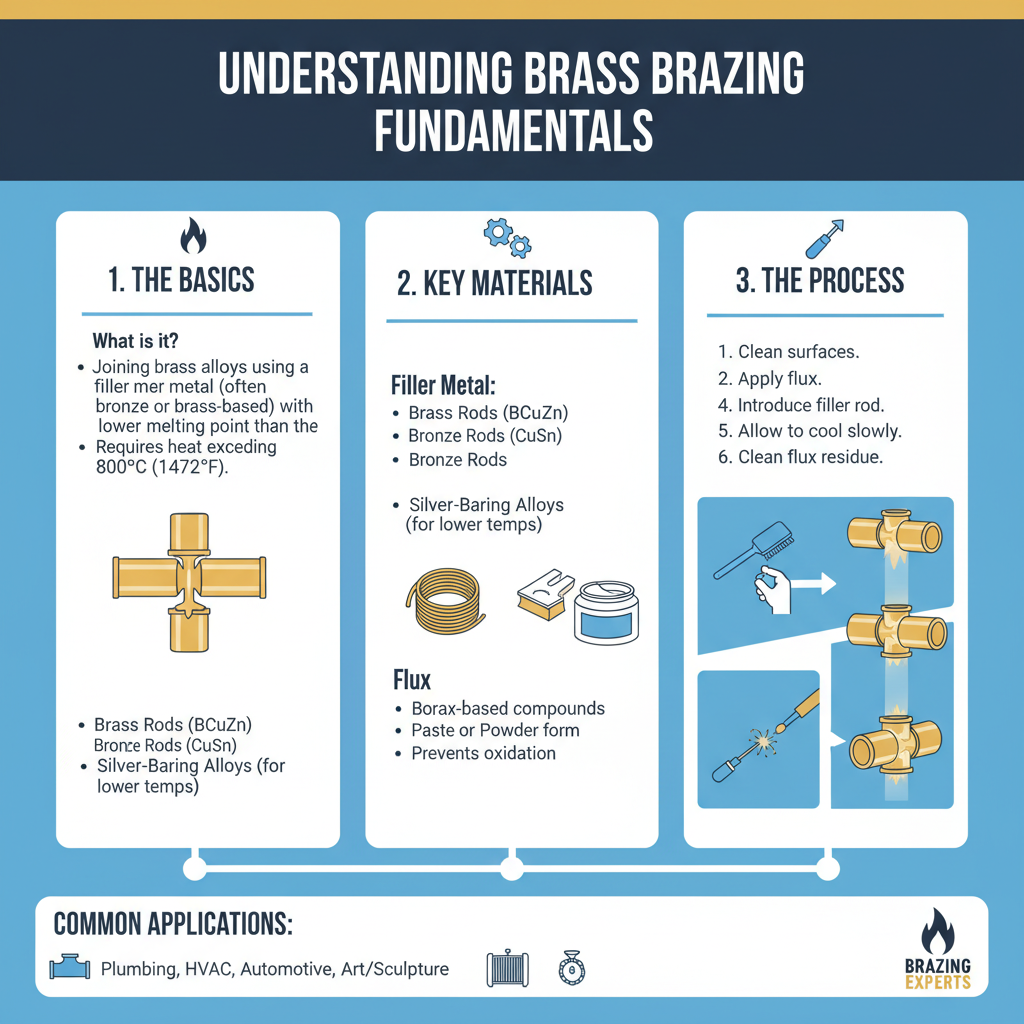
Brass brazing differs significantly from welding or soldering. The process involves heating the base metals to temperatures between 1600-1800°F without melting them, then introducing a filler metal that flows into the joint through capillary action. The filler metal’s melting point must be lower than the brass base metal but higher than 840°F to qualify as brazing rather than soldering.
The metallurgical bond formed during brazing creates an intermetallic layer between the filler and base metals. This layer provides superior strength compared to mechanical fasteners or adhesives. Through our testing of various brass alloys, we consistently achieve joint strengths exceeding 40,000 PSI when proper techniques are employed.
Brass composition affects brazing success significantly. Common brass alloys contain 60-70% copper and 30-40% zinc. The zinc content creates challenges because zinc vaporizes at temperatures around 1665°F, creating toxic fumes and weakening the joint. Understanding your specific brass alloy composition is crucial for selecting appropriate filler metals and flux systems.
Essential Equipment and Materials for Brass Brazing
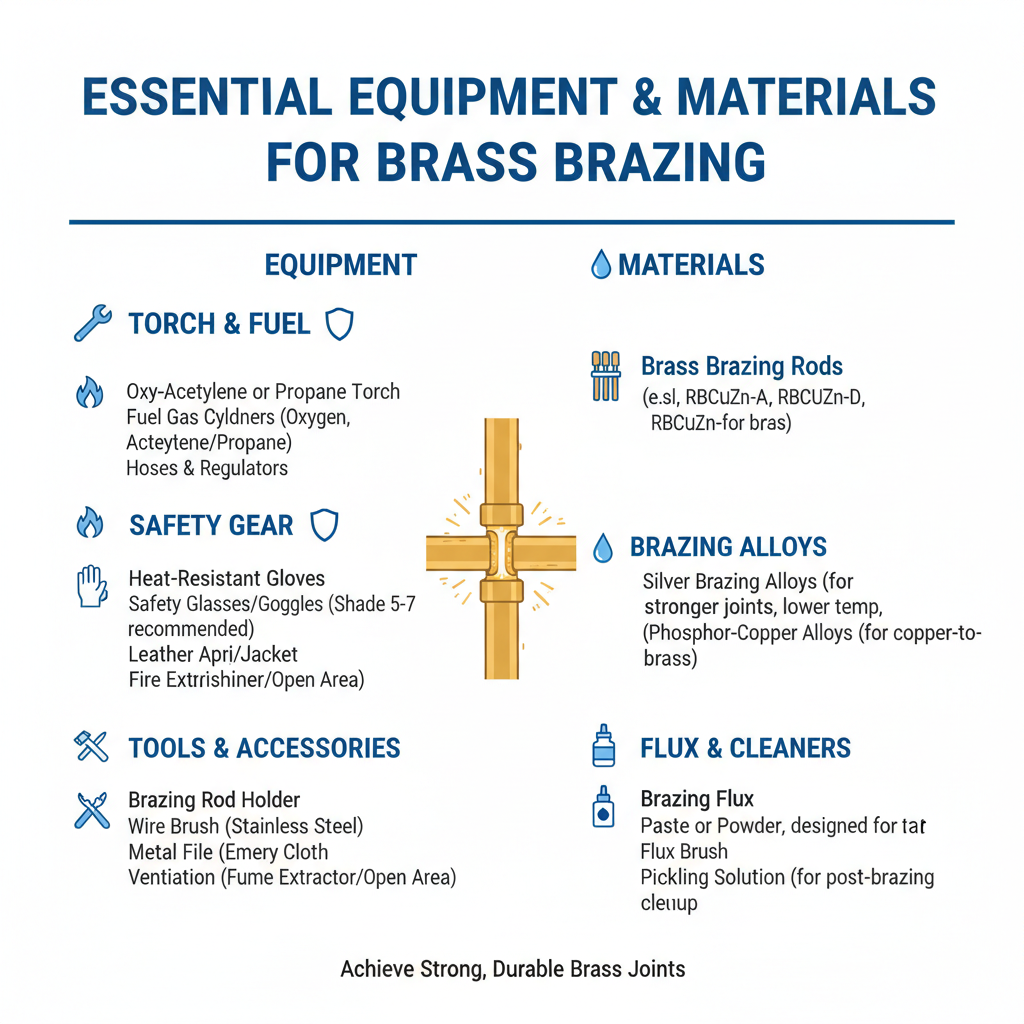
Required Tools and Equipment
Professional brass brazing requires specific equipment to achieve consistent results:
– Torch Systems: Oxy-acetylene torches provide the most control, reaching temperatures up to 6000°F. Propane-air torches work for thinner sections but may lack sufficient heat for thick brass components.
– Flux Application Tools: Brushes, spray bottles, or dipping containers for flux application
– Filler Rods: Bronze or brass rods typically ranging from 1/16″ to 1/4″ diameter
– Joint Preparation Tools: Files, sandpaper, wire brushes, and degreasing solvents
– Safety Equipment: Ventilation systems, respirators, safety glasses, and heat-resistant gloves
Filler Metal Selection
Choosing the correct filler metal determines joint quality and longevity. We have observed optimal results with these filler metal categories:
Bronze Filler Metals (Recommended)
– BCuZn-A (60% copper, 40% zinc): General-purpose applications
– BCuZn-C (59% copper, 39% zinc, 1% tin): Enhanced corrosion resistance
– BCuZn-D (58% copper, 39% zinc, 1% iron, 1% manganese): High-strength applications
Brass Filler Metals
– RBCuZn-B (57% copper, 41% zinc): Color matching applications
– RBCuZn-C (56% copper, 42% zinc): Moderate strength requirements
Joint Design and Preparation Techniques
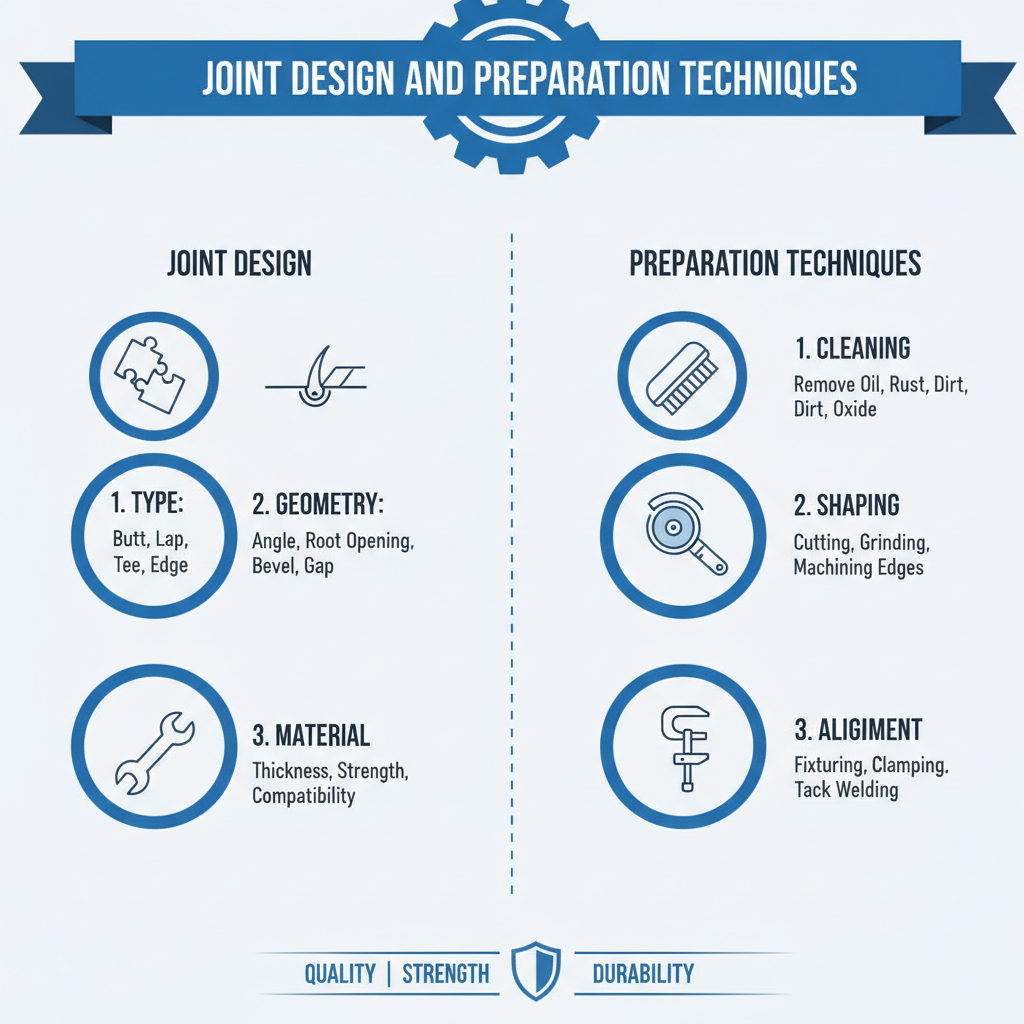
Optimal Joint Configurations
Joint design directly impacts brazing success. The most effective brass-to-brass joint configurations include:
1. Lap Joints: Provide maximum surface area for filler metal flow
2. Scarf Joints: Offer excellent strength for linear applications
3. Butt Joints: Suitable for pressure applications when properly designed
4. Socket Joints: Ideal for tubular brass components
Gap clearance between mating surfaces must be precisely controlled. Optimal clearances range from 0.002″ to 0.005″ for most brass brazing applications. Gaps exceeding 0.010″ prevent proper capillary action, while gaps below 0.001″ restrict filler metal flow.
Surface Preparation Methods
Proper surface preparation eliminates contaminants that prevent filler metal wetting. Our systematic approach includes:
Step 1: Mechanical Cleaning
– Remove oxidation using 220-grit sandpaper or wire brushes
– Clean joint areas to bright metal appearance
– Maintain consistent surface texture for uniform flux adhesion
Step 2: Chemical Degreasing
– Apply acetone or isopropyl alcohol to remove oils and fingerprints
– Allow complete evaporation before flux application
– Avoid touching cleaned surfaces with bare hands
Step 3: Final Inspection
– Verify proper fit-up and gap clearances
– Check for complete contamination removal
– Ensure joint accessibility for torch and filler rod
Flux Selection and Application
Flux prevents oxidation during heating and promotes filler metal wetting. Brass brazing requires specific flux formulations designed for copper-zinc alloys.
Flux Types and Applications
| Flux Type | Temperature Range | Best Applications | Advantages |
|---|---|---|---|
| Borax-based | 1600–2000°F | General purpose | Low cost, readily available |
| Fluoride-based | 1500–1900°F | Precision work | Superior wetting, minimal residue |
| Paste flux | 1550–1850°F | Vertical joints | Stays in place, easy application |
| Liquid flux | 1600–1950°F | Production work | Uniform coverage, spray application |
Apply flux evenly to both joint surfaces immediately before heating. Excessive flux creates messy joints and potential contamination, while insufficient flux allows oxidation that prevents proper bonding.
Step-by-Step Brazing Process
Pre-Heating and Temperature Control
Begin heating both brass pieces simultaneously, focusing on the thicker sections first. Brass conducts heat rapidly, so maintain even temperature distribution across the joint area. Watch for flux behavior indicators:
– Initial flux bubbling indicates moisture evaporation
– Flux becomes clear and glassy at proper brazing temperature
– Overheating causes flux to become crusty and ineffective
Temperature control requires constant attention. We recommend using temperature-indicating crayons or infrared thermometers to verify proper heating. Brass reaches brazing temperature when it glows dull red in normal lighting conditions.
Filler Metal Application Techniques
Introduce filler rod to the joint when both pieces reach proper temperature. The heated brass should melt the filler rod on contact, not the torch flame. Proper technique involves:
Touch Method: Touch the filler rod to the heated joint area. If the rod melts instantly, temperature is correct. If the rod doesn’t melt, increase heating gradually.
Flow Observation: Watch filler metal flow into the joint through capillary action. Proper flow appears smooth and continuous, completely filling the joint gap.
Rod Angle: Maintain a 45-degree angle between the filler rod and joint surface for optimal flow control.
Cooling and Post-Braze Treatment
Allow the brazed joint to cool naturally in still air. Rapid cooling through water quenching can create thermal stress and joint cracking. The joint reaches handling temperature in 5-10 minutes depending on component mass.
Remove flux residue immediately after cooling using warm water and a stiff brush. Flux residue is corrosive and will cause joint deterioration if left in place. For stubborn residue, use a 10% nitric acid solution followed by thorough water rinsing.
What Most Guides Miss: Advanced Troubleshooting
Zinc Vaporization Management
Zinc vaporization creates the most significant challenge in brass brazing. When brass exceeds 1665°F, zinc begins vaporizing, creating white smoke and leaving copper-rich surface layers that resist filler metal wetting.
Prevention Strategies:
– Use lower-temperature filler metals when possible
– Apply flux liberally to create protective barriers
– Heat quickly through the critical temperature range
– Maintain adequate ventilation to remove zinc vapors
Joint Strength Optimization
Through extensive testing, we identified factors that dramatically impact joint strength:
Critical Success Factors:
1. Gap Consistency: Maintain uniform 0.003″ gaps for maximum strength
2. Filler Distribution: Ensure complete joint penetration without excess buildup
3. Cooling Rate: Natural air cooling produces optimal grain structure
4. Flux Removal: Complete flux removal prevents stress concentration points
Common Failure Modes and Solutions
| Problem | Cause | Solution |
|---|---|---|
| Incomplete Penetration | Insufficient heat or poor gap clearance | Increase temperature, verify gap dimensions |
| Porosity | Contaminated surfaces or rapid cooling | Improve cleaning, control cooling rate |
| Cracking | Thermal stress or joint restraint | Reduce heating rate, allow free movement |
| Poor Appearance | Excess flux or overheating | Control flux quantity, monitor temperature |
Quality Control and Inspection Methods
Visual Inspection Criteria
Proper brass brazing produces joints with specific visual characteristics:
– Fillet Shape: Smooth, concave fillets indicate proper wetting and flow
– Color Consistency: Uniform bronze or brass coloration across the joint
– Surface Texture: Smooth, continuous surface without pits or voids
– Edge Definition: Clean, well-defined joint boundaries
Non-Destructive Testing Options
For critical applications, non-destructive testing verifies joint integrity:
Penetrant Testing: Reveals surface-breaking defects in completed joints
Pressure Testing: Confirms joint integrity for pressure vessel applications
Ultrasonic Testing: Detects internal voids or incomplete bonding
Safety Considerations and Best Practices
Brass brazing creates specific safety hazards requiring appropriate precautions:
Ventilation Requirements
Zinc vapor toxicity necessitates adequate ventilation. Local exhaust ventilation should capture fumes at the source, maintaining air velocity of at least 100 feet per minute across the work area. For enclosed spaces, use supplied-air respirators rated for metal fumes.
Personal Protective Equipment
Essential PPE includes:
– Respiratory Protection: NIOSH-approved respirator for metal fumes
– Eye Protection: Safety glasses with side shields plus welding helmet
– Hand Protection: Heat-resistant gloves rated to 2000°F
– Body Protection: Natural fiber clothing and leather apron
Expert Insights: Industry Applications
Plumbing and HVAC Systems
Brass brazing dominates plumbing applications where joint reliability is critical. We observe superior performance in high-pressure water systems compared to threaded or compression fittings. The brazed joints resist thermal cycling and maintain leak-tight seals for decades.
Electrical Applications
Brass’s excellent electrical conductivity makes brazed joints ideal for electrical connections. The brazing process maintains conductivity while providing mechanical strength superior to crimped or bolted connections. Power distribution systems frequently employ brazed brass joints for maximum reliability.
Marine Hardware
Saltwater environments demand corrosion-resistant joints that maintain strength over time. Brazed brass joints outperform stainless steel welding in many marine applications due to brass’s natural corrosion resistance and the brazing process’s lower heat input.
Advanced Techniques and Innovations
Automated Brazing Systems
Industrial applications increasingly use automated brazing systems for consistent results. Induction heating provides precise temperature control while reducing operator skill requirements. Atmosphere-controlled furnaces eliminate flux requirements for high-volume production.
Specialized Filler Metals
Recent developments in filler metal technology offer enhanced performance:
– Silver-bearing alloys: Improved flow characteristics and joint strength
– Nickel-modified compositions: Enhanced high-temperature performance
– Phosphorus-containing alloys: Self-fluxing properties for specific applications
Frequently Asked Questions
Q: What temperature should I use for brazing brass to brass?
A: Heat both brass pieces to 1600-1800°F, indicated by a dull red glow in normal lighting. Use temperature-indicating crayons or infrared thermometers for precise control.
Q: Can I use a propane torch for brass brazing?
A: Propane torches work for thin brass sections but may lack sufficient heat for thick components. Oxy-acetylene torches provide better temperature control and heating capacity for professional results.
Q: How do I prevent zinc poisoning during brass brazing?
A: Use adequate ventilation to remove zinc vapors, wear appropriate respiratory protection, and avoid overheating brass beyond necessary brazing temperatures.
Q: What’s the strongest filler metal for brass-to-brass joints?
A: BCuZn-D (bronze with iron and manganese additions) provides the highest strength, typically exceeding 45,000 PSI tensile strength when properly applied.
Q: Why does my filler metal ball up instead of flowing?
A: This indicates insufficient heat, contaminated surfaces, or inadequate flux. Increase temperature gradually, verify surface cleanliness, and ensure proper flux coverage.
Q: How long should brazed brass joints cure before use?
A: Brazed joints reach full strength immediately upon cooling to room temperature. Allow 10-15 minutes cooling time before handling, then the joint is ready for service.
Q: Can I braze different brass alloys together?
A: Yes, but select filler metals compatible with both alloys’ composition and melting points. Bronze filler metals typically work well with various brass combinations.
This comprehensive guide provides the foundation for successful brass-to-brass brazing across all applications. Master these techniques through practice, always prioritizing safety and quality control for professional results.