
Are you struggling to properly lay out a branch weld connection on your pipeline project? Getting the branch weld layout wrong can lead to costly rework, failed inspections, and compromised pipeline integrity. Whether you’re a new pipeliner or looking to refine your technique, understanding the precise steps for branch weld layout is essential for professional welding success.
A branch weld layout involves marking the main pipe for cutting, creating precise templates for the branch connection, and ensuring proper fit-up angles. The process requires accurate measurements, proper marking techniques, and careful attention to pipe specifications to achieve a code-compliant weld joint.
What You’ll Learn
This comprehensive guide covers everything you need to know about branch weld layouts:
• Step-by-step layout procedures and measurement techniques
• Essential tools and materials for accurate branch connections
• Common mistakes that lead to failed inspections and how to avoid them
• Professional tips for achieving perfect fit-up every time
Branch Weld Fundamentals
Branch welds connect a smaller diameter pipe (branch) to a larger main line at various angles. The most common branch connection is the 90-degree tee, but branches can be installed at virtually any angle depending on project requirements.
The layout process determines the exact location and shape of the opening in the main pipe. This opening must match the branch pipe’s outer diameter and contour perfectly to ensure proper penetration and structural integrity.
Key considerations include:
• Pipe wall thickness variations
• Branch angle requirements
• Code compliance specifications
• Fit-up tolerance requirements
Essential Tools and Materials
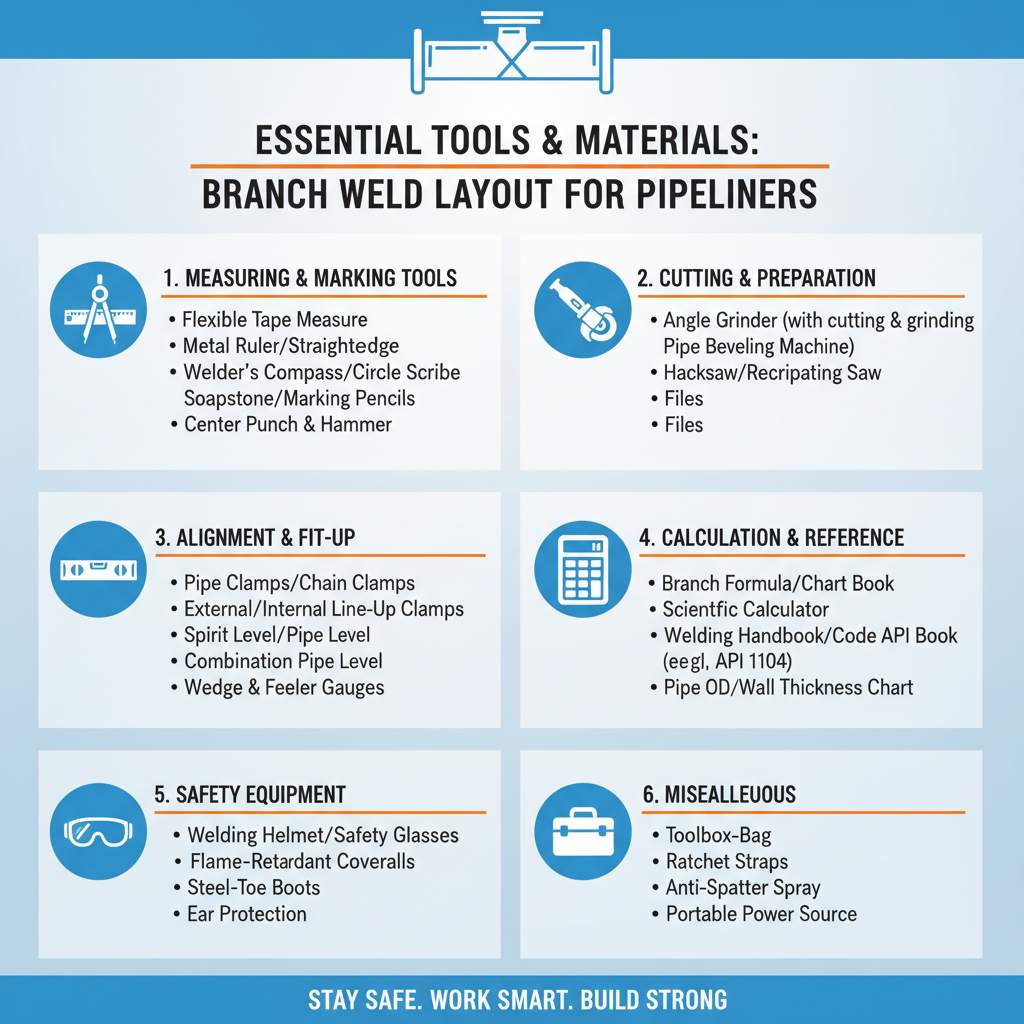
Professional branch weld layout requires specific tools for accuracy and efficiency.
Measuring and Marking Tools:
• Flexible steel tape measure
• Combination square
• Scribe or soapstone
• Center punch
• Dividers or compass
Layout Tools:
• Branch saddle templates
• Contour markers
• Pipe wrap-around guides
• Angle finders
Cutting Equipment:
• Plasma cutter or oxy-fuel torch
• Grinding wheels for beveling
• Files for fine adjustments
Having quality tools makes the difference between a professional layout and one that requires extensive rework.
Step-by-Step Branch Layout Process
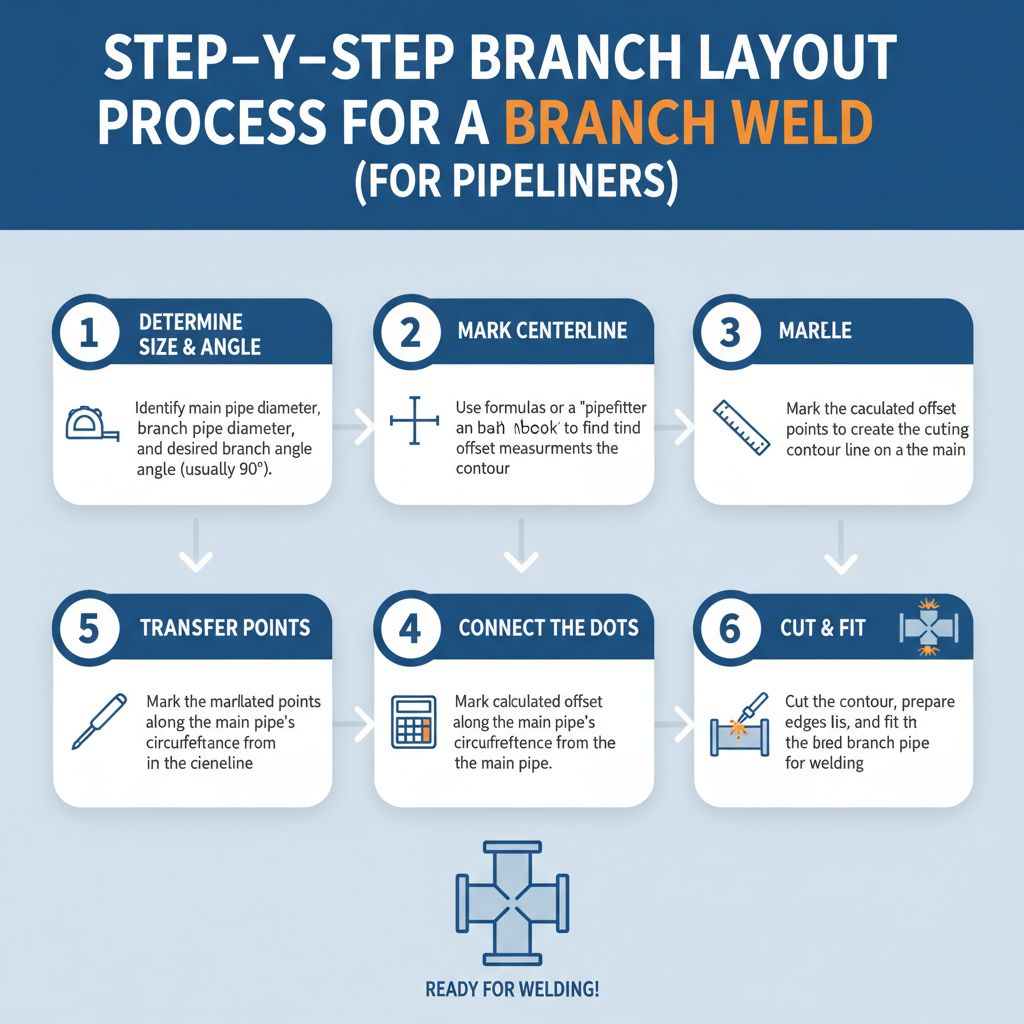
Now let’s walk through the complete branch weld layout procedure.
Step 1: Mark the Branch Center Point
Start by determining the exact location where the branch centerline intersects the main pipe. Use your tape measure and square to ensure accuracy.
Mark this point clearly with a center punch. This becomes your reference point for all subsequent measurements and layout work.
Step 2: Create the Branch Outline
Using dividers set to the branch pipe’s outside radius, scribe a circle around the center point. This circle represents the exact size of the opening needed in the main pipe.
For angled branches, adjust the circle to an elliptical shape that accounts for the angle. The steeper the angle, the more elongated the opening becomes.
Step 3: Mark the Contour Lines
The opening must follow the main pipe’s curvature to ensure proper fit-up. Use a contour marker or flexible template to mark the curved lines that match the branch pipe’s profile.
These contour lines are critical for achieving full penetration around the entire joint circumference.
Step 4: Verify Measurements
Double-check all measurements before cutting. Measure the opening diameter at multiple points to ensure consistency.
Use a template cut from cardboard or thin metal to test the fit before making the final cut in the pipe.
Branch Angle Calculations and Layout
Different branch angles require specific layout techniques to achieve proper fit-up.
90-Degree Branches:
• Use standard circular layout
• Opening diameter equals branch OD
• Straightforward cutting and fitting
45-Degree Branches:
• Opening becomes elliptical
• Length increases by approximately 40%
• Requires careful angle verification
Custom Angles:
• Calculate ellipse dimensions using trigonometry
• Create custom templates for complex angles
• Verify angle with precision instruments
Here’s a quick reference for common branch angles:
| Branch Angle | Opening Shape | Length Multiplier | Difficulty Level |
|————–|—————|——————-|——————|
| 90° | Circle | 1.0x | Basic |
| 60° | Ellipse | 1.15x | Moderate |
| 45° | Ellipse | 1.41x | Advanced |
| 30° | Ellipse | 2.0x | Expert |
Cutting and Beveling Techniques
Proper cutting technique ensures clean edges that require minimal preparation for welding.
Plasma Cutting Tips:
• Use appropriate amperage for pipe thickness
• Maintain consistent travel speed
• Keep torch perpendicular to surface
• Allow adequate cooling time
Oxy-Fuel Cutting:
• Preheat properly for thick walls
• Use steady, controlled movements
• Watch for slag formation
• Clean cuts immediately after completion
Beveling Requirements:
• Most codes require 30-37.5 degree bevels
• Maintain consistent bevel angle
• Remove all slag and oxidation
• Check bevel with angle gauge
The quality of your cut directly impacts weld quality and inspection results.
Fit-Up and Alignment Procedures
Achieving perfect fit-up requires patience and attention to detail.
Start by test-fitting the branch pipe in the opening. The branch should sit flush against the main pipe with minimal gaps around the circumference.
Gap Tolerance Guidelines:
• Root opening: 1/8 inch maximum
• Consistent gap around entire joint
• No high or low spots exceeding 1/16 inch
• Proper backing ring alignment (if required)
Use wedges or clamps to hold the branch in position during tack welding. Make small adjustments as needed to achieve uniform fit-up.
Common Layout Mistakes and Solutions
Even experienced pipeliners can make layout errors that compromise weld quality.
Measurement Errors:
• Always verify measurements twice
• Use quality measuring tools
• Account for pipe wall thickness
• Check for out-of-round conditions
Cutting Problems:
• Rough or uneven cuts require extensive grinding
• Oversized openings create large gaps
• Undersized openings prevent proper fit-up
• Poor bevel preparation affects penetration
Fit-Up Issues:
• Misaligned branches cause stress concentrations
• Excessive gaps require filler metal buildup
• Poor contour matching creates weak points
• Inadequate cleaning affects weld quality
Prevention is always better than correction when it comes to branch weld layouts.
Quality Control and Inspection Points
Professional branch weld layout includes built-in quality checkpoints.
Pre-Cut Inspection:
• Verify all measurements against drawings
• Check marking accuracy
• Confirm proper tools and consumables
• Review applicable welding procedures
Post-Cut Verification:
• Measure opening dimensions
• Check bevel angles and preparation
• Verify contour matching
• Test fit branch pipe
Final Fit-Up Check:
• Confirm proper alignment
• Measure gap consistency
• Check for stress-free positioning
• Verify backing requirements
Document any deviations from specifications and obtain approval before proceeding with welding.
Advanced Layout Techniques
Experienced pipeliners use specialized techniques for challenging branch connections.
Multiple Branch Layouts:
• Plan spacing to avoid interference
• Consider welding sequence
• Account for distortion effects
• Verify clearances for equipment access
Large Diameter Branches:
• Use reinforcement pad requirements
• Calculate stress concentration factors
• Plan for heavy lifting equipment
• Consider field vs. shop fabrication
High-Pressure Applications:
• Follow enhanced inspection requirements
• Use precision measurement tools
• Document all procedures thoroughly
• Coordinate with engineering review
These advanced applications require additional training and certification.
Frequently Asked Questions
How do I calculate the opening size for angled branches?
For angled branches, the opening becomes elliptical. The minor axis equals the branch OD, while the major axis equals the branch OD divided by the sine of the branch angle. Use trigonometric calculations or specialized software for precision.
What’s the maximum gap tolerance for branch connections?
Most welding codes specify maximum root openings of 1/8 inch for branch connections. However, gaps should be as small as possible while still allowing proper penetration. Consult your specific welding procedure specification for exact requirements.
Can I use templates for repetitive branch layouts?
Yes, templates are highly recommended for multiple identical branches. Create templates from sturdy material like thin steel or heavy cardboard. Verify template accuracy before using on production work.
How do I handle out-of-round pipe conditions?
Out-of-round pipe requires special consideration during layout. Measure the pipe diameter at multiple points around the branch location. Use the average diameter for layout calculations and adjust fit-up procedures as needed.
What tools are essential for accurate branch layout?
Essential tools include flexible tape measures, combination squares, dividers, contour markers, and quality marking materials. Invest in professional-grade tools for consistent accuracy.
How do I verify proper branch angle after installation?
Use precision angle finders or digital inclinometers to verify branch angles. Check angles from multiple directions to ensure accuracy. Document measurements for quality records.
What’s the best way to mark pipes for cutting?
Use soapstone or specialized marking pencils that won’t contaminate the weld area. Scribe lines lightly to avoid stress concentrations. Remove all marking materials before welding.
Key Takeaways
• Accurate measurements and marking are fundamental to successful branch weld layouts
• Proper tool selection and maintenance directly impact layout quality and efficiency
• Understanding branch angle calculations prevents costly cutting errors and rework
• Quality fit-up requires patience, precision, and attention to detail throughout the process
• Common mistakes like measurement errors and poor cutting technique are easily preventable
• Advanced techniques for complex branches require additional training and specialized tools
• Built-in quality checkpoints help identify problems before they become expensive failures
Final Thoughts
Mastering branch weld layout is essential for any serious pipeliner. The techniques covered in this guide provide the foundation for creating professional-quality branch connections that meet code requirements and pass rigorous inspections. Remember that practice and attention to detail are your best tools for developing the skills needed for consistent success.
Start with simple 90-degree branches to build your confidence, then gradually work up to more complex angles and configurations. With proper technique and quality tools, you’ll be creating perfect branch layouts that enhance both your reputation and your career prospects in the pipeline industry.