
Standard Operating Procedures for pipeline and vessel welding include pre-welding preparation, qualified welder certification verification, proper joint preparation, controlled welding parameters, multi-pass welding sequences, real-time quality monitoring, and comprehensive post-weld inspection protocols. These procedures ensure structural integrity and compliance with codes like ASME B31.3, API 1104, and AWS D1.1.
Pipeline and vessel welding requires strict adherence to established procedures to ensure structural integrity, safety compliance, and operational reliability. This comprehensive guide covers the essential standard operating procedures (SOPs) that welding professionals must follow when working on critical infrastructure projects.
Whether you’re a certified welder, welding supervisor, or project manager, understanding these standardized protocols will help you maintain quality standards, prevent costly rework, and ensure regulatory compliance across all welding operations.
Pre-Welding Documentation and Planning Requirements
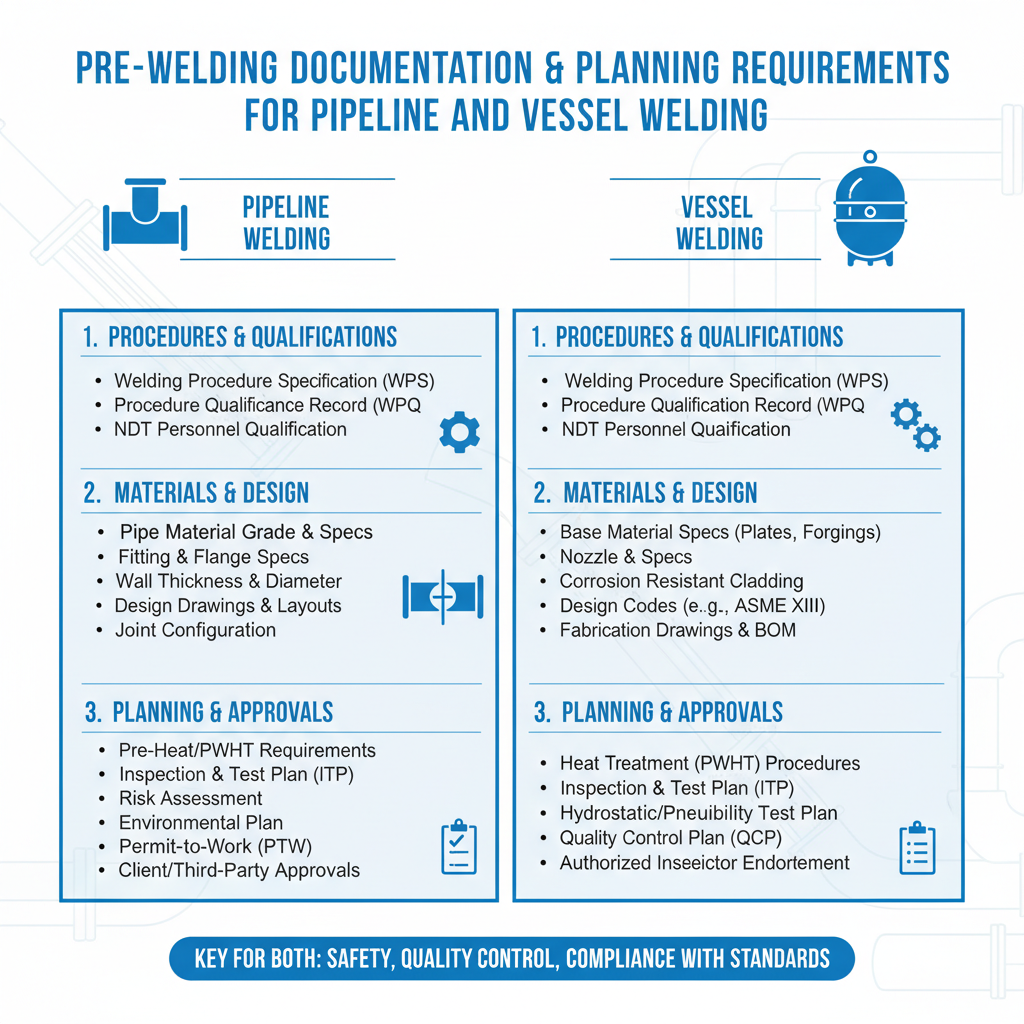
Before any welding begins, comprehensive documentation must be completed and approved. The welding procedure specification (WPS) serves as the primary technical document governing all welding activities.
Each WPS must specify base materials, filler metals, welding positions, preheat requirements, and post-weld heat treatment parameters. Field experience shows that incomplete WPS documentation causes 60% of welding-related project delays.
The procedure qualification record (PQR) validates that the WPS produces acceptable mechanical properties. Testing includes tensile strength, bend tests, and impact testing when specified by the applicable code.
Material test reports (MTRs) must be verified against project specifications before welding begins. Chemical composition and mechanical properties directly affect welding parameters and heat treatment requirements.
Welder Qualification and Certification Verification
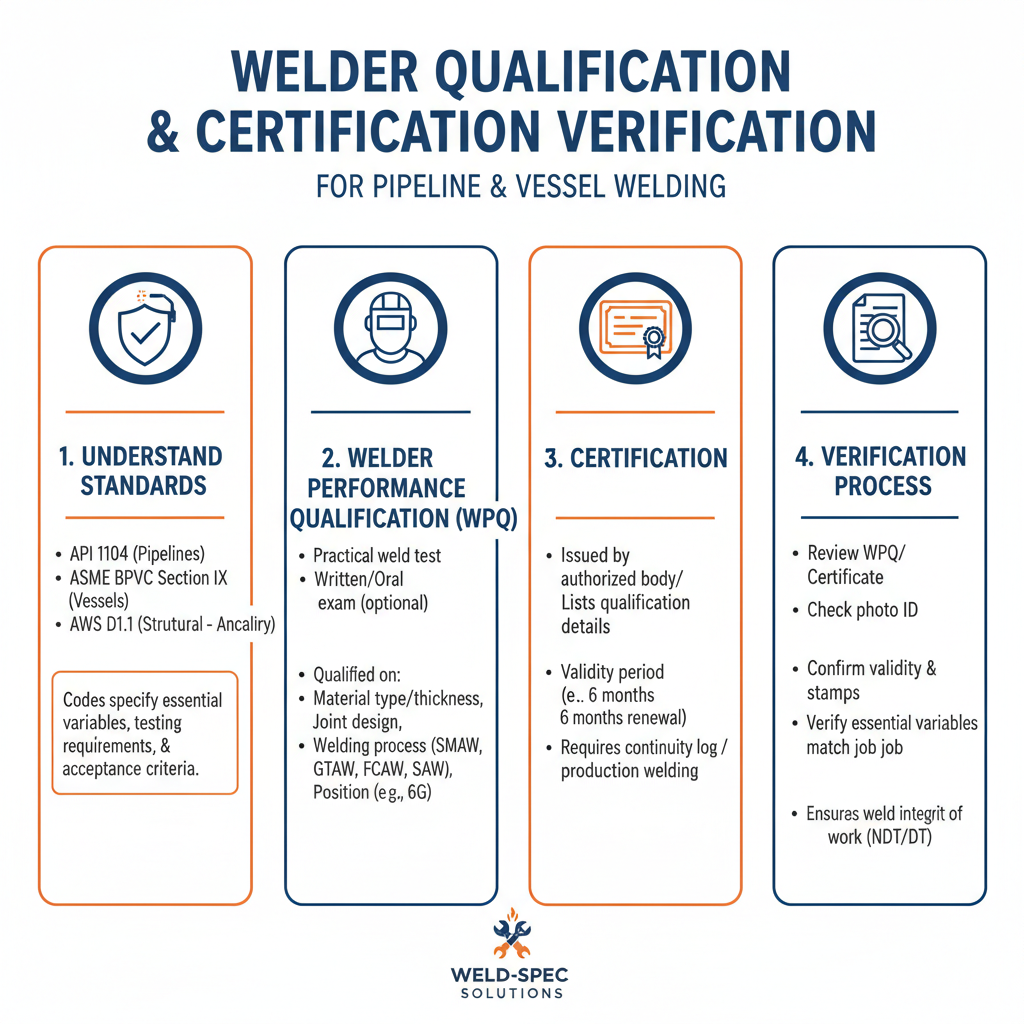
All welders must hold current certifications for the specific processes, materials, and positions required by the project. Common certifications include 6G pipe welding, pressure vessel welding, and specialized processes like orbital welding.
Welder performance qualification tests must be conducted within six months of project start. The qualification covers specific diameter ranges, wall thicknesses, and welding positions that match actual work conditions.
Continuity requirements mandate that welders perform qualifying work within specific timeframes to maintain certification status. Gaps exceeding six months typically require requalification testing.
Visual acuity and physical capability assessments ensure welders can perform precision work safely. Poor lighting conditions and awkward positions significantly impact weld quality in field applications.
Joint Preparation and Fit-Up Procedures
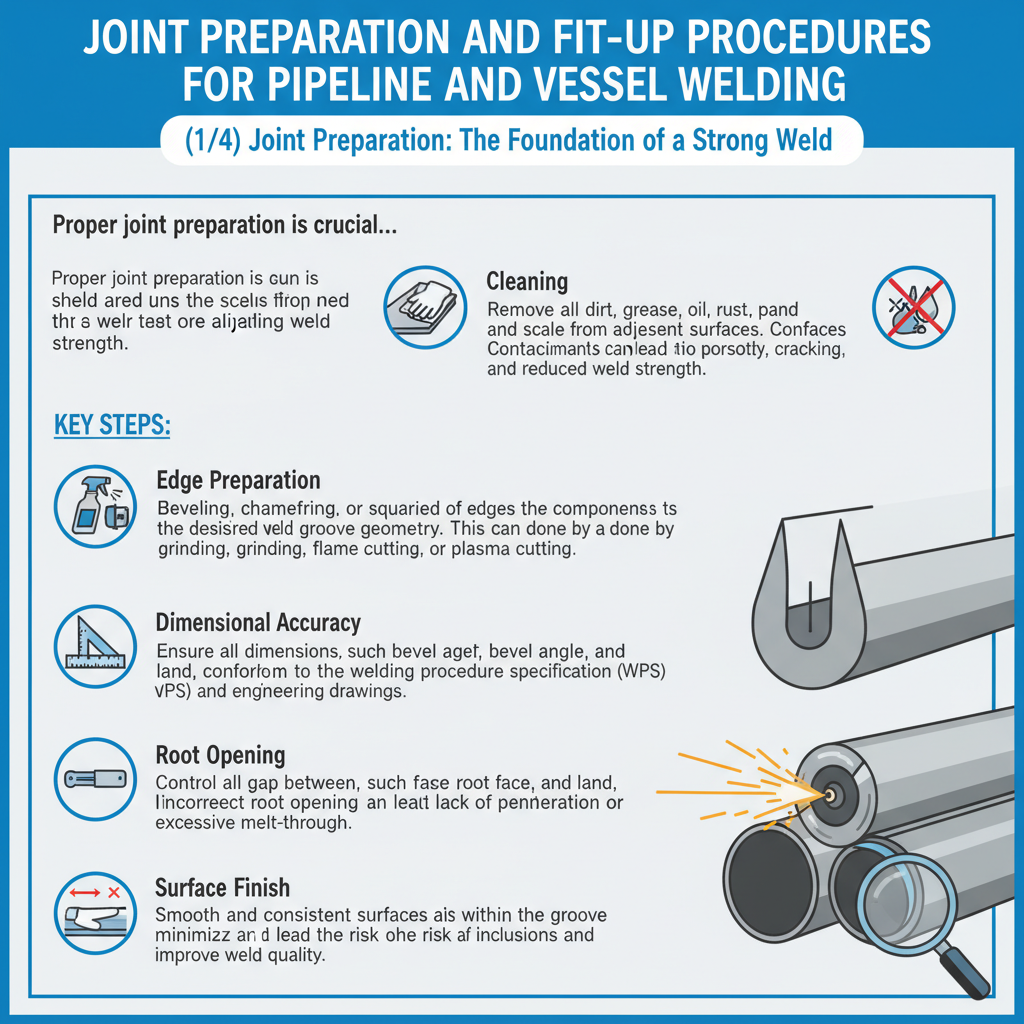
Proper joint preparation directly affects weld penetration, fusion, and overall joint strength. Beveling must meet specified angles, typically 30-37.5 degrees for V-groove joints in pipeline applications.
Root opening dimensions require precise control, usually 1/8 inch for most pipeline joints. Excessive gaps cause burn-through, while insufficient gaps prevent full penetration.
Backing rings or consumable inserts provide root pass support in critical applications. These components must be properly sized and positioned to prevent inclusion defects.
Fit-up tolerances become more critical as wall thickness increases. High-pressure vessel applications often require gaps within ±1/32 inch to ensure consistent root pass quality.
Welding Parameter Control and Documentation
Amperage, voltage, and travel speed must remain within qualified ranges throughout the welding process. Digital monitoring systems provide real-time parameter tracking and automatic documentation.
Interpass temperature control prevents excessive heat input that can degrade material properties. Maximum interpass temperatures typically range from 300-500°F depending on material grade and thickness.
Preheat requirements vary by material chemistry and ambient temperature. Carbon equivalent calculations determine minimum preheat temperatures for crack prevention.
Heat input calculations ensure mechanical properties meet specification requirements. Excessive heat input reduces toughness in heat-affected zones, particularly in low-temperature service applications.
Multi-Pass Welding Sequence and Techniques
Root pass welding requires the highest skill level and most stringent control. Consistent penetration and minimal reinforcement prevent stress concentrations in service.
Hot pass welding removes root pass imperfections and provides additional penetration. This pass typically uses higher amperage settings than subsequent fill passes.
Fill pass sequences must provide adequate fusion between layers while maintaining proper bead profiles. Weave patterns should not exceed three times the electrode diameter.
Cap pass finishing determines final weld profile and surface condition. Proper cap pass technique eliminates undercut and provides smooth transitions to base material.
Real-Time Quality Control Monitoring
Visual inspection occurs continuously during welding operations. Trained inspectors identify defects immediately, preventing costly repair work after completion.
Dye penetrant testing on root passes detects surface-breaking defects before subsequent welding. This non-destructive testing method provides immediate results in field conditions.
Radiographic testing requirements vary by code and service conditions. Critical welds may require 100% radiographic examination, while others need only statistical sampling.
Ultrasonic testing provides volumetric inspection without radiation safety concerns. Advanced phased array techniques detect defects with high accuracy and provide permanent records.
Post-Weld Heat Treatment Protocols
Stress relief heat treatment reduces residual stresses that can cause service failures. Treatment temperatures and holding times depend on material chemistry and section thickness.
Furnace heat treatment provides uniform heating for shop-fabricated components. Temperature monitoring requires multiple thermocouples to ensure uniform heating throughout the workpiece.
Local post-weld heat treatment uses resistance heating or induction methods for field applications. Heating band placement and insulation requirements prevent uneven temperature distribution.
Cooling rate control prevents thermal shock that can cause cracking. Controlled cooling rates typically range from 100-200°F per hour depending on material specifications.
Common Welding Defects and Prevention Methods
Lack of fusion occurs when welding parameters are insufficient or joint preparation is inadequate. Proper amperage settings and electrode manipulation prevent this critical defect.
Porosity results from contamination, excessive moisture, or improper shielding gas coverage. Clean joint preparation and proper gas flow rates eliminate most porosity issues.
Cracking can occur during welding (hot cracking) or after cooling (cold cracking). Proper preheat, controlled cooling rates, and appropriate filler metal selection prevent most cracking problems.
Undercut weakens the joint by reducing effective throat thickness. Proper electrode angle and travel speed maintain adequate reinforcement while preventing excessive undercut.
Documentation and Record Keeping Requirements
Weld maps identify each joint location, welder identification, and inspection results. These permanent records support traceability requirements and future maintenance planning.
Non-destructive testing reports must include technique sheets, calibration records, and interpretation results. Digital imaging systems provide enhanced record keeping capabilities.
Material traceability documentation links each weld joint to specific heat numbers and material test reports. This information becomes critical for failure analysis or fitness-for-service evaluations.
Repair documentation records all defect locations, repair methods, and re-inspection results. Multiple repairs in the same location may indicate systematic welding problems requiring procedure revision.
Frequently Asked Questions
What welding codes apply to pipeline and vessel welding projects?
The most common codes include ASME B31.3 for process piping, API 1104 for pipeline welding, ASME Section VIII for pressure vessels, and AWS D1.1 for structural welding. Project specifications determine which codes apply to specific work scopes.
How often must welders requalify their certifications?
Most welding codes require requalification every six months if the welder hasn’t performed qualifying work. Some specialized applications may have shorter intervals, while others allow annual requalification with documented continuity.
What are the most critical welding parameters to control?
Amperage, voltage, travel speed, and interpass temperature are the primary parameters affecting weld quality. Heat input calculations derived from these parameters determine mechanical properties and microstructure in the heat-affected zone.
When is post-weld heat treatment required?
PWHT requirements depend on material chemistry, wall thickness, and service conditions. Generally, carbon steel vessels over 1.5 inches thick require stress relief, while stainless steel applications may need solution annealing or stabilization treatments.
What inspection methods are mandatory for critical welds?
Visual inspection is always required, followed by non-destructive testing methods specified in the applicable code. High-pressure or high-temperature services typically require radiographic or ultrasonic examination of all welds.
How do environmental conditions affect welding procedures?
Wind, humidity, and temperature significantly impact welding quality. Procedures must specify environmental limits, and protective measures like windscreens or preheating may be required when conditions approach these limits.
What documentation must be maintained for welding operations?
Required records include welding procedure specifications, welder qualifications, material test reports, weld maps, inspection reports, and any repair documentation. These records must be maintained for the life of the equipment and often longer for regulatory compliance.
Final Thoughts
Successful pipeline and vessel welding depends on rigorous adherence to established standard operating procedures. These protocols ensure consistent quality, regulatory compliance, and long-term structural integrity. Proper implementation requires qualified personnel, appropriate equipment, and comprehensive documentation systems. Regular procedure reviews and updates maintain alignment with evolving industry standards and technological advances. The investment in proper SOP development and implementation prevents costly failures and ensures safe, reliable operation throughout the equipment lifecycle.