
One of the biggest lessons learned in the shop was how much welding rod size and amperage really control the outcome of a weld. Early on, it was easy to grab whatever filler rod was on hand, crank the machine until the arc felt “right,” and hope for the best — only to end up with spatter, poor penetration, or a bead that just didn’t look trustworthy.
That confusion is common, especially when jumping between MIG vs TIG, working on stainless welding, or switching metal thickness from thin sheet to heavier plate. Rod diameter, amperage range, joint prep, and arc control all have to work together, or weld quality and structural strength take a hit — not to mention wasted rods and rework.
Dialing this in matters for safety, consistency, and cost-efficiency. Stick with me, because this guide breaks it all down with practical, real-world advice you can actually use at the machine.
Why Welding Rod Size and Amperage Matter in the Real World
You’re out in the field repairing a trailer hitch, and you’ve got the wrong rod size paired with amps that are way off. The weld looks okay at first, but a week later, it’s failing under load, costing you a callback or worse. That’s why understanding welding rod size and amperage is crucial—it’s about building welds with real strength and integrity.
The rod size dictates how much filler you lay down and how the arc behaves, while amperage controls the heat input, penetration, and overall weld quality. Get it wrong, and you risk porosity, slag inclusions, or distortion that warps your workpiece.
From a safety standpoint, improper settings can lead to arc flashes, excessive spatter, or even rod explosions if you’re pushing too much current through a thin electrode. In terms of cost efficiency, using the right combo means less rod waste, fewer do-overs, and smoother operation on your US-made machines like Lincoln or Miller welders.
And for job-site reliability, especially in industries like construction or automotive repair, matching these factors to your material ensures welds that pass muster without failing in harsh conditions. I’ve seen pros blow through jobs faster by tweaking amps just right, avoiding the headaches that come with trial-and-error.
Think about material compatibility too—mild steel loves certain rod sizes, while stainless or aluminum demands adjustments. It’s all interconnected, and once you grasp it, your welds go from passable to professional-grade. Let’s break it down step by step, starting with the basics.
Decoding Welding Rod Sizes: From Thin Sheets to Heavy Plate
Welding rods come in various diameters, and picking the right one is like choosing the right tool for the job—too big, and it’s unwieldy; too small, and it won’t get the work done. Rod sizes are measured in fractions of an inch, like 1/16″, 3/32″, 1/8″, and up to 5/16″ or more for industrial beasts. The size affects everything from how easy it is to start the arc to the amount of metal you deposit per pass.
In my experience, for most DIY or hobbyist work in the garage, you’ll live in the 3/32″ to 1/8″ range. These handle everyday repairs on gates, brackets, or exhaust systems without overwhelming your 110V machine.
But when you’re tackling thicker stock, say 1/4″ plate on a truck frame, bump up to 5/32″ or 3/16″ for better fill and fewer passes. I’ve burned through plenty of small rods on heavy jobs, wasting time layering beads when a bigger one would’ve done it in one go.
Common Rod Diameters and Their Sweet Spots
Let’s talk specifics. A 1/16″ rod is your go-to for super-thin sheet metal, like patching auto body panels where you don’t want to warp the hell out of it. It’s delicate, runs cool, but can be finicky to strike an arc without sticking.
Jump to 3/32“—this one’s a workhorse for 1/8″ to 1/4” materials. I’ve used it countless times on farm implements, where you need good penetration without blowing holes. It handles vertical welds decently too, as the smaller puddle is easier to control.
Then there’s the 1/8″ rod, probably the most versatile in any shop. Great for 3/16″ to 3/8″ stock, it lays down solid beads on structural stuff like I-beams or trailers. I remember welding up a custom workbench frame with these; they gave me clean, strong joints without excessive heat buildup.
For heavier fabrication, 5/32” shines on 1/4″ and up, providing deep penetration for load-bearing repairs. And if you’re in pipeline or heavy equipment territory, 3/16″ or larger rods are essential, but they demand a beefy machine—think 200+ amps capability.
Why use them? Smaller rods mean lower amps and less heat, perfect for avoiding distortion on thin stuff. Larger ones crank up productivity on thick plates, but they require steady hands to manage the bigger puddle.
When to Step Up or Down a Size
Sometimes the “rules” go out the window based on what you’ve got. If your machine maxes at 140 amps, don’t grab a 5/32″ rod expecting miracles—it’ll run cold and slaggy. Instead, downsize to 1/8″ and make multiple passes.
On overhead work, always drop a size to keep the molten metal from dripping everywhere. I’ve learned this the hard way, cleaning spatter off my boots after ignoring gravity.
Material type plays in too—cast iron might need a nickel rod in a specific size to avoid cracking, while aluminum wires (for MIG) behave differently. Always prep your joint: bevel edges on thick stuff for better fusion, and clean off rust or paint to prevent contamination.
Amperage Basics: Heating Up Your Welds Without the Drama
Amperage is the juice that powers your arc, and it’s all about balance. Too low, and your rod sticks like glue with shallow penetration; too high, and you’re dealing with burn-through, undercut, or a rod that glows cherry red.
In stick welding, which is what most rod talk centers on, amps range from 20 for tiny rods up to 500 for monsters, but in a typical US shop, you’re looking at 50-200 amps.
From hands-on time, I can tell you amperage controls the weld pool’s size and fluidity. Higher amps mean a hotter, wider bead with deeper bite—ideal for thick joints. Lower amps keep things tight and controlled for precision work. But it’s not just a dial-twist; factors like rod type, position, and even humidity affect it.
How Amperage Interacts with Rod Size
The rod size sets your amp floor and ceiling. A small 3/32″ rod might run 40-90 amps, while a 1/8″ jumps to 75-125. Push beyond that, and the coating burns off unevenly, leading to porosity. I’ve dialed in amps by starting mid-range—say 100 for a 1/8″ 7018—then tweaking based on how the arc sounds and feels. A smooth hum means you’re good; crackling or popping, adjust down.
For DC machines, electrode positive (DCEP) gives better penetration, which I prefer for most steel work. AC is spattier but works on magnetized materials. Always check your rod’s polarity recommendation—some like 6010 dig deep on DC positive.
Adjusting Amps for Different Welding Positions
Flat welding lets you run hotter for speed, but vertical up? Drop 10-15 amps and use a smaller rod to fight gravity. Overhead, shave another 5-10% to avoid sags. I once welded a ceiling beam in a barn, starting too high and ending up with drips everywhere—lesson learned: test on scrap first.
Joint design matters too. Butt joints need lower amps for clean roots; fillets can handle more for leg size. And don’t forget preheat on thick or cold metal— it effectively lowers your amp needs by making the base more receptive.
Matching Rod Size, Amperage, and Material Thickness
This is where the rubber meets the road. The base metal thickness is your North Star for rod size and amps. For thin stuff under 1/8″, stick with 1/16″ or 3/32″ rods at 20-80 amps to prevent warping. On 1/4″ plate, 1/8″ at 90-140 amps gets solid fusion without multiple passes.
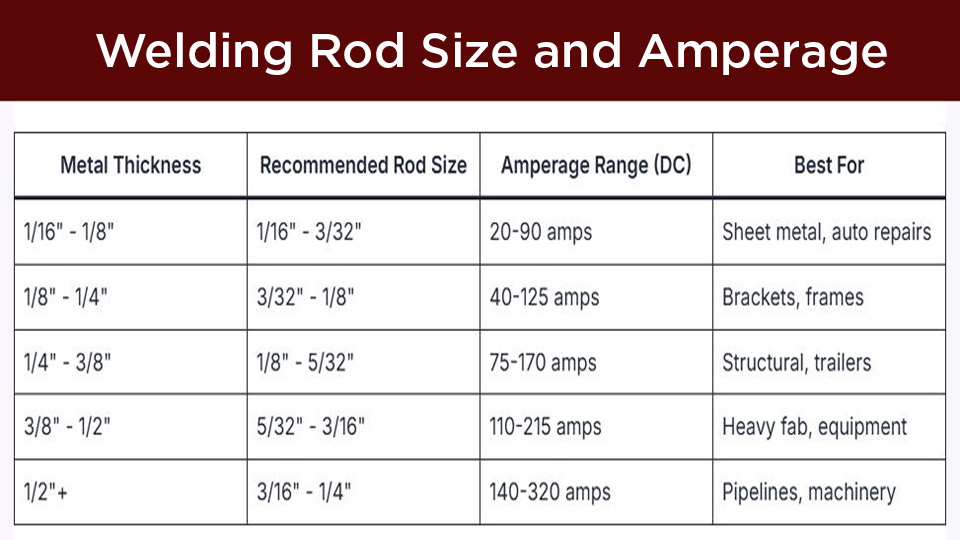
Here’s a handy comparison table I’ve put together from shop trials:
| Metal Thickness | Recommended Rod Size | Amperage Range (DC) | Best For |
|---|---|---|---|
| 1/16″ – 1/8″ | 1/16″ – 3/32″ | 20-90 amps | Sheet metal, auto repairs |
| 1/8″ – 1/4″ | 3/32″ – 1/8″ | 40-125 amps | Brackets, frames |
| 1/4″ – 3/8″ | 1/8″ – 5/32″ | 75-170 amps | Structural, trailers |
| 3/8″ – 1/2″ | 5/32″ – 3/16″ | 110-215 amps | Heavy fab, equipment |
| 1/2″+ | 3/16″ – 1/4″ | 140-320 amps | Pipelines, machinery |
Use this as a starting point—always fine-tune. For example, on 1/4″ mild steel, a 1/8″ 6013 at 110 amps gives smooth beads with minimal cleanup.
Step-by-Step Guide to Setting Up for a Weld
- Measure your metal thickness with calipers—don’t eyeball it.
- Select a rod thinner than the metal but not half or less.
- Check rod type: 6010 for deep pen on dirty steel, 7018 for clean, strong welds.
- Set amps mid-range for the rod (e.g., 100 for 1/8″).
- Prep: Grind joints, clamp for fit-up, ensure good ground.
- Strike arc on scrap, adjust amps until puddle flows right—no sticking, no spatter fountains.
- Weld: Maintain short arc length, travel steady.
- Inspect: Look for uniform bead, no cracks.
I’ve used this process on everything from fence posts to custom grills, and it cuts down errors big time.
Pros and Cons of Different Sizes in Practice
Small rods (under 1/8″): Pros—easy control, low heat, great for thin or positional work. Cons—slow deposition, more passes needed.
Medium (1/8″-5/32″): Pros—versatile, good balance of speed and control. Cons—can overheat thin metal if amps aren’t watched.
Large (over 5/32″): Pros—fast fill on thick stuff. Cons—needs high-amp machines, harder to maneuver.
Amperage Charts for Popular Rod Types
Different rods have unique amp sweet spots due to their coatings. Here’s what I’ve found reliable in the shop.
6010 and 6011 Rods: Diggers for Dirty Jobs
These cellulose-coated beasts love high amps for penetration on rusty or painted steel. For 3/32“: 40-80 amps; 1/8″: 75-125; 5/32″: 110-170. I use them on farm repairs—run hot for root passes, then cap cooler.
6013 Rods: User-Friendly for Beginners
Mild-mannered with easy slag removal. 3/32″: 45-90; 1/8″: 80-130; 5/32″: 105-180. Great for hobbyists on clean metal; I dial 100 amps on 1/8″ for smooth fillets.
7018 Rods: Low-Hydrogen for Strength
Keep these dry for crack-free welds. 3/32″: 70-100; 1/8″: 115-165; 5/32″: 150-220. In structural work, I’ve run 140 amps on 1/8″ for code-quality beads.
Full chart for quick reference:
| Diameter | 6010/6011 | 6013 | 7018 |
|---|---|---|---|
| 3/32″ | 40-80 | 45-90 | 70-100 |
| 1/8″ | 75-125 | 80-130 | 115-165 |
| 5/32″ | 110-170 | 105-180 | 150-220 |
| 3/16″ | 140-215 | 150-230 | 200-275 |
Adjust for AC by adding 10%.
Common Mistakes and Fixes from the Shop Floor
One big blunder: Ignoring rod size for amps. Crank 150 on a 3/32″ and it’ll melt like butter—fix by matching charts.
Another: No test welds. I’ve skipped this and regretted it; always scrap-test.
Overheating thin metal—drop amps 20% and use stringer beads.
Sticking rods? Amps too low; bump up and shorten arc.
Porosity from high amps? Cool it down, check for drafts.
Joint prep skips lead to weak welds—always bevel and clean.
Real-World Welding Scenarios and Pro Tips
In auto repair: For exhaust, 3/32″ at 60 amps prevents burn-through.
Farm fab: Trailer axles need 5/32″ at 150 for strength.
Hobby projects: Bike racks with 1/8″ at 110—multi-pass for looks.
When tools are limited: If no big machine, use smaller rods and weave.
Safety first: Gloves, helmet, ventilation—amps mean heat and fumes.
Conclusion
From sizing rods to your metal and dialing amps for perfect penetration, to avoiding those costly mistakes, you’re set for stronger, safer welds that last. Whether you’re a DIYer fixing up the garage or a student prepping for the field, this knowledge boosts your confidence and efficiency.
Always keep a notebook of your successful settings—machine, rod, material—it’ll save you headaches on repeat jobs.
FAQs
What rod size should I use for 1/4-inch steel?
For 1/4″ steel, go with a 1/8″ rod at 90-140 amps. It gives good fill without overkill. Prep by beveling if it’s a butt joint, and run stringers for even heat.
How do I know if my amperage is too high?
If your rod turns red-hot, spatter flies everywhere, or you burn through, amps are too high. Drop 10-20 amps, shorten your arc, and test on scrap to find the sweet spot.
Can I use the same amp settings for all rod types?
Nope—6010 digs at higher amps, while 7018 runs smoother lower. Check the box for ranges, start mid, and adjust based on puddle behavior.
What’s the best rod size for overhead welding?
Drop to 3/32″ or 1/8″ with 10% lower amps than flat. It keeps the puddle small and controllable—I’ve welded barn roofs this way without disasters.
How does material type affect rod size and amps?
Mild steel forgives more, but stainless needs lower amps to avoid carbide precipitation. For aluminum (TIG/MIG), wire size matters similarly—thinner for thin stock. Always match filler to base.