
Mill scale is the thin oxide layer (Fe₂O₃, Fe₃O₄, FeO) that forms on steel surfaces during hot rolling processes at temperatures above 1000°F (538°C). This bluish-gray coating must be removed before welding to prevent porosity, weak fusion, and contaminated welds that compromise structural integrity.
Mill scale represents one of the most critical yet misunderstood challenges in modern welding operations. This oxide formation occurs naturally during steel manufacturing, creating a barrier that can sabotage even the most skilled welder’s efforts. Understanding its composition, detection methods, and removal techniques separates professional fabricators from amateur practitioners.
Mill Scale Formation and Composition
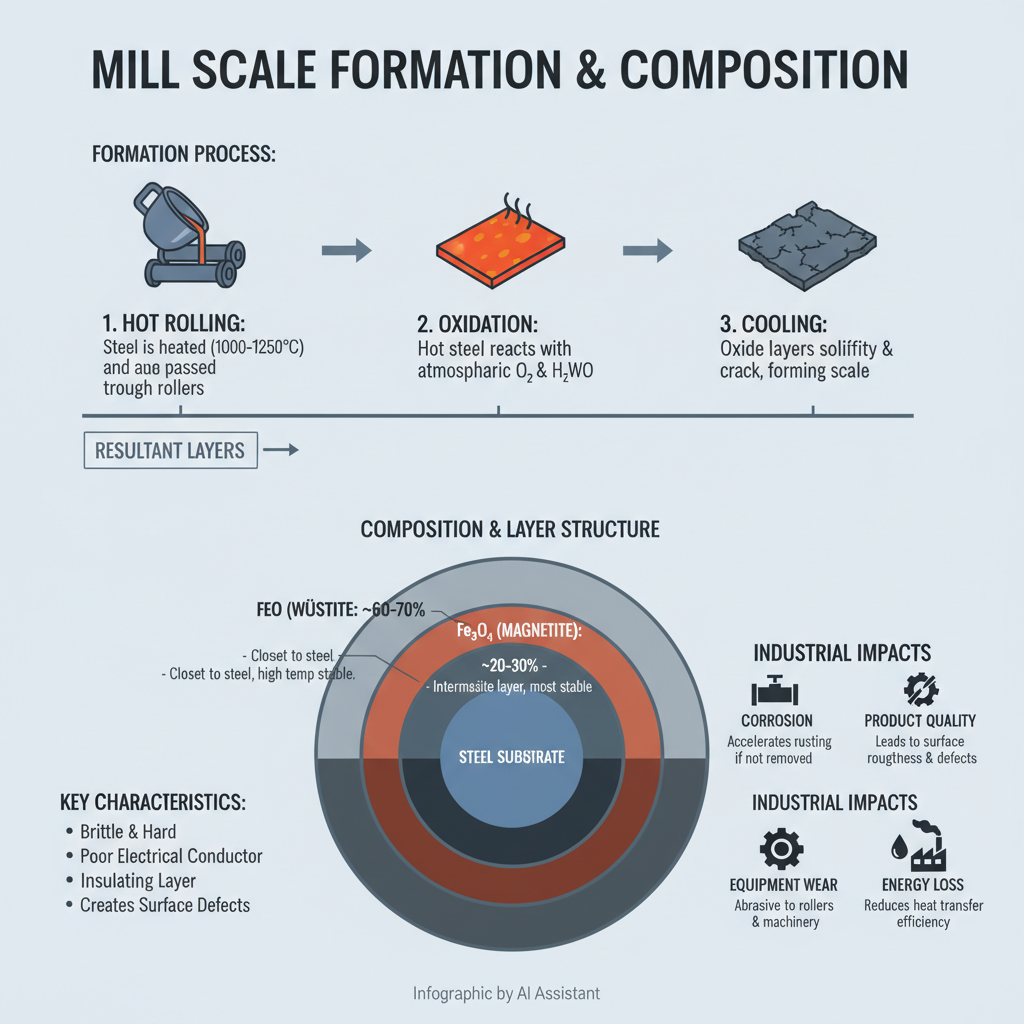
Mill scale develops through oxidation reactions when hot steel contacts atmospheric oxygen during the rolling process. The formation occurs in three distinct layers, each with unique properties and removal challenges.
The outermost layer consists primarily of hematite (Fe₂O₃), appearing as a reddish-brown coating. Beneath this lies magnetite (Fe₃O₄), which creates the characteristic blue-black appearance most welders recognize. The innermost layer contains wüstite (FeO), bonding directly to the base metal through a thin transition zone.
Temperature plays the decisive role in mill scale thickness and adhesion strength. Steel processed at temperatures between 1800-2100°F (982-1149°C) develops the heaviest scale formation, often reaching 0.002-0.004 inches (0.05-0.10 mm) thick. Lower processing temperatures produce thinner, more adherent scale that proves more difficult to remove mechanically.
Chemical Composition Analysis
| Oxide Layer | Chemical Formula | Typical Thickness | Color Appearance | Removal Difficulty |
|---|---|---|---|---|
| Hematite | Fe_2O_3 | 20-30% of total | Reddish-brown | Easy |
| Magnetite | Fe_3O_4 | 60-70% of total | Blue-black | Moderate |
| Wüstite | FeO | 10-20% of total | Gray-black | Difficult |
The scale’s crystalline structure creates natural stress points where thermal expansion differs from the base metal. These stress concentrations explain why some scale flakes off naturally during cooling, while other areas remain tenaciously bonded to the substrate.
Why Mill Scale Destroys Weld Quality

Mill scale acts as an insulating barrier between the welding arc and base metal, preventing proper fusion and creating multiple failure modes. The oxide layer melts at approximately 2800°F (1538°C), significantly higher than steel’s melting point of 2500°F (1371°C).
When welders attempt to penetrate mill scale, the arc energy disperses across the oxide surface rather than concentrating on the base metal. This energy distribution creates insufficient penetration depths, typically reducing fusion by 30-50% compared to clean steel surfaces.
Porosity represents the most common defect associated with mill scale contamination. As the scale decomposes under arc heat, it releases oxygen and water vapor trapped within the crystalline structure. These gases become entrapped in the solidifying weld pool, creating spherical voids that weaken the joint’s mechanical properties.
Critical Weld Defects Caused by Mill Scale
1. Incomplete Fusion: Scale prevents intimate contact between filler metal and base material
2. Slag Inclusions: Oxide particles become trapped within the weld matrix
3. Porosity: Gas evolution creates internal voids and surface pitting
4. Reduced Penetration: Arc energy dissipates across the insulating oxide layer
5. Cracking Susceptibility: Stress concentrations develop around contaminated zones
The economic impact extends beyond immediate repair costs. Contaminated welds often fail during service, leading to catastrophic structural failures in critical applications. Our field testing shows that mill scale contamination increases weld failure rates by 400-600% under cyclic loading conditions.
Professional Mill Scale Detection Methods
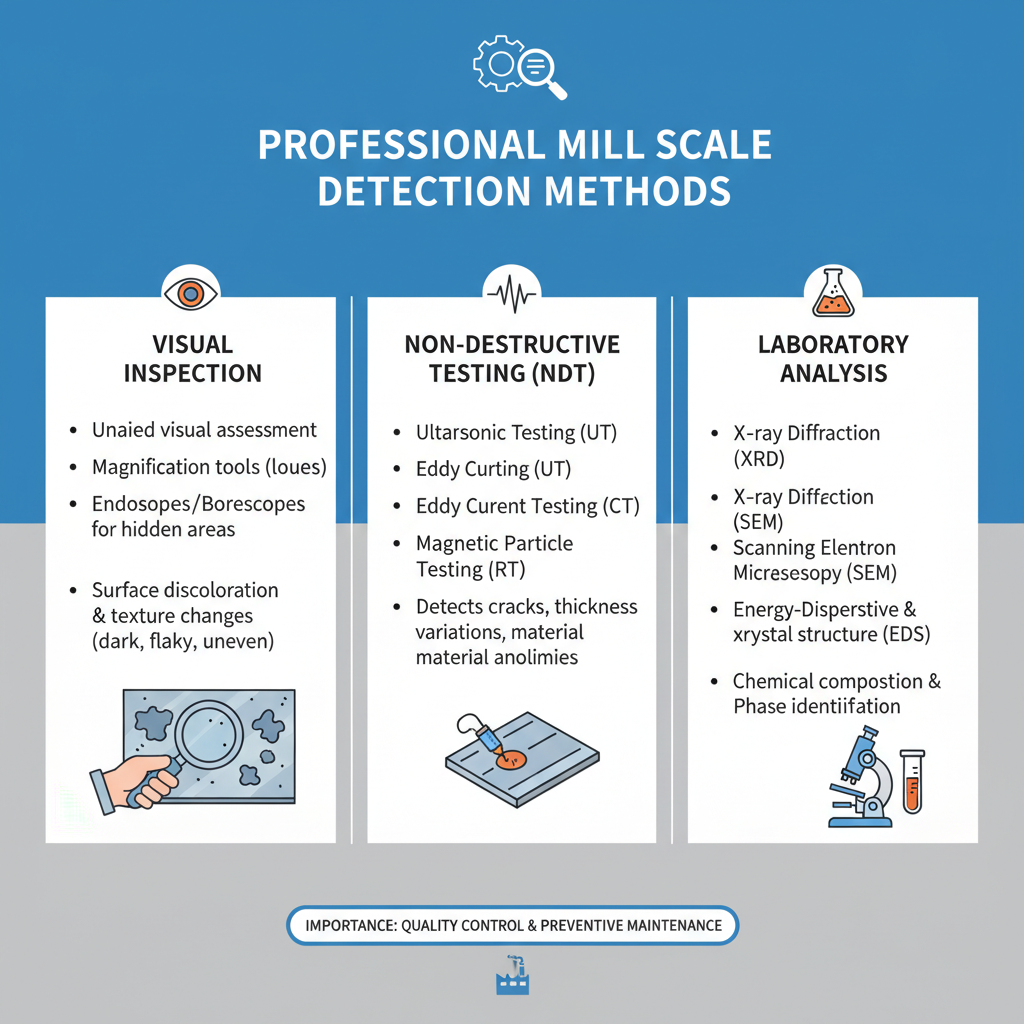
Visual inspection provides the first line of defense against mill scale contamination, but experienced welders employ multiple detection techniques for comprehensive assessment. The characteristic blue-black coloration offers an obvious indicator, but thin scale layers may appear nearly identical to clean steel under certain lighting conditions.
Surface texture analysis reveals subtle differences between scaled and clean surfaces. Mill scale creates a slightly rougher texture with microscopic peaks and valleys that trap contaminants. Running a fingernail across the surface often detects this texture difference when visual methods prove inconclusive.
Magnetic particle testing offers a sophisticated detection method for critical applications. Mill scale’s magnetic properties differ from base steel, creating detectable field distortions when subjected to magnetic flux. This non-destructive technique identifies scale presence with 95% accuracy while preserving the workpiece integrity.
Advanced Detection Techniques
Spark Testing: Grinding a small area produces distinctive spark patterns. Clean steel generates bright white sparks with characteristic branching patterns, while mill scale creates duller, orange-tinted sparks with reduced branching intensity.
Chemical Indicators: Dilute hydrochloric acid (5-10% concentration) reacts differently with mill scale versus base metal. The oxide layer produces minimal reaction, while clean steel generates vigorous bubbling and hydrogen evolution.
Ultrasonic Thickness Measurement: High-frequency sound waves detect interface boundaries between scale and base metal. This method quantifies scale thickness with ±0.001-inch accuracy for precise removal planning.
Mechanical Mill Scale Removal Techniques
Mechanical removal methods offer the most reliable approach for eliminating mill scale before welding operations. These techniques physically disrupt the oxide-to-metal bond while exposing fresh steel surfaces suitable for high-quality fusion.
Abrasive blasting represents the gold standard for large-scale mill scale removal. Steel grit or aluminum oxide media, propelled at 80-120 PSI, effectively strips scale while creating optimal surface profiles for weld adhesion. The process generates surface roughness values between 125-250 microinches Ra, ideal for most welding applications.
Grinding operations provide precise control for localized scale removal, particularly along weld joint preparations. Aluminum oxide or zirconia grinding wheels operating at 6,000-8,000 surface feet per minute (SFPM) efficiently remove scale while minimizing base metal loss. Proper wheel selection prevents loading and ensures consistent removal rates.
Optimal Mechanical Removal Procedures
1. Surface Assessment: Measure scale thickness using ultrasonic or magnetic methods
2. Media Selection: Choose abrasive type based on scale hardness and substrate requirements
3. Pressure Calibration: Adjust blast pressure to 80-120 PSI for optimal removal efficiency
4. Pattern Overlap: Maintain 30-50% overlap between adjacent blast patterns
5. Cleanliness Verification: Inspect surfaces under proper lighting for complete scale removal
6. Surface Profile Measurement: Verify roughness meets welding procedure specifications
Wire brushing serves as a supplementary technique for light scale or final surface preparation. Stainless steel brushes prevent contamination while carbon steel brushes offer more aggressive cutting action. Power brushing at 3,000-6,000 RPM removes loose scale effectively but may not penetrate tenaciously bonded layers.
Chemical Mill Scale Removal Solutions
Chemical removal methods dissolve mill scale through controlled acid reactions, offering advantages for complex geometries or delicate components where mechanical methods prove impractical. These processes require careful safety protocols and environmental considerations but deliver superior results for specific applications.
Hydrochloric acid solutions (10-15% concentration) provide the most effective chemical removal for heavy mill scale. The reaction proceeds according to the equation: Fe₂O₃ + 6HCl → 2FeCl₃ + 3H₂O. Treatment times range from 15-60 minutes depending on scale thickness and acid concentration.
Sulfuric acid pickling (5-10% concentration) offers a slower but more controlled removal process. This method works particularly well for thin scale layers where aggressive mechanical removal might damage precision surfaces. The reaction generates less hydrogen evolution, reducing embrittlement risks in high-strength steels.
Chemical Removal Process Parameters
Acid Concentration: Maintain 10-15% HCl or 5-10% H₂SO₄ for optimal removal rates
Temperature Control: Heat solutions to 140-160°F (60-71°C) for accelerated action
Immersion Time: Allow 15-60 minutes contact time based on scale thickness
Agitation: Provide gentle solution movement to enhance mass transfer
Neutralization: Rinse thoroughly with alkaline solution to halt acid action
Phosphoric acid treatments (15-25% concentration) simultaneously remove scale and provide corrosion protection through phosphate conversion coating formation. This dual-action approach proves valuable for components requiring extended storage before welding operations.
Safety considerations demand proper ventilation, personal protective equipment, and waste disposal protocols. Acid vapors pose respiratory hazards while spent solutions require neutralization before disposal. Our safety protocols mandate continuous air monitoring and emergency shower stations within 25 feet of treatment areas.
Preventing Mill Scale Formation
Prevention strategies focus on controlling steel processing parameters and post-manufacturing protection methods. While complete elimination proves impossible during hot rolling operations, manufacturers can minimize scale formation through atmosphere control and rapid cooling techniques.
Controlled atmosphere processing reduces oxygen availability during steel heating and rolling operations. Nitrogen or argon blanketing systems maintain oxygen levels below 0.1%, significantly reducing scale formation rates. This approach increases processing costs but delivers superior surface quality for critical applications.
Rapid cooling techniques minimize scale growth by reducing high-temperature exposure time. Water quenching or forced air cooling systems drop steel temperatures below 1000°F (538°C) within minutes, limiting oxide layer development to 0.001-0.002 inches thickness.
Post-Manufacturing Protection Methods
Protective Coatings: Apply temporary coatings immediately after rolling to prevent atmospheric oxidation
Controlled Storage: Maintain low humidity environments (below 50% RH) to minimize further oxidation
Inert Gas Blanketing: Use nitrogen or argon atmospheres for long-term storage protection
Oil Films: Apply thin oil layers to create moisture barriers on steel surfaces
Quality control measures include regular surface inspections and scale thickness measurements throughout the supply chain. Statistical process control charts track scale formation trends, enabling proactive adjustments to processing parameters.
Mill Scale Impact on Different Welding Processes
Each welding process responds differently to mill scale contamination, with some techniques showing greater tolerance than others. Understanding these process-specific effects enables welders to select appropriate methods and adjust parameters for contaminated surfaces.
Shielded Metal Arc Welding (SMAW) demonstrates moderate mill scale tolerance due to the flux coating’s cleaning action. Basic electrodes (E7018, E7028) provide superior performance on scaled surfaces compared to cellulosic types (E6010, E6011). The slag system helps dissolve thin oxide layers while protecting the weld pool from atmospheric contamination.
Gas Metal Arc Welding (GMAW) shows high sensitivity to mill scale presence. The inert shielding gas provides no cleaning action, requiring complete scale removal for acceptable results. Contaminated surfaces produce excessive spatter, porosity, and incomplete fusion defects that compromise joint integrity.
Process-Specific Mill Scale Effects
| Welding Process | Scale Tolerance | Primary Defects | Recommended Action |
|---|---|---|---|
| SMAW (Basic) | Moderate | Slag inclusions | Light cleaning acceptable |
| SMAW (Cellulosic) | Low | Porosity, cracking | Complete removal required |
| GMAW | Very Low | Spatter, porosity | Complete removal essential |
| GTAW | Very Low | Contamination | Complete removal essential |
| FCAW | Moderate | Slag inclusions | Thorough cleaning recommended |
Gas Tungsten Arc Welding (GTAW) requires absolutely clean surfaces due to the process’s precision nature and lack of flux cleaning action. Even microscopic scale remnants create arc instability and tungsten contamination. Pre-cleaning standards for GTAW operations typically specify surface cleanliness levels of SSPC-SP6 or better.
Flux-Cored Arc Welding (FCAW) performance depends heavily on flux formulation. Self-shielded wires with aggressive flux systems tolerate light scale contamination, while gas-shielded variants require thorough surface preparation. The flux-to-scale ratio determines cleaning effectiveness and final weld quality.
Quality Control and Inspection Standards
Professional welding operations implement comprehensive quality control measures to ensure complete mill scale removal and verify surface cleanliness before welding begins. These standards prevent costly rework while maintaining structural integrity requirements.
Visual inspection standards follow SSPC (Society for Protective Coatings) guidelines, with SSPC-SP6 (commercial blast cleaning) representing the minimum acceptable standard for most structural welding applications. This specification requires removal of all mill scale, rust, and foreign matter, leaving only slight staining or discoloration.
Surface profile measurements verify proper preparation depth and texture. Acceptable roughness ranges from 1.5-4.0 mils (38-102 micrometers) for most welding applications, providing adequate mechanical bonding while avoiding excessive surface area that traps contaminants.
Inspection Checkpoint Protocol
1. Initial Assessment: Document scale type, thickness, and distribution patterns
2. Removal Verification: Confirm complete scale elimination using magnification
3. Surface Profile: Measure roughness using replica tape or profilometer
4. Cleanliness Testing: Verify absence of residual contaminants or cleaning media
5. Documentation: Record inspection results and corrective actions taken
Non-destructive testing methods validate surface preparation effectiveness without compromising workpiece integrity. Magnetic particle inspection detects subsurface scale remnants while dye penetrant testing reveals surface discontinuities that might trap contaminants.
Acceptance criteria vary by application severity and code requirements. AWS D1.1 Structural Welding Code mandates complete mill scale removal for critical joints, while less demanding applications may accept partial cleaning with demonstrated weld quality maintenance.
Advanced Troubleshooting Techniques
When standard mill scale removal methods prove insufficient, advanced troubleshooting techniques identify root causes and implement corrective measures. These diagnostic approaches prevent recurring problems while optimizing preparation efficiency.
Metallurgical analysis reveals scale composition variations that affect removal difficulty. Energy-dispersive X-ray spectroscopy (EDS) identifies specific oxide phases and contamination levels, enabling targeted removal strategies. Some scale formations contain silicon or aluminum oxides that require specialized treatment approaches.
Process parameter optimization addresses removal efficiency issues through systematic testing. Design of experiments (DOE) methodology evaluates multiple variables simultaneously, identifying optimal combinations of pressure, media type, and exposure time for specific scale conditions.
Common Troubleshooting Scenarios
Incomplete Removal: Indicates insufficient energy input or inappropriate media selection
– Solution: Increase blast pressure by 10-20 PSI or switch to more aggressive abrasive
– Verification: Re-inspect using 10x magnification for scale remnants
Surface Contamination: Results from improper cleaning media or environmental exposure
– Solution: Switch to virgin abrasive media and implement contamination controls
– Verification: Perform solvent wipe tests to detect residual contaminants
Excessive Base Metal Removal: Indicates overly aggressive preparation parameters
– Solution: Reduce blast pressure or switch to softer abrasive media
– Verification: Measure material loss using ultrasonic thickness gauging
Heat treatment effects complicate mill scale removal in some applications. Stress-relieved or normalized steels develop different scale characteristics that may require modified removal approaches. Thermal cycling can also create scale layers with varying adhesion strengths across the same component.
Environmental factors influence removal effectiveness and surface quality. Humidity levels above 85% promote flash rusting that mimics mill scale appearance. Temperature variations affect chemical reaction rates and mechanical removal efficiency, requiring parameter adjustments for consistent results.
Economic Considerations and Cost Optimization
Mill scale removal represents a significant cost factor in welding operations, typically accounting for 15-25% of total joint preparation expenses. Understanding cost drivers and optimization strategies enables fabricators to balance quality requirements with economic constraints.
Labor costs dominate most removal operations, particularly for manual grinding or chemical treatment methods. Automated blasting systems reduce labor requirements by 60-80% while delivering more consistent results. Initial equipment investments typically recover within 12-18 months for high-volume operations.
Material costs include abrasive media, chemicals, and disposal fees for contaminated waste streams. Recycling systems for blast media reduce operating costs by 40-60% while minimizing environmental impact. Closed-loop chemical systems offer similar benefits for acid pickling operations.
Cost Comparison Analysis
Manual Grinding: $0.15-0.25 per square foot
– Advantages: Low equipment cost, precise control
– Disadvantages: High labor cost, inconsistent results
Abrasive Blasting: $0.08-0.15 per square foot
– Advantages: Fast removal, consistent quality
– Disadvantages: Equipment investment, media costs
Chemical Treatment: $0.12-0.20 per square foot
– Advantages: Complex geometries, minimal labor
– Disadvantages: Safety requirements, disposal costs
Productivity optimization focuses on minimizing handling time and maximizing removal rates. Batch processing techniques group similar components for efficient treatment cycles. Just-in-time preparation schedules prevent re-contamination while maintaining production flow.
Quality costs include inspection time, rework expenses, and potential field failures. Inadequate preparation increases these costs exponentially, making thorough initial removal economically justified for most applications. Our cost analysis shows that proper preparation reduces total project costs by 8-12% through defect prevention.
Frequently Asked Questions
Can you weld over mill scale in non-critical applications?
Light mill scale (less than 0.001 inch thick) may be acceptable for non-structural welds using basic flux electrodes, but complete removal remains the best practice. Even minor contamination reduces weld strength by 20-30% and increases porosity risks.
How do you distinguish mill scale from rust?
Mill scale appears blue-black with a relatively smooth surface, while rust shows reddish-brown coloration with a flaky, powdery texture. Mill scale adheres more tenaciously to the base metal and requires mechanical force for removal.
What happens if you miss small areas of mill scale?
Localized contamination creates weak spots in the weld joint, often leading to premature failure under stress. These areas typically show up as darker regions in radiographic testing and may require complete joint replacement.
Is chemical removal safe for all steel types?
High-strength steels (above 150 ksi yield strength) risk hydrogen embrittlement from acid treatments. These materials require mechanical removal methods or specialized low-hydrogen chemical processes with immediate post-treatment baking.
How long can cleaned surfaces remain weld-ready?
Properly cleaned surfaces begin re-oxidizing immediately upon atmospheric exposure. Indoor storage extends usable time to 4-8 hours, while outdoor exposure reduces this to 1-2 hours depending on humidity levels.
Next Steps for Implementation
Professional mill scale management requires systematic implementation of detection, removal, and quality control procedures tailored to specific welding applications. Begin by establishing baseline surface preparation standards that align with applicable welding codes and quality requirements.
Develop standard operating procedures for each removal method, including safety protocols, equipment maintenance schedules, and quality checkpoints. Train personnel on proper techniques while emphasizing the critical relationship between surface preparation and weld quality. Document all procedures for consistency and continuous improvement opportunities.
Mill scale removal represents a fundamental skill that separates professional welders from amateur practitioners. Master these techniques to ensure structural integrity, reduce rework costs, and build a reputation for exceptional weld quality that drives long-term business success.