
Choosing the right generator size for your welder is crucial for safe and efficient welding operations. The generator must provide adequate power to handle your welder’s electrical demands while maintaining stable voltage and frequency. This guide will help you determine exactly what size generator you need based on your specific welding requirements.
For most welders, you need a generator that produces 20-25% more watts than your welder’s maximum power consumption. A 140-amp MIG welder typically requires a 5,000-6,000 watt generator, while a 200-amp stick welder needs 8,000-10,000 watts. Calculate your welder’s wattage by multiplying voltage times amperage, then add extra capacity for auxiliary tools and safety margin.
Understanding Welder Power Requirements
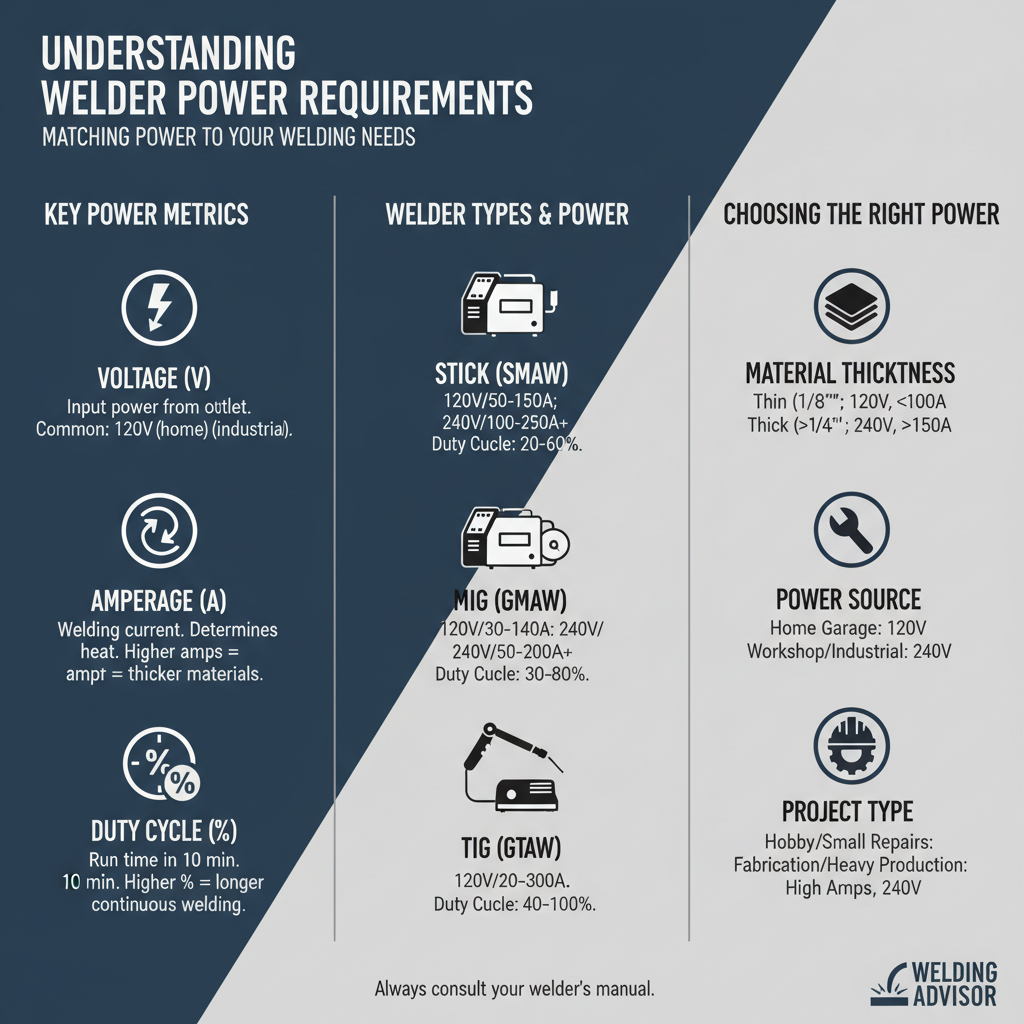
Before selecting a generator, you need to understand how welders consume power. Welders require significant electrical current to create the arc needed for joining metals. The power consumption varies based on the welding process, material thickness, and electrode size.
Most welders operate on either 120V or 240V power systems. Stick welders typically require 240V for heavy-duty applications, while smaller MIG welders may run on 120V. The amperage draw determines the total power consumption, measured in watts or kilowatts.
When calculating generator requirements, consider both the running watts and starting watts. Welders often have a higher initial power draw when striking an arc, similar to how motors require extra power during startup.
The duty cycle also affects power requirements. A welder with a 60% duty cycle at 200 amps means it can weld continuously for 6 minutes out of every 10-minute period at maximum output. Understanding this helps prevent generator overload during extended welding sessions.
Calculating Generator Size for Different Welder Types
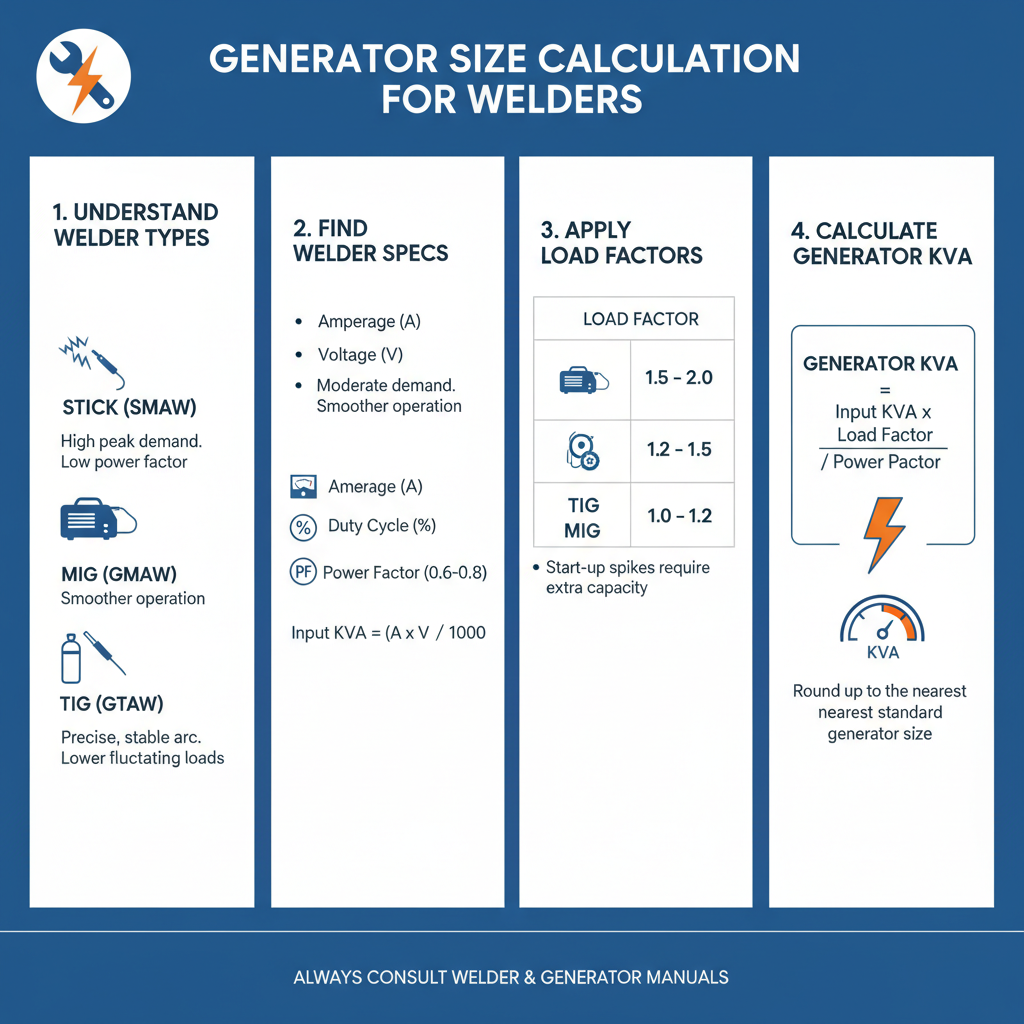
Stick Welders (SMAW)
Stick welders are among the most common types used with generators. For a 200-amp stick welder operating at 240V, you’ll typically need a generator producing 8,000 to 10,000 watts. The Lincoln Electric Ranger 225 welder-generator combination provides both welding capability and auxiliary power, making it popular for remote welding applications.
Small stick welders running 120-amp output require approximately 5,000 to 6,000 watts. Medium-duty 160-amp units need 6,500 to 8,000 watts. Heavy-duty 300-amp stick welders may require generators producing 12,000 to 15,000 watts or more.
Consider the electrode size when calculating power needs. Larger electrodes require more current, increasing the generator size requirement. A 1/8-inch electrode typically needs 90-120 amps, while a 5/32-inch electrode requires 120-160 amps.
MIG Welders (GMAW)
MIG welders have different power characteristics compared to stick welders. A 140-amp MIG welder typically requires 4,000 to 5,000 watts from the generator. Medium-duty 180-amp units need approximately 6,000 to 7,500 watts.
Wire feed speed affects power consumption in MIG welding. Higher wire speeds require more current, increasing the generator load. Gas-shielded MIG welding generally requires less power than flux-core welding due to better arc stability.
TIG Welders (GTAW)
TIG welders typically have the most stable power requirements. A 200-amp TIG welder usually needs 7,000 to 9,000 watts. The precise arc control in TIG welding means less power fluctuation compared to other welding processes.
High-frequency start TIG welders may have brief power spikes during arc initiation. Ensure your generator can handle these momentary increases without voltage drops that could affect weld quality.
Generator Types and Welding Compatibility
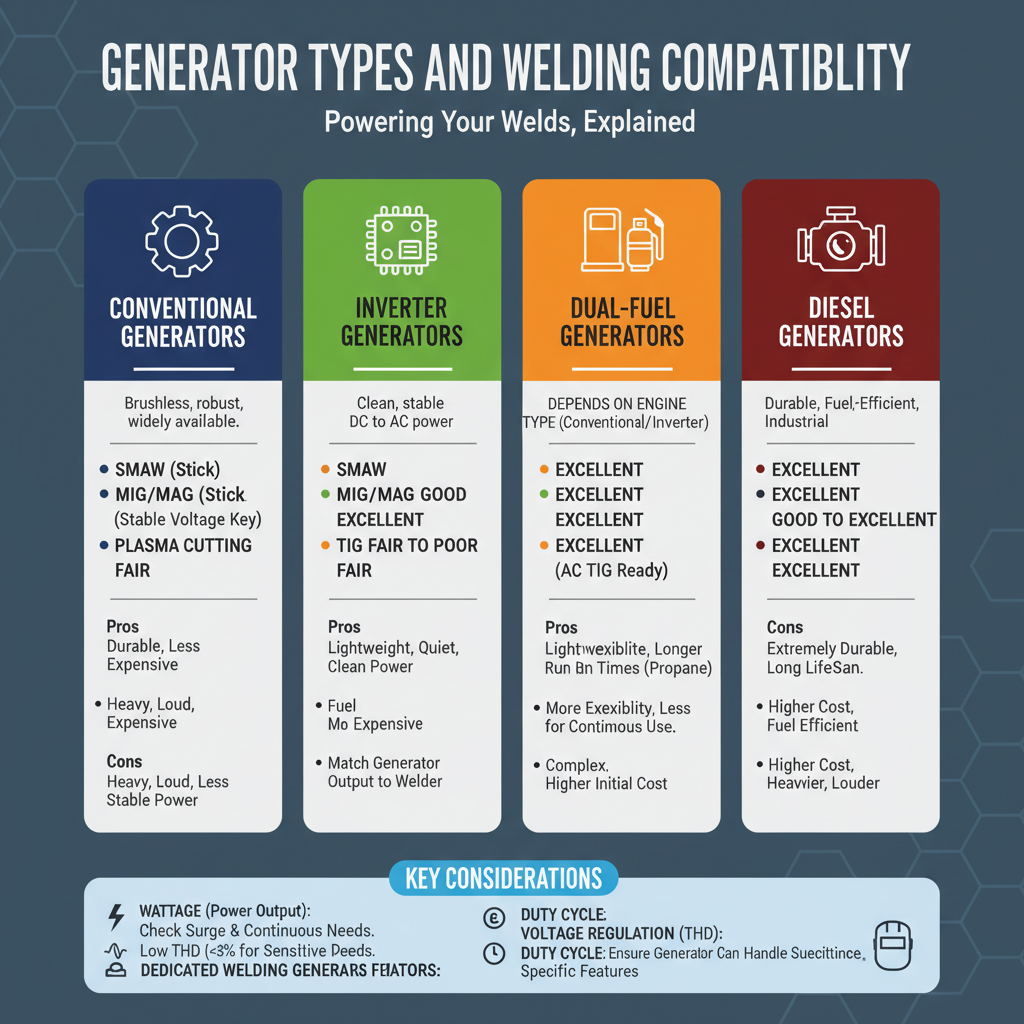
Conventional Generators
Standard generators work well for most welding applications but may have voltage fluctuations under varying loads. These generators typically cost less but may not provide the cleanest power for sensitive welding processes.
For basic stick welding, conventional generators of appropriate size work adequately. However, voltage regulation becomes more critical with precision welding processes like TIG welding.
Inverter Generators
Inverter generators provide cleaner, more stable power ideal for modern welding equipment. The Honda EU7000iS inverter generator delivers consistent power suitable for sensitive welding applications requiring stable voltage and frequency.
These generators automatically adjust engine speed based on electrical load, improving fuel efficiency during light welding or when powering auxiliary tools. The stable sine wave output protects sensitive electronics in modern welders.
Welder-Generator Combinations
Combination units integrate the welder and generator into a single machine. These units are specifically designed for welding applications and typically provide optimal power characteristics for consistent arc performance.
Engine-driven welders eliminate the need for separate generator calculations since the engine is matched to the welding output requirements. However, auxiliary power capacity may be limited compared to standalone generators.
Key Factors Affecting Generator Selection
Altitude and Temperature
Generator output decreases with altitude due to reduced air density. Expect approximately 3-4% power reduction per 1,000 feet above sea level. High temperatures also reduce generator capacity, with output dropping as ambient temperatures exceed 77°F (25°C).
When welding at high altitudes or in hot climates, select a generator with 10-15% more capacity than calculated requirements to compensate for these environmental factors.
Duty Cycle Considerations
Match the generator’s continuous power rating to your welder’s duty cycle requirements. If your welder operates at 60% duty cycle, ensure the generator can continuously supply the required power during the “on” portion of the cycle.
Generators running at maximum capacity continuously may experience reduced lifespan. Operating at 75-80% of rated capacity provides better longevity and reliability.
Auxiliary Power Needs
Consider additional power requirements beyond the welder itself. Grinders, lights, fans, and other tools add to the total electrical load. A 200-amp welder might need 8,000 watts, but total job site requirements could reach 10,000-12,000 watts.
Plan for future power needs when selecting generator size. It’s often more economical to purchase a slightly larger generator initially rather than upgrading later.
Voltage Regulation and Power Quality
Welding requires stable voltage for consistent arc characteristics and quality results. Look for generators with automatic voltage regulation (AVR) to maintain steady output voltage under varying loads.
Voltage fluctuations can cause arc instability, poor penetration, and inconsistent weld appearance. Quality generators maintain voltage within ±5% of rated output, which is acceptable for most welding applications.
Frequency stability is equally important, especially for inverter-based welders. Modern welding equipment may not function properly with frequency variations exceeding ±2 Hz from the standard 60 Hz.
Fuel Consumption and Runtime
Generator fuel consumption increases with electrical load. A 10,000-watt generator might consume 0.8-1.2 gallons per hour under full load, while partial loads reduce consumption proportionally.
Calculate daily fuel requirements based on expected welding time and generator efficiency. Diesel generators typically offer better fuel economy and longer runtime compared to gasoline units, making them preferable for extended welding projects.
Tank capacity affects continuous operation time. Larger fuel tanks reduce refueling frequency but increase overall weight and cost. Balance portability requirements with desired runtime between refueling.
Safety Considerations and Best Practices
Never exceed the generator’s rated capacity, as this can damage both the generator and welding equipment. Overloaded generators may experience voltage drops, frequency instability, and potential component failure.
Ensure proper grounding for both the generator and welding equipment. Use appropriate extension cords rated for the electrical load, keeping cord length as short as practical to minimize voltage drop.
Maintain adequate ventilation around the generator to prevent overheating. Position the generator away from the welding area to avoid contamination from exhaust fumes and to reduce noise exposure.
Regular maintenance extends generator life and ensures reliable operation. Check oil levels, air filters, and spark plugs according to manufacturer recommendations. Clean fuel systems prevent carburetor problems that could interrupt welding operations.
Sizing Examples for Common Applications
For light-duty farm and maintenance welding using a 140-amp MIG welder, a 5,000-6,000 watt generator provides adequate power with some reserve capacity for auxiliary tools.
Construction and fabrication work with 200-amp stick welders typically requires 8,000-10,000 watt generators. This capacity handles the welder plus essential job site tools like grinders and lighting.
Heavy industrial welding with 300-amp equipment needs 12,000-15,000 watt generators or larger. These applications often justify welder-generator combinations designed specifically for high-output welding.
Pipeline and remote welding operations frequently use diesel-powered welder-generators in the 300-400 amp range, providing both welding capability and substantial auxiliary power for support equipment.
Conclusion
Selecting the right generator size for your welder requires careful consideration of the welder’s power requirements, duty cycle, and auxiliary power needs. Calculate the welder’s wattage requirements based on voltage and amperage specifications, then add 20-25% capacity for safety margin and auxiliary equipment.
Consider environmental factors like altitude and temperature that affect generator output. Invest in quality generators with voltage regulation for consistent welding performance. Whether choosing a conventional generator, inverter unit, or welder-generator combination, ensure the power output matches your specific welding applications and job site requirements.
Proper generator sizing ensures reliable welding performance, protects equipment from damage, and provides the flexibility to handle various welding tasks efficiently. Take time to accurately assess your power needs before making this important investment in your welding capabilities.