
Pipeline welding requires specialized techniques and strict quality standards to ensure safe transportation of oil, gas, and other fluids across vast distances. The choice of welding method directly impacts the integrity, durability, and safety of these critical infrastructure systems.
Shielded Metal Arc Welding (SMAW) is the most common welding process for pipeline construction, particularly for the root pass and fill passes. Gas Metal Arc Welding (GMAW) and Flux-Cored Arc Welding (FCAW) are also widely used for fill and cap passes due to their higher deposition rates and efficiency in field conditions.
This article explains the primary welding processes used in pipeline construction, their specific applications, and the factors that determine which method works best for different pipeline projects. You’ll learn about the technical requirements, equipment considerations, and quality standards that guide welding decisions in the pipeline industry.
Primary Welding Processes for Pipeline Construction
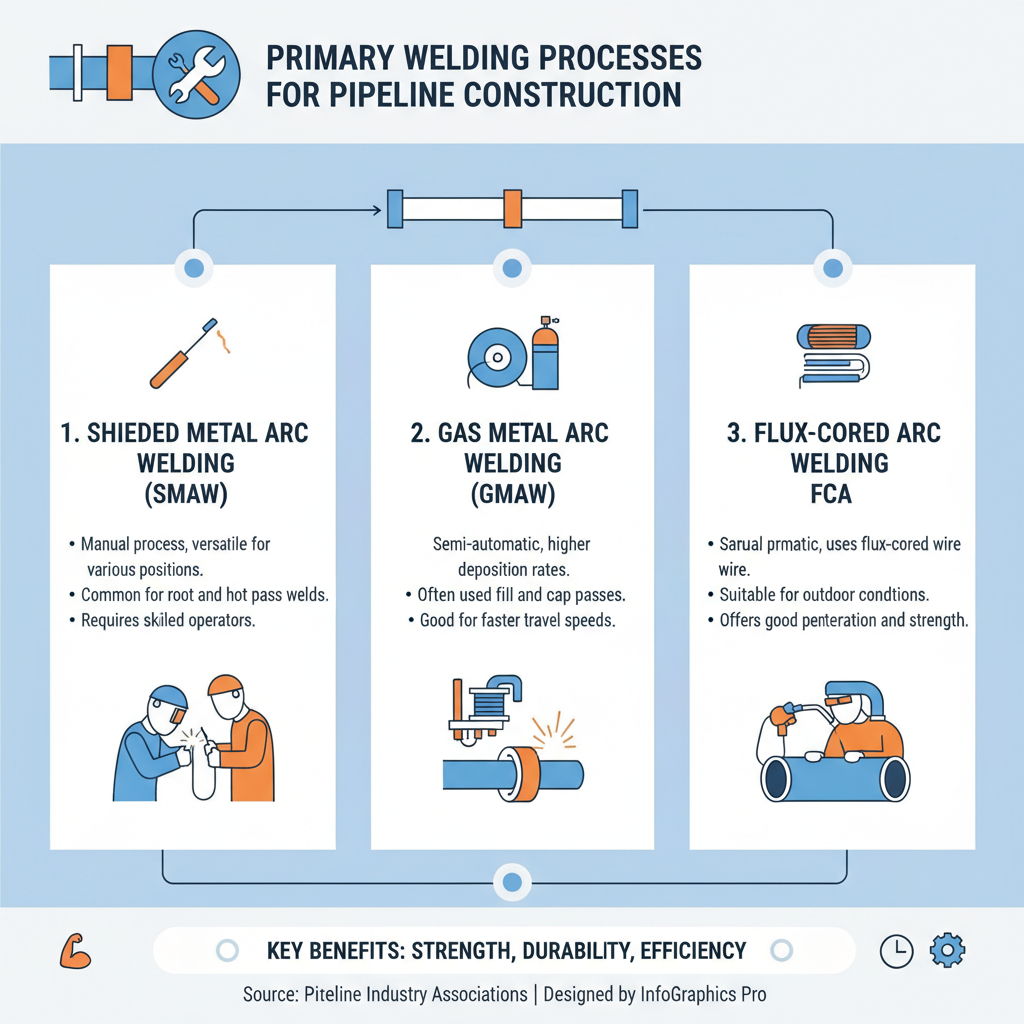
Pipeline welding relies on several arc welding processes, each serving specific purposes in the construction sequence. The selection depends on factors such as pipe diameter, wall thickness, environmental conditions, and project specifications.
Shielded Metal Arc Welding dominates pipeline construction because of its versatility and reliability in outdoor conditions. This process uses a consumable electrode coated with flux that creates a protective gas shield when heated. The flux coating also produces slag that protects the cooling weld metal from atmospheric contamination.
Gas Metal Arc Welding offers higher deposition rates and faster travel speeds compared to SMAW. This semi-automatic process uses a continuous wire electrode fed through a welding gun, with an external shielding gas protecting the weld pool. GMAW works particularly well for fill and cap passes on larger diameter pipes.
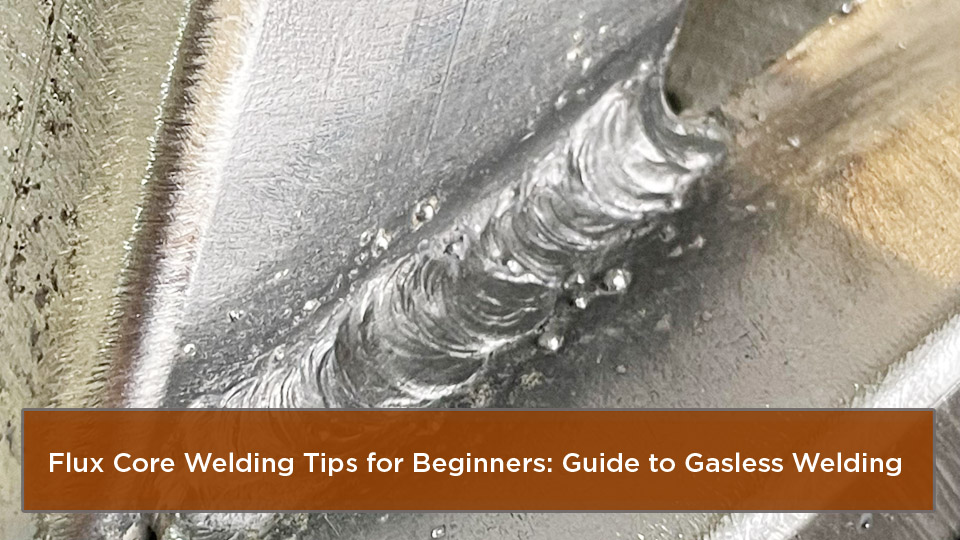
Flux-Cored Arc Welding combines advantages of both SMAW and GMAW. The tubular wire electrode contains flux in its core, providing some protection even if external shielding gas is disrupted by wind. This makes FCAW especially valuable for outdoor pipeline work where weather conditions can be challenging.
Root Pass Welding Requirements
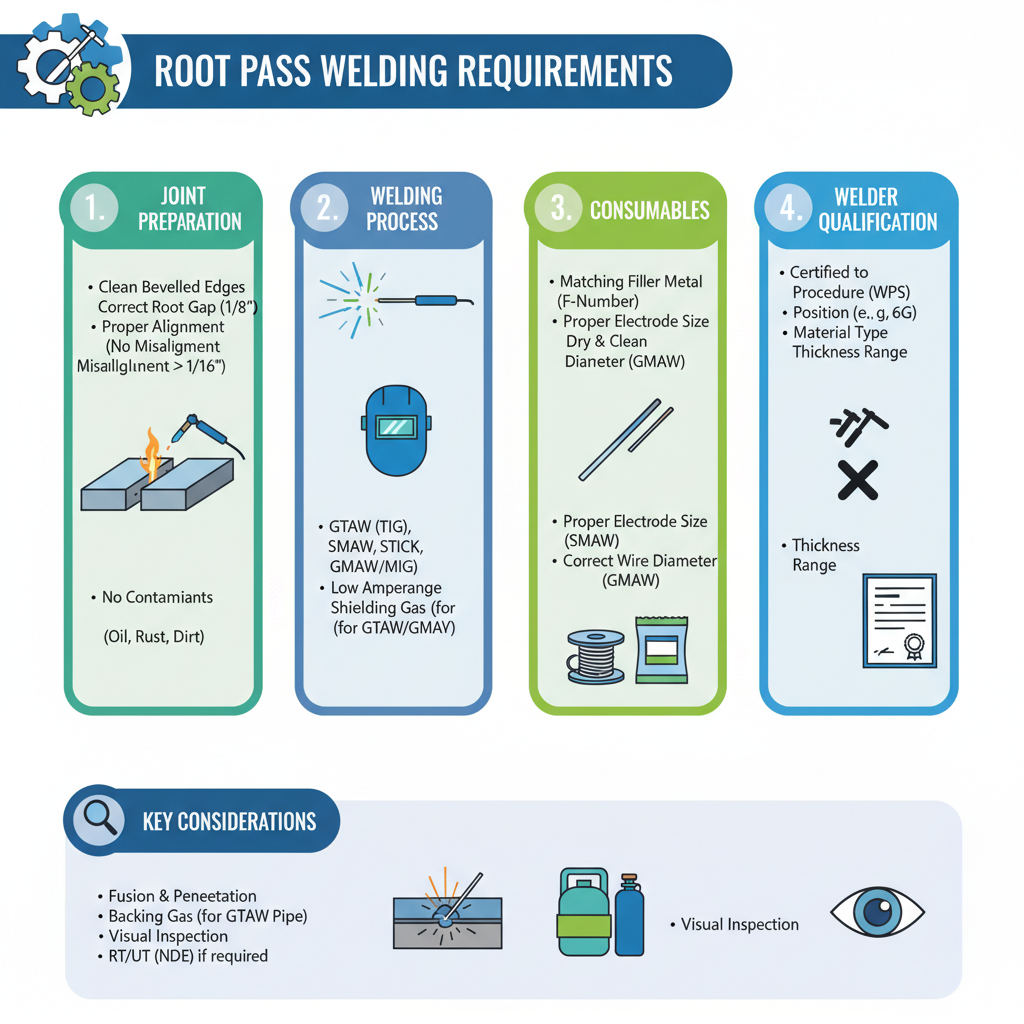
The root pass represents the most critical weld in pipeline construction. This first pass must achieve complete penetration while maintaining proper root reinforcement and avoiding defects like lack of fusion or excessive penetration.
SMAW remains the preferred method for root passes on most pipeline projects. Cellulosic electrodes, particularly E6010 and E8010 classifications, provide deep penetration and excellent arc characteristics for downhill welding. These electrodes create a forceful arc that burns through mill scale and light contamination while producing minimal slag.
The downhill welding technique used with cellulosic electrodes allows welders to complete root passes quickly while maintaining good penetration. Field experience shows that skilled welders can achieve consistent root quality using this combination, even in challenging positions around the pipe circumference.
Some projects specify uphill root passes using low-hydrogen electrodes like E7018. This approach requires more time but can produce superior mechanical properties in certain applications, particularly for sour service or high-pressure applications.
Fill and Cap Pass Strategies
Fill passes build up the weld to the required thickness, while cap passes provide the final weld profile and surface finish. These passes allow for higher deposition rates and faster completion compared to root pass welding.
GMAW excels in fill pass applications due to its high deposition rates and consistent wire feed. The process works particularly well with automated or semi-automated equipment that can maintain consistent travel speeds and wire feed rates. Short-circuit transfer mode provides good control for out-of-position welding, while spray transfer offers maximum deposition rates in flat and horizontal positions.
FCAW provides an excellent compromise between deposition rate and wind resistance. The flux-cored wire protects the weld pool even when external shielding gas coverage is compromised by wind or equipment positioning issues. This reliability makes FCAW popular for fill passes on cross-country pipeline construction.
Multiple pass sequences typically involve 2-4 fill passes depending on wall thickness, followed by a single cap pass. The cap pass requires careful attention to profile and surface finish since it affects both appearance and potential stress concentration points.
Specialized Pipeline Welding Applications
Certain pipeline applications require modified welding approaches or specialized processes. These situations often involve extreme service conditions, unusual materials, or specific code requirements.
Sour service pipelines carrying hydrogen sulfide require low-hydrogen welding processes throughout the entire joint. This typically means using GMAW or FCAW for all passes, or switching to low-hydrogen SMAW electrodes like E7018 for fill and cap passes even when cellulosic electrodes are used for the root.
High-strength steel pipelines often specify modified welding procedures to maintain proper heat input and cooling rates. These applications may require preheating, controlled interpass temperatures, and post-weld heat treatment depending on the steel grade and service conditions.
Offshore and arctic pipelines face additional challenges from environmental conditions. Welding procedures must account for extreme temperatures, high winds, and limited access for equipment. These conditions often favor FCAW due to its wind resistance and ability to operate in challenging weather.
Welding Equipment and Setup Considerations
Pipeline welding requires portable equipment capable of operating reliably in remote field conditions. Power sources must provide stable arc characteristics while remaining transportable and durable enough for construction site environments.
Engine-driven welders dominate pipeline construction due to their independence from electrical grid power. These units typically provide 300-400 ampere capacity with auxiliary power for lighting and small tools. Diesel engines are preferred for their fuel efficiency and reliability in remote locations.
Wire feeders for GMAW and FCAW applications must handle the demands of outdoor construction. Push-pull systems work well for longer cable runs, while standard push systems suffice for shorter distances. Weather protection for wire feeders prevents moisture contamination that can cause porosity and other weld defects.
Shielding gas systems require careful attention in pipeline applications. Gas cylinders or bulk systems must provide consistent flow rates despite temperature variations and wind conditions. Argon-CO2 mixtures are common for GMAW, while 100% CO2 often works well for FCAW applications.
Quality Control and Testing Standards
Pipeline welding quality requirements exceed those of most other welding applications due to the critical nature of pipeline service. Multiple inspection methods verify weld integrity throughout the construction process.
Visual inspection occurs at each welding stage, with specific acceptance criteria for root pass, fill pass, and cap pass appearance. Trained inspectors check for proper penetration, adequate reinforcement, and absence of surface defects like cracks, porosity, or incomplete fusion.
Radiographic testing examines internal weld quality on a percentage of joints determined by project specifications. Typical requirements call for 10-100% radiographic inspection depending on the pipeline class and service conditions. Digital radiography is increasingly common due to its speed and image quality advantages.
Ultrasonic testing provides an alternative to radiography for detecting internal discontinuities. Advanced phased array systems can examine complex geometries and provide detailed flaw characterization. Some projects specify ultrasonic testing for 100% inspection due to its speed and immediate results.
Mechanical testing verifies that welded joints meet strength and toughness requirements. Tensile tests, bend tests, and Charpy impact tests are performed on qualification specimens and production test welds according to applicable codes and standards.
Environmental and Safety Factors
Pipeline welding often occurs in challenging environmental conditions that affect process selection and welding procedures. Weather, terrain, and remote locations all influence welding decisions.
Wind represents the primary environmental challenge for pipeline welding. GMAW requires wind screens or shelters to maintain proper shielding gas coverage, while FCAW offers better wind resistance due to its flux-cored wire design. SMAW remains largely unaffected by moderate wind conditions.
Temperature extremes affect welding procedures and material properties. Cold weather may require preheating to prevent cracking, while hot weather can cause rapid cooling that affects mechanical properties. Welding procedures must specify temperature limits and any required thermal treatments.
Remote locations limit equipment options and maintenance capabilities. Welding processes and equipment must operate reliably with minimal maintenance and repair requirements. This often favors simpler processes like SMAW over more complex automated systems.
Safety considerations include fire prevention in areas with flammable materials, proper ventilation in confined spaces, and protection from electrical hazards in wet conditions. Pipeline welding safety programs address these specific risks through training and procedural controls.
Frequently Asked Questions
What welding process is most commonly used for pipeline root passes?
Shielded Metal Arc Welding (SMAW) with cellulosic electrodes like E6010 is most common for root passes due to its deep penetration capability and reliability in field conditions.
Can you use MIG welding for pipeline construction?
Yes, Gas Metal Arc Welding (GMAW/MIG) is widely used for fill and cap passes in pipeline construction, offering high deposition rates and good weld quality when properly shielded from wind.
Why is downhill welding preferred for pipeline root passes?
Downhill welding with cellulosic electrodes provides faster travel speeds, good penetration, and the ability to burn through light contamination, making it efficient for field conditions.
What makes pipeline welding different from structural welding?
Pipeline welding requires higher quality standards, specific inspection requirements, and procedures designed for outdoor field conditions with portable equipment.
Do all pipeline welds require X-ray inspection?
No, the percentage of radiographic inspection varies from 10% to 100% depending on pipeline class, service conditions, and applicable codes.
What welding process works best in windy conditions?
Flux-Cored Arc Welding (FCAW) offers the best wind resistance due to its flux-filled wire that provides protection even when external shielding gas is disrupted.
Are there special requirements for sour service pipelines?
Yes, sour service pipelines typically require low-hydrogen welding processes and may prohibit cellulosic electrodes to prevent hydrogen-induced cracking.
Key Takeaways for Pipeline Welding Success
Pipeline welding combines multiple arc welding processes to achieve the quality, efficiency, and reliability required for critical infrastructure projects. SMAW dominates root pass applications due to its field-proven performance with cellulosic electrodes, while GMAW and FCAW provide efficient solutions for fill and cap passes.
The choice of welding process depends on specific project requirements including pipe specifications, environmental conditions, quality standards, and equipment availability. Successful pipeline welding requires understanding these factors and selecting appropriate processes and procedures for each application.
Quality control remains paramount in pipeline welding, with multiple inspection methods ensuring weld integrity throughout construction. Proper training, equipment maintenance, and adherence to welding procedures are essential for meeting the demanding standards of pipeline construction projects.