
If you’ve been welding aluminum with a standard MIG setup and noticed porosity, burn-through, or a rough bead appearance, double pulse might be the feature you’ve been missing — or wondering whether it’s worth the cost.
Double pulse MIG welding does matter for aluminum, particularly when weld quality, appearance, and heat control are priorities. It produces a stacked-dime bead pattern similar to TIG welding, reduces heat buildup, minimizes burn-through on thin material, and improves fusion consistency. For production welding or cosmetic applications, the difference is clearly visible and mechanically significant.
What Double Pulse Actually Does
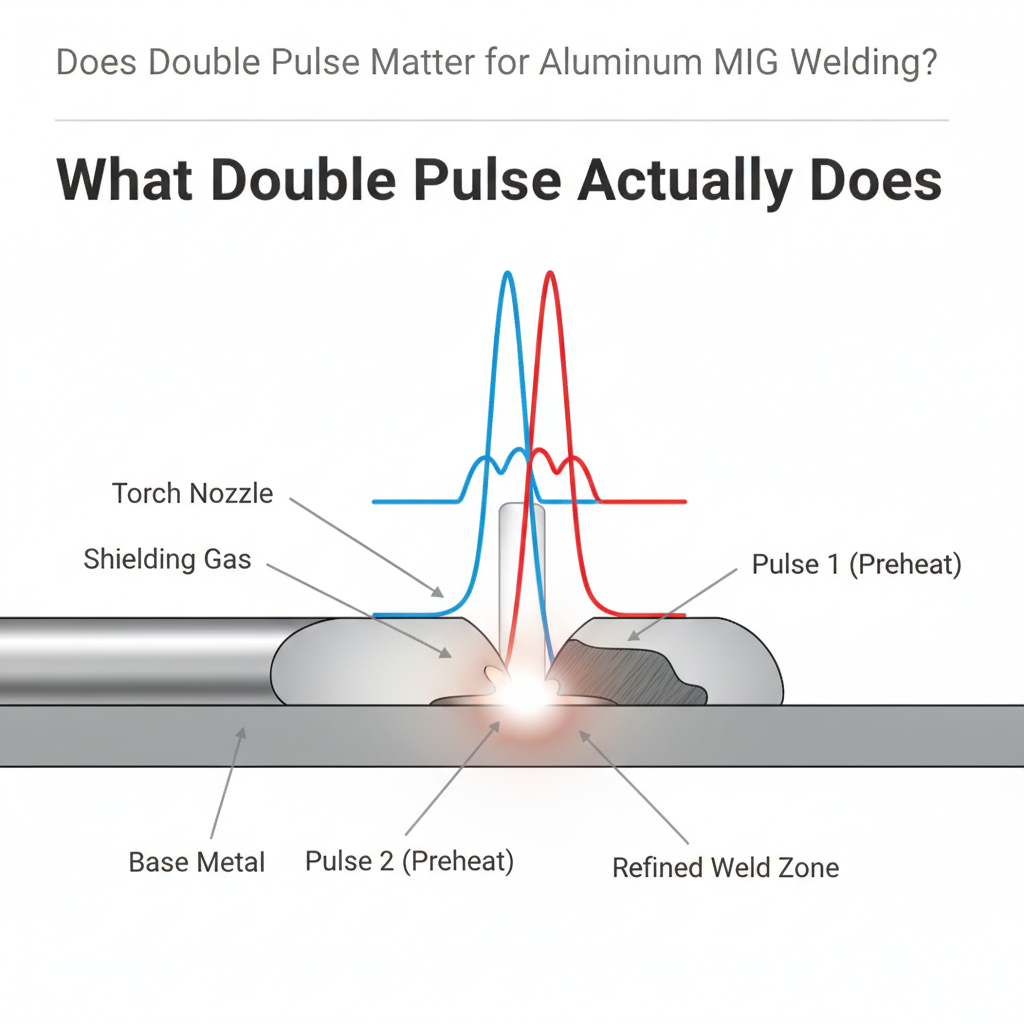
To understand double pulse, it helps to first understand single pulse MIG on aluminum.
Standard pulse MIG alternates between a high peak current and a lower background current. This reduces spatter and gives better arc stability compared to straight CV (constant voltage) welding on aluminum.
Double pulse takes that one step further. It adds a second, slower modulation layer — essentially pulsing the pulse frequency itself. The arc alternates between a hotter phase and a cooler phase in a rhythmic cycle, which controls the heat input over time rather than just moment to moment.
The result is a weld pool that cyclically solidifies slightly and then re-melts at a controlled rate. This mimics the hand rhythm of a skilled TIG welder dipping filler rod into the puddle, creating that recognizable rippled bead pattern.
The Heat Control Advantage on Aluminum
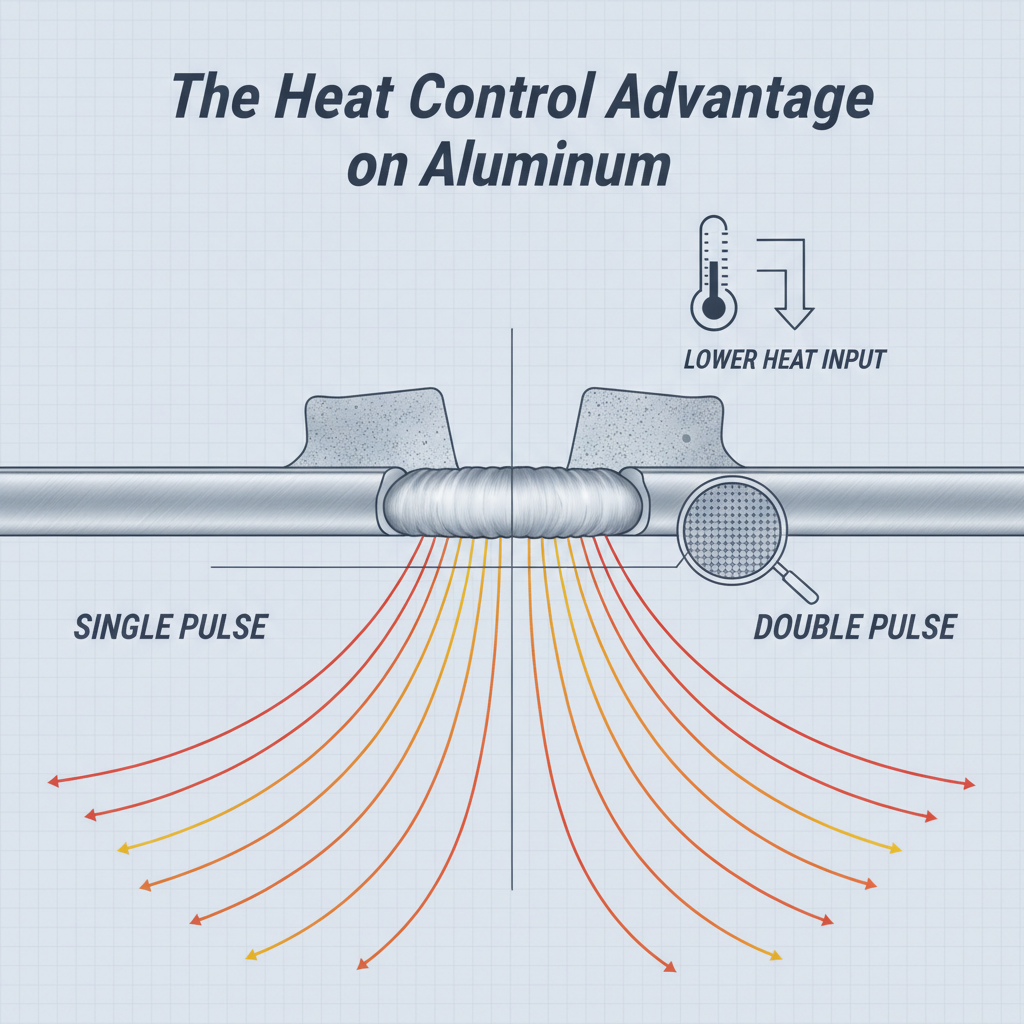
Aluminum is thermally conductive and has a relatively low melting point compared to steel. It absorbs and distributes heat quickly, which creates a unique challenge — the workpiece can reach critical temperature faster than the welder can react.
Single pulse helps, but it doesn’t fully solve the heat accumulation problem on longer runs or thinner sections.
Double pulse actively manages heat input by reducing the effective average amperage during the cool phase of each cycle. This keeps the base metal from soaking up excessive heat, which directly reduces:
- Burn-through on thin plate (especially below 3mm)
- Warping on structural parts where dimensional tolerance matters
- Porosity caused by gas escaping from an overheated, oversized weld pool
- Hot cracking, which is a real risk on certain aluminum alloys like 6061
In practice, fabricators working on automotive panels, marine components, or aerospace structures notice a measurable difference in distortion when switching from single to double pulse.
Bead Appearance: Cosmetic or Structural?
One of the most obvious results of double pulse is the TIG-like bead appearance. Each ripple in the bead corresponds to one double pulse cycle. Adjust the cycle frequency and travel speed together and you control the spacing between ripples.
Some welders dismiss this as purely cosmetic. That’s not entirely accurate.
The stacked-dime pattern does indicate consistent fusion and uniform heat cycling, which correlates with a more homogeneous weld microstructure. In non-destructive testing scenarios, a consistent ripple pattern often signals better fusion integrity than an irregular or washout bead.
That said, for purely structural welds where appearance is not inspected, single pulse aluminum MIG can produce strong, sound welds when dialed in correctly. Double pulse adds value in quality-sensitive environments — it doesn’t make single pulse structurally useless.
Where Double Pulse Makes the Biggest Difference
| Application | Double Pulse Benefit | Priority Level |
|---|---|---|
| Thin aluminum sheet (1.5–3mm) | Reduces burn-through, controls heat | High |
| Cosmetic/visible welds | TIG-like rippled appearance | High |
| Long continuous runs | Prevents heat buildup and distortion | High |
| Structural butt joints (thick plate) | Moderate improvement | Medium |
| Short tack welds | Minimal difference | Low |
| High-speed production welding | Reduces rework, improves consistency | High |
Setting Up Double Pulse Correctly
Double pulse only works well when the parameters are properly matched. Mismatched settings can actually produce worse results than standard pulse.
Key parameters to adjust:
- Pulse frequency (Hz) — Controls how fast the arc cycles between hot and cool phases. Lower frequency (0.5–2 Hz) creates wider ripples; higher frequency (3–5 Hz) tightens them.
- Pulse amplitude (or low pulse current %) — Determines how much the current drops during the cool phase. Too little difference and you lose the heat control benefit. Too much and the arc becomes unstable.
- Travel speed — Must be matched to pulse frequency. If you move too fast or too slow relative to the cycle, the ripple pattern becomes uneven.
- Wire feed speed (WFS) — Should remain consistent with the base pulse settings for the material thickness.
A common starting mistake is activating double pulse without adjusting travel speed, which results in an inconsistent bead that looks worse than single pulse. The two settings work as a pair.
Machines like the Lincoln Electric Square Wave TIG 200 are sometimes compared in this discussion, but for MIG-specific double pulse, the Miller Electric Multimatic 220 AC/DC and ESAB Rebel EMP 285ic are frequently referenced by fabricators for their aluminum double pulse performance and parameter control flexibility.
When Double Pulse Isn’t Worth It
Double pulse is not a universal improvement for every situation.
- Thick aluminum (6mm and above): Heat control becomes less critical, and deep penetration requirements may be better served by optimizing standard pulse settings.
- Short, interrupted welds: The benefit of thermal cycling doesn’t accumulate significantly over short weld lengths.
- Welders still learning wire manipulation: If travel speed consistency isn’t there yet, double pulse won’t compensate — it will amplify inconsistency.
- Machines without true double pulse firmware: Some lower-cost machines advertise “pulse” features that are not genuine double pulse. Using these aggressively can produce arc instability without the heat control benefits.
If your primary goal is simply getting metal joined and appearance is not a factor, spending significantly more on a machine with double pulse capability is difficult to justify on those grounds alone.
Common Setup Mistakes with Double Pulse on Aluminum
- Using incorrect shielding gas: Aluminum MIG requires 100% argon. Any CO2 content will cause black soot, porosity, and arc instability regardless of pulse settings.
- Running wire too cold: Under-powered double pulse settings can cause cold lap, where the ripples look clean but fusion is incomplete at the edges.
- Mismatched gun and liner: Aluminum wire is soft and kinks easily. A Teflon or graphite-lined gun (or a spool gun) is essential for consistent wire feeding. Erratic feed directly disrupts pulse stability.
- Dirty base material: Aluminum oxide must be cleaned before welding. Double pulse does not compensate for contamination.
FAQ
Is double pulse MIG the same as TIG welding aluminum?
No, but they share some characteristics. Double pulse MIG produces a similar-looking bead and comparable heat control in some scenarios, but TIG still offers greater precision, cleaner welds on thin material, and better control for out-of-position work. Double pulse MIG is faster and more practical for production or structural aluminum work where TIG speed is a limitation.
What aluminum alloys benefit most from double pulse MIG?
6061 and 6063 alloys benefit significantly because they are prone to hot cracking and distortion from excessive heat. 5052 and 5083 are more forgiving, but double pulse still improves bead consistency and reduces warping on thinner gauges of these alloys as well.
Can you use double pulse MIG on a spool gun?
It depends on the machine. Some welders support double pulse through a spool gun, but many consumer and semi-professional machines limit pulse functionality to the standard push feeder. Check the manufacturer specifications. Push-pull gun setups generally offer the best compatibility with double pulse parameters on aluminum.
Does double pulse MIG improve tensile strength of the weld?
Directly, the improvement is modest. Double pulse primarily improves fusion consistency and reduces defects like porosity and cold lap, which indirectly contributes to mechanical strength. In controlled testing, well-executed double pulse welds often show more consistent cross-sectional fusion compared to single pulse welds at the same settings.
What’s the difference between double pulse and synergic pulse MIG?
Synergic pulse automatically adjusts voltage and wire feed speed as a linked pair — you primarily dial in one parameter. Double pulse is a specific waveform mode that adds a second layer of current modulation on top of pulse. Many modern welders combine both: synergic control for ease of setup and double pulse for aluminum-specific heat cycling.
How do I know if my MIG welder actually has double pulse?
Check the machine’s specification sheet, not just the marketing label. Genuine double pulse allows independent control of low pulse frequency, low pulse amperage percentage, and high pulse parameters. If the machine only has a single “pulse” toggle with no secondary cycle frequency adjustment, it likely does not have true double pulse capability.
Is double pulse worth the extra cost for a hobbyist?
For occasional welding on non-critical aluminum projects, probably not. The quality improvement is real, but the cost difference between a basic pulse-capable aluminum MIG setup and a true double pulse machine is substantial. Hobbyists who regularly fabricate visible or thin-wall aluminum parts — boat trailers, motorcycle frames, enclosures — will see clearer justification for the investment.
Double pulse genuinely matters for aluminum MIG welding when quality, appearance, and heat control are real priorities. It closes a meaningful gap between MIG and TIG results on thin aluminum. Where it doesn’t matter is on thick structural work, short welds, or when the machine’s implementation of the feature isn’t properly calibrated. Know what you’re welding, what quality level is required, and whether your machine’s double pulse is genuine — and the answer becomes straightforward.