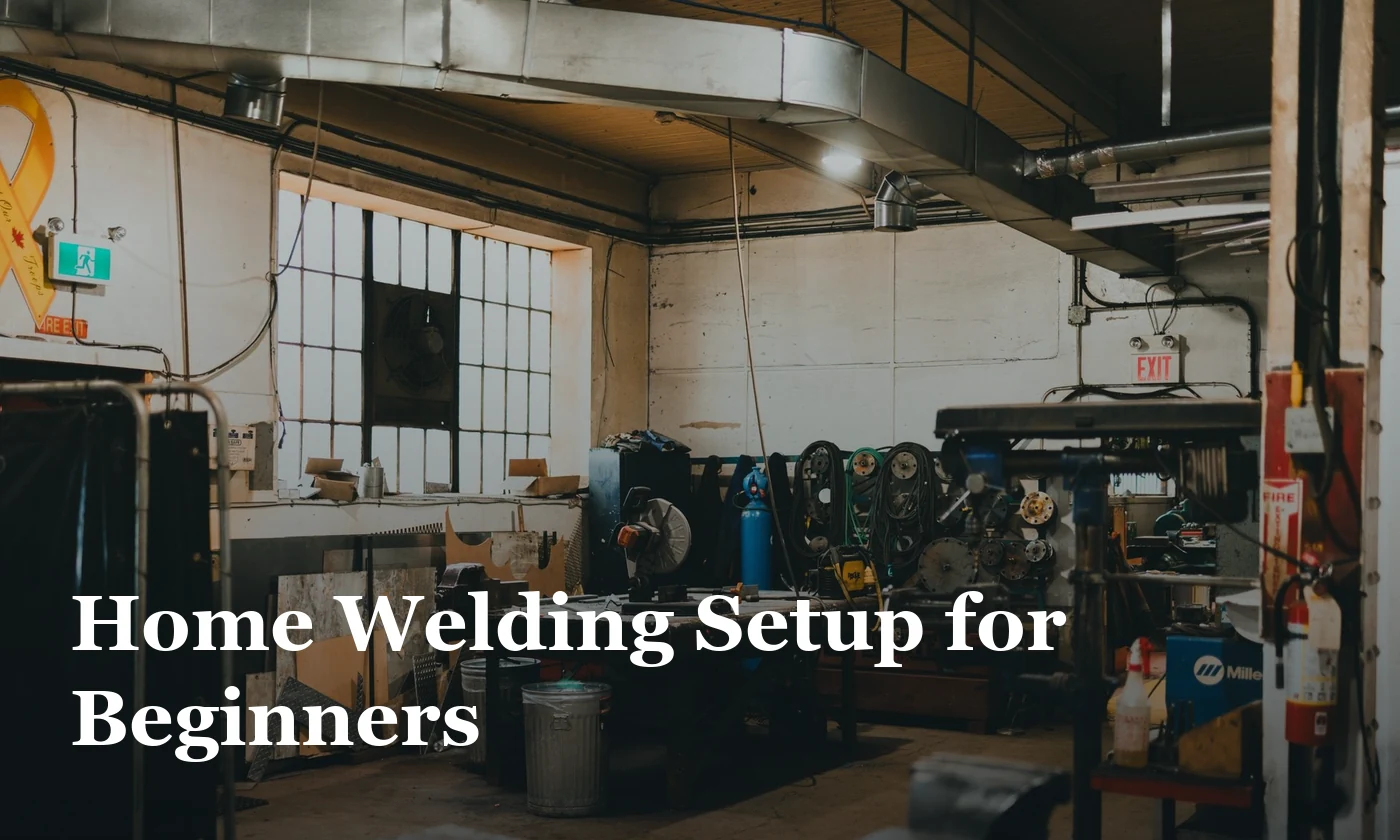
A home welding setup starts with the work you intend to do, the material you can identify, and a space suitable for hot work. Buying a machine is only one part of that decision. This guide covers planning for noncritical practice on known material; it is not an electrical installation design or approval of a garage for welding.
Start with a plan of the space
Measure the room, doors, workbench and storage. Use the garage layout planner to place equipment, flag overlapping footprints and build a budget. Leave the exits accessible and account for people, pets and adjoining spaces. A floor plan cannot establish safe fire distances or adequate ventilation.
Choose a process for a specific job
Compare material, thickness, location and finish requirements with the process selector. Then check the exact machine and consumable documentation. Solid-wire MIG normally needs external shielding gas; self-shielded flux-cored wire is a different consumable and has its own polarity and operating requirements. TIG uses a tungsten electrode and separate filler when filler is needed. Ordinary DC scratch-start equipment should not be presented as a general beginner solution for aluminum TIG.
Choose a machine with suitable output and input requirements for your intended work. Do not select a power supply, extension lead or circuit from a generic online wattage rule. Have a qualified electrician assess the installation against the machine instructions and applicable local requirements.
Plan fume control before striking an arc
Welding produces fumes and gases. Their composition depends on the process, base metal, consumable and surface contamination. Identify coatings and materials before work. Do not assume that an open door, bathroom fan or hobby carbon filter makes the breathing zone safe. Suitable local exhaust or other controls must be selected for the actual exposure and workspace; respiratory protection requires appropriate selection and use.
Keep your head out of the plume, and obtain competent advice where the exposure or controls are uncertain. Do not weld in a confined space as a casual home project. Read OSHA’s welding hazard resources and its welding fumes guidance as background; workplace and local requirements still apply.
Build the preparation list
- A suitable noncombustible work surface and secure workholding.
- Welding eye and face protection selected for the process and operating current, suitable clothing and gloves, and protection for grinding and other preparation tasks.
- Fire prevention arrangements covering sparks, hot metal and hidden combustible material, including the other side of the work area.
- Controls to protect other people from arc radiation and exposure.
- Correct cylinder restraint, handling and storage if the process uses gas.
- A machine manual, consumable instructions and a way to identify the base material.
The Miller first-welder guide provides process and equipment background. Product-specific instructions take precedence over generic suggestions.
Budget for the complete setup
Include workholding, preparation tools, consumables, protective equipment, fume controls and any necessary electrical work alongside the welder. Use supplier quotes for those items. The metal weight calculator helps compare nominal stock quantities, and the gas estimator distinguishes arc time from elapsed workshop time.
Make the first sessions measurable
Begin with known practice coupons and instruction appropriate to the process. Record the machine, material, consumable, polarity, settings and observations in the weld practice log. Change one variable at a time within the manufacturer’s permitted setup. A tidy bead or a self-assigned practice score does not prove strength or internal soundness.
Do not use trailer hitches, vehicle structures, lifting equipment, pressure containers or other safety-critical parts as beginner practice projects. The project plan builder offers dimensioned noncritical concepts to discuss with a competent fabricator; its drawings carry no load rating.
About the illustration and this revision
This article was revised on September 7, 2026 to replace the earlier image, remove unsupported personal claims and improvised fume-control advice, and add practical planning resources. No claim of an on-site safety inspection is made.