
Explosion welding represents one of the most dramatic and effective methods for joining dissimilar metals that would otherwise be impossible to weld using conventional techniques. This specialized process harnesses the controlled power of explosives to create metallurgical bonds between materials with vastly different properties. Whether you’re an engineer exploring advanced manufacturing options or simply curious about this fascinating industrial process, understanding explosion welding opens the door to appreciating how modern industry tackles some of its most challenging material joining problems.
Quick Answer: What Is Explosion Welding?
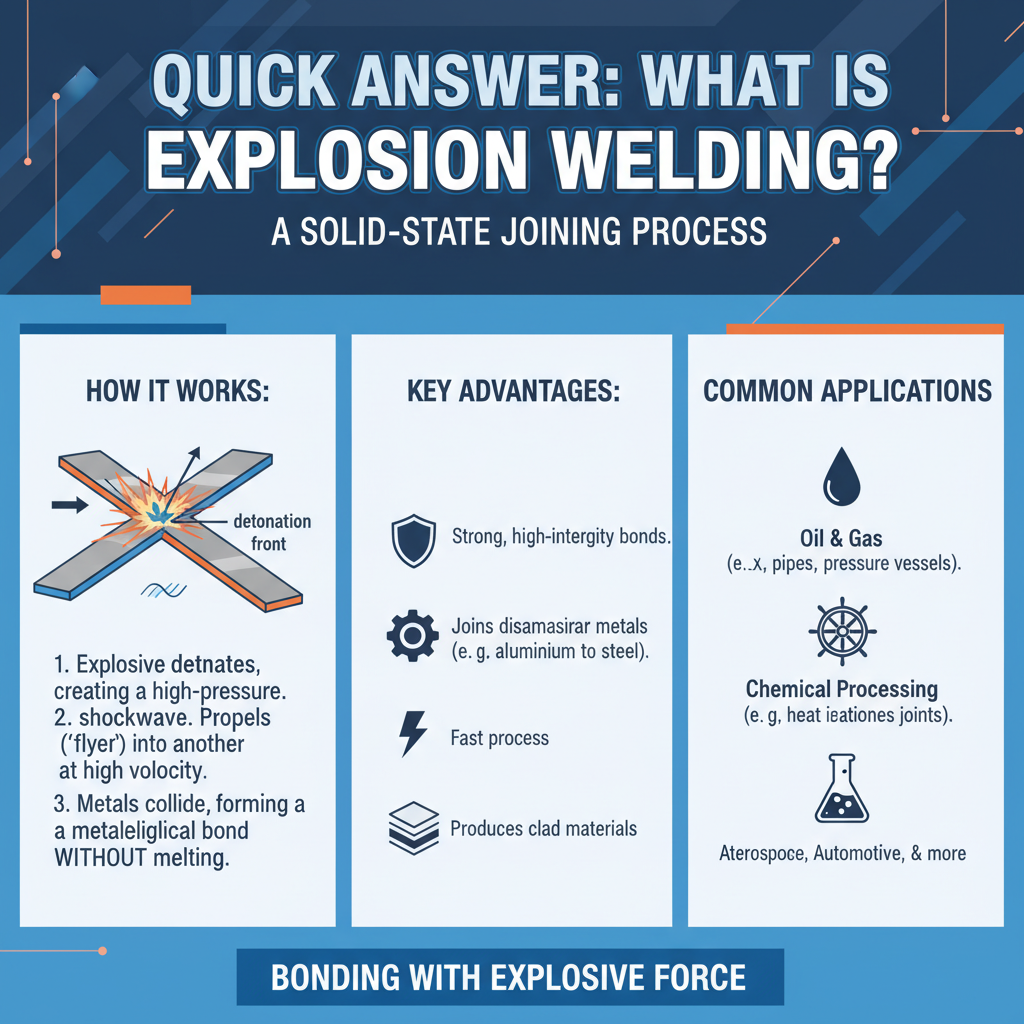
Explosion welding is a solid-state welding process that uses controlled explosive detonation to accelerate one metal plate at extremely high velocity into another, creating a metallurgical bond without melting either material. The process typically joins dissimilar metals like aluminum to steel or titanium to copper, producing bonds stronger than conventional welding methods.
The technique works by positioning an explosive charge above a flyer plate, which gets propelled at speeds exceeding 1,000 meters per second into a base plate below. The collision creates intense pressure and heat at the interface, forming a wavy bond pattern characteristic of explosion welding.
How the Explosion Welding Process Works
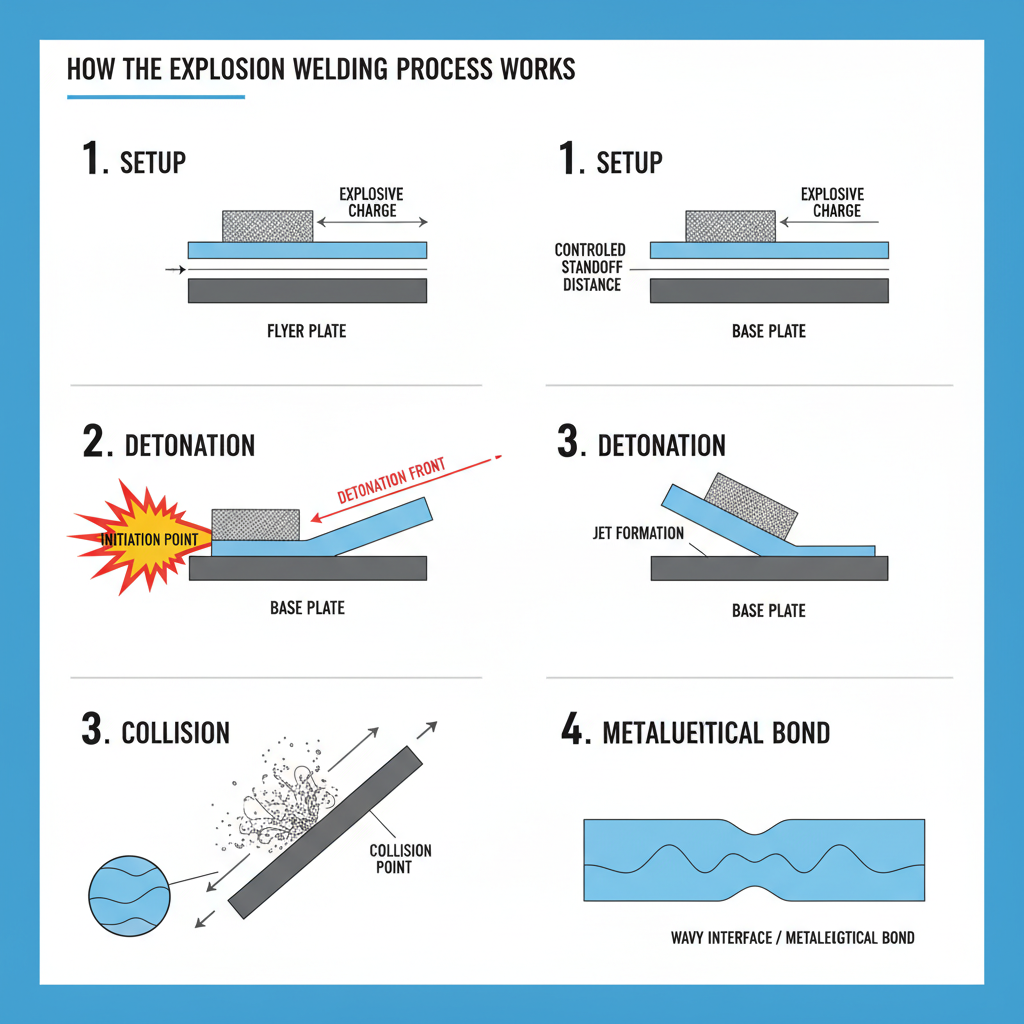
The explosion welding process follows a precise sequence that transforms explosive energy into metallurgical bonding. A standoff distance separates the flyer plate from the base plate, typically ranging from 0.5 to 3 times the flyer plate thickness.
When the explosive detonates, it creates a detonation wave traveling at approximately 2,000 to 8,000 meters per second. This wave progressively accelerates the flyer plate, causing it to collide with the base plate at an acute angle rather than parallel impact.
The angled collision creates a jet of metal that cleans both surfaces instantaneously, removing oxides and contaminants. Behind this cleaning jet, the metals undergo plastic deformation under extreme pressure, typically 1 to 10 GPa, forming the characteristic wavy interface pattern.
The Science Behind Explosive Metal Bonding
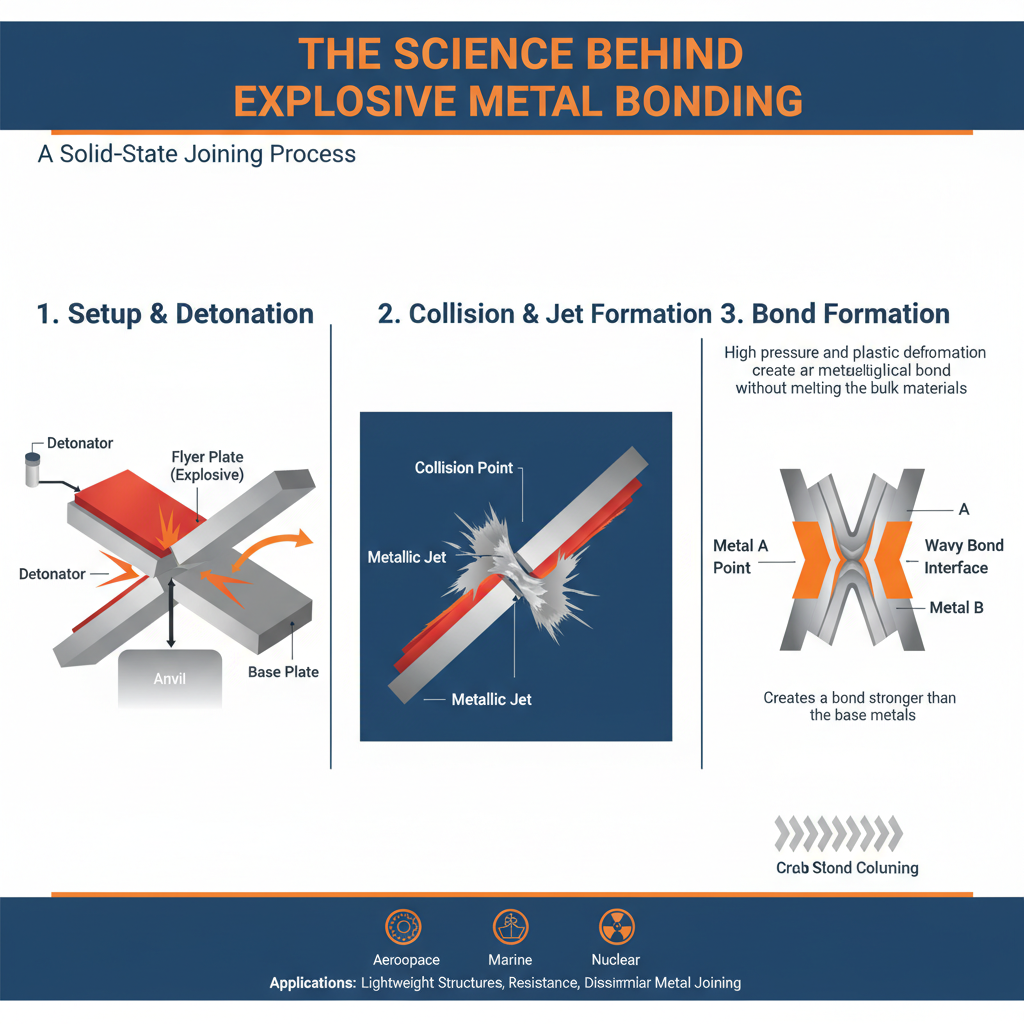
The metallurgical bond formation in explosion welding occurs through several simultaneous mechanisms. The collision generates localized temperatures between 500°C to 1,200°C, well below the melting points of most metals but sufficient to promote atomic diffusion.
Extreme plastic deformation breaks up surface films and brings clean metal surfaces into intimate contact. The high strain rates, often exceeding 10^6 per second, create unique microstructural conditions that enhance bonding.
The wavy interface pattern results from fluid-like behavior of the metals under extreme conditions. These waves increase the bonded surface area and create mechanical interlocking that contributes significantly to joint strength.
Materials Successfully Joined Through Explosion Welding
Explosion welding excels at joining material combinations that resist conventional welding methods. Common successful combinations include aluminum to steel, titanium to steel, copper to aluminum, and stainless steel to carbon steel.
The process works particularly well with materials having different melting points, thermal expansion coefficients, or crystal structures. Refractory metals like tantalum and niobium can be bonded to more common structural materials.
Field experience shows that explosion welding can join materials with thickness ratios ranging from 1:10 to 10:1, though optimal results typically occur within 1:3 to 3:1 ratios. The process handles plate thicknesses from 0.5mm to over 100mm effectively.
Critical Parameters That Determine Weld Quality
Several parameters must be precisely controlled to achieve successful explosion welds. The explosive loading, measured in kilograms per square meter, determines the acceleration imparted to the flyer plate.
Standoff distance critically affects the collision angle and velocity. Too little standoff prevents proper acceleration, while excessive distance allows the flyer plate to become unstable during flight.
The collision velocity must fall within specific windows for each material combination. Velocities too low fail to create sufficient bonding pressure, while excessive velocities can cause material damage or incomplete bonding.
Surface preparation requirements vary by material but generally involve removing heavy oxides, oils, and loose scale. Light surface oxidation often improves bonding by providing additional cleaning action during collision.
Advantages Over Conventional Welding Methods
Explosion welding offers unique advantages that make it invaluable for specific applications. The process creates bonds without melting either base material, preserving their original properties and avoiding heat-affected zones.
Joint strengths often exceed the weaker of the two base materials, with shear strengths typically ranging from 200 to 400 MPa depending on the material combination. The wavy interface provides excellent fatigue resistance compared to straight fusion weld interfaces.
Large area bonding capability distinguishes explosion welding from other solid-state processes. Single shots can bond areas exceeding 10 square meters, making it economical for large-scale applications.
The process works with materials in their final heat-treated condition, eliminating concerns about thermal cycling effects on material properties.
Limitations and Safety Considerations
Explosion welding requires specialized facilities and extensive safety measures due to the use of explosives. Operations typically occur in remote locations or specially designed blast chambers with appropriate containment.
The process generates significant noise, ground vibration, and air blast effects that must be carefully managed. Regulatory compliance involves explosive handling licenses and environmental impact assessments.
Geometric limitations restrict the process to relatively flat configurations, though some curved surfaces can be accommodated with specialized tooling. Complex three-dimensional shapes generally cannot be explosion welded directly.
Post-weld machining is often necessary to achieve final dimensions and remove edge effects from the explosive process.
Industrial Applications and Real-World Uses
The petrochemical industry extensively uses explosion-welded clad plates for pressure vessels and heat exchangers. These applications benefit from corrosion-resistant cladding bonded to structural steel backing.
Shipbuilding applications include aluminum superstructures explosion-welded to steel hulls, providing weight savings while maintaining structural integrity. The process enables dissimilar metal transitions that would be impossible with fusion welding.
Electronics and aerospace industries use explosion welding for electrical contacts and heat sinks where different materials must be joined without intermetallic compound formation.
A common issue technicians encounter is achieving consistent bond quality across large areas, requiring careful explosive layout design and detonation timing control.
Quality Control and Testing Methods
Non-destructive testing of explosion welds typically employs ultrasonic inspection to detect unbonded areas or internal defects. The wavy interface can complicate interpretation, requiring specialized techniques and experienced operators.
Destructive testing includes peel tests, shear tests, and metallographic examination of the bond interface. Peel tests reveal bond strength distribution, while metallography confirms proper wave formation and absence of melting.
In practice, quality control begins with careful parameter selection based on material properties and continues through post-weld inspection protocols. Statistical process control helps maintain consistent results across production runs.
Cost Factors and Economic Considerations
Explosion welding costs depend heavily on explosive quantities, safety requirements, and production volume. Setup costs are significant due to safety infrastructure and specialized equipment needs.
For large-scale production, the process becomes economically attractive compared to alternatives like roll bonding or brazing. The ability to process large areas in single operations provides economies of scale.
Material costs include not only the base metals but also explosive charges, which typically represent 5-15% of total processing costs. Remote location requirements can add transportation and logistics expenses.
Frequently Asked Questions
Can explosion welding join more than two materials at once?
Yes, explosion welding can create multi-layer composites by stacking multiple flyer plates or using sequential explosive charges. Three-layer combinations are common, while more complex arrangements require careful engineering.
What is the maximum size that can be explosion welded?
Current technology allows explosion welding of areas up to approximately 15 square meters in single shots. Larger areas can be achieved through multiple overlapping welds or segmented approaches.
How strong are explosion-welded joints compared to the base materials?
Explosion-welded joints typically achieve 80-100% of the strength of the weaker base material. The wavy interface often provides superior fatigue resistance compared to straight interfaces.
Is explosion welding environmentally friendly?
The process produces no chemical emissions or toxic byproducts, making it environmentally cleaner than many alternative joining methods. However, noise and vibration impacts require careful management.
Can explosion welding be performed underwater or in special atmospheres?
Underwater explosion welding is possible and sometimes used for marine repairs. Special atmospheres like vacuum or inert gas environments can be employed for reactive materials.
What happens if the explosive charge is too large or too small?
Insufficient explosive loading results in incomplete bonding or no bond formation. Excessive loading can cause material damage, excessive deformation, or bond degradation through overheating.
How long do explosion-welded joints last in service?
Properly executed explosion welds demonstrate excellent long-term durability, with some joints in service for over 40 years showing no degradation. The solid-state nature of the bond contributes to this longevity.
Final Thoughts
Explosion welding stands as a remarkable example of how controlled destructive forces can create something beneficial and lasting. This process fills a crucial niche in modern manufacturing by enabling the joining of material combinations that would otherwise remain incompatible. While the dramatic nature of the process might seem intimidating, the precision and control involved demonstrate the sophisticated engineering behind this technology. For applications requiring dissimilar metal joints with exceptional strength and durability, explosion welding continues to provide solutions that conventional methods simply cannot match. Understanding this process reveals how innovative thinking and careful engineering can transform apparent limitations into powerful capabilities.