
Why the Zinc Coating Creates Problems
Removing the Zinc Before You Weld
Ventilation and Safety Requirements
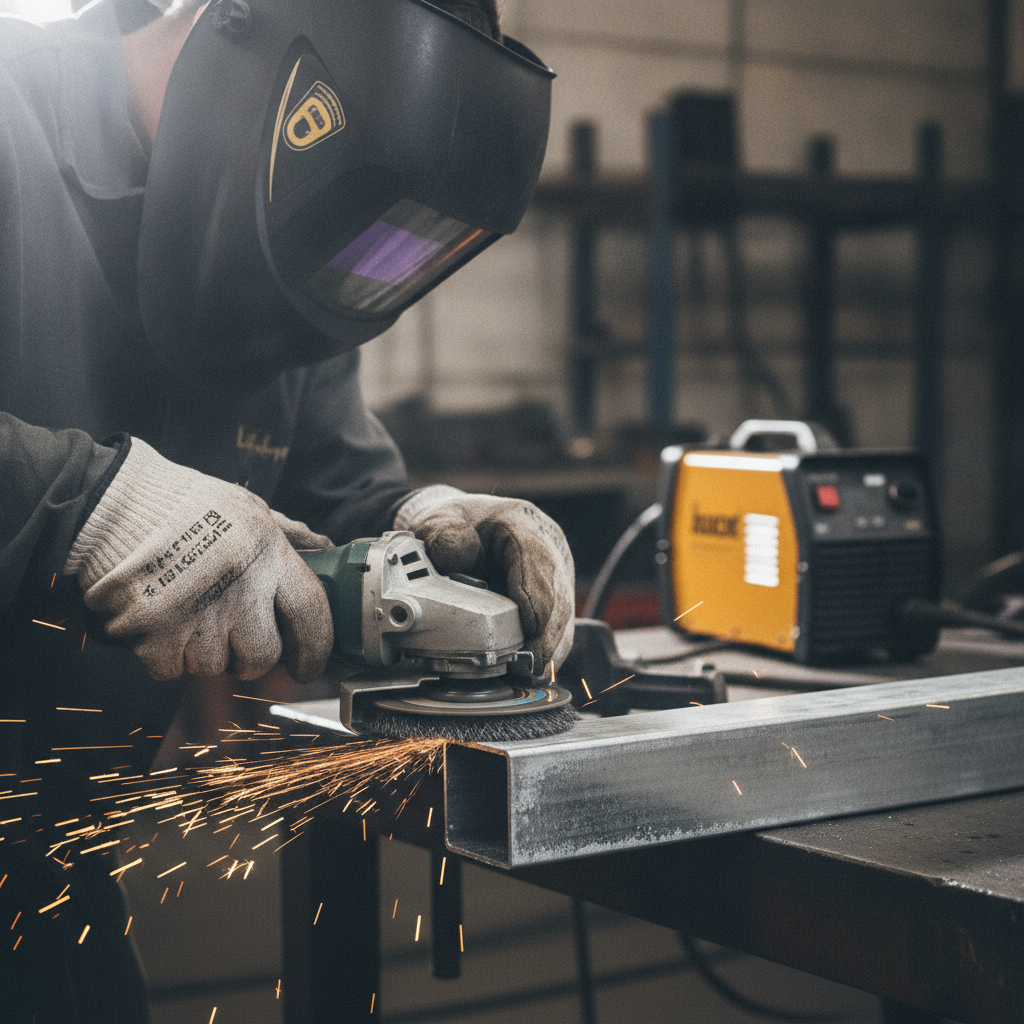
Even with the zinc removed from the immediate weld area, galvanized steel nearby will still produce some fumes as heat radiates outward. Safety measures are non-negotiable here. – Work outdoors or in a space with strong forced-air ventilation – Use a respirator rated for metal fumes — a standard dust mask is not adequate. A half-face respirator with P100/OV cartridges is the minimum – Keep your face out of the fume plume – Use a welding fume extractor positioned close to the weld if you’re working indoors Never assume the fumes are minor or manageable without protection. Metal fume fever is real, and it has put more than a few welders out for a day or two.MIG Settings for Welding Galvanized Steel
Once the zinc is removed from the weld zone, welding galvanized steel isn’t dramatically different from welding regular mild steel of the same thickness. The base metal is carbon steel, so standard mild steel parameters apply. Wire: – ER70S-6 is the standard choice — it has a slightly higher silicon and manganese content that tolerates minor surface contamination better than ER70S-3 – This matters because you may not remove every trace of zinc at the edges Shielding gas: – 75% Argon / 25% CO₂ (C25) is the standard recommendation for mild steel — it produces a stable arc, good penetration, and manageable spatter – For a deeper look at gas selection options, the MIG welding shielding gas selection guide covers the full range of gas choices across different materials Voltage and wire speed: Use parameters appropriate for the material thickness. Galvanized steel is typically available in light to medium gauges for most shop applications. | Material Thickness | Voltage (Approx.) | Wire Speed (Approx.) | Wire Diameter | |—|—|—|—| | 18 gauge (1.2mm) | 16–18V | 200–280 IPM | 0.023″ or 0.025″ | | 16 gauge (1.6mm) | 17–19V | 230–300 IPM | 0.025″ or 0.030″ | | 1/8″ (3.2mm) | 18–21V | 280–360 IPM | 0.030″ or 0.035″ | | 3/16″ (4.8mm) | 20–23V | 320–420 IPM | 0.035″ | Always dial in with test welds on scrap of the same thickness before running a production weld.Welding Through the Coating (When It’s Unavoidable)
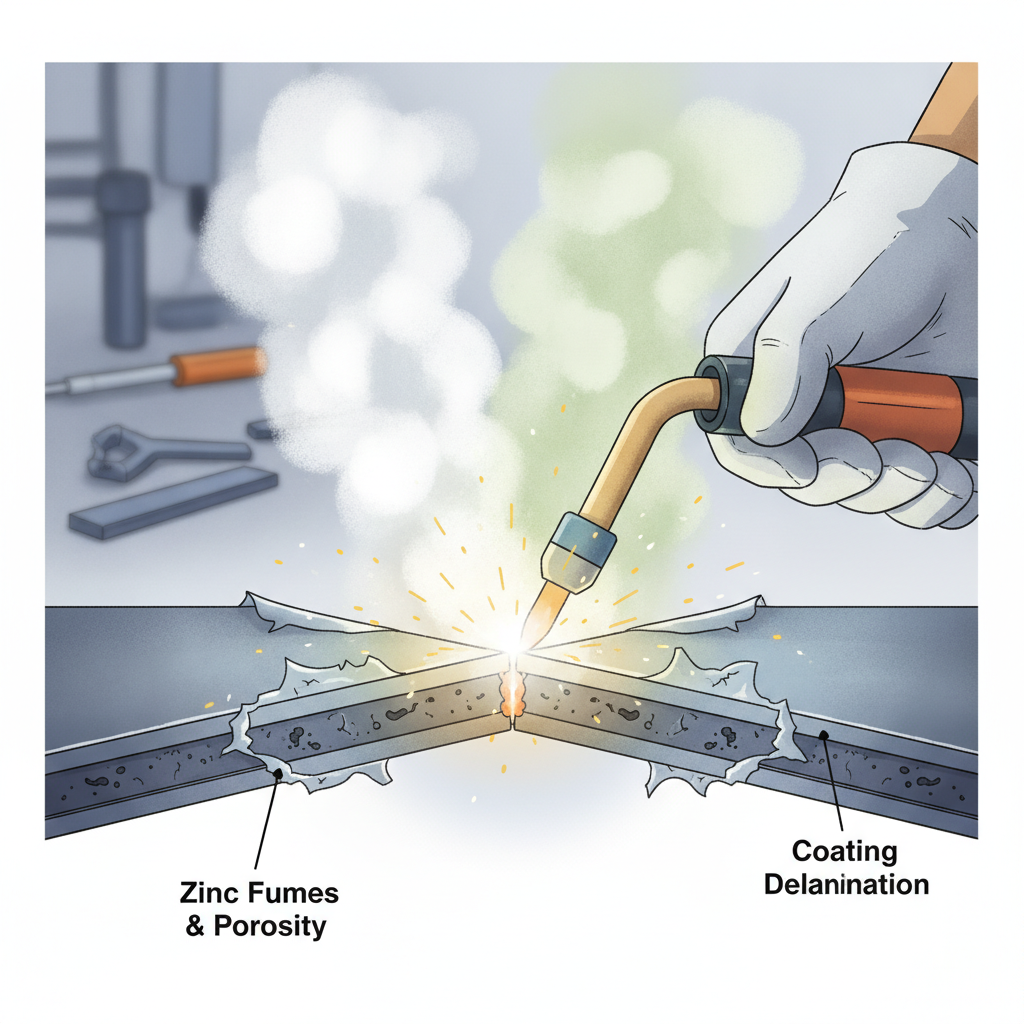
In field situations — repair work on existing galvanized structures, for example — grinding every weld area isn’t always practical. Some welders do weld through the coating when no other option exists. If you must weld through galvanized coating: – Maximize ventilation and respiratory protection – Slow your travel speed slightly to allow zinc to burn off ahead of the puddle – Increase wire speed marginally to maintain arc stability – Expect more spatter — adjust torch angle and use anti-spatter spray – Accept that porosity may be present and plan weld inspection accordingly – Use a multi-pass approach on thicker material rather than trying to force penetration in one pass Structural welds through intact zinc coating should be avoided whenever the application involves load-bearing or safety-critical joints. The weld quality simply cannot be guaranteed without removing the coating first.Post-Weld Treatment for Galvanized Steel
Once welding is complete, the areas that were ground or chemically stripped — and the weld itself — are now bare steel with no corrosion protection. If the piece will be exposed to moisture or outdoor conditions, you need to restore that protection. Options include: – Cold galvanizing compound — zinc-rich paint that partially restores galvanic protection (Rust-Oleum Cold Galvanizing Compound is widely used for this) – Zinc spray primer — aerosol zinc coating for smaller areas – Hot-dip re-galvanizing — sends the part back through a galvanizing bath, practical only for smaller components or production work Without some form of zinc restoration, the weld zone will rust significantly faster than the surrounding galvanized surface.Common Mistakes to Avoid
A few errors come up repeatedly when welders first tackle galvanized material: – Skipping the respirator — the most serious and unfortunately common mistake – Not grinding wide enough — zinc just outside the weld zone still burns and affects the puddle – Using the wrong wire — ER70S-3 works but ER70S-6 handles edge-of-weld contamination better – Cranking up heat to fight porosity — more heat often makes fume-related porosity worse, not better – Forgetting post-weld rust protection — a perfectly welded galvanized part left bare at the weld will corrode fastFAQ
Is it illegal to MIG weld galvanized steel without ventilation? In most countries, welding galvanized steel without adequate fume control violates workplace health and safety regulations — including OSHA standards in the United States. In a commercial shop setting, proper ventilation and respiratory protection are legal requirements, not just recommendations. Even in a home shop, the health risk alone makes cutting corners a bad decision. How long does metal fume fever last from welding galvanized steel? Symptoms typically appear 4–12 hours after exposure and feel similar to the flu — chills, fever, muscle aches, and nausea. Most cases resolve within 24–48 hours with rest and hydration. Repeated exposure doesn’t build immunity; it actually increases sensitivity. If symptoms are severe or don’t resolve, seek medical attention. Can you flux core weld galvanized steel instead of MIG? Flux core welding galvanized steel is possible and some welders prefer it for outdoor work because it doesn’t require shielding gas. The fume risk is the same — zinc oxide fumes are produced regardless of process. The same prep steps apply: grind the zinc from the weld area, ensure ventilation, and use appropriate respiratory protection. Will welding galvanized steel void its corrosion warranty? In most cases, yes. Any manufacturer’s corrosion warranty on galvanized steel products is typically voided the moment the material is cut, ground, or welded — because all of those operations compromise the zinc coating. Post-weld treatment with a cold galvanizing compound helps restore some protection but doesn’t reinstate a factory warranty. What’s the best respirator for welding galvanized steel? A half-face respirator with combination P100 particulate and organic vapor (OV) cartridges — such as the 3M 6200 with 60923 cartridges — provides solid protection against zinc oxide particles and metal fumes. A supplied-air respirator is the highest level of protection for heavy or prolonged work. Standard N95 dust masks are not rated for metal fumes and should not be used. How thick can galvanized steel be before MIG welding becomes difficult? MIG welding handles galvanized steel across a wide range of thicknesses. Thicker material (above 1/4 inch) simply requires more passes and appropriate parameters — the galvanizing itself doesn’t create thickness-related difficulty. The challenges remain consistent regardless of thickness: zinc removal, fume management, and post-weld protection. Does galvanized steel affect MIG wire consumption or tip wear? Welding near or through zinc coating increases spatter significantly, which accelerates contact tip contamination and wear. Tips may clog or burn back faster than when welding clean mild steel. Using anti-spatter spray on the nozzle and keeping spare tips available is practical advice for anyone doing regular galvanized welding work.MIG welding galvanized steel is entirely workable — the zinc coating just changes how you prep and how you protect yourself. Grind the weld zone, run a proper respirator, use ER70S-6 wire with standard C25 shielding gas, and restore zinc protection after the weld. Done right, you’ll get strong, clean welds on galvanized material without risking your health or compromising the joint.