
How CO₂ Changes the Arc Behavior
What CO₂ Specifically Increases in MIG Welding Steel
Penetration: The Primary Reason Welders Use CO₂
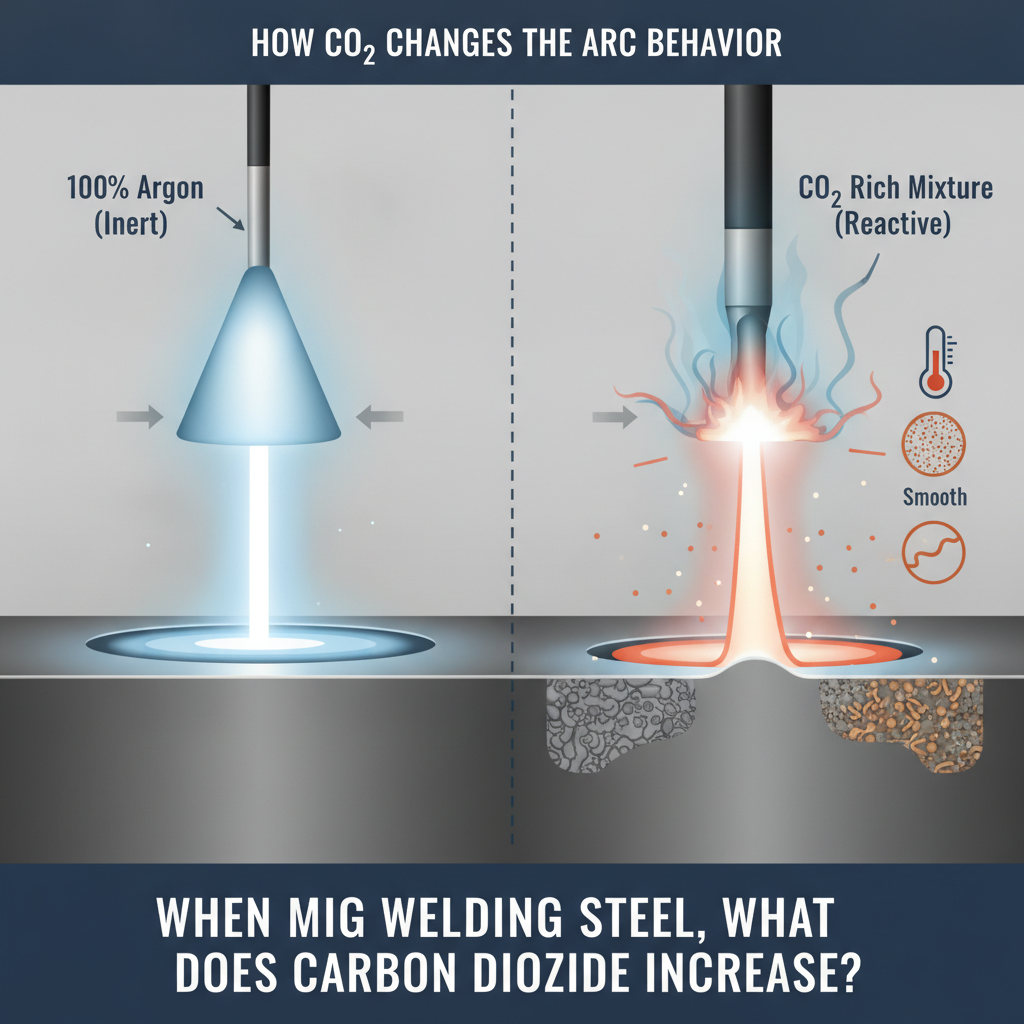
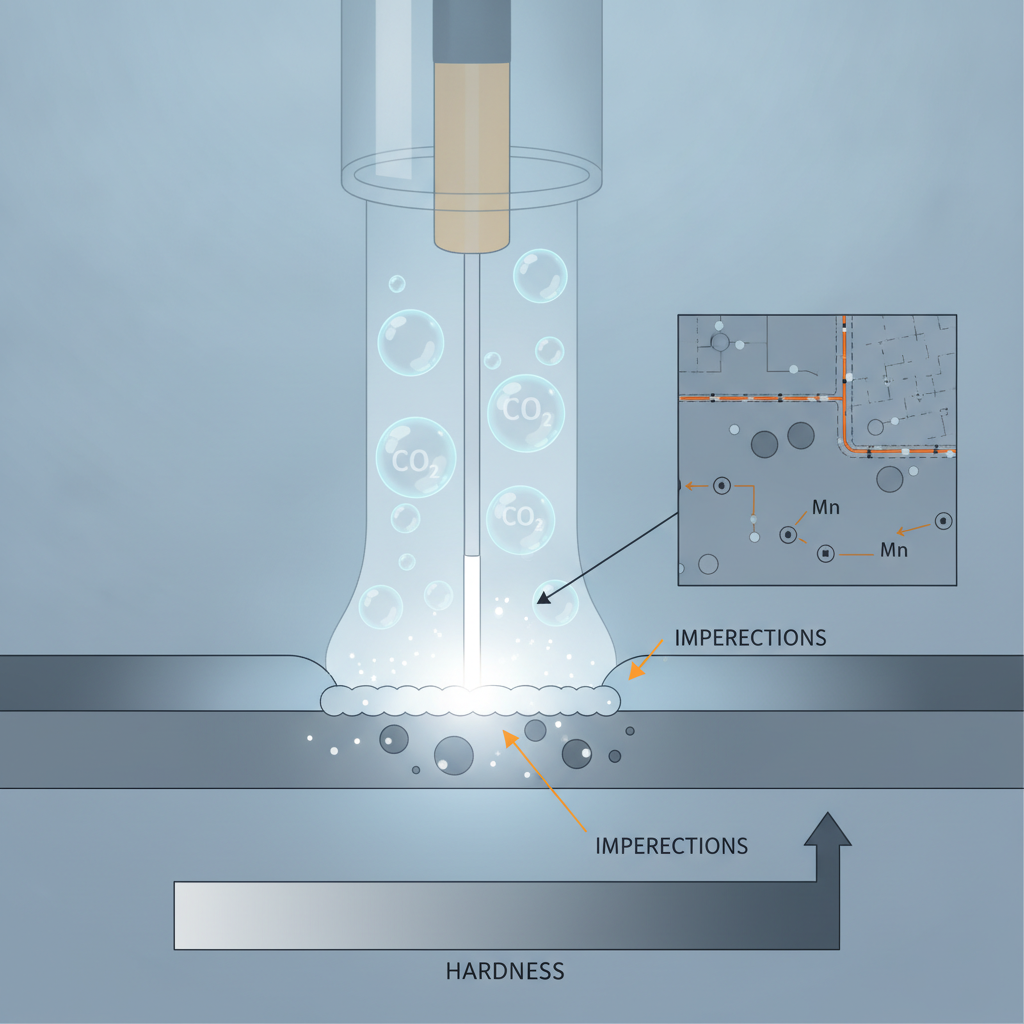
Penetration is the main technical benefit CO₂ brings to the table. The reactive nature of the gas concentrates heat more aggressively into the workpiece. In practice, this makes pure CO₂ or higher CO₂ blends a reasonable choice when welding thicker mild steel where lack of fusion is a real risk. Structural fabrication shops and heavy equipment repair operations often use CO₂ for exactly this reason. For thinner gauge steel — automotive sheet metal, brackets, light tubing — that extra penetration works against you. It increases the risk of burn-through and makes it harder to control the heat-affected zone. Choosing the right gas for MIG welding mild steel really comes down to matching the CO₂ percentage to the material thickness and the weld quality you need.Spatter Increase: The Cost of Higher CO₂
More CO₂ means more spatter — there’s no way around it. The reactive arc creates an unstable transfer mode that throws more molten droplets outside the weld pool. This matters more in some situations than others: – Structural steel and heavy fabrication — Spatter is manageable. Post-weld grinding is part of the workflow anyway. – Visible or cosmetic welds — Higher spatter becomes a real problem. More cleanup time, more risk of surface damage. – Painted or coated steel nearby — Spatter can burn through coatings and cause corrosion points. Most hobbyists and shop welders using moderate material thicknesses find that C25 (75/25 argon/CO₂) hits the right balance: solid penetration without excessive spatter.CO₂ vs. Argon/CO₂ Blends: Direct Comparison
The practical choice for most MIG welding on steel comes down to pure CO₂ versus a mixed gas, typically C25. | Feature | Pure CO₂ (100%) | C25 (75% Ar / 25% CO₂) | |—|—|—| | Penetration | Deep | Moderate-deep | | Spatter | High | Low-moderate | | Arc stability | Lower | Higher | | Bead appearance | Rough, convex | Smoother, flatter | | Cost | Lower | Higher | | Best for | Thick steel, structural work | General purpose, most MIG applications | | Wire transfer mode | Globular at lower voltages | Short-circuit, spray possible | Pure CO₂ locks you into globular or short-circuit transfer. C25 opens up the possibility of spray transfer at higher voltages — a much cleaner process that produces smooth, spatter-free beads on heavier material.Heat Input and Its Downstream Effects
Higher CO₂ content increases overall heat input during the weld. That increased heat does more than just improve penetration. It widens the heat-affected zone (HAZ) — the area of base metal altered by welding heat but not melted. A larger HAZ means more potential distortion, especially on thinner plate or parts with tight tolerances. For a reference for MIG settings across different material thicknesses, matching your voltage and wire speed to the gas mix is important, because CO₂-heavy setups often need parameter adjustments relative to argon blends. In structural applications where distortion tolerance is high and penetration matters more, the higher heat from CO₂ is acceptable. In precision fabrication, it’s a liability.Why CO₂ Is Still Widely Used Despite Its Trade-Offs
Cost is the honest answer. CO₂ is significantly cheaper than argon and argon blends. In high-volume production environments or hobbyist shops where cosmetics are less critical, the savings add up. CO₂ is also more readily available in many regions and requires no special handling beyond standard compressed gas precautions. The Lincoln Electric Power MIG 210 MP and similar multi-process welders are often used in production environments where the gas choice gets made based on job type and budget rather than aesthetics. For welders running heavy structural passes on carbon steel where every bead will be ground and inspected rather than left exposed, pure CO₂ remains a sensible, cost-effective choice.FAQ
Does CO₂ improve weld strength in MIG welding? CO₂ increases penetration depth, which can improve fusion into the base metal on thicker sections. Weld strength itself depends on wire selection, technique, and joint preparation — not just gas. In most cases, the strength difference between CO₂ and C25 welds on properly prepared joints is minimal when technique is consistent. Can you use 100% CO₂ for all MIG welding on steel? Technically yes, but it’s not always practical. Pure CO₂ works well on thicker mild steel where penetration is a priority and spatter cleanup is acceptable. For thin gauge steel, automotive work, or any application requiring a clean bead appearance, a C25 blend will give significantly better results with far less spatter. What happens if you use too much CO₂ in your shielding gas? Excessive CO₂ content introduces more oxygen into the arc, increasing spatter, destabilizing the arc, and potentially causing porosity if the wire doesn’t have adequate deoxidizers. ER70S-6 wire handles higher CO₂ content better than ER70S-3 because it contains more manganese and silicon to counteract oxidation. Does CO₂ percentage affect wire feed speed or voltage settings? Yes. Higher CO₂ content generally requires slight voltage adjustments because the arc runs hotter and more aggressively. When switching from C25 to pure CO₂, welders often need to reduce voltage slightly or increase wire feed speed to maintain a stable weld pool. Always re-test settings when changing gas mixes. Why does CO₂ cause more spatter than argon in MIG welding? Argon is an inert noble gas that produces a smooth, stable arc. CO₂ is reactive — it breaks down in the arc and releases oxygen, creating an unstable globular metal transfer mode at lower voltages. This turbulence throws molten droplets outside the weld pool, resulting in the characteristic higher spatter of CO₂-heavy shielding gas. You can review a full breakdown in this MIG welding gas selection guide covering all common gas combinations. Is CO₂ safe to use indoors for MIG welding? CO₂ shielding gas itself is not flammable, but it displaces oxygen in enclosed spaces, creating a suffocation risk at high concentrations. Adequate ventilation is required whenever welding indoors, regardless of gas type. MIG welding also produces metal fumes that need proper extraction. The gas supply side is less hazardous than the fume side, but both need attention. What wire is best when using CO₂ as shielding gas? ER70S-6 is the standard recommendation for pure CO₂ or high-CO₂ applications on mild steel. Its elevated manganese and silicon content acts as deoxidizers, counteracting the oxidizing effect of CO₂ and producing cleaner welds with less porosity. ER70S-3 can be used with CO₂ but is better suited to cleaner base metal and lower CO₂ mixtures.CO₂ increases penetration and heat input, but those benefits come paired with more spatter, a rougher bead, and a less stable arc. For general-purpose MIG welding on mild steel, C25 balances both worlds effectively. Reserve pure CO₂ for thicker structural work where deep fusion matters and post-weld cleanup is part of the job. Match your wire selection — specifically ER70S-6 — to get the most consistent results when CO₂ content is high.