
Why Car Body Panels Are Unforgiving to Weld
Equipment and Consumables You’ll Need
Preparing the Panels Properly
Preparation is where most DIY body repairs actually succeed or fail. Welding over contaminated metal produces porous, weak welds regardless of technique. Steps for proper prep: 1. Remove all paint, rust, and filler from the weld zone using a grinder or flap disc. Bare, shiny metal is the target — at least 1 inch back from the planned weld line on both sides. 2. Cut patch panels cleanly. A clean, straight edge fit is easier to weld than ragged cuts. Use a quality cut-off wheel or nibbler tool. 3. Aim for a tight fit-up. For butt joints on body panels, a gap of 0″ to 1/16″ is ideal. Larger gaps increase the risk of burn-through and make weld quality inconsistent. 4. Apply weld-through primer to any areas that will be inaccessible after welding — the back side of closed seams, inner edges, and any surface prone to future corrosion. 5. Clamp securely. The panel should not move or flex during welding. Magnetic clamps work well for flat sections; panel clamps work better on curved surfaces.Setting Up Your MIG Welder for Body Panels
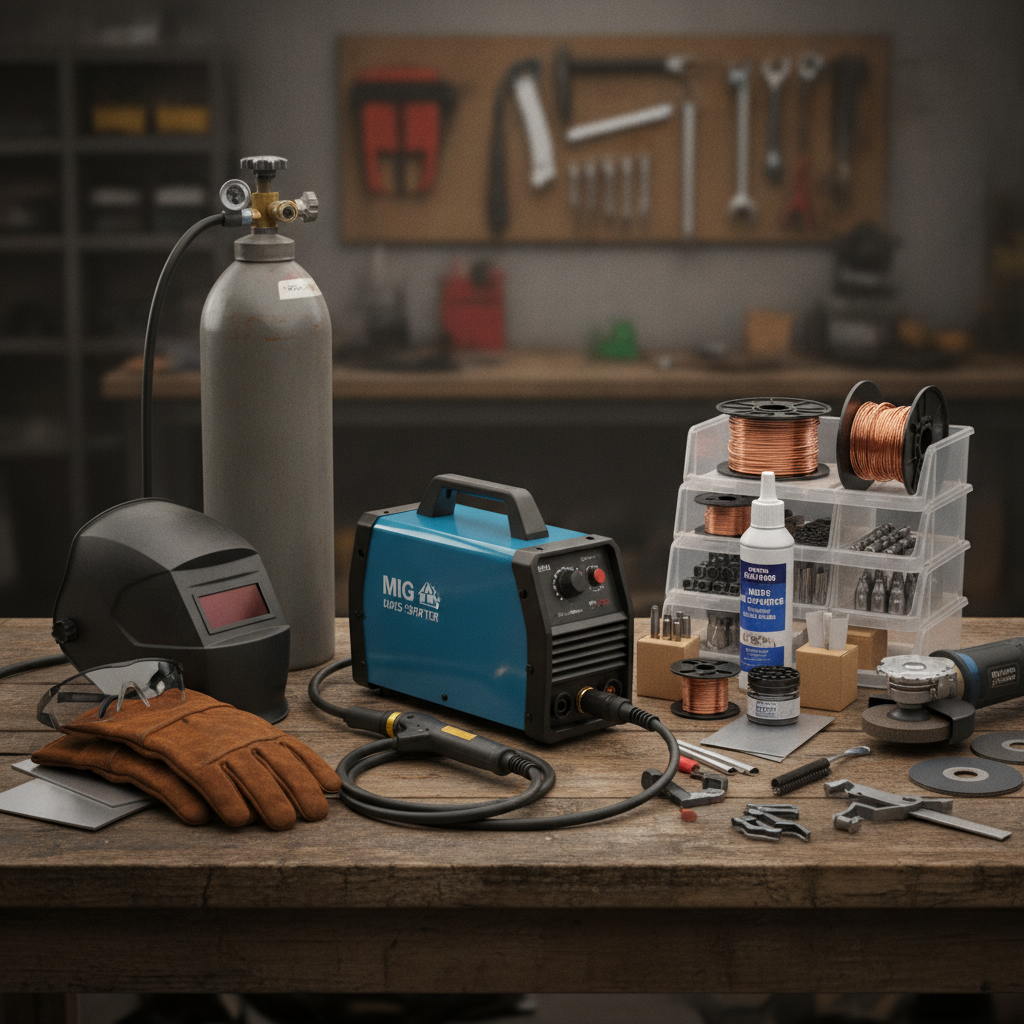
Dialing in the welder correctly is non-negotiable on thin sheet metal. A setting that works fine on 1/8″ steel will burn straight through an 18-gauge door skin. Starting point settings for 18–20 gauge mild steel with 0.023″ ER70S-6 wire and C25 gas: | Parameter | Setting | |—|—| | Voltage | 15–17V | | Wire Feed Speed | 150–200 IPM | | Gas Flow Rate | 15–20 CFH | | Wire Diameter | 0.023″ | | Polarity | DCEP (electrode positive) | These are starting points — always run a test bead on a scrap piece of the same gauge before touching the actual panel. On thinner 22-gauge material, drop voltage toward the lower end of the range and reduce wire speed accordingly. The weld pool should move quickly and feel “tight” rather than sluggish.The Stitch Welding Technique
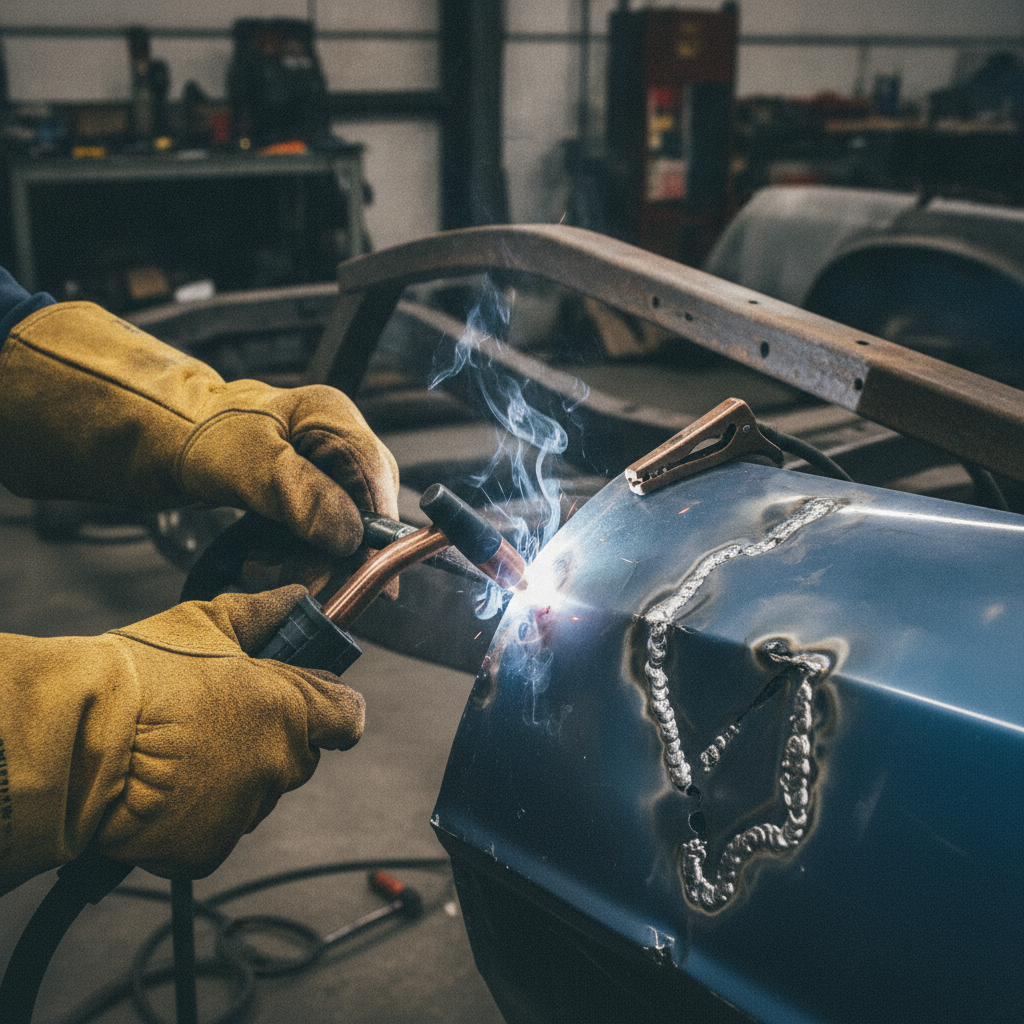
Continuous beads on thin sheet metal cause heat buildup and warping. The professional approach is stitch welding — short tack welds placed in a deliberate sequence to manage heat distribution. How to stitch weld body panels: 1. Start with a series of evenly spaced tack welds — roughly every 2 to 3 inches along the joint. 2. Let the metal cool between tacks. Touch it with an ungloved hand (carefully) — if it’s too hot to hold, it’s too hot to weld again yet. 3. Place additional tacks between the original ones, filling in the gaps gradually. 4. Continue alternating positions — work left, then right, then center — rather than running from one end to the other. 5. Once tacks are 1/2″ to 1″ apart, connect them with short 1/2″ stitch welds, still alternating position. 6. Grind welds flush and check for warping as you go — catching it early is much easier to correct than fixing a fully welded panel. The goal is to never concentrate heat in one spot long enough to cause the metal to move. In practice, this means welding for one or two seconds, stopping, moving to a different area, welding again.Butt Joints vs. Lap Joints on Body Panels
The choice of joint type has real consequences for the finished repair — both in strength and appearance. | Joint Type | Appearance | Strength | Rust Risk | Best Use | |—|—|—|—|—| | Butt joint | Flat, minimal material buildup | Good when done well | Lower (no overlap) | Visible exterior panels | | Lap joint | Raised edge visible | Very strong | Higher (moisture trap) | Hidden structural areas | Butt joints are the preferred method for exterior body panels. They create a flat seam that’s easier to finish, and they don’t trap moisture between layers. The tradeoff is they’re harder to weld correctly because fit-up must be near-perfect. Lap joints are faster and more forgiving of imperfect cuts, but the overlapping edge creates a moisture trap that can cause premature rust. They’re acceptable on inner structures, floors, or areas that will be fully sealed afterward. For most visible panel repairs — door skins, quarter panels, fender patches — butt joints with careful fit-up are the right choice.Common Problems and How to Fix Them
Burn-through holes: Lower voltage, reduce wire feed, use a copper backing bar behind the joint to absorb heat. Work in even shorter bursts. Warping and distortion: Almost always caused by too much heat concentrated in one area. Stitch welding with adequate cooling time between passes is the prevention. Minor warping can sometimes be tapped back into position using a body hammer and dolly. Severe warping in an already-welded panel is very difficult to correct. Porosity (small holes or pits in the weld): Usually caused by contaminated base metal, insufficient gas coverage, or a gas flow rate that’s too low. Check that your metal is clean, your gas line has no leaks, and flow rate is set correctly. Cold welds (weld sits on surface, poor fusion): Voltage too low, wire speed too high, or travel speed too fast. The weld pool needs to be visibly penetrating the base metal, not just sitting on top of it. Spatter: Often caused by voltage being too low relative to wire speed, or using CO2-heavy gas. Adjust the ratio — slightly increasing voltage or reducing wire speed helps. Anti-spatter spray on surrounding metal saves cleanup time. Welding automotive sheet metal shares many of these challenges — for a broader look at welding automotive sheet metal techniques, including preparation and joint selection, that’s worth reading alongside this guide.Finishing the Weld
A welded body panel isn’t done when the arc stops. Finishing correctly determines whether the repair is invisible or obvious under paint. 1. Grind the weld flush using a flap disc (80-grit works well) on an angle grinder. Don’t grind aggressively — you’re removing the crown of the weld, not digging into the base metal. 2. Check for pinholes or voids. Small pinholes are common and need to be filled with another quick tack before grinding again. 3. Apply body filler sparingly over the finished and primed weld area. Good welding technique and careful grinding minimize how much filler you need. 4. Prime and seal all bare metal immediately. Bare steel starts flashing rust quickly, especially in humid environments.FAQ
What wire size is best for welding car body panels? 0.023″ ER70S-6 solid wire is the most commonly recommended choice for automotive body panels. It runs at lower heat than 0.030″ wire, which reduces the risk of burn-through on 18–22 gauge steel. Some experienced welders use 0.024″ with similar results. Avoid flux-core wire on exterior body panels — it runs hotter and leaves slag that’s harder to finish cleanly. Can I MIG weld body panels without shielding gas? Technically you can use flux-core wire without external gas, but it’s not recommended for exterior body panels. Flux-core runs hotter, produces more spatter, and leaves a slag layer that complicates finishing. The weld quality and appearance are noticeably inferior compared to solid wire with C25 gas. For structural repairs hidden inside a car, flux-core is more acceptable, but for visible panels, gas-shielded solid wire is the right approach. You can read more about welding body panels using flux-core wire if you’re working without a gas cylinder. Why does my MIG weld keep burning through thin body panel metal? The most common causes are voltage too high, wire feed speed too low relative to voltage, pausing too long on the trigger, or insufficient cooling time between stitches. Start lower than you think you need, run test beads on matching scrap, and keep each weld burst under two seconds. A copper backing bar behind the joint also helps absorb heat and bridge small gaps without melting through. Do I need to use weld-through primer before closing a panel seam? Yes — any surface that will be sandwiched and inaccessible after welding should be coated with weld-through primer (zinc-based) before final assembly. This prevents rust from forming inside closed seams. You don’t apply it directly in the weld path, but cover the surrounding area that won’t be exposed after the repair is complete. How do I prevent warping when welding a large patch panel? Use the stitch welding method, alternating weld position across the entire joint rather than running from one end to the other. Allow the panel to cool between every 2–3 tacks. Clamp the panel firmly to hold it in position during welding. If the panel starts to pull, you can sometimes use a body hammer or heat-and-cool cycles to relax the distortion before it becomes permanent. What’s the best MIG welder for home garage body panel work? For a home garage, a 140-amp class MIG welder with true voltage adjustment (not just a coarse step switch) handles most body panel repairs well. If you’re looking for specific options, the best MIG welders for auto body repair covers several machines suited to sheet metal work at different price points. Can I MIG weld body panels with a 110V welder? Yes. Most automotive body panel work doesn’t require a 220V machine. A 110V welder running 0.023″ wire at low voltage settings is well-matched to 18–22 gauge steel. The Miller Multimatic 215 and similar machines offer 110/220V flexibility, but a capable 110V-only unit handles panel patches and floor repairs without issue.MIG welding car body panels is a skill that rewards patience over speed. Getting the fit-up tight, keeping heat low and distributed, and working in short bursts will produce clean, flat welds that finish well and hold up for years. The technique gap between a warped, burn-through-riddled patch and a smooth, solid repair almost always comes down to heat management — not the welder or the wire.