You’re at the welding supply store, you already have a tank of pure argon for TIG work, and you’re wondering if you can just hook it up to your MIG welder and skip buying a separate gas mix. It seems logical enough.
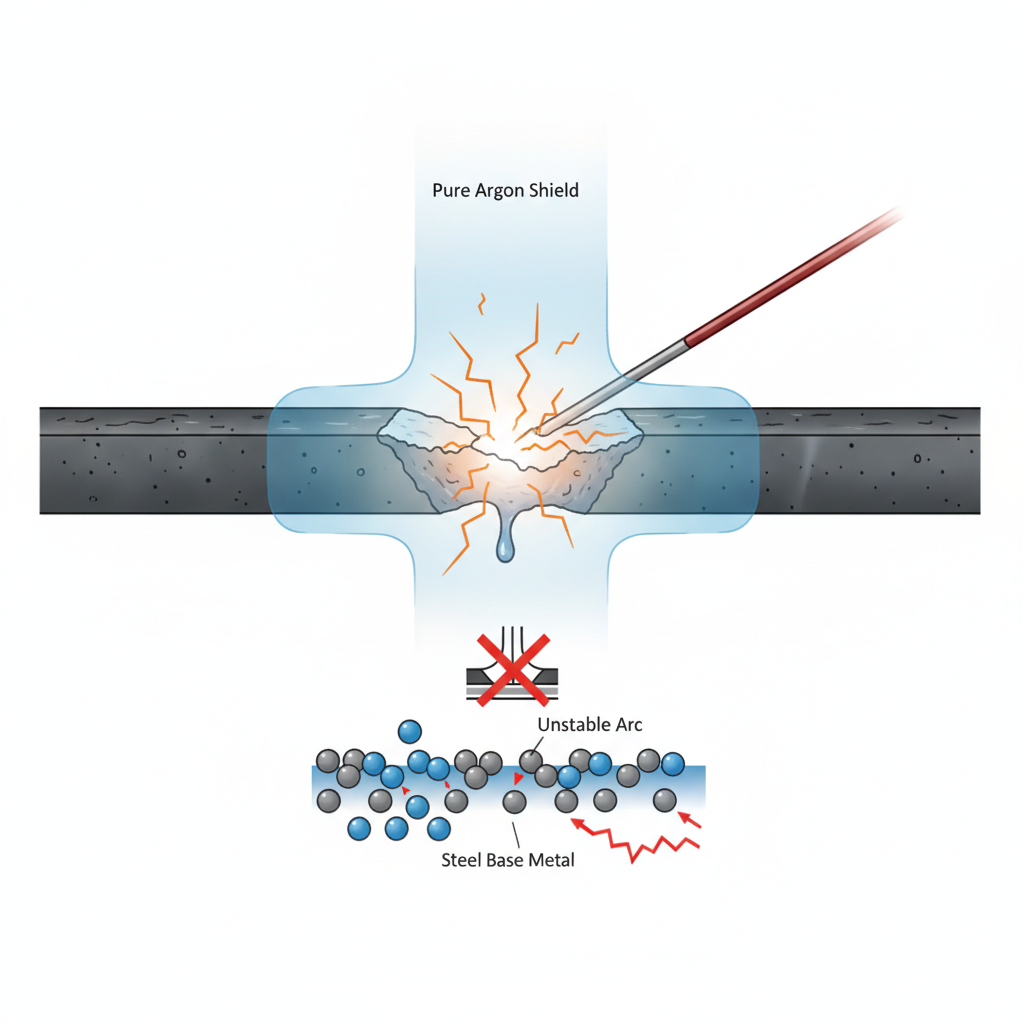
Using 100% argon for MIG welding is possible but not recommended for most steel applications. Pure argon causes an unstable arc, poor fusion, and excessive spatter when welding mild steel or stainless. It works well only for MIG welding aluminum, where 100% argon is actually the correct and preferred shielding gas choice.
Why Pure Argon Struggles on Steel
The issue comes down to how argon behaves during the arc transfer process.
Argon is a noble gas with low thermal conductivity. On steel, this creates a narrow, constricted arc that concentrates heat in a small pinpoint rather than spreading it across the weld puddle. The result is a bead that sits high and narrow with poor sidewall fusion — even if it looks okay on the surface.
The arc itself becomes erratic. Without any reactive gas component, metal transfer through the arc becomes irregular, producing more spatter and a rougher appearance than you’d get with a proper shielding gas blend.
In practice, welders who try pure argon on mild steel often describe the arc as “jumpy” or difficult to control, even at settings that normally work well.
Where 100% Argon Actually Belongs: Aluminum MIG Welding
Aluminum is the one MIG application where pure argon is not just acceptable — it’s the standard recommendation.
Aluminum oxide has a much higher melting point than the base metal itself, and the welding process relies on the arc’s cleaning action to break through that oxide layer. Argon provides the right arc characteristics for this, delivering the smooth, stable transfer needed when running aluminum wire through a spool gun or push-pull setup.
If you’re MIG welding aluminum with a spool gun, 100% argon at the correct flow rate is exactly what you want. Adding CO₂ to the mix for aluminum would cause severe porosity and burn damage to the weld.
The Right Gas for MIG Welding Steel
For mild steel, the industry standard is a blend of 75% argon and 25% CO₂, commonly called C25. This combination gives you:
– A stable, smooth arc
– Good penetration and fusion
– Minimal spatter compared to straight CO₂
– A cleaner bead appearance
The CO₂ component adds the reactive element that helps the arc spread properly across the weld zone, improving fusion and making the puddle more controllable.
Some welders also use straight CO₂ for mild steel, which produces deeper penetration and more spatter — acceptable for structural or outdoor work but messier than C25. For a more detailed breakdown, the best gas for MIG welding mild steel depends on your specific application and finish requirements.
Gas Comparison: 100% Argon vs. Common MIG Shielding Gases
| Gas | Steel MIG | Aluminum MIG | Arc Stability | Spatter | Penetration |
|—|—|—|—|—|—|
| 100% Argon | Poor | Excellent | Unstable on steel | High on steel | Narrow, poor fusion |
| 75% Ar / 25% CO₂ (C25) | Excellent | Not suitable | Very stable | Low | Good, balanced |
| 100% CO₂ | Acceptable | Not suitable | Moderate | High | Deep |
| 98% Ar / 2% CO₂ | Good for stainless | Not suitable | Stable | Low | Moderate |
What Happens If You Try It Anyway
If you do run 100% argon on steel out of necessity or curiosity, here’s what to expect:
– Arc instability: The arc will feel inconsistent and harder to control, especially at lower amperages.
– High bead profile: The weld bead will be narrow and raised rather than flat and properly fused.
– Poor sidewall fusion: The weld may look like it adhered but lack proper penetration into the base metal.
– Excessive spatter: More cleanup time, more wire wasted.
– Possible cold laps: Areas where the weld appears to connect but hasn’t actually fused — a structural concern.
Short tacks or emergency repairs might get by, but anything structural or requiring reliable penetration should not be welded with pure argon on steel.
Stainless Steel: Close, But Not Pure Argon
For MIG welding stainless steel, you also don’t use 100% argon. The standard is a tri-mix gas — typically 90% helium, 7.5% argon, and 2.5% CO₂ — or a simpler blend of 98% argon with 2% CO₂.
The small reactive component helps stabilize the arc and improve wetting without introducing enough oxidation to compromise corrosion resistance. If you’re dialing in your MIG welding stainless steel settings, confirming your shielding gas blend is just as important as setting voltage and wire speed.
Can You Mix Argon and CO₂ Yourself?
Some welders ask about manually blending gases to avoid buying premixed cylinders. In practice, this is not a practical DIY option. Gas blending requires precise equipment to achieve consistent ratios, and an improper blend will give inconsistent results weld to weld.
Premixed C25 cylinders are widely available and cost-effective. If you’re managing your shielding gas usage carefully, understanding how to calculate argon gas consumption for welding can help you avoid running out mid-project.
For a complete reference on which gas suits which process and material, the MIG welding gas chart covers the full range of common applications in one place.
FAQ
Can I use my TIG argon tank for MIG welding aluminum?
Yes. If your tank contains 100% argon and is the correct fitting type, you can use it for both TIG and aluminum MIG welding. The gas itself is identical — pure argon is pure argon regardless of the process it’s used for. Just verify your regulator and hose connections are compatible with your MIG setup before switching.
Will 100% argon ruin my MIG welder if I use it on steel?
It won’t damage the machine itself, but it will produce poor weld quality. The welder will run, but the arc characteristics on steel will be unstable. You’ll see increased spatter, poor penetration, and a raised bead profile. The welder is fine — the weld quality is the problem.
What’s the minimum CO₂ percentage needed for a stable MIG arc on steel?
Generally, at least 5–8% CO₂ is needed to noticeably improve arc stability on steel compared to straight argon. Most welders use C25 (25% CO₂) as the practical standard because it balances stability, spatter control, and penetration effectively. Some specialty wires are optimized for lower CO₂ percentages, but C25 is the go-to blend.
Does pure argon work for flux-core MIG welding?
Flux-core welding doesn’t require external shielding gas at all for self-shielded wire, since the flux in the wire creates its own protection. For gas-shielded flux-core wire (FCAW-G), the recommended gas is typically 75/25 argon/CO₂ or straight CO₂ — not pure argon. Using 100% argon with gas-shielded flux-core wire would result in similar problems as with solid wire on steel.
Is there any MIG welding wire designed to work with 100% argon on steel?
Some metal-core wires are formulated to run on 100% argon or high-argon blends, typically used in specialized high-deposition industrial applications. These are not standard solid MIG wires. For typical ER70S-6 solid wire — which is what most home and shop welders use — C25 or CO₂ is still the correct choice.
What flow rate should I use with 100% argon for aluminum MIG welding?
For aluminum MIG welding with 100% argon, a flow rate of 20–30 CFH (cubic feet per hour) is typical, though thinner material or indoor conditions may allow the lower end of that range. Outdoor or drafty environments may require slightly higher flow to maintain consistent coverage. Getting the right flow rate for MIG welding matters regardless of which gas you’re using.
Can 100% argon be used for MIG welding copper or other non-ferrous metals?
Pure argon can work for certain non-ferrous metals like copper alloys, though helium blends are often preferred because helium’s higher thermal conductivity improves heat transfer into materials with high thermal conductivity. Argon-helium blends are common for specialized non-ferrous MIG work. For standard shop use, this is rarely a concern.
The Practical Takeaway
Pure argon has one correct MIG welding application: aluminum. For everything else — mild steel, stainless, or flux-core processes — a blend with CO₂ or other reactive gases is needed for a stable arc and proper fusion. If you already have an argon tank for TIG work, it pulls double duty on aluminum MIG jobs without any issue. For steel, buy the right gas blend and save yourself the frustration of chasing a poor arc.