
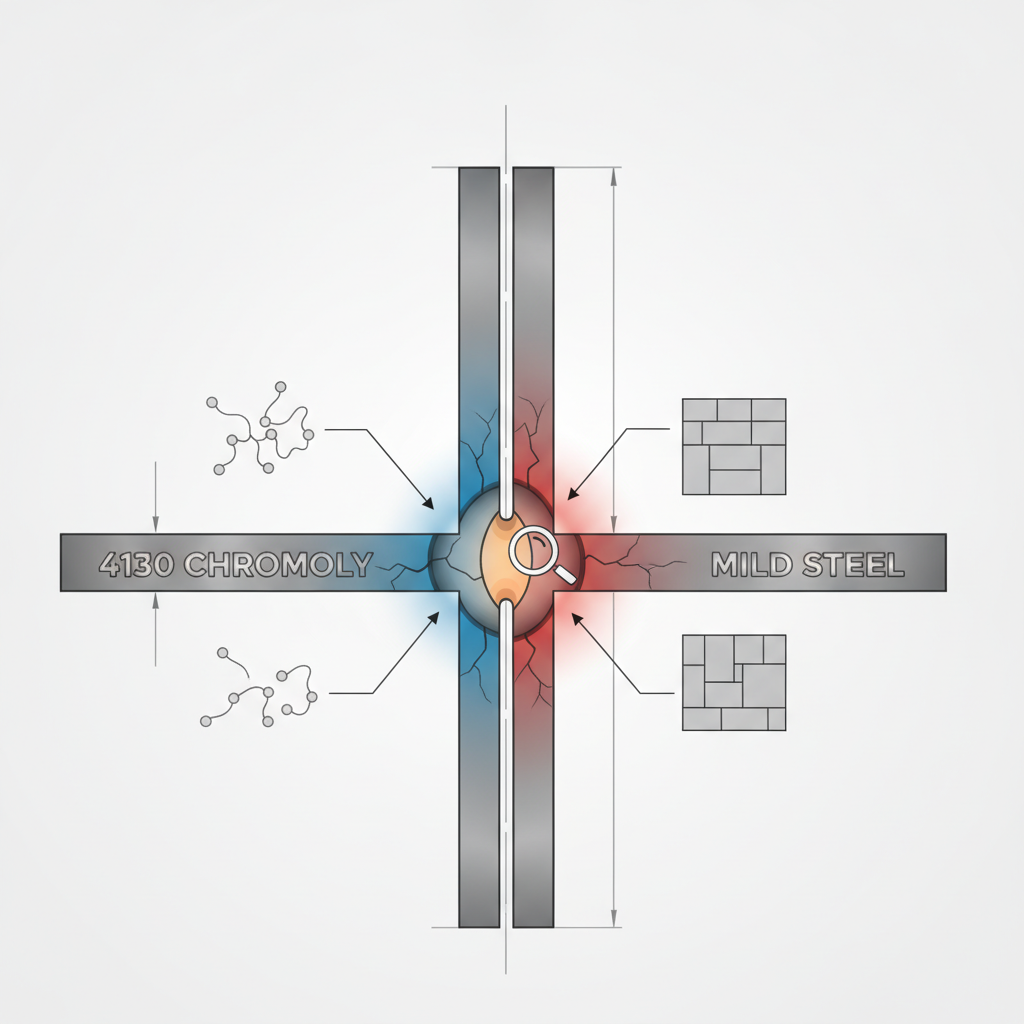
Why 4130 Chromoly Behaves Differently Than Mild Steel
Choosing the Right Wire for MIG Welding 4130
Shielding Gas Selection
For MIG welding 4130, the standard 75% Argon / 25% CO2 (C25) blend used for mild steel works acceptably. It produces good penetration and a stable arc. A better option when weld quality is a priority is 98% Argon / 2% CO2 or 90% Argon / 10% CO2. Higher argon content reduces oxidation, produces a cleaner weld bead, and results in a slightly softer, more ductile HAZ — which is beneficial for chromoly. If you’re already dialing in your shielding gas selection for different materials, it’s worth keeping a higher-argon mix on hand for chromoly work. Pure CO2 is generally not recommended for 4130 because it creates a more oxidizing atmosphere and increases spatter, which doesn’t help when you’re trying to keep heat input controlled.Preheat: When You Actually Need It
For 4130 tubing commonly used in chassis and cage work — typically 0.065 to 0.120 inch wall thickness — preheating is generally not required. The thin sections cool slowly enough on their own, and the low carbon equivalent keeps cracking risk manageable. When preheat becomes important: – Wall thickness over 3/16 inch (4.8mm) – Welding at ambient temperatures below 50°F (10°C) – High-restraint joints where the weld can’t move as it cools – Repair welding on heavily loaded or work-hardened sections If preheat is needed, a temperature of 300–500°F (150–260°C) is the typical range for 4130. A temperature-indicating stick or infrared thermometer works well here. Post-weld stress relief (heating to around 1100°F and slow cooling) is sometimes specified for aircraft or certified structural work, but it’s rarely done in general fabrication shops.Practical MIG Welding Technique for 4130
Getting clean results on chromoly requires a bit more attention to detail than mild steel, but the technique isn’t radically different. Key points to keep in mind: – Keep heat input controlled. Use the lowest voltage and wire speed that still produces full fusion. Excess heat widens the HAZ unnecessarily. – Travel speed matters. Move steadily and avoid dwelling in one spot. A slow, pausing technique dumps more heat into the joint. – Fit-up quality is critical. Gaps force you to slow down and add more heat to fill them. Tight, consistent fit-up keeps heat input low. – Clean the metal thoroughly. Chromoly is sensitive to contamination. Remove mill scale, rust, oil, and paint in the weld zone. An angle grinder or flap disc followed by acetone wipe-down is standard practice. – Let it cool naturally. Don’t quench with water or compressed air. Rapid cooling is exactly what causes the HAZ to harden and become brittle. For thin-wall 4130 tubing, the same burn-through concerns that apply to any thin-gauge steel are present. Controlling your approach to MIG welding thin metal is directly applicable here — short stitch welds, appropriate voltage settings, and avoiding continuous passes on thin sections all help.MIG vs. TIG for 4130: Honest Comparison
This question comes up every time someone starts a chromoly project. | Factor | MIG Welding | TIG Welding | |—|—|—| | Heat input | Higher, less controllable | Lower, precise control | | Speed | Faster | Slower | | Equipment cost | Lower | Higher | | Skill required | Moderate | High | | HAZ width | Wider | Narrower | | Ideal applications | Non-certified fabrication, secondary structures | Roll cages, aircraft, certified structural work | | Post-weld appearance | Acceptable | Excellent | TIG welding 4130 is considered the gold standard for precision work because the lower, more controlled heat input produces a narrower heat-affected zone and less risk of HAZ brittleness. Many sanctioning bodies (like the SFI Foundation for motorsports roll cages) specify TIG welding in their certifications. That said, MIG welding 4130 produces perfectly serviceable welds for brackets, gussets, secondary chassis members, off-road fabrication, and general shop work where certification isn’t required. If you’re building a certified roll cage for a track car, use TIG. If you’re building a utility trailer subframe from 4130 or reinforcing a non-certified project chassis, MIG is a practical choice.Common Mistakes to Avoid
A few errors show up repeatedly when welders first tackle 4130 chromoly. – Using the wrong wire without understanding the trade-offs. ER70S-6 works, but it leaves the weld softer than the base metal. On a joint carrying real load, this creates a weak point. – Ignoring fit-up and then compensating with extra heat. Poor gaps lead to more dwell time, more heat, and a larger HAZ. – Grinding the weld too aggressively afterward. Grinding heats the metal locally and can introduce stress risers. Grind only what’s necessary for fit or inspection. – Welding over contaminated surface. Porosity and inclusions in chromoly welds are harder to tolerate than in mild steel. Clean preparation is non-negotiable. – Skipping preheat on thick sections. On material over 3/16 inch, especially in cold weather, skipping preheat is a genuine cracking risk. If you run into porosity, lack of fusion, or arc instability while MIG welding 4130, many of the same diagnostic steps apply as with other steel types — reviewing your approach to troubleshooting common MIG welding problems is a useful starting point.FAQ
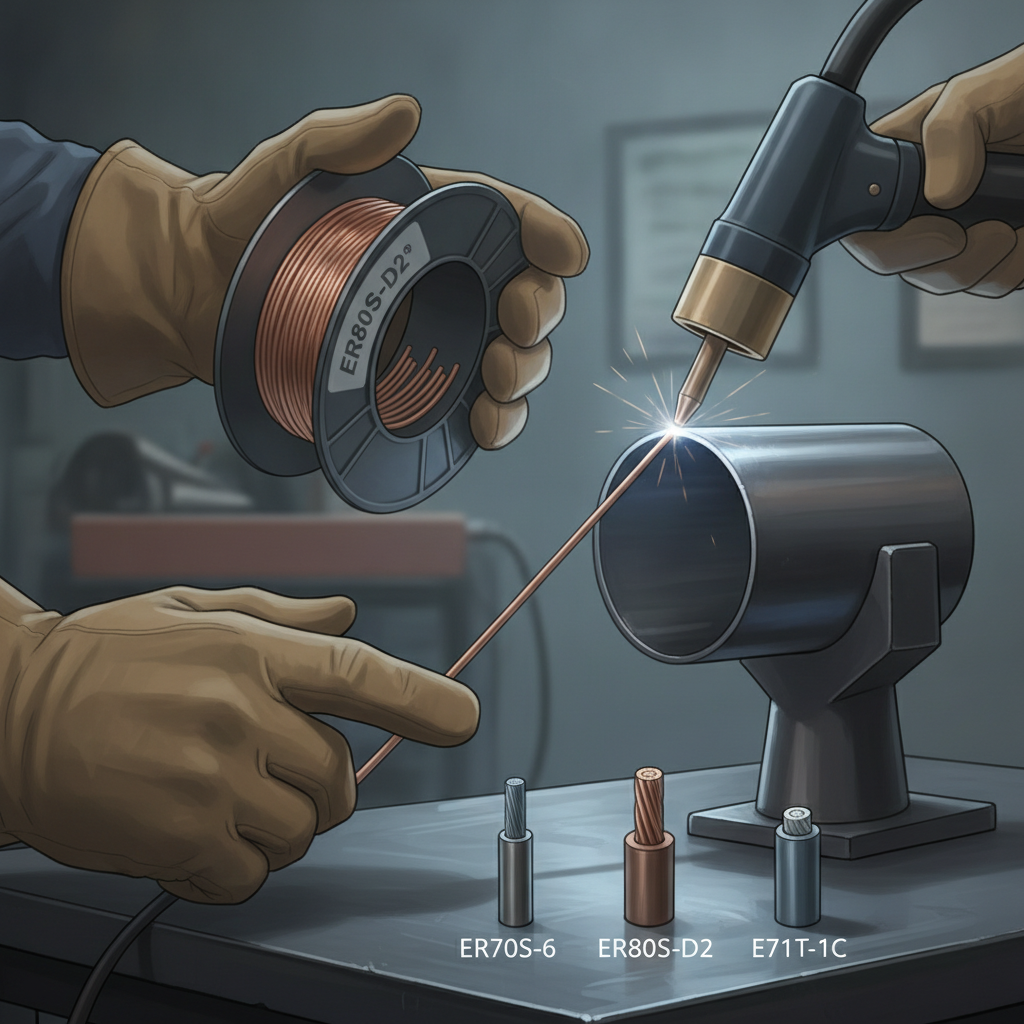
What MIG wire is best for welding 4130 chromoly? ER80S-D2 is a practical and widely available choice for most 4130 applications. It provides better mechanical property matching than ER70S-6 and is easier to source than ER4130 wire. For critical structural work, ER4130 wire offers the closest chemical match to the base metal. ER70S-6 works for thin tubing in non-structural applications but leaves the weld zone softer than the surrounding material. Do I need to preheat 4130 chromoly before MIG welding? For typical thin-wall 4130 tubing under 3/16 inch, preheat is generally not required at normal shop temperatures. Preheat becomes necessary for thicker sections, high-restraint joints, or when welding in cold environments. A preheat temperature of 300–500°F is typically used when required. Always let the weld cool to room temperature naturally — never quench it. Can you MIG weld 4130 chromoly for a roll cage? Technically yes, but many motorsports sanctioning bodies and certification standards require TIG welding for certified roll cages. If your roll cage needs to meet a specific SFI, FIA, or series-specific safety standard, check the rules before committing to MIG welding. For uncertified off-road or recreational builds, MIG welding 4130 is used regularly in the field. Is 4130 chromoly harder to MIG weld than mild steel? It’s not dramatically harder, but it does require more attention to heat input, fit-up quality, and wire selection. The main risk — HAZ brittleness and potential cracking — is manageable with proper technique and appropriate consumables. Welders comfortable with mild steel can weld 4130 successfully with modest adjustments to their approach. What shielding gas works best for MIG welding 4130? A high-argon blend such as 90% Argon / 10% CO2 or 98% Argon / 2% CO2 produces cleaner welds with less oxidation than standard C25 (75/25). The standard 75% Argon / 25% CO2 mix also works and is more readily available, making it acceptable for general shop use. Avoid pure CO2, which increases spatter and produces a more oxidizing weld environment. Does MIG welding 4130 require post-weld heat treatment? For most general fabrication, no. Post-weld stress relief or full heat treatment is typically reserved for aircraft components, certified structural assemblies, or applications governed by specific engineering or regulatory requirements. In typical motorsports and general fabrication work, post-weld heat treatment is not standard practice on MIG-welded 4130 joints. Can you weld 4130 chromoly to mild steel with MIG? Yes. 4130 and mild steel can be joined with MIG welding using ER70S-6 or ER80S-D2 wire. The joint strength will be limited by the weaker of the two base materials (mild steel) and the filler metal. This is a common scenario when attaching 4130 components to a mild steel frame, and it poses no special technical problems beyond standard chromoly precautions.MIG welding 4130 chromoly is genuinely viable when you match your wire selection to the application, manage heat input carefully, and ensure thorough surface preparation. The material’s reputation for being “difficult” is somewhat overstated for thinner sections — most of the real risk comes from using the wrong consumables or ignoring fit-up quality. Reserve TIG for certified structural work, and approach MIG 4130 projects with the same discipline you’d bring to any alloy steel.