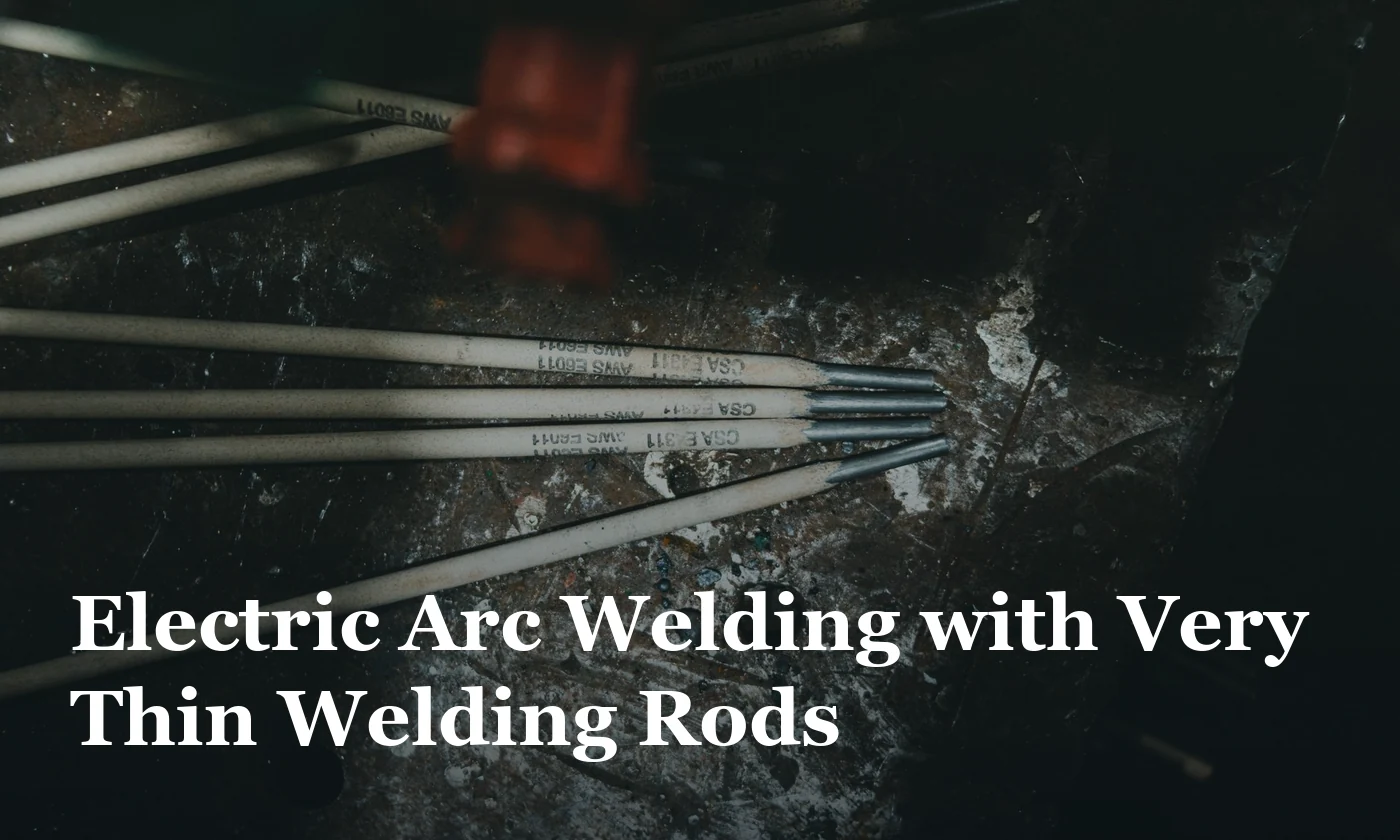
Welding thin metal with a stick welder is one of the more demanding tasks in the shop. The margin between a clean bead and a hole melted straight through the base metal is narrow, and the rod you choose plays a major role in whether that gap works in your favor.
For electric arc welding on thin material, the most commonly used small-diameter rods are 3/32-inch (2.4mm) electrodes such as the E6013 or E6011. These rods operate at lower amperages — typically 45–90A depending on the electrode and material — which reduces heat input and lowers the risk of burn-through. On very thin steel, generally under 3/16 inch, a 3/32-inch rod is usually the practical minimum for stick welding. Material thinner than 1/16 inch is generally better suited to MIG or TIG.
Why Electrode Diameter Affects Heat Control on Thin Metal
The diameter of a welding rod directly determines the minimum amperage needed to sustain a stable arc. A larger rod needs more current to melt properly, and more current means more heat going into the base metal. On thin sheet, that excess heat concentrates fast and burns through before the puddle has time to travel.
Smaller-diameter rods allow the welder to dial amperage down to a range where the arc stays stable without overloading the metal with heat. This is the core reason thin-metal stick welding demands the right rod diameter before anything else.
A common beginner mistake is running a 1/8-inch rod at 90–100A on 14-gauge sheet because that is what was available. The result is predictable: blow-through, warping, and frustration.
Which Rods Are Actually Designed for Thin Metal
Not every electrode classification handles thin material equally. The two most practical options for thin-metal stick welding are:
E6013
- Soft arc, low spatter, easy slag removal
- Works well on thin mild steel and light fabrication
- Suited to AC or DC power sources
- Best for flat and horizontal positions on thinner gauges
- Easier for beginners to control on thinner material
- Typically run at 45–75A for 3/32-inch diameter
E6011
- More penetrating arc than E6013
- Works on AC or DC, handles light rust and mill scale better
- More versatile across positions
- Requires slightly more operator control
- Also available in 3/32-inch diameter at similar amperages
For most thin mild steel work, a 3/32-inch E6013 is the starting recommendation. If the surface is slightly contaminated or the joint requires better penetration into a fitment gap, the E6011 may produce more reliable fusion. You can read more about how different types of welding rods compare in terms of classification, coating, and application.
Amperage Starting Ranges for Small-Diameter Electrodes
These are approximate starting values for common small-diameter rods on mild steel. Actual settings depend on your machine, base-metal thickness, joint type, and welding position.
| Electrode | Diameter | Approximate Amperage Range | Polarity |
|---|---|---|---|
| E6013 | 3/32 in (2.4mm) | 45–75A | AC, DCEP, or DCEN |
| E6011 | 3/32 in (2.4mm) | 50–80A | AC or DCEP |
| E6013 | 1/8 in (3.2mm) | 75–110A | AC, DCEP, or DCEN |
| E6011 | 1/8 in (3.2mm) | 75–110A | AC or DCEP |
| E7018 | 3/32 in (2.4mm) | 65–85A | DCEP |
Always treat these as starting points. Check the electrode manufacturer’s data sheet and your machine’s recommended settings chart. For a more detailed breakdown of how rod size relates to amperage, welding rod size and amperage charts can help you match the right variables before you strike an arc.
Preparing Thin Metal Before You Strike an Arc
Fit-up matters more on thin material than on heavier stock. A gap that would be manageable on 1/4-inch plate becomes a guaranteed blow-through on 18-gauge sheet.
Before welding:
- Remove mill scale, rust, paint, and coatings from the weld zone and at least one inch back on each side
- Ensure tight, consistent fit-up with minimal gaps — even a 1/16-inch gap can cause problems at low amperages
- Clamp or tack securely to control distortion during welding
- Check that your work clamp makes solid electrical contact close to the weld area
Contaminated surfaces cause porosity and erratic arcs even when settings are correct. Clean metal is a non-negotiable starting point regardless of electrode choice. If you are working with coated metal such as galvanized steel, the coating must be removed before welding, both for weld quality and to avoid producing toxic fumes.
Technique Adjustments That Make a Measurable Difference
With a small-diameter rod on thin metal, technique has to work alongside the low amperage setting rather than fight it.
Arc length: Keep it as short as practical without stubbing the rod into the puddle. A long arc on thin metal spreads heat unnecessarily and creates more spatter.
Travel speed: Move faster than you would on heavier plate. A slower travel speed lets heat build up in one area and increases the chance of burn-through.
Work and travel angles: A slight drag angle — typically 5–15 degrees in the direction of travel — is standard for most stick electrodes. Avoid steep angles that push the arc into the base metal with more force.
Stringer beads over weaving: On thin metal, tight stringer beads concentrate less total heat than wide weave patterns. Keep the bead narrow and let the metal cool between passes if multiple passes are needed.
Short intermittent welds (stitch welding) are often more practical on thin sheet than attempting a continuous run. Weld a short segment, move ahead, and alternate sides on longer joints to distribute heat and reduce warping. Welding thin metal with an arc welder involves more than just turning the amperage down — technique and sequencing matter just as much.
Common Defects When Stick Welding Thin Material
| Defect | Likely Cause | Practical Fix |
|---|---|---|
| Burn-through | Amperage too high, travel too slow, poor fit-up | Lower amps, increase travel speed, close the gap |
| Porosity | Contamination, arc too long, damp electrodes | Clean metal, shorten arc, use dry electrodes |
| Rod sticking | Amperage too low, rod touching puddle | Raise amps slightly, maintain consistent arc length |
| Undercut | Arc too long, amperage too high, steep angle | Reduce amps, shorten arc, adjust travel angle |
| Warping | Excessive heat input, no tack sequence | Stitch weld, alternate sides, use more tacks |
When the rod keeps freezing to the base metal, the usual cause is amperage set too low for the rod diameter — not necessarily the rod itself. Before changing your technique, confirm the machine is actually delivering the set amperage and that your connections are clean. If rod sticking is a recurring problem, understanding why welding rods stick can help you isolate whether the issue is amperage, polarity, or operator technique.
Safety When Arc Welding Thin Metal
Thin metal doesn’t require different PPE than any other stick welding work, but the conditions it creates — shorter passes, more frequent stops, repositioning — can sometimes lead to rushing and shortcuts.
Before welding:
- Wear a welding helmet with a lens shade appropriate for the amperage being used — typically shade 9–11 for stick welding at the low amperages used on thin material
- Wear flame-resistant clothing, welding gloves, and appropriate footwear
- Ensure adequate ventilation; fumes from coated, galvanized, or painted metal are a serious hazard
- Clear combustible materials from the work area
- Inspect cables, electrode holder, and connections for damage before each session
- Never weld near flammable liquids, fuel lines, or pressurized containers
Thin metal heats up fast and stays hot longer than it might appear. Allow adequate cooling time before handling the workpiece without gloves.
When Stick Welding Is the Wrong Tool for the Job
Stick welding has a practical lower limit on thin material. Below approximately 16–18 gauge (about 1/16–1/20 inch), maintaining arc stability and avoiding burn-through becomes very difficult even with the smallest available electrodes and the lowest practical amperages.
At that thickness range, MIG welding with 0.023-inch or 0.025-inch wire typically provides better results with far more heat control. TIG welding gives the most precise control of all but requires more operator skill. For a direct comparison of how these processes differ in practice, the breakdown of MIG vs TIG welding covers the relevant differences in control, setup, and application.
Stick welding on thin metal is workable within its practical range, but knowing where that range ends is part of getting consistently good results.
Frequently Asked Questions
What is the thinnest metal you can stick weld without burning through?
Most experienced welders treat approximately 3/16 inch as a comfortable lower limit for stick welding, though 1/8 inch is achievable with a 3/32-inch E6013 and carefully controlled amperage and technique. Below that, the risk of burn-through increases significantly. Material thinner than 1/16 inch is generally not recommended for stick welding regardless of rod size, as sustaining a stable arc without damaging the base metal becomes impractical.
What amperage should I use for a 3/32-inch welding rod on thin steel?
A 3/32-inch E6013 on thin mild steel typically starts in the range of 45–70A, depending on the specific machine, joint type, and position. For a 3/32-inch E6011, a starting range of 50–75A is more common. Treat these as initial settings and adjust based on arc stability, bead appearance, and whether you are experiencing burn-through or rod sticking. Always cross-reference with the electrode manufacturer’s data sheet.
Can I use an E7018 rod for thin metal stick welding?
The E7018 is a low-hydrogen, DCEP electrode with a more penetrating arc than the E6013. It is available in 3/32-inch diameter, but it generally requires slightly higher minimum amperages to run cleanly, and it demands dry storage conditions. On thin material, the E6013 is typically more forgiving and easier to control. The E7018 makes more sense for strength-critical welds on medium or heavier plate rather than thin-metal general work.
Why does my rod keep sticking when I try to weld thin metal?
Rod sticking when attempting low-amperage welding on thin metal is almost always a sign that the amperage is set too low for the electrode diameter. The arc extinguishes before it can stabilize, and the rod fuses to the base metal. Try raising amperage in small increments — about 5A at a time — until the arc starts cleanly and runs without freezing. Also check that the work clamp connection is solid, as poor grounding can produce the same symptom.
Is the E6013 better than the E6011 for thin metal?
For most thin-metal stick welding on clean mild steel in flat or horizontal positions, the E6013 is generally easier to control. Its softer arc, lower penetration, and easy slag removal make it more forgiving on thin material. The E6011 has a more forceful arc and better penetration, which is useful when the surface has rust, mill scale, or a tight fitment gap, but it requires more technique to avoid burn-through on light gauges.
Does stick welding on thin metal require special electrodes, or will any rod work?
Not every rod is suitable for thin material. Larger-diameter electrodes like 5/32-inch or 3/16-inch rods require amperages that are too high for thin sheet. The practical choices for thin mild steel are 3/32-inch E6013 or E6011. Specialty electrodes exist for specific thin-metal applications, but for general shop work, a quality 3/32-inch E6013 covers most situations within the practical limits of the stick welding process.
Can I weld thin sheet metal with a basic inverter stick welder?
Modern inverter stick welders handle low-amperage work considerably better than older transformer-style machines. Machines with a rated output that extends down to 20–30A and an arc-force or anti-stick feature can maintain a more stable arc at the low settings needed for thin material. That said, even the best machine cannot fully compensate for using the wrong rod diameter or poor fit-up. The combination of the right electrode, clean metal, tight fit-up, and correct technique matters more than the machine brand.
Getting the Most From Small-Diameter Rods
The biggest variable when stick welding thin material is heat management, and heat management starts with electrode selection before the arc is even struck. A 3/32-inch E6013 run at conservative amperage with a tight arc and brisk travel speed gives you the best conditions the process can offer on thin steel. Beyond the right rod and settings, fit-up quality and welding sequence — short staggered passes rather than one continuous run — do more to prevent burn-through and warping than any single amperage adjustment. When the material falls below the practical range of stick welding, switching processes is not a failure; it is the correct decision.