
How Each Process Actually Works
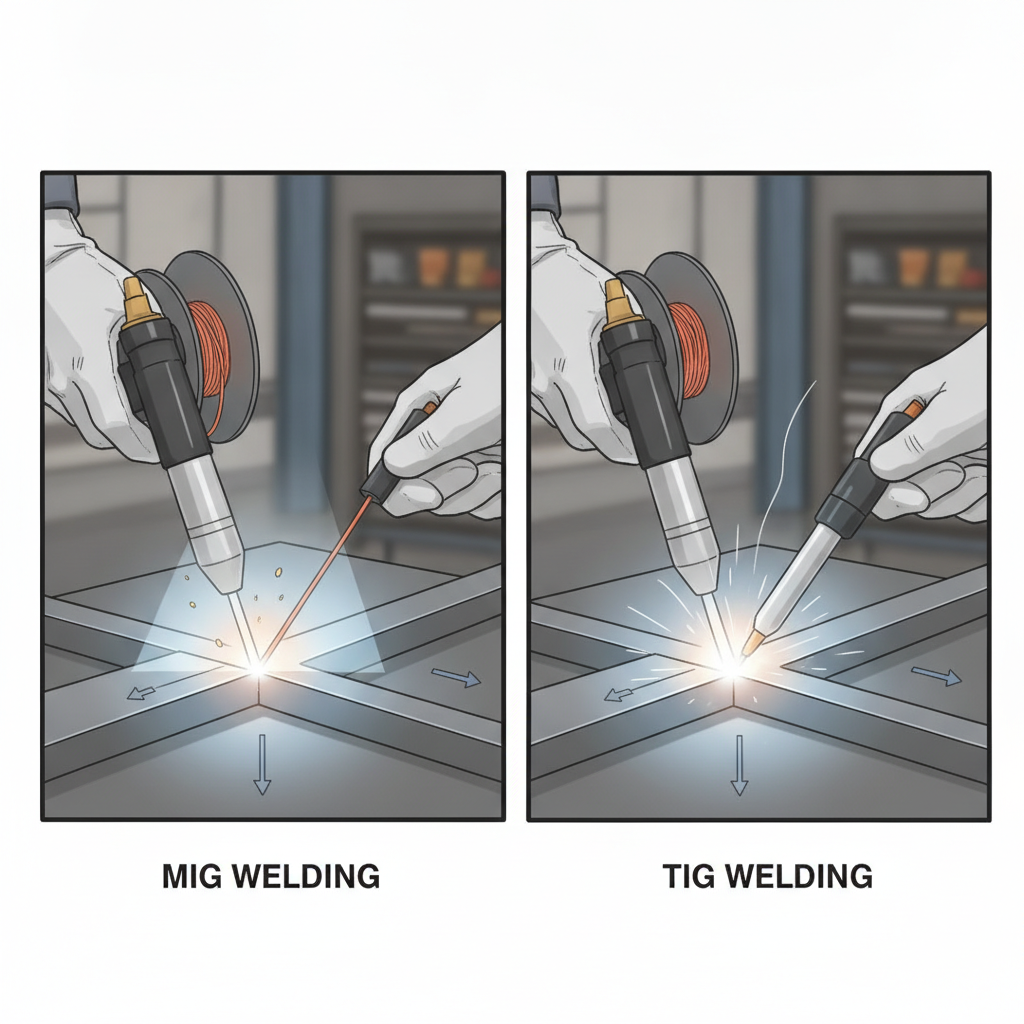
Side-by-Side Comparison
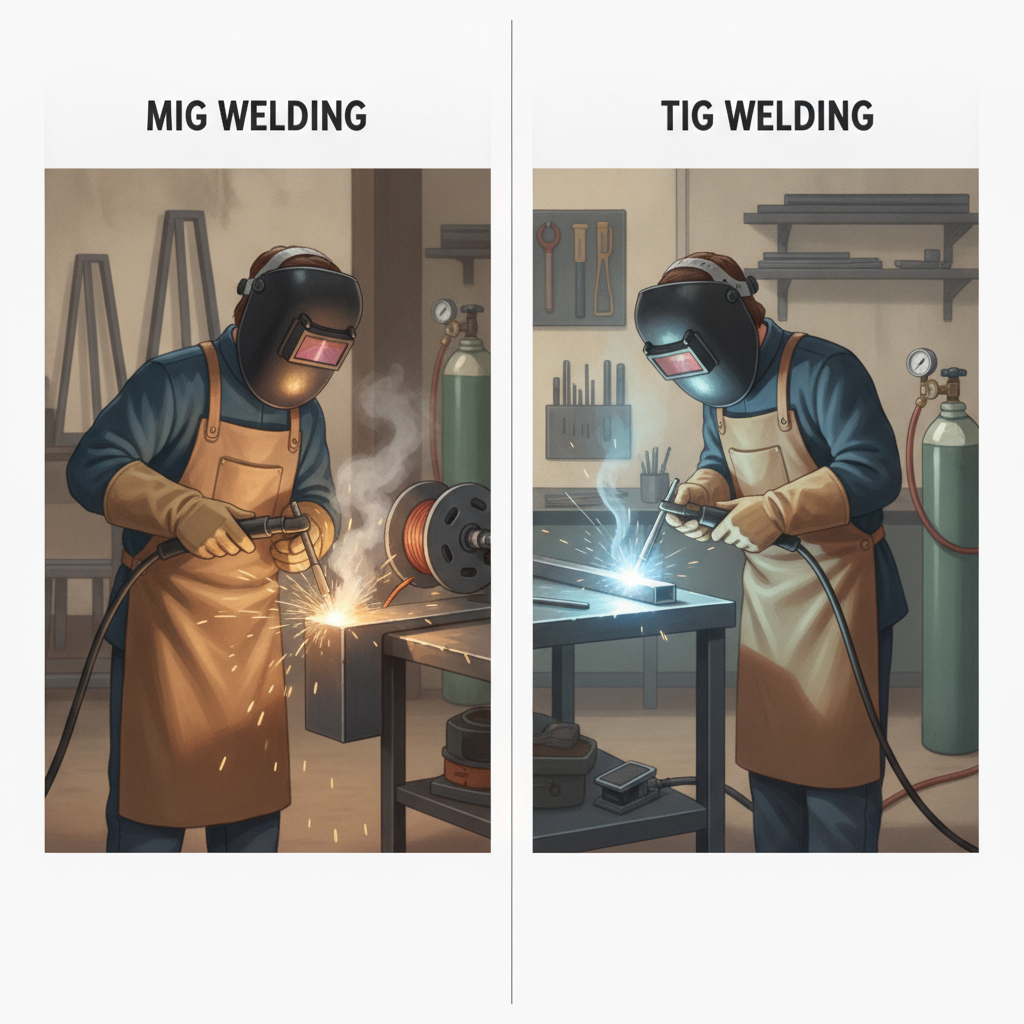
Weld Quality and Appearance
TIG welds are generally cleaner and more visually consistent. The manual control over heat and filler deposition means less spatter, more precise bead profiles, and better fusion on thin sections. Stack-of-dimes is a term often used to describe a good TIG bead, and it’s a fair description. MIG welds are fully capable of being strong and reliable, but they typically show more spatter and less bead uniformity — especially at higher wire speeds. For structural work, painted surfaces, or repairs where aesthetics aren’t critical, this isn’t a problem. For visible stainless, aluminum trim, or artistic metalwork, TIG is almost always preferred.Which Materials Each Process Handles Best
MIG welding works well on mild steel, stainless steel, and aluminum, though aluminum MIG requires a spool gun in most setups. It handles thicker material (3mm and above) efficiently and is widely used for structural steel, automotive body panels, and general shop fabrication. TIG welding handles a much wider range of materials cleanly — mild steel, stainless, aluminum, copper, titanium, and exotic alloys. It excels on thin-gauge material where burn-through is a risk. For example, welding 1.5mm stainless tubing for an exhaust system is far more controllable with TIG than MIG. If you’re curious how this plays out in practice, welding exhaust systems with TIG vs MIG covers the real-world trade-offs for that specific application.Speed and Productivity
MIG is significantly faster. The automatic wire feed eliminates the stop-start rhythm of manual rod feeding, and travel speeds are higher. In production environments — automotive manufacturing, structural steel shops, and light fabrication — MIG is the default process for this reason. TIG is slower by design. Feeding filler manually, managing amperage with a foot pedal, and maintaining precise torch angle all reduce travel speed. A TIG welder might lay down a fraction of the weld length per hour compared to MIG on the same joint. For most DIY or small-shop work, speed rarely matters enough to override quality considerations. But in a production context, TIG on thick structural joints is rarely practical.Equipment and Setup Differences
A basic MIG setup includes the welder, wire spool, gun, and a cylinder of shielding gas. Entry-level machines like the Lincoln Electric Weld-Pak 140 HD handle most light fabrication and repair work without complex settings. Choosing the right MIG shielding gas is one of the most important early decisions — the wrong mix can cause porosity, poor fusion, or excessive spatter. TIG setups are more involved. You need a TIG-capable machine (usually with AC/DC output for aluminum), a TIG torch, a foot pedal amperage controller, tungsten electrodes, and filler rods specific to the base metal. The Miller Diversion 180 is a commonly referenced beginner-to-intermediate TIG machine that handles both AC aluminum and DC steel work. Gas selection for TIG is simpler — TIG welding gas selection almost always defaults to 100% argon.Common Beginner Mistakes with Each Process
With MIG: – Incorrect wire feed speed causes either stubbing (too slow) or excessive spatter (too fast) – Wrong polarity leads to poor fusion or arc instability — MIG welding polarity is worth understanding early – Holding the gun too far from the workpiece increases contact tip wear and reduces shielding effectiveness – Skipping surface prep — mill scale, rust, and paint cause porosity and poor fusion With TIG: – Contaminating the tungsten by dipping it into the weld pool — this ruins the arc immediately – Inconsistent filler rod angle causes cold laps and inconsistent bead width – Rushing amperage buildup on thin material leads to burn-through – Forgetting to purge back-purge sensitive materials like stainless or titaniumWhen to Choose MIG Over TIG (and Vice Versa)
Choose MIG when: – Welding mild steel, general fabrication, or repairs – Working on thicker material (3mm+) – Speed and efficiency matter more than aesthetics – You’re a beginner building fundamental skills first – Budget is a primary concern Choose TIG when: – Welding thin or exotic materials (stainless, aluminum, titanium) – The finished weld will be visible and appearance matters – Precision control over heat input is critical – Working on pipe, pressure vessels, or structural aerospace components – You’re welding a wide range of materials with one setup In practice, many experienced welders own both. MIG handles the bulk of production or repair work; TIG comes out for jobs that demand clean results or involve challenging materials.FAQ
Can you TIG weld without filler rod? Yes — autogenous TIG welding uses no filler and fuses the base material directly. It works on thin-gauge material where the joint fit-up is tight enough to allow fusion without additional material. Sheet metal edge joints and flange welds are common examples. However, most TIG applications do use filler for proper joint strength and bead profile. Is MIG or TIG welding stronger? Weld strength depends more on technique, preparation, and material compatibility than the process itself. A properly executed MIG weld on mild steel is fully as strong as an equivalent TIG weld. TIG offers more control over fusion quality, which can matter on critical joints — but a well-set MIG weld is not inherently weaker. Bad technique in either process produces weak welds. Can a beginner learn TIG welding without knowing MIG first? Technically yes, but it’s harder. MIG builds fundamental awareness of arc length, travel speed, and weld pool behavior. Starting with TIG as an absolute beginner usually means managing too many variables at once before developing basic instincts. Most instructors recommend MIG first — then TIG once you understand how a weld pool behaves. Do MIG and TIG use the same shielding gas? Not typically. MIG commonly uses a 75% argon / 25% CO₂ blend for mild steel, while TIG almost exclusively uses 100% argon. Using CO₂-heavy mixes with TIG produces arc instability and contaminated welds. The shielding gas requirements for each process are different enough that they generally can’t be swapped without affecting weld quality. What metals can you NOT weld with MIG? MIG struggles with very thin materials (under 1mm) where burn-through is difficult to control, and it’s rarely used on exotic alloys like titanium or magnesium where contamination risk is high. It also isn’t practical for cast iron, which requires specific preheat and rod-based processes. TIG handles most of these materials more effectively. Which process produces less fume and is safer overall? Both processes produce welding fumes that require ventilation and respiratory protection. MIG tends to generate more spatter and fume volume because of higher wire feed rates and arc intensity. TIG produces less smoke overall due to lower heat input and no flux. That said, MIG welding safety risks are well understood and manageable with proper PPE and ventilation in both cases. Is TIG welding more expensive than MIG? Generally yes — on multiple fronts. TIG machines cost more, tungsten electrodes and filler rods add consumable costs, and the slower process increases labor time. Entry-level TIG setups typically cost 30–50% more than equivalent MIG setups. For professional use, the quality and versatility often justify the investment. For occasional home use, MIG is usually more cost-effective.MIG and TIG aren’t competing processes — they solve different problems. MIG gets metal joined quickly and reliably. TIG gives you precision, clean aesthetics, and the ability to work on materials MIG handles poorly. The right choice depends on what you’re building, what it’s made of, and what the finished weld needs to look like.