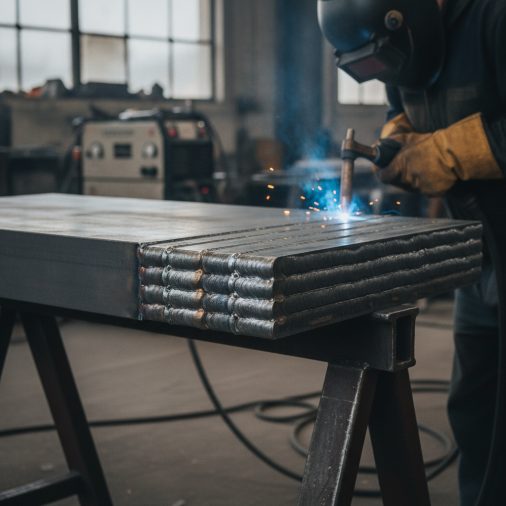
Welding 4-inch thick steel puts you firmly in heavy fabrication territory — the kind of work found in structural steel construction, heavy equipment repair, shipbuilding, and large industrial frames. Getting the amperage right is critical for achieving full fusion at that depth.
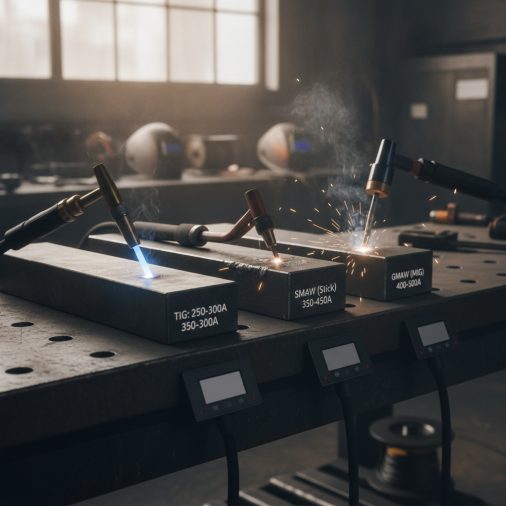
For 4-inch (approximately 100 mm) thick steel, amperage requirements depend heavily on the welding process, joint design, and whether you’re welding the root pass or a fill pass. Stick welding with a large-diameter electrode such as a 5/32-inch or 3/16-inch E7018 typically runs between 160 and 300+ amps per pass. MIG and flux-core processes may run 250–450+ amps for fill and cap passes on this thickness. TIG welding is rarely the primary process at this thickness. Critically, welding 4-inch steel is a multi-pass procedure — no single pass fuses that depth completely, and the total heat input builds cumulatively across dozens of passes.
No Single Pass Welds 4-Inch Steel Through
This is the most important concept to understand before touching the amperage dial. At 4 inches thick, you are not looking at a single-pass weld. Even with the most powerful machines available in production environments, welding steel at this thickness requires a carefully sequenced multi-pass weld procedure.
Each pass typically penetrates somewhere between 3 mm and 8 mm depending on the process, electrode size, and technique. A complete weld on 4-inch steel requires careful joint preparation — usually a groove weld configuration such as a double-V groove or U-groove — followed by a root pass, multiple fill passes, and a cap pass.
The amperage per pass remains within a manageable range. What changes is the number of passes and the cumulative heat input across the entire joint.
Amperage Ranges by Process
The correct amperage depends significantly on which process you’re using. Each process handles thick steel differently.
Stick Welding (SMAW)
Stick welding is one of the most common processes for heavy structural plate. On 4-inch steel, you would typically sequence through passes using electrodes in the 3/32-inch to 3/16-inch diameter range.
Electrode Diameter
Classification
Typical Amperage Range
3/32 inch (2.4 mm)
E7018
70–110 A
1/8 inch (3.2 mm)
E7018
115–165 A
5/32 inch (4.0 mm)
E7018
150–220 A
3/16 inch (4.8 mm)
E7018
200–300 A
For root passes on tight groove joints, smaller electrodes and lower amperage are typically used to maintain control and avoid burn-through of the backing or root face. Fill and cap passes step up to larger electrodes at higher amperage for deposition efficiency.
These are approximate starting ranges. Always check the electrode manufacturer’s data sheet and any applicable welding procedure specification (WPS).
Flux-Core Arc Welding (FCAW)
FCAW is a high-deposition process frequently used for heavy structural steel, including thick plate. Dual-shield flux-core wire — which uses both flux and external shielding gas — delivers strong mechanical properties and excellent deposition rates on heavy sections.
A common wire diameter for thick plate work is 0.045-inch or 1/16-inch (1.6 mm) flux-core wire. At these diameters, operating amperage typically falls in the 200–450 A range depending on wire feed speed, voltage, and the specific wire classification. Lincoln Electric Innershield NR-232 is one widely recognized flux-core wire used in heavy structural applications, though optimal settings vary by machine and position.
Solid-wire MIG welding is less common on 4-inch steel in production environments due to lower deposition rates compared to flux-core, but it is still used in some fabrication shops. With larger wire diameters such as 0.045 inch or 1/16 inch and 75/25 argon/CO₂ or 100% CO₂ shielding gas, operating amperage on fill passes typically ranges from roughly 200 to 400 A.
Short-circuit transfer is not appropriate for this thickness. Spray transfer or pulsed spray transfer provides better fusion and deposition rates on thick plate.
For a broader reference across material thicknesses and processes, a welding amps to metal thickness chart can help illustrate how amperage scales with plate thickness across common processes.
TIG Welding (GTAW)
TIG welding 4-inch steel is not a practical primary process for this thickness. TIG’s deposition rate is far too low for efficient fill on a joint requiring dozens of passes. TIG may be used for the root pass on critical code-quality work where root integrity is essential — particularly in pipe and pressure vessel fabrication — but fill and cap passes are typically handled by SMAW, FCAW, or GMAW.
Joint Design Determines What Your Amperage Actually Has to Do
At 4-inch plate thickness, you cannot simply lay a fillet weld on the surface and call it a weld. The joint must be prepared with a groove that allows the welder to access the full depth in manageable layers.
Common groove configurations for this thickness include:
– Double-V groove — beveled from both sides to reduce the total volume of weld metal needed
– U-groove or J-groove — used when distortion control or deposition volume is a priority
– Single-V groove with backing bar — used when only one-side access is available
Proper joint prep directly affects the amperage you’ll need. A tight root gap with a backing bar may allow a controlled low-amperage root pass, while a wider groove with access from both sides allows higher-amperage fill passes without losing control of the puddle.
For reference on how joint geometry relates to weld size requirements, understanding maximum fillet weld size for plate thickness provides useful context on how plate thickness governs weld sizing decisions.
Preheat and Interpass Temperature Are Not Optional at This Thickness
Amperage selection cannot be separated from preheat and interpass temperature control at 4-inch plate thickness, particularly on carbon steel with higher carbon equivalent values.
Heavy sections retain and distribute heat differently than thin sheet. Without adequate preheat:
– Hydrogen-induced cracking (cold cracking) becomes a significant risk
– Rapid cooling of the root pass increases the likelihood of root cracking
– Fusion quality at the sidewall of the groove deteriorates
AWS D1.1 Structural Welding Code — Steel provides preheat requirements based on base metal classification and thickness. For steel plate 1.5 inches (38 mm) and above, minimum preheat temperatures of 225°F (107°C) or higher are commonly required depending on the steel grade. At 4-inch thickness, preheat and interpass temperature monitoring should be considered mandatory, not optional.
Interpass temperature — the maximum temperature allowed between passes — must also be controlled. Exceeding the interpass limit causes excessive grain growth in the heat-affected zone, which degrades mechanical properties.
Machine and Equipment Capacity for This Work
Running 250–400+ amps continuously across dozens of passes places serious demands on welding equipment. A standard 200-amp hobby or light industrial machine is not suitable for 4-inch plate work.
At minimum, this type of work requires:
– A machine rated for the required amperage (typically 350–600 A range for production FCAW or SMAW work)
– A duty cycle sufficient for extended multi-pass runs — at least 60% at the operating amperage, ideally 100%
– A properly sized power supply — 480V three-phase is typical in heavy fabrication environments
– Appropriate cable sizing, connections, and ground placement
If you are evaluating what size of machine fits a particular thickness requirement, it helps to first understand what size welder is needed for progressively thicker steel, since the scaling principle applies even if 4-inch work requires a step far beyond light shop machines.
Safety and Code Compliance at This Thickness
Work at this scale is rarely outside a regulated environment. Structural and pressure-containing welds on 4-inch plate are typically subject to:
– AWS D1.1 (structural steel), ASME Section IX (pressure vessels and piping), or other applicable codes
– Mandatory welding procedure specifications (WPS) and procedure qualification records (PQR)
– Welder qualification requirements
– Third-party inspection and non-destructive examination (NDE) such as ultrasonic testing (UT) or radiographic testing (RT)
From a personal safety standpoint:
– Use a welding helmet with an appropriate lens shade — shade 10 to 14 is typical depending on amperage
– Wear flame-resistant clothing, welding gloves, and appropriate footwear
– Ensure adequate ventilation or fume extraction — heavy multi-pass welding on thick plate generates significant fume volume
– Allow for adequate cooling between passes as specified by the WPS
– Follow all employer procedures and applicable workplace regulations
Do not rely on visual bead appearance to confirm weld quality on structural or load-bearing work at this thickness. Internal defects such as lack of fusion, hydrogen cracking, or porosity require NDE to detect.
Quick Reference: Approximate Amperage by Process on 4-Inch Steel
Process
Wire / Electrode Size
Typical Pass Amperage
Notes
SMAW (stick) – root
3/32–1/8 in E7018
70–165 A
Controlled root fusion
SMAW (stick) – fill/cap
5/32–3/16 in E7018
150–300 A
Higher deposition
FCAW (flux-core) – fill
0.045–1/16 in
200–450 A
Check wire manufacturer data
GMAW (MIG) – fill
0.045–1/16 in
200–400 A
Spray or pulsed transfer
GTAW (TIG) – root only
Varies
150–300 A
Rarely used for fill passes
All values are approximate starting references. Actual settings depend on position, groove design, machine calibration, and the applicable welding procedure specification.
What is the minimum amperage needed to weld 4-inch steel?
There is no single minimum amperage that welds 4-inch steel as a whole. A root pass on a prepared groove joint might use 90–130 amps with a 1/8-inch E7018 electrode. Fill passes step up significantly from there. The complete weld is achieved through a structured multi-pass sequence, not a single amperage setting. Preheat, joint preparation, and interpass temperature control matter as much as the amperage itself.
Can a 200-amp welder weld 4-inch steel?
A 200-amp machine can handle root passes and some fill passes on prepared groove joints, but it is not well suited for efficient production welding on 4-inch plate. Fill and cap pass work typically benefits from 250–400+ amps, depending on the process and electrode size. Duty cycle limitations on a 200-amp machine become a significant bottleneck during extended multi-pass welding.
How many passes does it take to weld 4-inch steel?
The number of passes depends on the groove design, electrode size, and welding process, but 4-inch plate with a double-V groove commonly requires 20 to 60 or more individual passes to achieve full joint penetration. Wider grooves, smaller electrodes, and flat-position welding affect this significantly. The applicable WPS will specify the required pass sequence for code work.
Does welding position affect the amperage needed for thick plate?
Yes. Overhead and vertical positions typically require 10–20% less amperage than flat or horizontal positions to maintain puddle control. Welders often reduce amperage in positional work and compensate with technique adjustments. The stick welder settings chart illustrates how position affects recommended amperage across different electrode sizes.
What electrode is best for welding 4-inch structural steel?
E7018 is the most widely used electrode for structural carbon steel plate work. It produces low-hydrogen deposits, which is critical for reducing hydrogen-induced cracking risk in thick sections. E7016 is an alternative in some cases. The electrode selection should align with the base metal specification and any applicable code or welding procedure. Always use low-hydrogen electrodes from sealed containers or properly maintained electrode ovens on this type of work.
Do I need a preheat for 4-inch mild steel?
In most cases, yes. AWS D1.1 and other structural codes typically require minimum preheat temperatures for steel above 1.5 inches thick, particularly when the carbon equivalent of the base metal is elevated. Even for non-code work, preheating 4-inch steel to at least 150–225°F (65–107°C) significantly reduces the risk of cold cracking and improves fusion quality across the root and early fill passes. Always verify preheat requirements against the applicable standard and base metal grade.
Can flux-core welding handle 4-inch plate without problems?
Dual-shield flux-core welding is one of the most efficient processes for 4-inch plate in flat and horizontal positions. It offers high deposition rates and strong mechanical properties when used with the correct wire classification and shielding gas. However, operator skill, interpass cleaning, preheat compliance, and machine calibration all affect the quality of the finished weld. For code work, the process must be qualified under the applicable standard.
What Matters Most When Welding Steel This Thick
The amperage per pass is only one variable. On 4-inch steel, the joint preparation, preheat temperature, interpass temperature limits, pass sequence, and electrode selection determine whether the weld achieves full penetration and acceptable mechanical properties. For any structural, pressure-containing, or load-bearing application at this thickness, an approved welding procedure specification and qualified welders are not optional extras — they are the baseline requirement. Visual inspection alone cannot confirm weld integrity in a joint of this depth.