If you’re deciding between MIG and TIG for a structural project, a repair, or just your next shop build, weld strength is probably the first question on your mind. And it’s the right one to ask.
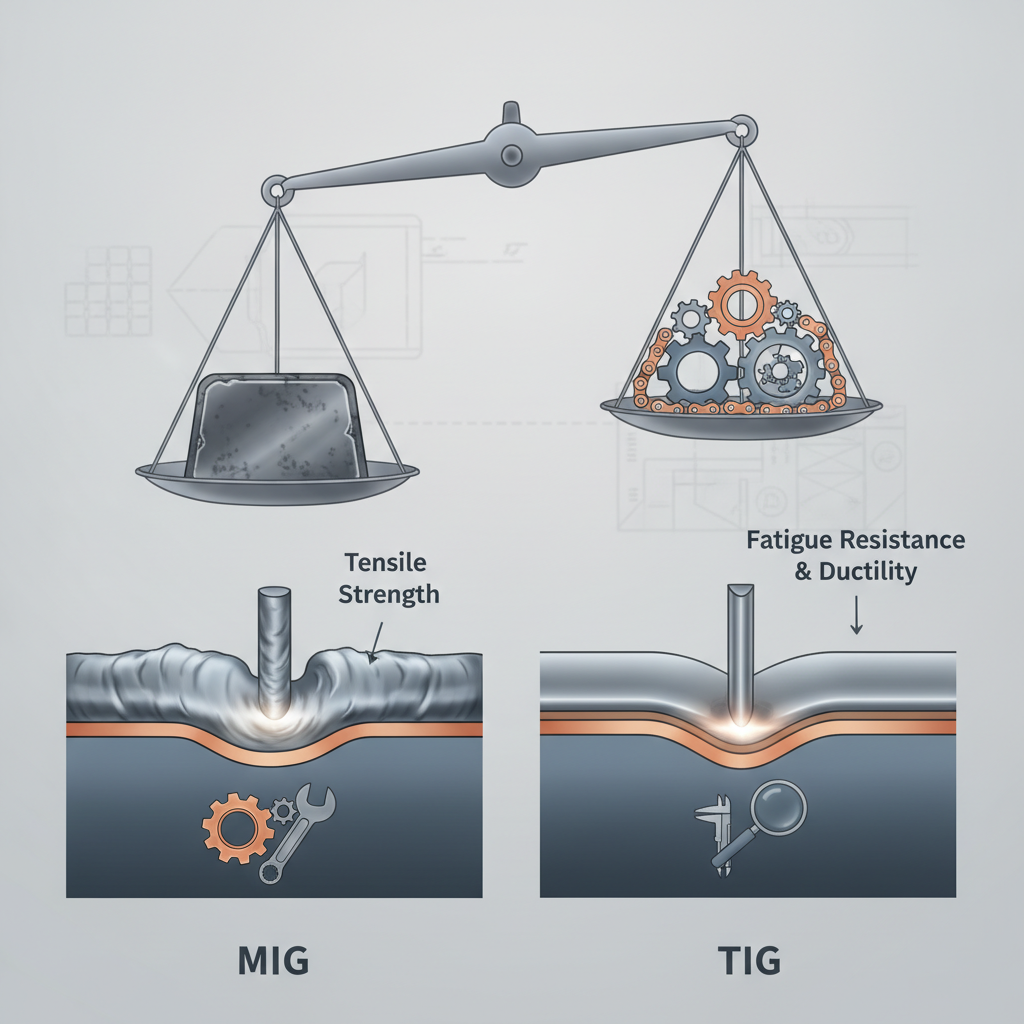
In most cases, TIG welding produces stronger, higher-quality welds than MIG welding — but the full answer depends heavily on the material, application, and welder skill level. TIG offers greater control, a cleaner heat-affected zone, and better fusion on thin or critical materials. MIG, however, consistently delivers strong, reliable welds on thicker mild steel and is far more forgiving for everyday fabrication work.
What Actually Determines Weld Strength
Weld strength isn’t just a function of which process you use. Several factors play a larger role than the process itself:
– Penetration depth — how far the weld fuses into the base metal
– Heat-affected zone (HAZ) — excessive heat weakens surrounding metal
– Filler metal quality and compatibility — wrong filler reduces joint strength
– Weld geometry — a properly sized bead distributes stress correctly
– Operator technique — inconsistent speed or angle causes weak spots regardless of process
Both MIG and TIG can produce welds that meet or exceed the base metal’s tensile strength when done correctly. The difference lies in how much control each process gives you over these variables.
How MIG and TIG Welding Work Differently
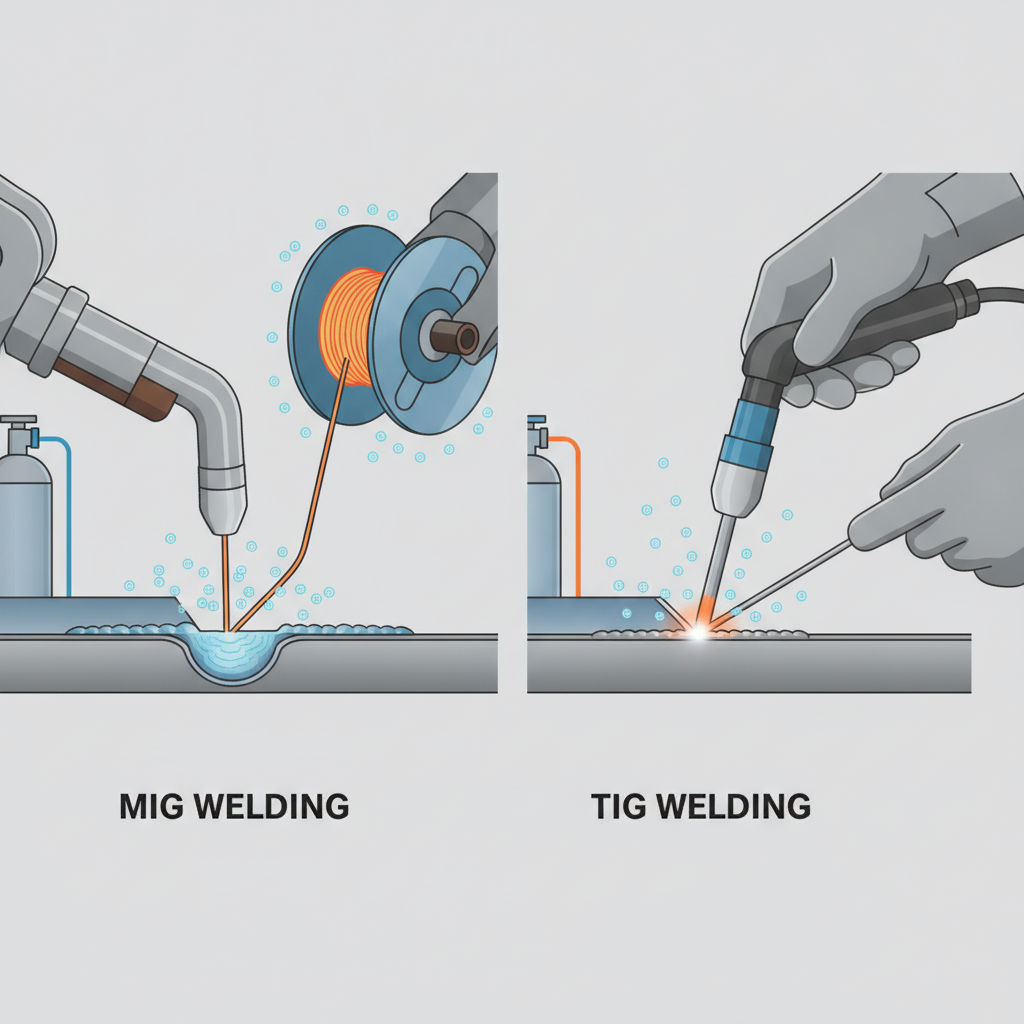
MIG (Metal Inert Gas) welding feeds a consumable wire electrode continuously through the gun while shielding gas protects the puddle. It’s fast, easy to learn, and handles material variability well. The machine does a lot of the work.
TIG (Tungsten Inert Gas) welding uses a non-consumable tungsten electrode to create the arc. The welder feeds filler rod manually with the other hand while controlling the arc with a foot pedal or thumb control. Every variable — heat input, filler addition, travel speed — is in the welder’s hands.
That manual control is exactly why TIG can produce stronger welds in the right situations. It also means the results depend far more on the person behind the torch.
TIG excels in situations where precision and clean metallurgy matter most:
– Thin materials — TIG’s precise heat control prevents over-penetration and burn-through
– Stainless steel and aluminum — cleaner HAZ, minimal contamination
– Critical structural joints — aerospace, roll cages, pressure vessels
– Exotic metals — titanium, chromoly, Inconel, copper alloys
– Root passes on pipe — clean fusion without slag inclusions
The filler rod is added only when and where needed, giving TIG welders precise control over the bead profile. This results in a denser, cleaner weld with fewer voids or inclusions compared to an improperly set MIG weld.
For example, chromoly tubing used in motorsport chassis is almost always TIG welded. The alloy is sensitive to heat, and the structural requirements leave zero margin for weak joints. If you’re working with chromoly or any heat-sensitive alloy, you can learn more about TIG welding different thickness metals to understand how heat management changes across joint configurations.
Where MIG Welding Holds Its Own
MIG isn’t weaker by nature — it’s just a different tool for different situations. On mild steel in the 1/8″ to 1/2″ thickness range, a well-executed MIG weld can be extremely strong. In production and structural fabrication, MIG is the dominant process precisely because of its speed and consistency.
MIG tends to outperform TIG in these scenarios:
– Thicker mild steel plate and structural shapes — better deposition rate, full fusion
– High-volume fabrication — less fatigue, faster travel speeds
– Outdoor or field repairs — more tolerant of surface imperfections
– Beginners and intermediate welders — more consistent results with less technique required
A skilled MIG welder using ER70S-6 wire on clean mild steel will produce joints that comfortably exceed the yield strength of the base material. The Lincoln Electric Easy MIG 180 is a common example of a machine used in both hobby and light commercial settings that can produce genuinely structural-grade welds when dialed in properly.
Comparing MIG vs. TIG Weld Strength by Application
Application
Stronger Process
Why
Mild steel structural plate
MIG or TIG (equal)
Both achieve full fusion with proper technique
Thin stainless steel (under 3mm)
TIG
Better heat control, cleaner HAZ
Aluminum
TIG (generally)
Cleaner fusion, fewer porosity issues
Chromoly / 4130 tubing
TIG
Alloy-sensitive, requires precise heat input
Carbon steel pipe root pass
TIG
Cleaner root fusion without slag
Heavy equipment repair
MIG
Faster deposition, tolerates rougher conditions
Exhaust pipe fabrication
TIG preferred, MIG capable
Both work; TIG gives cleaner results on thin tubing
Automotive sheet metal
MIG (with short-circuit transfer)
Faster, good penetration at low heat
If you’re working on exhaust fabrication and deciding between processes, the application-specific breakdown for welding exhausts with TIG or MIG goes deeper into that specific use case.
The Skill Factor: Why Process Alone Doesn’t Decide It
A mediocre TIG bead is weaker than a solid MIG weld. This is one of the most commonly overlooked points in the MIG vs. TIG debate.
TIG’s precision is a double-edged tool. A welder who lacks control over their foot pedal, filler feed rate, or torch angle will produce a weld with inconsistent fusion — sometimes weaker than a beginner-level MIG weld. In practice, strength comparisons between MIG and TIG only hold when both are performed at a competent level.
MIG welding is more forgiving. The machine’s wire feed and voltage settings do a lot of the stabilizing work. Beginners can produce structurally acceptable welds after far less practice than TIG requires. Machines like the Hobart Handler 210MVP allow beginners to dial in reasonably strong mild steel welds quickly, even without formal training.
Joint Design and Proper Sizing Matter More Than You Think
No matter which process you use, an undersized or poorly designed weld joint will fail before the base material. Fillet weld size, throat dimension, and root fusion directly determine load capacity.
Getting these right is more important than choosing between MIG and TIG. Understanding how to determine proper weld size will have a bigger impact on joint performance than the welding process in most shop scenarios.
FAQ
Is TIG stronger than MIG on aluminum?
Generally yes. TIG welding aluminum produces cleaner fusion with less porosity and a more controlled heat-affected zone. MIG welding aluminum with a spool gun is viable, but the process is more prone to inconsistency on thinner material. For structural aluminum components, TIG is typically the preferred choice when quality is the priority.
Can MIG welding be as strong as TIG for structural steel?
Yes, on mild steel structural applications. Both processes can achieve full joint penetration and meet structural strength requirements when properly executed. The key variables are joint preparation, fit-up quality, filler metal selection, and welder technique — not the process itself. MIG is actually more common in structural steel fabrication due to its speed advantage.
Which process is better for thin metal?
TIG is generally better for thin metal because the foot pedal allows the welder to reduce heat input instantly, reducing burn-through risk. MIG can work on thin material but requires short-circuit transfer mode and careful settings. If you’re struggling with this, the guide on MIG welding thin metal without burning through covers the settings adjustments that help most.
Does TIG welding have better penetration than MIG?
Not necessarily. Penetration depends more on amperage, travel speed, and joint geometry than on the process. MIG welding at higher amperages in spray transfer mode can achieve excellent penetration on thicker material. TIG’s advantage is not deeper penetration — it’s more controlled fusion, especially on alloy-sensitive metals.
Which weld process is better for stainless steel?
TIG is preferred for most stainless steel applications, particularly in food-grade, medical, or corrosion-critical environments. It produces cleaner welds with less heat discoloration and oxidation. MIG welding stainless is possible and practical for less critical work, but controlling heat input and using the correct tri-mix shielding gas is essential. For more detail, the breakdown of MIG welding stainless steel settings explains how to approach it properly.
Does weld process affect fatigue strength?
Yes, indirectly. Fatigue failure typically initiates at weld toe discontinuities, undercut, or porosity. TIG welds tend to have smoother profiles and fewer surface defects, which slightly improves fatigue resistance in cyclic-load applications. For static loads, the difference between a clean MIG and TIG weld is minimal on compatible base metals.
The Practical Takeaway
TIG gives you more control, and with that control comes the potential for a stronger, cleaner weld — especially on alloy steels, thin materials, and precision applications. MIG is faster, more accessible, and entirely capable of producing structural-grade welds on everyday mild steel work. The process matters less than most people assume. Proper joint preparation, the right filler metal, and consistent technique are what actually determine whether a weld will hold under load.