
Working with fittings, tapped ports, or threaded pipe connections on compressed air systems, hydraulic lines, or fabrication projects brings you into contact with 1/8 pipe thread regularly. Getting the thread type, drill size, and sealing method right the first time prevents leaks and failed connections.
1/8 pipe thread refers to the nominal pipe size designation, not the actual outside diameter of the pipe or fitting. A 1/8 NPT (National Pipe Taper) thread has an actual outside diameter of approximately 0.405 inches (10.3 mm) and 27 threads per inch. The thread is tapered at 1° 47′, which creates a mechanical seal as the fitting is tightened. Most 1/8 pipe thread connections in North America use NPT, though BSPT (British Standard Pipe Taper) and NPSM (straight pipe) variants exist for specific applications.
Why “1/8 Pipe” Doesn’t Mean What It Sounds Like
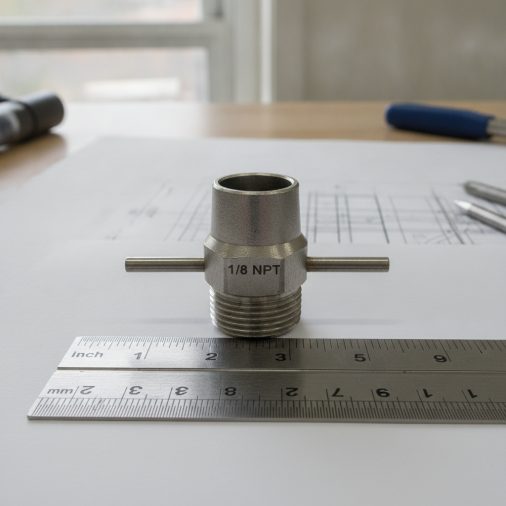
The 1/8 designation is a nominal trade size inherited from early plumbing standards. It no longer corresponds to any actual measured dimension on the fitting.
The outside diameter of a 1/8 NPT male thread measures roughly 0.405 inches, which is significantly larger than 1/8 of an inch. This naming convention was established when pipe wall thickness was much heavier, and the nominal size reflected the approximate inside bore diameter of the pipe — not the outside.
Understanding this distinction matters when sourcing fittings, machining ports, or ordering taps and dies. Always specify the thread standard (NPT, BSPT, NPSM) alongside the nominal size to avoid ordering the wrong part.
NPT, BSPT, and Straight Thread: Which Standard Applies
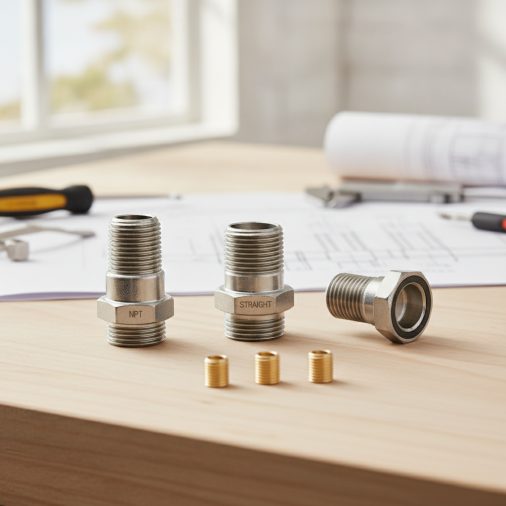
Three thread standards appear frequently in workshop and fabrication settings at the 1/8 size:
| Thread Standard | Taper | TPI | Seal Method | Common Region |
|---|---|---|---|---|
| 1/8 NPT | 1° 47′ | 27 | Thread interference + sealant | North America |
| 1/8 BSPT (R 1/8) | 1° 47′ | 28 | Thread interference + sealant | UK / Europe / Asia |
| 1/8 NPSM | None (straight) | 27 | Requires separate sealing face | Specialty / adapters |
NPT and BSPT look almost identical and can sometimes be partially threaded together, but they are not compatible. Mixing them produces a cross-threaded or leaking joint. Check the thread standard marked on the fitting or equipment port before assuming compatibility.
Straight pipe threads (NPSM) rely on a face seal or O-ring and must not be used as a pressure seal based on thread engagement alone.
Correct Drill Bit Size for a 1/8 NPT Tap
Tapping a 1/8 NPT threaded port requires drilling to the correct size before threading. Because NPT threads are tapered, the drill creates the entry-point diameter, and the tap cuts the taper progressively.
The standard drill size for a 1/8 NPT tap is R (letter R), which equals 0.339 inches (8.61 mm).
Some machinists use a 21/64-inch (0.328 inch) drill bit in softer materials where slightly more thread engagement is acceptable, but the R-size drill is the standard recommendation for most metals.
For a full breakdown of drill sizing and tapping procedure, selecting the correct drill bit for 1/8 pipe thread covers the complete process in detail.
Drilling undersize makes tapping harder and risks tap breakage. Drilling oversize reduces thread engagement and weakens the seal. For most applications in steel, aluminum, and cast iron, the R-size drill provides correct thread form and adequate engagement.
Sealing 1/8 NPT Threads Correctly
The taper in NPT threads creates an interference fit as the male fitting is tightened into the female port. However, thread-to-thread contact alone rarely produces a reliable pressure seal. A thread sealant is almost always required.
Common sealing options:
– PTFE tape (thread seal tape): Wrap 2–3 layers clockwise onto the male thread before assembly. Commonly used for low-pressure pneumatic and hydraulic connections. Avoid using PTFE tape on oxygen lines unless the tape is rated for oxygen service.
– Anaerobic pipe thread sealant (such as Loctite 567 Thread Sealant): Applied to the male thread and allowed to cure after assembly. Suitable for higher-pressure hydraulic and fuel systems. Check chemical compatibility with the fluid being sealed.
– Pipe dope (paste compound): A traditional option still used in plumbing and some industrial applications. Not suitable for all media types.
Do not over-tighten 1/8 NPT fittings. The tapered thread pulls tight quickly, and excessive torque can crack cast ports in aluminum or brittle iron manifolds. Hand-tighten until snug, then apply 1 to 3 additional turns with a wrench, depending on the fitting material and port material.
Where 1/8 Pipe Thread Appears in Welding and Fabrication
1/8 NPT threads appear frequently in shop environments beyond plumbing:
– Compressed air fittings and manifolds: Quick-disconnect bodies, regulators, gauges, and blow-gun adapters often use 1/8 NPT ports.
– Welding gas systems: Some regulator body ports and flow-meter inlets use 1/8 NPT threads, though CGA fittings govern the cylinder connections themselves.
– Hydraulic system ports: Small hydraulic manifolds, pressure gauges, and test ports frequently use 1/8 NPT.
– Engine and equipment ports: Oil pressure sender units, coolant temperature sensors, and vacuum ports on engines commonly use 1/8 NPT threads.
– Custom fabricated parts: Welded tubing assemblies, custom headers, and manifolds often require drilled and tapped 1/8 NPT ports for sensors or service fittings.
When fabricating a part that needs a tapped 1/8 NPT port, wall thickness matters. The minimum recommended wall thickness around a 1/8 NPT port is generally 3/16 inch (approximately 4.8 mm) or more, depending on the pressure rating and material. Thin-wall tubing or sheet metal typically cannot support a properly tapped pipe thread without additional boss material.
Tapping 1/8 NPT Threads in Welded Fabrications
Adding a tapped 1/8 NPT port to a fabricated part — such as a custom pipe fitting, sensor boss, or manifold block — involves a few critical steps beyond simply drilling and tapping.
Before welding:
If the port will be tapped after welding, ensure the base material has enough wall thickness and that the heat-affected zone from welding does not extend into the threaded area. Weld distortion can pull bored holes out of alignment if the boss is not properly supported.
Material selection for tapped bosses:
– Mild steel weld-on threaded bosses (commonly called NPT weld bosses or pipe thread bungs) are widely available in 1/8 NPT and can be MIG or TIG welded directly onto tubing or plate.
– These eliminate the need to drill and tap thin-wall material, which is often impractical.
Tapping sequence for machined ports:
1. Center-punch and drill with an R-size drill bit.
2. Chamfer the entry hole to reduce tap lead-in resistance.
3. Use a 1/8 NPT taper tap with cutting oil in steel or aluminum.
4. Advance the tap gradually, reversing periodically to break chips.
5. Stop when the tap shoulder reaches the material surface.
6. Clean threads before installing any fitting.
NPT taps cut a tapered thread and will not bottom out like a standard tap. Do not force a standard bottom tap into a tapped NPT hole expecting a deeper thread — the taper geometry does not work that way.
Common Problems with 1/8 Pipe Thread Connections
Thread leaks after assembly:
Usually caused by insufficient sealant, cross-threading, or inadequate engagement. Back the fitting out completely, inspect threads for damage, apply fresh sealant, and re-engage carefully by hand before using a wrench.
Cracked port or manifold:
Over-tightening is the most common cause. Cast aluminum and iron manifolds are particularly vulnerable. Use a torque wrench where manufacturer torque specifications are available. If the port is cracked, the part typically requires replacement or professional repair — attempting to weld a cracked pressurized port without full evaluation is not advisable.
Cross-threading:
NPT and BSPT threads are easy to cross-thread when alignment is off. Always start fittings by hand and confirm they thread smoothly for at least 2–3 turns before applying a wrench.
Seized threads:
Steel fittings can gall and seize in aluminum ports. Anti-seize compound applied to the male thread reduces this risk, particularly in high-temperature applications. Note that anti-seize acts as a lubricant and can cause over-tightening if torque is not reduced accordingly.
FAQ
What is the actual outside diameter of a 1/8 NPT thread?
A 1/8 NPT male thread has an actual outside diameter of approximately 0.405 inches (10.3 mm). The 1/8 designation is a nominal trade size that dates back to early pipe standards and does not represent any real measurement on the fitting. Always use thread gauges or calliper measurements when exact dimensions matter.
Can I use 1/8 BSPT fittings in a 1/8 NPT port?
Not reliably. Although 1/8 NPT and 1/8 BSPT both have a 1° 47′ taper, their thread pitch differs — NPT uses 27 TPI while BSPT uses 28 TPI. They may partially engage but will not seal properly and risk cross-threading or leakage under pressure. Always match the thread standard to the port specification before assembly.
How many turns should a 1/8 NPT fitting engage before it is tight?
A 1/8 NPT fitting typically engages 2 to 3 hand-tight turns before the taper begins to bind. After hand-tightening, 1 to 3 additional turns with a wrench are generally sufficient to achieve a seal. The exact number varies slightly by fitting material, sealant used, and port condition. Avoid exceeding 3 wrench turns past hand-tight without a manufacturer torque specification.
What drill bit do I use before tapping a 1/8 NPT thread?
The standard drill size for a 1/8 NPT tap is a letter R drill bit, which measures 0.339 inches (8.61 mm). Some machinists use a 21/64-inch bit in softer materials, but the R-size drill produces the most consistent thread engagement across common metals including steel, aluminum, and brass. Using the wrong size risks tap breakage or inadequate thread form.
Is PTFE tape suitable for all 1/8 NPT applications?
PTFE tape works well for low-to-medium-pressure pneumatic, water, and hydraulic connections but has limitations. It should not be used on oxygen service lines unless specifically rated for oxygen. For fuel, strong solvents, or high-vibration applications, an anaerobic thread sealant such as Loctite 567 Thread Sealant typically provides better resistance to loosening and chemical attack. Always check the sealant’s compatibility with the fluid or gas in the system.
Can a 1/8 NPT port be tapped into thin-wall tubing?
Generally, no. Thin-wall tubing does not provide enough wall thickness for proper thread engagement, and the walls will deform or strip under fitting torque. The minimum wall thickness for a reliable tapped 1/8 NPT port is typically around 3/16 inch. For thin-wall tube fabrications, weld-on 1/8 NPT threaded bosses are the practical solution, providing the necessary material for a full-depth, leak-free thread.
What is the torque specification for a 1/8 NPT fitting in aluminum?
Torque values vary by fitting material, port material, and sealant type. As a general starting range, 1/8 NPT fittings in aluminum ports are often torqued to approximately 8–12 ft-lb, but this varies by manufacturer and application. Always prioritize the equipment manufacturer’s published torque specification over general guidelines, particularly for pressurized hydraulic or pneumatic systems. Over-torquing is the leading cause of cracked aluminum ports at this fitting size.
Getting 1/8 pipe thread connections right comes down to three things: confirming the correct thread standard (NPT vs. BSPT vs. straight), drilling with the proper R-size bit before tapping, and using an appropriate sealant for the media and pressure involved. The nominal size tells you nothing about the actual dimensions — always work from thread specifications, not the name. For fabricated parts requiring tapped ports in thin or welded material, weld-on threaded bosses eliminate the guesswork and provide reliable engagement without compromising wall integrity.