
If you’ve ever looked at your welder’s polarity settings and wondered which one applies to MIG welding, you’re not alone. Polarity affects weld quality more than most beginners expect, and getting it wrong produces frustrating results.
MIG welding (GMAW) runs on DCEP — Direct Current Electrode Positive, also called reverse polarity. This means the welding wire (electrode) is connected to the positive terminal, and the workpiece connects to the negative terminal. DCEP produces a stable arc, good penetration, and clean welds on most metals and is the standard polarity for solid wire MIG welding with shielding gas.
What DCEP Actually Means in a MIG Setup
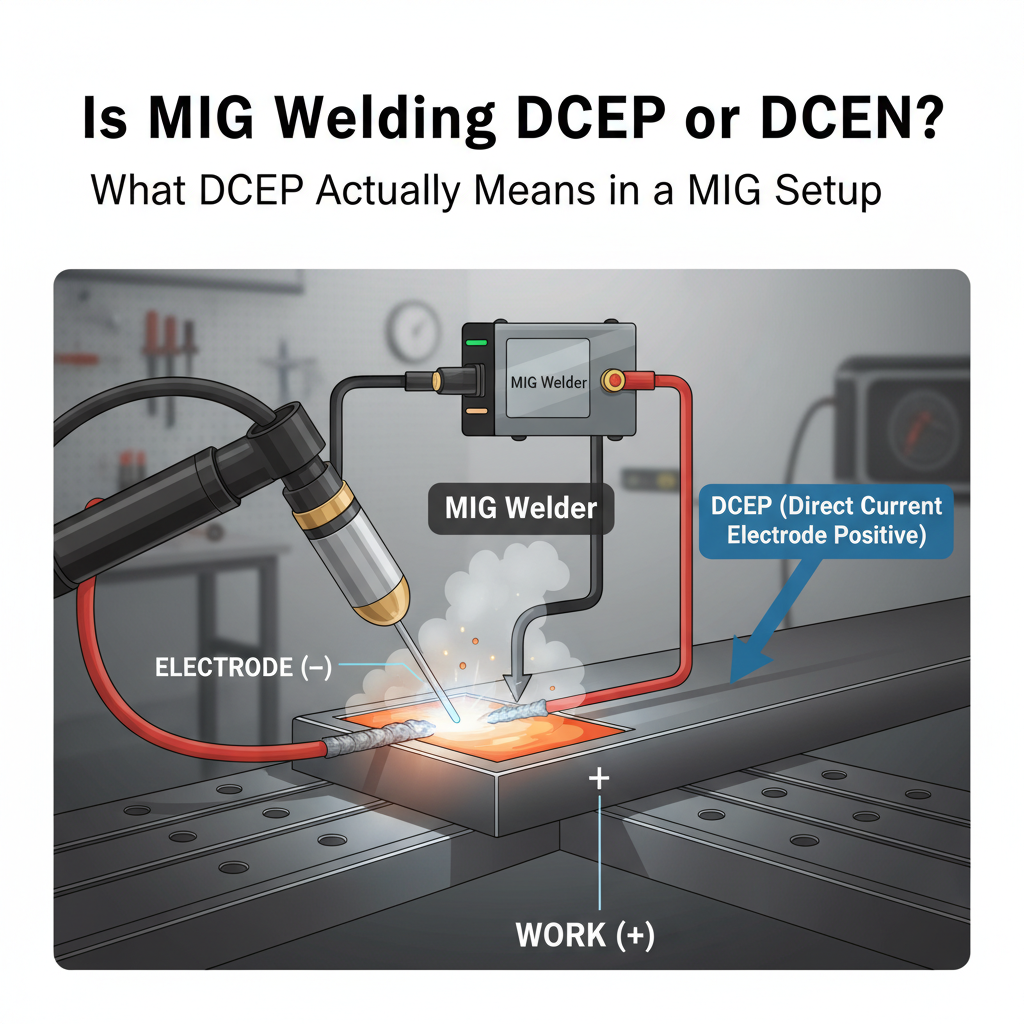
In any DC welding circuit, current flows in one direction. The polarity determines whether that current flows into the electrode or out of it.
- DCEP (Direct Current Electrode Positive): Electrode is positive, workpiece is negative. Electrons flow from the workpiece to the electrode.
- DCEN (Direct Current Electrode Negative): Electrode is negative, workpiece is positive. Electrons flow from the electrode to the workpiece.
In a MIG welder, the electrode is the wire being fed through the gun. With DCEP, roughly two-thirds of the arc heat concentrates at the workpiece, which promotes fusion and penetration. The remaining heat goes into the wire, which helps with consistent melting and metal transfer.
This heat distribution is exactly why DCEP is the default for MIG welding.
Why MIG Welding Uses DCEP
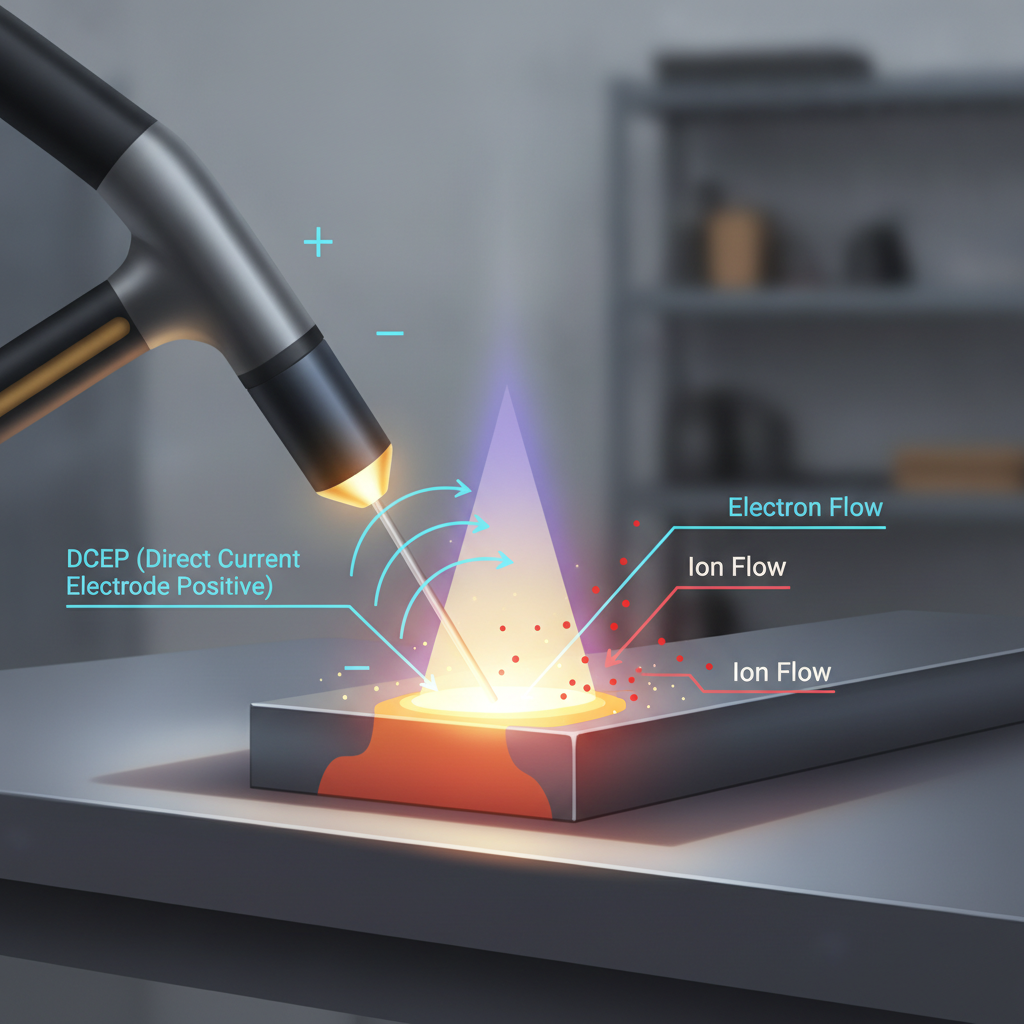
The physics behind DCEP make it the practical choice for MIG. Electron bombardment from the workpiece onto the electrode creates a cleaning action on the base metal surface — particularly useful on aluminum, where DCEP helps break up the oxide layer.
The arc behavior is more stable with DCEP in GMAW processes. Metal transfer modes — short circuit, globular, spray — all function more predictably on DCEP than DCEN with solid wire.
Weld appearance also improves. Spatter is generally lower, the weld bead profile is more consistent, and fusion at the toes of the weld is better defined.
The Exception: Flux-Core Wire and DCEN
This is where many beginners get confused. Some flux-cored wires actually require DCEN — and using the wrong polarity with flux core will cause serious weld quality problems.
There are two main types of flux-cored wire:
| Wire Type | Polarity | Shielding Gas |
|---|---|---|
| Self-shielded flux-core (FCAW-S) | Typically DCEN | None required |
| Gas-shielded flux-core (FCAW-G) | Typically DCEP | External gas required |
Self-shielded wires like Lincoln Electric Innershield NR-211-MP are designed for DCEN. The flux chemistry in these wires produces its own shielding and works with DCEN to create proper arc characteristics and weld protection. Running self-shielded flux core on DCEP causes porosity, poor fusion, and excessive spatter.
Gas-shielded flux-core runs on DCEP, similar to solid wire MIG.
Always check the wire manufacturer’s polarity specification before welding. It’s printed on the wire packaging and often stamped on the wire spool itself.
How to Change Polarity on a MIG Welder
Most MIG welders have a polarity changeover accessible inside the machine, typically behind a panel or near the wire drive compartment.
The process is straightforward on most machines:
- Turn off and unplug the welder.
- Locate the polarity changeover terminals inside the machine.
- Swap the cable connections — the work lead connection and the torch/wire drive lead connection exchange positions.
- Confirm the torch lead and work lead are correctly matched to the desired polarity.
- Close the panel and plug back in.
On some machines, like the Lincoln Electric Weld-Pak 140, polarity swap instructions are printed directly inside the wire compartment door. This makes it easy to verify you’ve set it correctly before you strike an arc.
What Happens If You Weld With the Wrong Polarity?
Running solid MIG wire on DCEN will produce noticeably poor results. The arc becomes erratic and hard to control. Spatter increases significantly. Penetration drops because heat concentrates in the wire rather than the base metal, leading to cold lap or incomplete fusion.
The weld bead looks rough, irregular, and often sits on top of the metal rather than fusing into it. If you’ve ever seen a MIG weld that looks like a thick, blobby rope sitting on the surface, wrong polarity is a likely cause.
Running self-shielded flux core on DCEP produces similar problems — erratic arc, porosity, and inconsistent deposition. It’s one of those mistakes that looks and sounds noticeably wrong even to a new welder.
Quick Polarity Reference for Common MIG Processes
| Process | Wire Type | Correct Polarity |
|---|---|---|
| MIG (GMAW) | Solid wire | DCEP |
| Flux-core (FCAW-G) | Gas-shielded flux core | DCEP |
| Flux-core (FCAW-S) | Self-shielded flux core | DCEN |
| Aluminum MIG | Solid aluminum wire | DCEP |
FAQ
Can you MIG weld on DCEN?
Solid wire MIG welding is designed for DCEP and performs poorly on DCEN. The arc becomes unstable, penetration is shallow, and spatter increases substantially. Some specialized applications use DCEN for specific reasons like reducing heat input on thin materials, but these are niche cases. For standard MIG welding, DCEP is the correct and practical choice.
Why does flux-core use DCEN instead of DCEP?
Self-shielded flux-core wire uses DCEN because the flux formulation is chemically designed to work with that polarity. The flux ingredients react differently depending on current direction. With DCEN, the self-shielded wire generates proper gas shielding and arc stabilization. Using DCEP reverses the expected arc behavior and breaks down the shielding mechanism, leading to weld defects.
Does polarity affect penetration in MIG welding?
Yes, significantly. With DCEP, approximately 65–70% of arc heat concentrates at the workpiece, promoting fusion and penetration into the base metal. DCEN shifts heat toward the electrode, reducing penetration. This is why DCEN is sometimes used intentionally for very thin materials or surfacing applications where deep penetration would cause burn-through.
How do I know if my MIG welder is set to the correct polarity?
Check the polarity changeover terminals inside the wire compartment. Most machines label the terminals clearly as positive (+) and negative (−). For standard solid wire MIG, the torch lead should be connected to the positive terminal and the work clamp lead to the negative terminal. When in doubt, check the machine’s manual or look for the polarity diagram inside the wire compartment door.
Does MIG welding aluminum require a different polarity?
No. Aluminum MIG welding still uses DCEP, just like steel MIG. However, aluminum welding typically requires a spool gun or push-pull system due to the soft wire, 100% argon shielding gas, and specific wire speed settings. The polarity remains DCEP regardless of whether you’re welding steel, stainless, or aluminum.
What is the difference between DCEP and reverse polarity?
They’re the same thing. DCEP (Direct Current Electrode Positive) is the technical term, while “reverse polarity” is the older shop-floor terminology. Similarly, DCEN is sometimes called “straight polarity.” Both terms refer to the same electrical configuration — you’ll encounter both depending on the welding reference or manual you’re reading.
Can wrong polarity damage my MIG welder?
Wrong polarity won’t typically damage the machine itself, but it will produce poor welds and can cause excessive wear on consumables like contact tips if spatter becomes severe. The bigger risk is producing welds with hidden defects — insufficient fusion or porosity — that fail under load without obvious visible warning signs.
Practical Takeaway
For standard MIG welding with solid wire, DCEP is always the correct polarity — no exceptions. The only time DCEN enters the picture is with self-shielded flux-core wire, and the wire manufacturer’s spec sheet will tell you that directly. When setting up an unfamiliar machine or switching between wire types, verifying polarity before welding takes thirty seconds and prevents a frustrating troubleshooting session later.