If you’ve ever watched two experienced welders argue about torch angle, this debate is probably familiar. Push versus pull sounds like a minor detail, but it directly affects bead shape, penetration, and how much spatter you’re dealing with.
For standard MIG welding with solid wire and shielding gas, pushing is generally preferred. The push technique (forehand welding) directs the arc ahead of the puddle, producing a flatter, wider bead with a cleaner appearance and less spatter. Pulling (backhand welding) increases heat input and penetration but creates a narrower, higher bead profile and more spatter. Most MIG welding situations favor the push technique, though exceptions exist.
What Push and Pull Actually Mean
Before getting into which is better, it helps to be precise about the terminology, because it gets confused constantly.
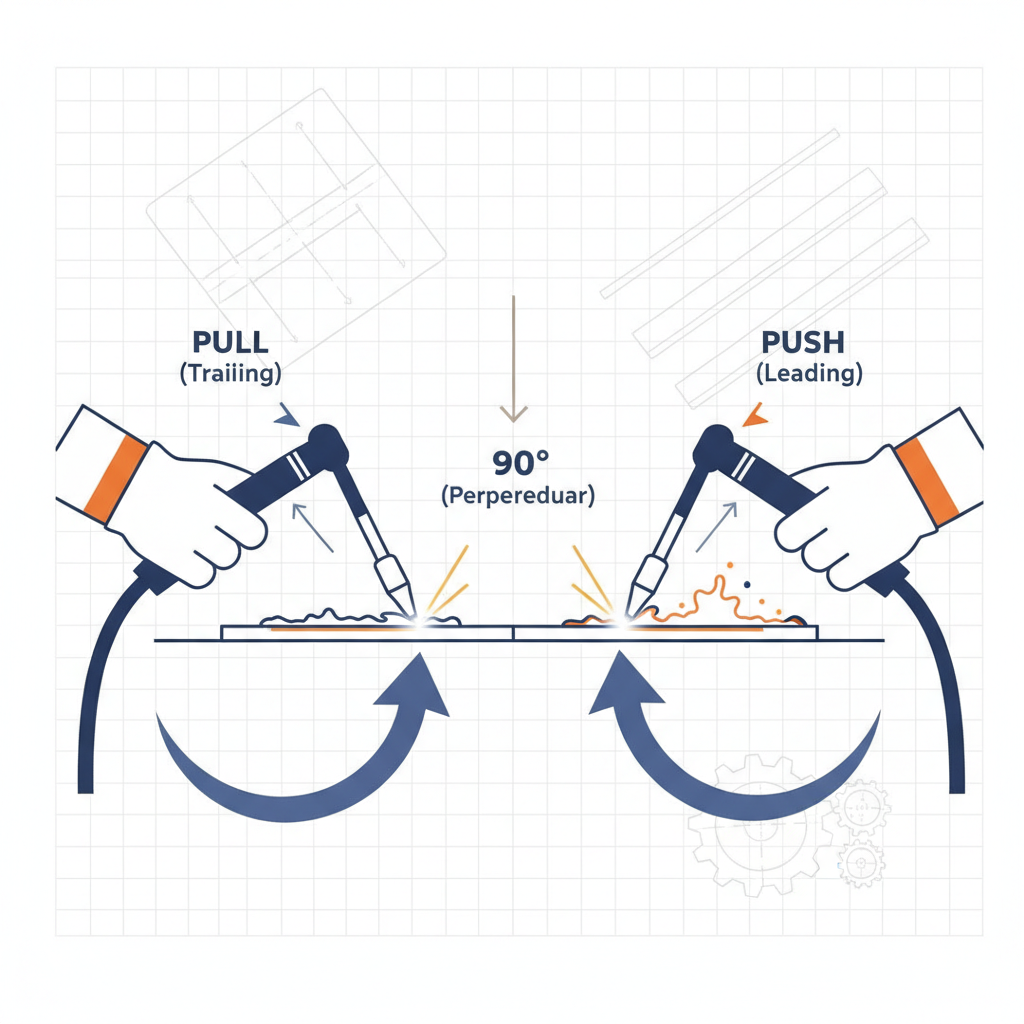
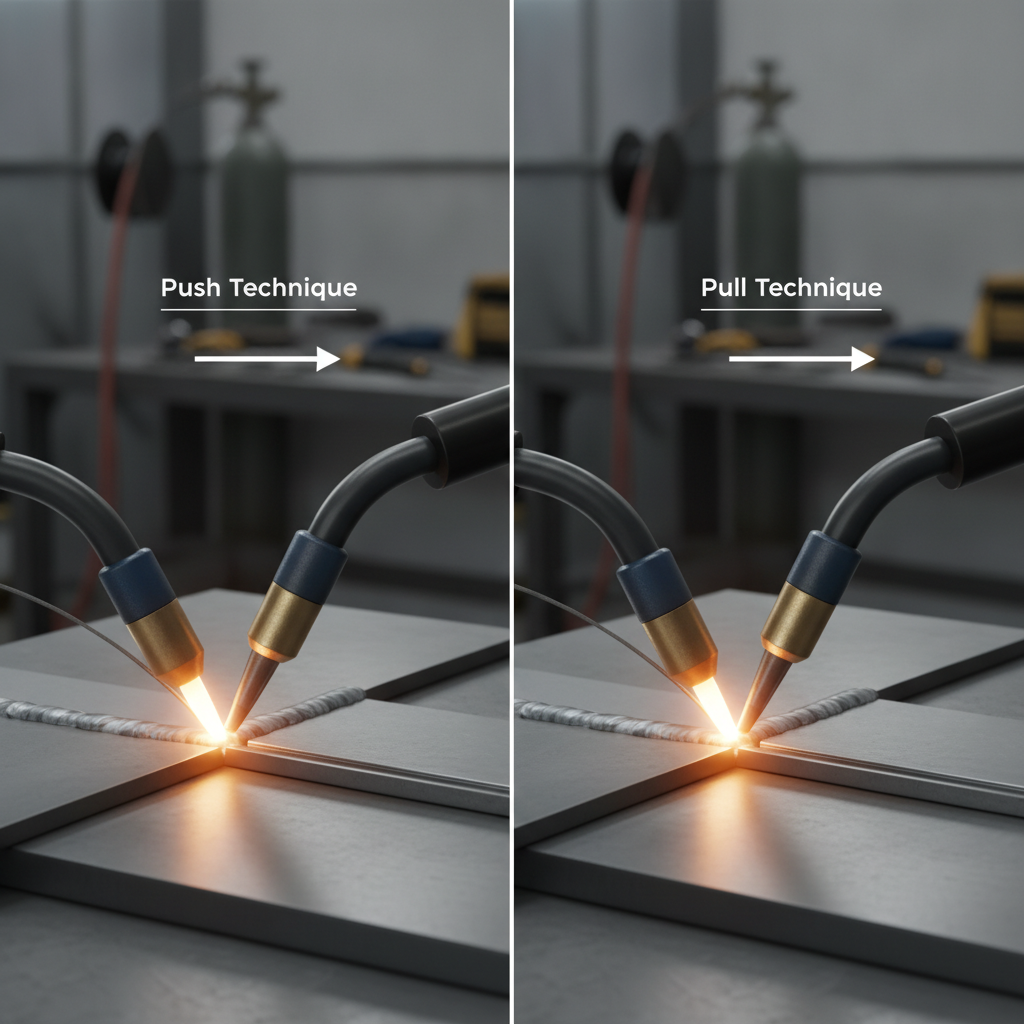
Push (forehand welding): The gun points back toward the completed weld, and you travel in the direction the nozzle is pointing — away from the deposited bead. The arc pushes into clean, unmelted base metal.
Pull (backhand welding): The gun points forward toward the direction of travel, and you move the gun back over the weld puddle. The arc pulls back over already-deposited metal.
A simple way to remember it: if the gun is tilted so the nozzle leads the puddle, that’s push. If the handle leads and the nozzle trails behind, that’s pull.
The work angle (side-to-side tilt) stays roughly the same for both techniques — it’s the travel angle (forward-backward tilt) that changes.
Why Push Works Better for Most MIG Applications
MIG welding with solid wire and an active shielding gas like C25 (75% argon / 25% CO2) was designed around the push technique. Here’s what actually happens at the arc level.
When you push, the shielding gas cone sweeps ahead of the puddle, pre-cleaning and pre-heating the base metal before the arc arrives. The result is better gas coverage, a flatter puddle, and significantly less spatter.
The bead profile with a push technique is typically:
– Wider and flatter
– Smoother surface appearance
– Less spatter on the surrounding base metal
– Easier to visually monitor the joint while welding
This matters a lot for visible welds where appearance counts — automotive work, furniture fabrication, structural joints that get painted or inspected.
The tradeoff is slightly less penetration compared to a pull technique. For most mild steel work in the 18-gauge to 1/4-inch range, this difference is negligible when settings are dialed correctly.
When Pulling Can Be the Right Choice
Pull isn’t a mistake — it’s a different tool for different situations. It concentrates heat more narrowly, which increases penetration and produces a more convex, “stacked” bead profile.
Situations where pulling may be preferable or necessary:
– Heavier plate where maximum penetration is the priority
– Poor fit-up where the extra heat helps fuse irregular surfaces
– Vertical-down welding where some welders find it easier to control the puddle with a trailing technique
– Dirty or coated base metal where the concentrated arc helps burn through contamination
One honest caveat: pulling in solid-wire MIG does increase spatter, and the narrower bead means you need to be more precise about tracking the joint.
For flux core welding, the push-or-pull answer is actually reversed — flux core typically requires a drag (pull) technique because the slag system needs to trail behind the arc to protect the cooling weld. This is a common point of confusion for welders switching between processes.
Push vs. Pull: Direct Comparison
Factor
Push Technique
Pull Technique
Bead width
Wider
Narrower
Bead height
Flatter
More convex
Penetration
Slightly less
Slightly more
Spatter
Less
More
Shielding gas coverage
Better
Reduced ahead of arc
Visibility of joint
Better
Can be obstructed
Best for
Most MIG applications
Heavy plate, poor fit-up
Appearance
Cleaner, smoother
Rougher surface
Travel Angle: The Number That Actually Matters
Whether you’re pushing or pulling, the travel angle determines how extreme the effect is. Most guidance points to a 5–15 degree angle from vertical as the practical sweet spot.
At 5 degrees, the difference between push and pull is barely noticeable. Push at 30 degrees, and you’ll see a dramatic flattening of the bead. Pull at 30 degrees, and spatter increases noticeably while penetration deepens.
In practice, most experienced welders work around 10–15 degrees in either direction. Going beyond 20 degrees in either direction rarely improves the weld and often causes problems.
The work angle (side tilt) matters separately. For flat butt joints, keep it 90 degrees to the workpiece. For fillet welds, split the angle evenly into the corner — typically 45 degrees.
How Technique Changes by Position and Joint Type
Welding position changes the practical application of push versus pull significantly.
Flat position: Push is comfortable and gives you full puddle visibility. This is where most learning happens, and the push technique shines here.
Horizontal position: Push still works well. Keep the gun pointed slightly upward to prevent the puddle from sagging.
Vertical-up: Most welders find a slight push easier to control. A whip-and-pause or weave motion helps manage heat. Attempting to pull on vertical-up often causes the puddle to run out of control.
Vertical-down: Pull can work here, but only on thin material where you want limited penetration. On anything thicker than 14 gauge, vertical-down welding already has penetration limitations regardless of technique.
Overhead: Push is standard. Pulling overhead makes it harder to see the puddle and manage droplets.
For specific challenges like MIG welding thin metal without burning through, technique becomes even more critical — the push angle and travel speed together determine whether you stay on top of the puddle or sink through it.
Common Mistakes That Hurt Regardless of Technique
Most MIG weld quality problems aren’t actually about push versus pull. They’re about fundamentals that override technique choice.
Travel speed too slow: The puddle builds up, bead gets too convex, and you risk burn-through on thin metal. Slow travel amplifies both push and pull effects.
Travel speed too fast: Cold laps, porosity, and inconsistent fusion. The bead looks thin and stringy.
Incorrect work angle: Causes uneven penetration in fillet welds, with most fusion going to one side of the joint.
Gun too close or too far from the workpiece: Contact tip to work distance (CTWD) should typically stay between 3/8 and 5/8 inch for most applications. Too close causes spatter; too far increases resistance and produces a weak, wandering arc.
Dragging the nozzle: A common beginner habit. The nozzle should never contact the base metal — it blocks gas flow and quickly plugs with spatter.
Does It Matter on Aluminum?
Aluminum MIG welding (GMAW with a spool gun or push-pull gun) uses slightly different logic. The push technique is still preferred, but for an additional reason: aluminum oxide forms almost instantly on the surface, and a pushing arc helps the leading edge of the arc break through that oxide layer ahead of the puddle.
If you’re dialing in parameters for aluminum, getting the technique right is only part of the picture — aluminum MIG welding settings for wire feed, voltage, and gas need to match the base metal thickness precisely before technique makes a meaningful difference.
FAQ
Does the push or pull direction affect weld strength?
In most standard MIG welding applications, the difference in mechanical strength between push and pull is minimal when settings are correct. Penetration is slightly deeper with a pull technique, but a properly dialed push weld meets structural requirements for the vast majority of applications. Strength is more affected by joint design, material prep, and correct settings than by technique direction.
Why does my MIG weld have more spatter when I pull?
Pulling concentrates arc energy and disrupts the shielding gas coverage ahead of the puddle. The result is increased turbulence in the molten pool and more spatter ejected from the arc. Reducing travel angle, slowing down wire feed slightly, or switching to a push technique typically reduces spatter significantly without changing other settings.
Can I push when doing flux core welding?
No — flux core welding (FCAW) requires a drag (pull) technique in nearly all cases. The flux inside the wire creates a protective slag layer that must trail behind the arc to shield the cooling weld. Pushing with flux core traps slag inside the weld, causing inclusions and porosity. This is one of the most important differences between solid wire MIG and flux core processes.
What travel angle should I use when pushing?
A push angle of 5–15 degrees from vertical is the standard recommendation for most MIG applications. At this range, you get the benefits of the push technique — better gas coverage, flatter bead, less spatter — without the excessive flattening or cold laps that can happen at extreme angles above 20–25 degrees.
Does push or pull matter on thin sheet metal?
Yes, more than on thicker material. On thin sheet metal (18–22 gauge), pushing at a moderate angle and maintaining a faster travel speed helps prevent burn-through by keeping the arc moving and reducing concentrated heat. Pulling on thin sheet metal increases the risk of burn-through because the concentrated heat input is harder to manage at the travel speeds required. For MIG welding thin-wall square tubing, this technique detail affects both penetration consistency and distortion.
Does gun angle matter if I have good settings?
Settings and technique work together — one doesn’t cancel the other out. Good settings with poor technique produces mediocre welds. Good technique with incorrect settings produces the same result. The push angle, travel angle, work angle, and travel speed all interact with voltage and wire feed speed simultaneously. Experienced welders adjust all of these variables in combination, not in isolation.
Should beginners start with push or pull?
Push is the better starting point for beginners using solid wire MIG. It’s easier to see the joint ahead of the gun, the puddle behavior is more forgiving, and the resulting bead is smoother. The Hobart Handler 140 is a popular beginner machine where practicing the push technique on flat plate is a practical way to develop arc awareness before moving to positional welding.
The Practical Takeaway
For solid wire MIG welding with shielding gas, push is the default technique for good reason — better gas coverage, cleaner bead appearance, and less spatter. Keep the travel angle between 5 and 15 degrees, monitor the puddle ahead of the arc, and adjust travel speed before blaming the technique.
Pulling has its place on heavier material or when penetration is the priority, but it’s the exception rather than the rule. If you’re switching between solid wire MIG and flux core, remember that flux core reverses the logic entirely — always drag with flux core.