
A welding defects chart categorizes common welding flaws into six main types: cracks, porosity, inclusions, incomplete fusion, profile defects, and dimensional defects. Each defect has specific visual characteristics, causes, and prevention methods that welders can use for quality control and troubleshooting.
Welding defects can compromise structural integrity and project quality, making proper identification crucial for any welding professional. Understanding these flaws through visual charts and systematic classification helps welders prevent costly repairs and safety hazards.
This guide provides a comprehensive welding defects chart with clear descriptions, causes, and prevention methods. You’ll learn to identify the most common welding flaws, understand their root causes, and implement effective solutions to improve your welding quality.
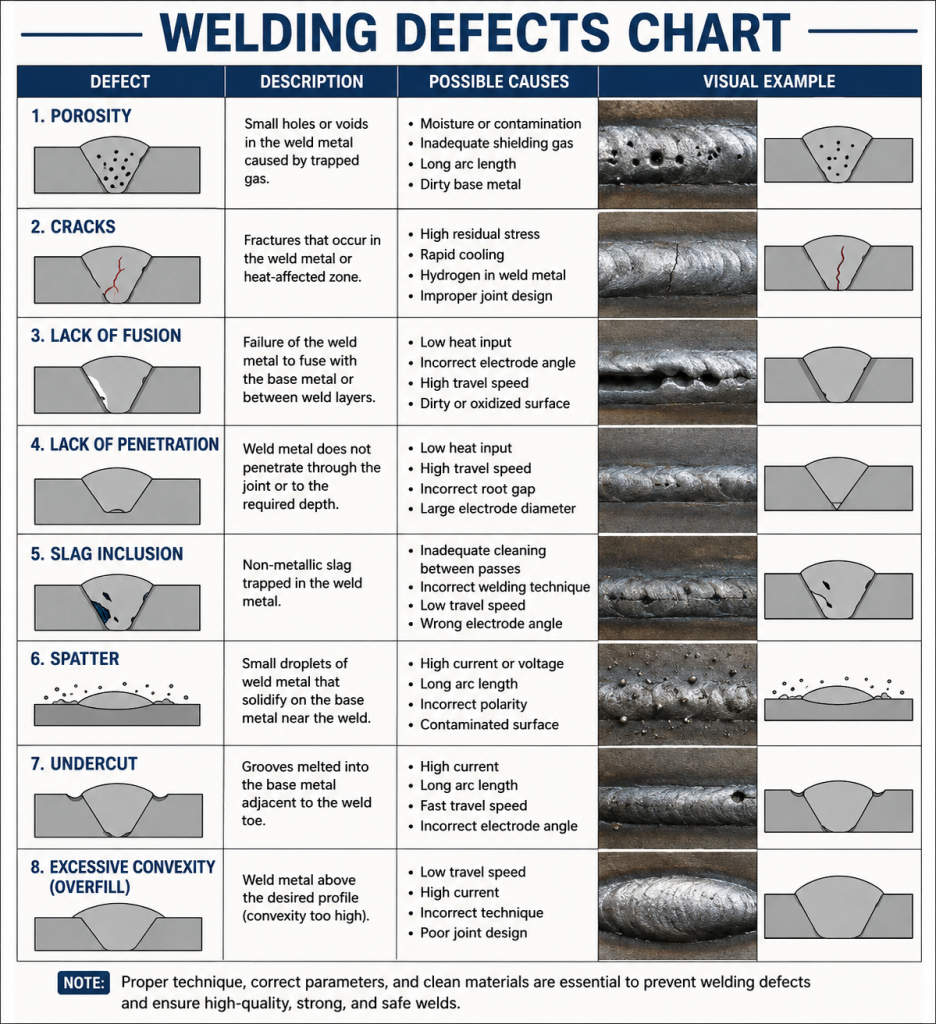
Welding Defects Comparison
| Welding Defect | Description | Common Causes | Prevention / Fix |
|---|---|---|---|
| Porosity | Small holes or gas pockets trapped in the weld metal | Moisture, dirty metal, poor shielding gas, long arc length | Clean metal, use proper gas flow, keep electrodes dry |
| Cracks | Fractures in the weld or heat-affected zone | Rapid cooling, residual stress, hydrogen contamination | Preheat metal, use correct filler, reduce cooling speed |
| Lack of Fusion | Weld metal fails to fuse properly with base metal | Low heat input, fast travel speed, dirty surface | Increase heat, clean joint, improve torch angle |
| Lack of Penetration | Weld does not fully penetrate the joint | Low current, incorrect joint prep, small root gap | Increase amperage, improve joint design, proper root opening |
| Slag Inclusion | Slag trapped inside the weld metal | Poor cleaning between passes, incorrect angle | Remove slag after each pass, maintain correct angle |
| Spatter | Small metal droplets around the weld area | High current, long arc, wrong polarity | Adjust settings, shorten arc length, use anti-spatter spray |
| Undercut | Groove melted into base metal near weld toe | Excessive current, fast travel speed | Lower current, slow travel speed, correct torch angle |
| Excessive Convexity (Overfill) | Too much weld metal above joint surface | Slow travel speed, too much filler metal | Control deposition rate, improve technique |
| Burn Through | Hole melted completely through the base metal | Excessive heat, thin metal | Reduce heat input, increase travel speed |
| Overlap | Weld metal rolls over without proper fusion | Slow travel speed, low voltage | Increase voltage slightly, improve travel speed |
| Distortion | Warping or bending of welded metal | Excessive heat buildup, uneven welding | Use clamps, stagger welds, reduce heat input |
| Arc Strike | Unwanted arc marks outside weld zone | Accidental arc contact | Strike arc only in weld area, use run-on tabs |
| Incomplete Root Fusion | Root area not properly fused | Improper root gap, low heat | Correct root opening, increase penetration |
| Excessive Reinforcement | Weld bead too large or high | Too much filler metal, slow movement | Reduce filler deposition, maintain steady speed |
| Crater Crack | Crack forming at the end of weld bead | Improper weld termination | Fill crater before stopping arc |
| Lamellar Tearing | Step-like cracking in base metal | High shrinkage stress, poor material quality | Use proper joint design and low-hydrogen process |
Main Categories of Welding Defects
Welding defects fall into distinct categories based on their formation mechanism and appearance. professional welding standards like AWS D1.1 and ISO 5817 classify these defects systematically.
For detailed information on professional welding standards and classifications, the AWS Safety and Health Fact Sheets provide comprehensive guidance on welding defect categories and safety practices.
Crack Defects represent the most serious category, including hot cracks, cold cracks, and crater cracks. These linear discontinuities can propagate under stress and cause catastrophic failure.
Porosity Defects appear as gas-filled cavities within the weld metal. Surface porosity shows as visible holes, while subsurface porosity requires radiographic testing to detect.
Inclusion Defects occur when foreign materials become trapped in the weld. Slag inclusions are most common, followed by tungsten inclusions in TIG welding.
Incomplete Fusion Defects happen when the weld metal fails to fuse completely with the base material or previous weld passes. This category includes lack of penetration and lack of sidewall fusion.
Profile Defects affect the weld’s external shape and include undercut, overlap, excessive reinforcement, and irregular weld profiles.
Dimensional Defects involve incorrect weld size, length, or positioning that doesn’t meet specification requirements.
Visual Identification Chart
Surface-Visible Defects
Cracks appear as thin, dark lines on the weld surface. Hot cracks typically run along the weld centerline, while cold cracks often occur in the heat-affected zone at angles to the weld direction.
Surface Porosity shows as round or elongated holes on the weld face. Clustered porosity indicates gas entrapment, while scattered pores suggest contamination issues.
Undercut creates a groove or depression along the weld toe where the base metal has been melted away. This defect appears as a continuous or intermittent channel parallel to the weld.
Overlap looks like excess weld metal that flows onto the base material surface without fusion. The unfused edge creates a visible line where the weld metal meets the base.
Spatter appears as small metal droplets scattered around the weld area. While not always considered a defect, excessive spatter indicates poor welding parameters.
Internal Defects Requiring Testing
Subsurface Porosity requires radiographic or ultrasonic testing for detection. X-ray images show these as dark circular or elongated areas within the weld cross-section.
Slag Inclusions appear as irregular dark areas on radiographs. These non-metallic inclusions often have angular shapes and may be linear or scattered throughout the weld.
Lack of Penetration shows as a dark line at the weld root on radiographic images. This defect indicates insufficient heat input or improper joint preparation.
Incomplete Fusion appears as linear indications along the fusion line on ultrasonic testing. These areas show poor bonding between weld metal and base material.
Root Causes and Formation Mechanisms
Process-Related Causes
Incorrect Welding Parameters cause many defects. Excessive current creates burn-through and distortion, while insufficient current leads to lack of penetration and cold lap.
Travel Speed Issues significantly impact weld quality. Too fast travel speed causes lack of penetration and irregular bead shape. Too slow travel speed creates excessive heat input, leading to burn-through and distortion.
Improper Shielding Gas allows atmospheric contamination. Insufficient gas flow permits oxygen and nitrogen pickup, causing porosity and brittleness. Excessive flow creates turbulence that disrupts the protective atmosphere.
Arc Length Problems affect heat distribution and penetration. Long arc length reduces penetration and increases spatter. Short arc length can cause electrode sticking and irregular bead formation.
Material-Related Causes
Base Metal Contamination introduces foreign substances into the weld pool. Oil, grease, paint, and rust create gas pockets and inclusions when heated during welding.
Moisture Content in electrodes and base materials generates hydrogen gas. This hydrogen can cause porosity immediately or delayed cracking hours after welding completion.
Joint Preparation Issues include improper fit-up, inadequate cleaning, and incorrect bevel angles. Poor preparation leads to incomplete fusion, slag entrapment, and dimensional defects.
Filler Metal Problems occur when using incorrect wire composition, contaminated consumables, or improper storage conditions. These issues cause chemical incompatibility and mechanical property degradation.
Environmental Factors
Wind and Drafts disrupt shielding gas coverage, allowing atmospheric contamination. Even light air movement can affect gas-shielded processes like TIG and MIG welding.
Temperature Extremes affect welding behavior. Cold base metals increase cooling rates and cracking susceptibility. Hot ambient temperatures can cause excessive penetration and distortion.
Humidity Levels influence hydrogen pickup in the weld. High humidity increases moisture content in the welding environment, contributing to porosity and cracking.
Prevention Strategies by Defect Type
Crack Prevention
Preheat and Interpass Temperature Control reduces cooling rates and prevents cold cracking. Carbon steel typically requires 200-400°F preheat depending on thickness and carbon content.
Proper Joint Design minimizes restraint and stress concentration. Avoid sharp corners and provide adequate root openings for full penetration.
Filler Metal Selection should match or exceed base metal strength properties. Lower-strength filler metals can accommodate shrinkage stresses better than high-strength alternatives.
Post-Weld Heat Treatment relieves residual stresses and improves ductility. Stress relief temperatures typically range from 1100-1250°F for carbon steels.
Porosity Prevention
Surface Preparation removes all contaminants before welding. Use mechanical cleaning methods like grinding or wire brushing rather than chemical solvents when possible.
Proper Gas Flow Rates maintain adequate shielding. Typical flow rates range from 15-25 CFH for MIG welding and 10-20 CFH for TIG welding, depending on conditions.
Electrode Storage keeps consumables dry and clean. Store low-hydrogen electrodes in heated ovens at 250-300°F and use within exposure time limits.
Welding Technique includes proper gun angle, travel speed, and manipulation. Maintain consistent standoff distance and avoid excessive weaving that exposes the puddle.
Inclusion Prevention
Slag Removal between passes prevents entrapment. Use chipping hammers and wire brushes to remove all slag before depositing subsequent layers.
Proper Manipulation ensures good slag fluidity and separation. Maintain appropriate travel speed and avoid excessive oscillation that traps slag.
Current Settings affect slag behavior. Insufficient current prevents proper slag melting, while excessive current can cause slag to mix with the weld metal.
Joint Access allows complete slag removal from groove welds. Provide adequate opening and bevel angles for cleaning tools and visual inspection.
Quality Control and Inspection Methods
Visual Inspection Techniques
Systematic Examination follows established procedures for consistent results. Inspect welds under adequate lighting with magnification when necessary.
Measurement Tools verify dimensional requirements. Use fillet weld gauges, bridge cam gauges, and rulers to check size, profile, and length specifications.
Documentation Standards record defect locations, types, and severity. Use standardized forms and photography to maintain quality records.
Accept/Reject Criteria based on applicable codes and specifications. Different applications have varying tolerance levels for specific defect types.
Non-Destructive Testing
Radiographic Testing reveals internal defects like porosity, inclusions, and lack of penetration. This method provides permanent film records for quality documentation.
Ultrasonic Testing detects internal flaws and measures weld dimensions. UT offers real-time results and can evaluate large areas quickly.
Magnetic Particle Testing finds surface and near-surface cracks in ferromagnetic materials. This method works well for detecting heat-affected zone cracking.
Liquid Penetrant Testing reveals surface-breaking defects in any material. The process highlights cracks, porosity, and other surface discontinuities.
Common Inspection Mistakes
Inadequate Lighting
Poor Visibility causes inspectors to miss surface defects. Use minimum 1000 lux illumination for visual inspection with shadow-free lighting arrangements.
Wrong Light Angles can hide undercut and other profile defects. Position lights to create slight shadows that highlight surface irregularities.
Color Temperature affects defect visibility. Use daylight-balanced lighting around 5000K for accurate color perception and contrast.
Measurement Errors
Incorrect Gauge Usage leads to false readings. Ensure fillet weld gauges contact both legs properly and bridge cam gauges span the entire weld width.
Parallax Errors occur when reading measurements from wrong angles. Position measuring instruments perpendicular to the surface being evaluated.
Calibration Issues cause systematic measurement errors. Verify gauge accuracy regularly using certified reference standards.
Documentation Problems
Incomplete Records make defect tracking difficult. Record defect location, size, type, and repair actions taken for each discrepancy found.
Unclear Photographs don’t show defect details adequately. Use proper focus, lighting, and scale references in documentation photos.
Missing Signatures invalidate inspection records. Ensure qualified inspectors sign and date all inspection reports and certifications.
Repair Techniques and Procedures
Crack Repairs
Complete Removal requires grinding or gouging out the entire crack length plus extensions. Remove material beyond visible crack tips to ensure complete elimination.
Preheat Requirements for repair welding often exceed original welding temperatures. Increase preheat 50-100°F above initial welding requirements to prevent new cracks.
Stress Relief may be necessary after major repairs. Consider post-weld heat treatment for critical applications or high-restraint conditions.
Porosity Repairs
Localized Grinding removes surface porosity without excessive material removal. Use small grinding wheels or burrs for precise defect removal.
Rewelding Procedures must address the original cause. Improve shielding, reduce contamination, or adjust parameters before repair welding.
Multiple Pass Repairs may be needed for extensive porosity. Remove and replace entire weld layers when defects are widespread.
Profile Corrections
Undercut Repairs add weld metal to fill the groove. Use lower current settings and careful manipulation to avoid creating new undercut.
Overlap Removal requires grinding the unfused edge. Remove overlap completely and blend the profile smoothly into the base metal.
Reinforcement Reduction brings excessive weld metal to specified limits. Grind carefully to avoid creating undercut or reducing throat thickness.
Frequently Asked Questions
What is the most serious welding defect? Cracks are considered the most serious welding defects because they can propagate under stress and cause sudden structural failure. Hot cracks and cold cracks both require immediate repair before the component enters service.
How do you identify porosity in welds? Surface porosity appears as round holes on the weld face, while subsurface porosity requires radiographic or ultrasonic testing. Clustered pores indicate gas entrapment, while scattered porosity suggests contamination issues during welding.
Can welding defects be prevented completely? While complete elimination is difficult, proper welding procedures, material preparation, and environmental control can minimize defects to acceptable levels. Following qualified welding procedures and maintaining equipment properly reduces defect occurrence significantly.
What causes lack of penetration in welds? Lack of penetration results from insufficient heat input, improper joint preparation, or incorrect welding parameters. Too fast travel speed, low current settings, or inadequate root opening can prevent the arc from reaching the joint root.
How often should welding equipment be inspected? Daily visual checks ensure basic equipment function, while comprehensive calibration should occur monthly or per manufacturer recommendations. Gas flow meters, voltage settings, and wire feed systems require regular verification for consistent weld quality.
What is the difference between porosity and inclusions? Porosity consists of gas-filled cavities within the weld metal, appearing round or elongated. Inclusions are solid foreign materials like slag or tungsten trapped in the weld, typically showing irregular shapes on radiographic images.
When is post-weld heat treatment required? Post-weld heat treatment becomes necessary for thick sections, high-carbon steels, or critical applications where residual stress relief is essential. Code requirements and material specifications determine specific PWHT needs for each application.
Final Thoughts
Effective welding defect identification and prevention requires systematic understanding of defect types, causes, and solutions. Using comprehensive defect charts helps welders and inspectors maintain consistent quality standards while reducing costly repairs and safety risks.
Success depends on combining proper welding techniques with thorough inspection procedures and accurate documentation. Regular training on defect recognition and prevention strategies ensures welding teams can identify problems early and implement appropriate corrective actions.
The investment in quality control procedures and defect prevention pays dividends through reduced rework, improved structural integrity, and enhanced project reputation. Professional welders who master defect identification and prevention techniques consistently deliver superior results that meet or exceed industry standards.
FAQ
How do environmental conditions affect welding defect formation?
Environmental factors significantly impact defect formation rates. High humidity increases hydrogen absorption risk, while wind can disrupt shielding gas coverage. Temperature extremes affect cooling rates and material properties. Welders should monitor weather conditions and adjust parameters accordingly, using windscreens and preheating when necessary.
What role does welder certification play in defect prevention?
Certified welders demonstrate proven competency in defect recognition and prevention techniques. Certification programs test both theoretical knowledge and practical skills, ensuring welders understand proper procedures for their specific processes. Regular recertification maintains current knowledge of evolving standards and techniques.
How often should welding equipment be calibrated to prevent defects?
Welding equipment requires regular calibration to maintain accurate parameter control. Power sources should be checked monthly or per manufacturer recommendations. Wire feeders need weekly inspection for consistent feed rates. Gas flow meters require quarterly calibration to ensure proper shielding coverage. Documentation of all calibration activities supports quality assurance programs.
What documentation is required for welding defect tracking?
Comprehensive defect tracking requires detailed records including defect location, type, size, repair method, and final inspection results. Photographic documentation provides visual reference for future analysis. Trend analysis helps identify recurring problems and process improvements. Many organizations use digital systems for efficient data collection and reporting.
How do joint design factors influence defect susceptibility?
Joint design significantly affects defect formation potential. Narrow groove angles increase lack of fusion risk, while excessive root openings promote burn-through. Improper fit-up creates conditions for incomplete penetration and porosity. Design modifications such as backing strips or consumable inserts can reduce defect susceptibility in challenging applications.
What are the most effective non-destructive testing methods for different defect types?
Visual inspection detects surface defects like cracks and undercut effectively. Penetrant testing reveals surface-breaking discontinuities in non-magnetic materials. Magnetic particle inspection identifies surface and near-surface defects in ferromagnetic materials. Radiographic testing shows internal defects like porosity and inclusions. Ultrasonic testing provides excellent sensitivity for volumetric defects and can measure defect depth accurately.
How do welding consumable storage conditions affect defect formation? Improper consumable storage creates conditions for defect formation. Moisture absorption in flux-cored wires and stick electrodes increases hydrogen content, leading to porosity and cracking. Temperature fluctuations can affect flux chemistry and wire feeding characteristics. Proper storage in heated ovens or sealed containers maintains consumable integrity and reduces defect risk.
What training methods are most effective for defect recognition skills?
Hands-on training with actual defect samples provides the most effective learning experience. Interactive defect identification exercises using various inspection methods build practical skills. Regular refresher training keeps skills current with evolving standards. Mentorship programs pair experienced inspectors with newcomers for knowledge transfer. Digital training modules supplement practical experience with theoretical knowledge.
How do code requirements vary for different defect acceptance criteria? Structural welding codes like AWS D1.1 have specific acceptance criteria for each defect type based on stress levels and service conditions. Pressure vessel codes such as ASME Section IX require more stringent criteria due to safety considerations. Aerospace applications often have zero-tolerance policies for certain defects. Understanding applicable code requirements ensures proper defect evaluation and disposition decisions.
What preventive maintenance schedules help minimize equipment-related defects? Daily equipment checks include gas connections, cable conditions, and consumable feed systems. Weekly maintenance covers contact tip replacement, liner inspection, and drive roll adjustment. Monthly procedures include power source calibration checks and shielding gas purity verification. Annual maintenance involves comprehensive electrical testing and component replacement per manufacturer schedules.
How do material thickness variations affect welding defect formation? Thick materials require higher heat input, increasing distortion and residual stress risks. Thin materials are susceptible to burn-through and warping. Section thickness changes within the same weldment create varying cooling rates and potential cracking locations. Proper heat input adjustment and sequence planning help manage thickness-related challenges.
What quality control checkpoints are most critical during welding operations? Pre-welding checkpoints include material verification, joint preparation inspection, and equipment setup validation. During welding, interpass temperature monitoring and visual inspection of each pass prevent defect propagation. Post-welding activities include dimensional checks, surface inspection, and non-destructive testing per specifications. Documentation at each checkpoint provides traceability and process control.
How do welding position requirements influence defect prevention strategies? Overhead welding requires lower heat input and smaller weld pools to prevent sagging and incomplete fusion. Vertical welding demands proper travel speed and weave patterns to avoid cold lap and lack of sidewall fusion. Horizontal welding needs careful heat distribution to prevent undercut on the upper edge. Position-specific techniques and parameters reduce defect formation in challenging orientations.
What are the economic impacts of welding defects on project costs? Defect repair costs typically exceed initial welding costs by 3-5 times due to additional labor, materials, and inspection requirements. Schedule delays from rework can trigger penalty clauses and extended overhead costs. Reputation damage from quality issues affects future business opportunities. Investing in defect prevention through proper procedures and training provides significant cost savings compared to reactive repair approaches.