Choosing between MIG and TIG welding isn’t always obvious, especially when both can handle the same material. The right choice depends on your project, your skill level, and what kind of result you actually need.
MIG welding is faster, easier to learn, and better suited for thicker materials, structural work, and production jobs. TIG welding is slower and more skill-intensive, but produces cleaner, more precise welds — making it the right choice for thin metals, stainless steel, aluminum, and applications where appearance matters. Most shops use both depending on the job.
How Each Process Actually Works
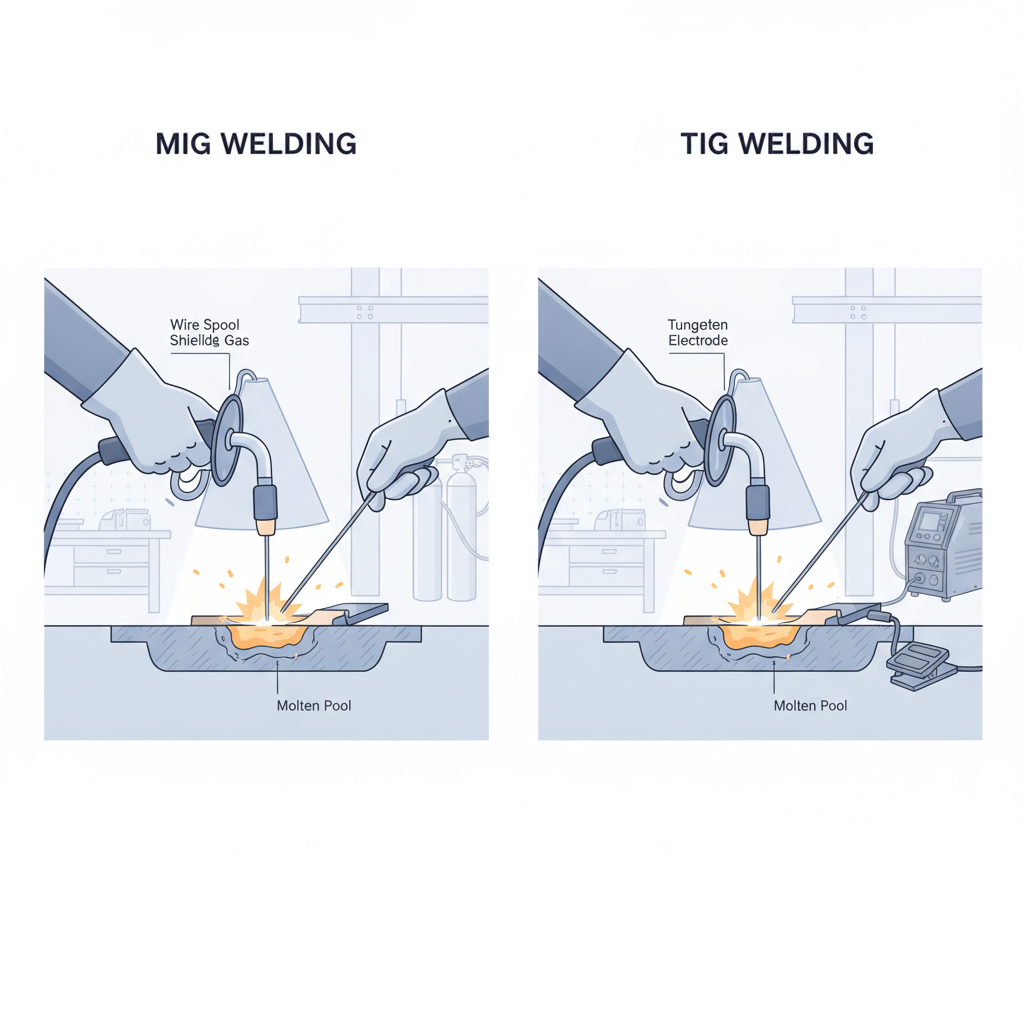
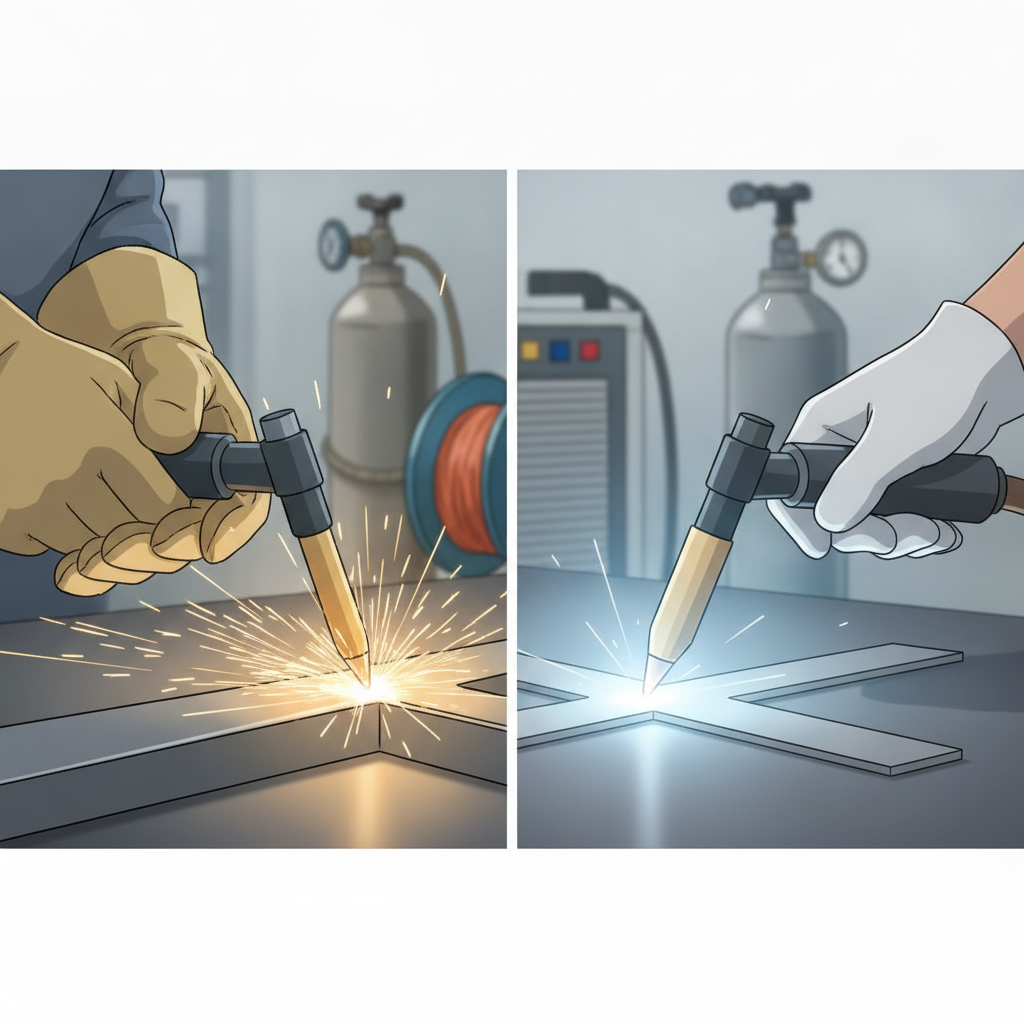
MIG (Metal Inert Gas) welding — technically called GMAW (Gas Metal Arc Welding) — feeds a continuous wire electrode through a gun. The arc melts the wire and the base metal simultaneously, while shielding gas protects the weld pool from contamination. The welder controls the gun; the machine handles the wire feed.
TIG (Tungsten Inert Gas) welding — technically GTAW (Gas Tungsten Arc Welding) — uses a non-consumable tungsten electrode to create the arc. The welder holds the torch in one hand and manually feeds filler rod with the other, while controlling amperage with a foot pedal. Every variable requires active management.
That fundamental difference explains almost everything else: why MIG is faster, why TIG is harder, and why they excel in different situations.
MIG is the workhorse of most fabrication shops and home garages. It’s productive, relatively forgiving, and handles a wide range of common welding tasks without demanding years of technique refinement.
Choose MIG when:
– You’re welding mild steel 1/8 inch and thicker
– Speed and productivity matter more than cosmetic perfection
– You’re doing structural welds, frames, brackets, or repairs
– You’re newer to welding and building fundamentals
– You’re working in an auto body or light fabrication context
One common area where MIG welders struggle is thin-gauge material. Burn-through becomes a real issue below around 18-gauge steel. If you’re working in that range, technique adjustments are essential — something covered in detail in this guide on MIG welding thin metal without burning through.
For most DIY and home-shop welding, a machine like the Lincoln Electric Weld-Pak 140 covers the majority of projects without unnecessary complexity.
When TIG Welding Is the Right Choice
TIG produces the highest quality welds of any arc process. The bead profile is smooth, the heat-affected zone is narrow, and the welder has precise control over every aspect of the puddle. That precision comes at the cost of speed and a much steeper learning curve.
Choose TIG when:
– You’re welding stainless steel and need to preserve corrosion resistance
– Material is thin — tubing, sheet metal, or pipe under 1/8 inch
– Weld appearance is critical (visible joints, food equipment, show cars)
– You’re working with aluminum, copper, titanium, or exotic alloys
– The application demands X-ray or code-quality welds
Exhaust fabrication is a good example where the process choice genuinely matters. Whether exhaust welding uses TIG or MIG depends on material thickness, the application, and whether aesthetics matter — performance builders often TIG weld stainless headers precisely because of the control TIG offers on thin-wall tubing.
TIG also handles unusual materials that MIG simply can’t manage well. If you’ve ever tried to TIG weld copper, you already know how differently exotic metals behave compared to mild steel.
Skill Gap: What It Really Takes to Run Each Process
MIG is genuinely accessible to beginners. Most people can lay a passable bead within an hour. The learning curve flattens quickly — controlling gun angle, travel speed, and standoff distance covers the majority of what you need.
TIG is a different discipline entirely. You’re managing three things simultaneously: the torch position, filler rod feeding, and foot pedal amperage. The tungsten must stay clean — any contact with the puddle contaminates it and requires regrinding before you can continue. Good TIG technique typically takes months of consistent practice to develop.
That said, TIG rewards patience. The precision you develop translates to better understanding of weld puddle behavior, heat input, and fusion — skills that make you a better welder in every process.
Mild Steel: Both processes work well. MIG is faster and more practical for most applications. TIG is preferred when the joint needs to look clean or when welding very thin sections.
Stainless Steel: TIG is the stronger choice. The narrow heat-affected zone minimizes sensitization and preserves corrosion resistance. MIG with tri-mix gas (He/Ar/CO2) works in production settings but rarely matches TIG quality on critical joints.
Aluminum: Both processes handle aluminum, but differently. TIG with a foot pedal gives you real-time heat control, which matters enormously with aluminum’s high conductivity. MIG with a spool gun or push-pull system is faster for thicker aluminum sections. For thin aluminum, TIG wins clearly. If you’re setting up for aluminum MIG work, dialing in the correct settings is critical — an aluminum MIG welding settings chart is worth having as a reference.
Automotive Sheet Metal: This is where both processes compete directly. MIG is faster for panel repair and lap joints, but TIG gives more control on thin body panels where burn-through risk is high. Many restoration shops use TIG for visible areas and MIG for structural sections. For a complete look at this application, the article on welding automotive sheet metal covers the practical approach in detail.
Equipment and Setup Differences
MIG setups are simpler. You need the welder, appropriate wire, and shielding gas. Gas flow rates, wire diameter, voltage, and wire speed are the primary settings. A beginner can be welding within 20 minutes of unboxing.
TIG setups involve more variables: tungsten type and diameter, filler rod selection, cup size, gas lens versus standard collet body, AC versus DC polarity (AC for aluminum, DC for steel and stainless), and foot pedal calibration. The Hobart EZ-TIG 165i is a solid entry point for welders transitioning from MIG to TIG — it’s forgiving on setup without sacrificing capability.
Shielding gas differs between the processes too. MIG typically uses a 75/25 argon/CO2 blend for mild steel or pure argon for aluminum. TIG uses pure argon for most applications regardless of material.
Frequently Asked Questions
Can a beginner learn TIG welding before MIG?
Technically yes, but it’s significantly harder. MIG builds fundamental arc welding instincts — puddle awareness, travel speed, gun angle — that make TIG easier to pick up later. Most instructors recommend MIG first, then TIG once you understand how a weld pool behaves. Jumping straight to TIG without any welding background is possible but extends the learning timeline considerably.
Is TIG stronger than MIG welding?
Not inherently. Weld strength depends on proper fusion, filler selection, and technique — not the process itself. A well-executed MIG weld on structural steel is just as strong as TIG. TIG’s advantage is precision and control, which matters more on thin materials or critical joints than raw strength. Both processes can produce welds that exceed base metal strength when done correctly.
Which process is better for stainless steel exhaust fabrication?
TIG is generally preferred for stainless exhaust work, especially on thin-wall tubing. The precise heat control prevents warping and minimizes oxidation. MIG with short-circuit transfer can work on heavier stainless sections, but TIG produces cleaner, more consistent results on the 16-gauge to 18-gauge material common in performance exhaust systems.
What is the main disadvantage of TIG welding?
Speed. TIG is significantly slower than MIG, which directly affects labor cost on production work. It also requires both hands and one foot to operate simultaneously, and tungsten contamination stops welding entirely until the electrode is reground. For high-volume fabrication where appearance isn’t critical, TIG’s precision isn’t worth the productivity cost.
Can I MIG weld the same materials as TIG?
Most common materials — mild steel, stainless steel, and aluminum — can be MIG welded. TIG has a broader material range that includes copper, titanium, Inconel, magnesium, and dissimilar metal combinations. MIG is also limited by minimum material thickness in a way TIG isn’t, since TIG’s foot pedal lets you reduce amperage precisely as you work around thin areas.
Which process produces less spatter?
TIG produces essentially zero spatter because there’s no wire electrode burning off across an arc gap. MIG spatter varies by mode — spray transfer produces very little, while short-circuit transfer creates more. In most MIG setups, some spatter cleanup is expected. For applications where post-weld cleanup is expensive or problematic, TIG is the cleaner option.
Is MIG or TIG better for welding square tubing on frames or roll cages?
MIG is the practical choice for most frame and structural tubing work where speed and penetration matter. TIG is preferred for roll cages and chassis applications where thin-wall DOM or chromoly tubing requires precise heat input to avoid cracking or distortion. The material — DOM, ERW, or chromoly — matters as much as the process when making this call.
The Practical Takeaway
MIG and TIG aren’t competing processes so much as complementary tools. If your work involves general fabrication, repairs, or structural welding, MIG will cover most of it efficiently. If you’re working with thin materials, exotic metals, or situations where weld appearance or precision is non-negotiable, TIG earns its place.
Most experienced welders keep both capabilities available for exactly that reason. Start with MIG, build your fundamentals, and add TIG when the work demands it.