
Getting aluminum MIG settings wrong is one of the fastest ways to ruin a weld. Porosity, burn-through, cold laps, and wire bird-nesting are all symptoms of dialed-in settings that simply don’t match the material. Aluminum behaves very differently from mild steel — it conducts heat faster, oxidizes instantly, and requires a push technique rather than a drag. This guide gives you a practical aluminum MIG welding settings chart, explains the logic behind each variable, and helps you troubleshoot the most common problems before they waste material or time.
Quick Answer
For most aluminum MIG welding, use 100% argon shielding gas, ER4043 or ER5356 wire, and set voltage between 18–26V depending on material thickness. Wire feed speed typically ranges from 200–500 IPM. Thicker material needs higher voltage, faster wire feed, and a larger wire diameter. Always use a spool gun or push-pull system to prevent wire feeding problems.
The Aluminum MIG Settings Chart
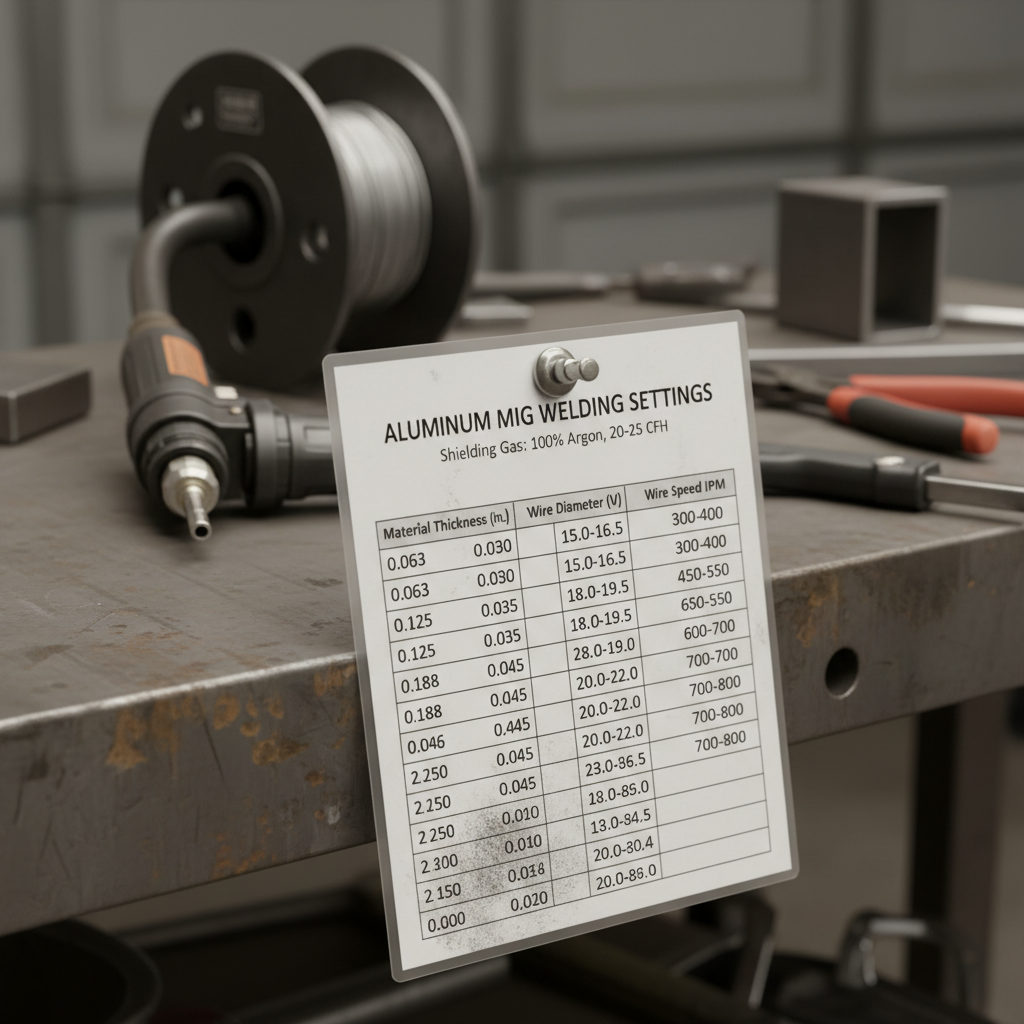
This chart covers the most common aluminum thicknesses welded in fabrication, automotive, marine, and structural applications. Values are starting points — fine-tuning based on your specific machine, joint type, and position is always necessary.
| Material Thickness | Wire Diameter | Voltage (V) | Wire Feed Speed (IPM) | Amperage (Approx.) | Shielding Gas |
|---|---|---|---|---|---|
| 1/16″ (1.6mm) | 0.030″ | 17–19 | 180–220 | 60–80A | 100% Argon |
| 1/8″ (3.2mm) | 0.030″–0.035″ | 19–21 | 250–320 | 90–120A | 100% Argon |
| 3/16″ (4.8mm) | 0.035″ | 21–23 | 320–380 | 130–160A | 100% Argon |
| 1/4″ (6.4mm) | 0.035″–3/64″ | 22–24 | 380–440 | 160–200A | 100% Argon |
| 3/8″ (9.5mm) | 3/64″ | 24–26 | 420–500 | 200–240A | 100% Argon |
| 1/2″ (12.7mm) | 3/64″–1/16″ | 25–28 | 480–560 | 240–280A | 100% Argon |
> Note: These values assume flat or horizontal position welding with a spool gun, clean base metal, and a standard push angle of 10–15 degrees. Vertical or overhead positions typically require reducing voltage by 1–2V and wire feed speed by 10–15%.
Why Aluminum Demands Different Settings Than Steel
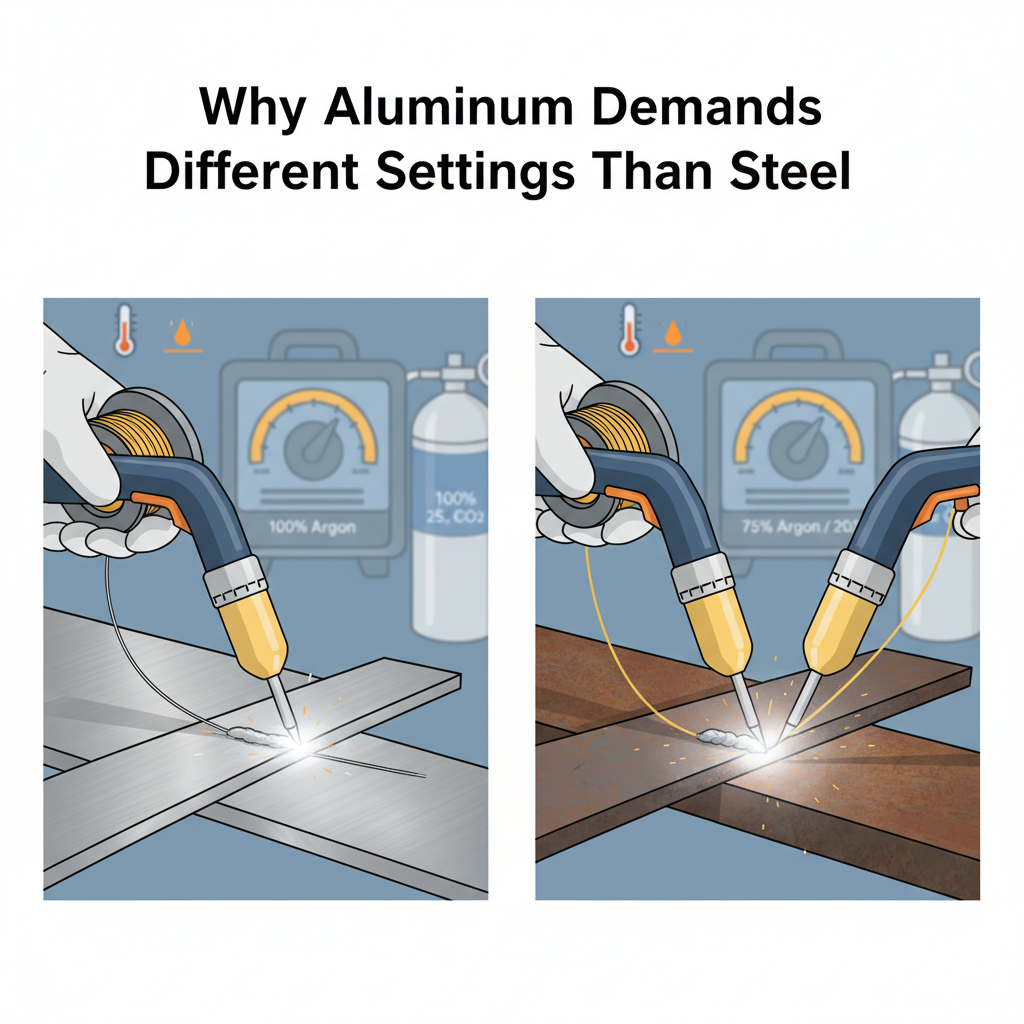
Aluminum’s thermal conductivity is roughly four times higher than mild steel. Heat dissipates through the base metal rapidly, which means you need more heat input upfront — especially at the start of a weld bead.
At the same time, aluminum melts at a much lower temperature (around 1,220°F vs. 2,500°F for steel). That narrow window between “not hot enough” and “burned through” is where most beginners struggle.
The oxide layer on aluminum melts at approximately 3,700°F — far above the base metal’s melting point. This is why proper cleaning and the cathodic cleaning action of DCEP (electrode positive) polarity are essential. MIG welding aluminum always uses DCEP, which helps break up the oxide layer during the arc.
Choosing the Right Wire: ER4043 vs. ER5356
Wire selection affects both weld quality and the settings you’ll use.
ER4043
– Silicon-alloyed wire with excellent fluidity
– Produces softer, more crack-resistant welds
– Better for castings and base alloys in the 6xxx series
– Lower tensile strength (~35,000 PSI)
– Runs slightly easier at lower wire feed speeds
ER5356
– Magnesium-alloyed wire with higher strength
– Better for 5xxx series base metals and structural applications
– Higher tensile strength (~42,000 PSI)
– Slightly stiffer wire — marginally more prone to feeding issues
– Not recommended for elevated-temperature service above 150°F
In practice, ER4043 is the more forgiving choice for general fabrication and repair work. ER5356 is the right call when strength matters more than ease of welding.
Spool Gun vs. Push-Pull: Which Setup You Actually Need
Standard MIG guns with a 10–15 foot liner are not designed for aluminum wire. Aluminum is soft, and the wire kinks, bird-nests, and jams in a conventional steel liner almost every time.
Spool Gun
– Holds a small spool of wire directly at the gun
– Eliminates the long feed path — virtually no bird-nesting
– Best for occasional aluminum welding or shop use
– Limited to smaller wire diameters and lower-duty cycles
Push-Pull System
– Uses a motorized drive at both the wire feeder and gun
– Maintains consistent tension over long cable runs
– Better for production welding and larger spools
– Higher cost, but significantly more reliable for continuous use
For most hobbyists and small shops, a spool gun is the practical choice. Production environments or anyone running aluminum wire for hours at a time should invest in a push-pull setup.
Common Problems and What’s Actually Causing Them
Porosity (Small Holes in the Weld Bead)
Porosity in aluminum almost always comes from contamination or inadequate shielding gas coverage.
– Cause: Oil, moisture, or oxide on the base metal; gas flow too low or too high; drafts disrupting the gas shield
– Fix: Clean aluminum with a dedicated stainless steel brush (never use one that’s touched steel), wipe with acetone before welding, set gas flow to 20–30 CFH, and shield the work area from wind
Burn-Through on Thin Material
Thin aluminum (under 1/8″) is unforgiving. Too much heat input and you’re welding air.
– Cause: Voltage or wire feed speed too high; travel speed too slow; no backing material
– Fix: Reduce voltage by 1–2V, increase travel speed, use a copper or aluminum backing bar to absorb heat, and consider pulsed MIG if your machine supports it
Wire Bird-Nesting at the Drive Rolls
– Cause: Drive roll pressure too high (crushes soft aluminum wire), wrong liner material, sharp bends in the cable
– Fix: Use U-groove drive rolls designed for aluminum, reduce drive roll tension to the minimum that still feeds consistently, use a Teflon or nylon liner, and keep the gun cable as straight as possible
Cold Laps and Lack of Fusion
The bead sits on top of the base metal instead of fusing into it.
– Cause: Travel speed too fast, voltage too low, or oxide layer not properly cleaned
– Fix: Slow down slightly, increase voltage by 1V increments, and re-clean the base metal
Expert Tips That Make a Real Difference
– Preheat thick sections. Material over 3/8″ benefits from preheating to 200–300°F. This reduces the heat sink effect and improves fusion at the start of the weld.
– Use a push angle, not a drag. Always push the gun away from the completed weld. Dragging traps shielding gas and creates porosity.
– Keep the contact tip recessed. Aluminum expands significantly when hot. A slightly recessed tip (1–2mm) reduces tip burnback.
– Replace your liner regularly. Aluminum deposits residue inside the liner over time. A contaminated liner is a hidden cause of feeding problems and inconsistent arc quality.
– Don’t reuse wire left on an open spool. Aluminum oxidizes quickly. Wire that’s been sitting exposed for weeks may cause porosity even if the base metal is clean.
FAQ
What gas do you use for aluminum MIG welding?
Always use 100% argon for aluminum MIG welding. Argon provides the cathodic cleaning action needed to break through aluminum’s oxide layer and produces a stable arc. Helium or argon-helium blends are used in some industrial applications for deeper penetration on thick material, but 100% argon is the standard for most shop and fabrication work. Never use CO2 or argon-CO2 blends — they will cause severe porosity and arc instability on aluminum.
What wire feed speed should I use for 1/8″ aluminum?
For 1/8″ aluminum with 0.030″ or 0.035″ ER4043 wire, a wire feed speed of 250–320 IPM is a reliable starting range. Set voltage to 19–21V and adjust from there. If the arc sounds harsh and spatter is excessive, reduce wire feed speed slightly. If the bead is cold and lacks fusion, increase both voltage and wire feed speed in small increments.
Can I MIG weld aluminum without a spool gun?
Technically possible, but not practical. Aluminum wire is too soft to feed reliably through a standard 10–15 foot MIG gun liner. Bird-nesting and inconsistent wire feed are almost guaranteed. A spool gun or push-pull system is the correct tool for aluminum MIG welding. Some welders use a very short gun cable (under 6 feet) with a Teflon liner as a workaround, but results are inconsistent compared to a proper spool gun setup.
Why does my aluminum weld look black and sooty?
Black soot around an aluminum weld bead usually indicates contamination or inadequate shielding gas coverage. Check that your gas flow rate is 20–30 CFH, verify there are no leaks in the gas line, clean the base metal thoroughly with acetone and a dedicated stainless brush, and ensure you’re not welding in a drafty environment. Soot can also result from a contaminated or worn contact tip — replace it and see if the issue clears.
What’s the difference between welding 6061 and 5052 aluminum?
6061 is a heat-treatable alloy commonly used in structural and machined parts. It welds well with ER4043 wire, which compensates for 6061’s tendency toward hot cracking. ER5356 can also be used but requires more care. 5052 is a non-heat-treatable alloy with good corrosion resistance, commonly used in marine and sheet metal applications. It pairs well with ER5356 wire. Settings for both alloys are similar at equivalent thicknesses — the wire choice matters more than adjusting voltage or amperage.
How do I prevent burn-through when welding thin aluminum sheet?
Use the lowest voltage that still produces a stable arc, increase travel speed, and use a copper or aluminum backing bar clamped behind the joint to absorb excess heat. Tack frequently to control distortion and heat buildup. If your machine has a pulsed MIG function, use it — pulse welding significantly reduces heat input on thin material while maintaining good fusion. Preheating is not recommended for thin sheet; it makes burn-through worse.
Does aluminum MIG welding require a special contact tip?
Yes. Use contact tips sized slightly larger than the wire diameter — for example, a 0.040″ tip with 0.035″ wire. Aluminum expands when heated, and a standard close-tolerance tip will seize up as the wire heats and swells inside it. Recessed tips also help reduce burnback. Replace tips more frequently than you would with steel wire, as aluminum deposits residue inside the tip bore over time.
Final Thoughts
Getting aluminum MIG settings right comes down to matching wire diameter and voltage to material thickness, using 100% argon at the correct flow rate, and having the right feeding system for the wire. The chart in this guide gives you a solid starting point, but every machine behaves slightly differently — treat those numbers as a baseline and adjust based on what you hear and see in the arc. Clean metal, a proper push angle, and a spool gun will solve the majority of problems before they start.
Meta Description: Get the complete aluminum MIG welding settings chart — voltage, wire feed speed, amperage, and gas by thickness. Includes troubleshooting tips and wire selection guidance.