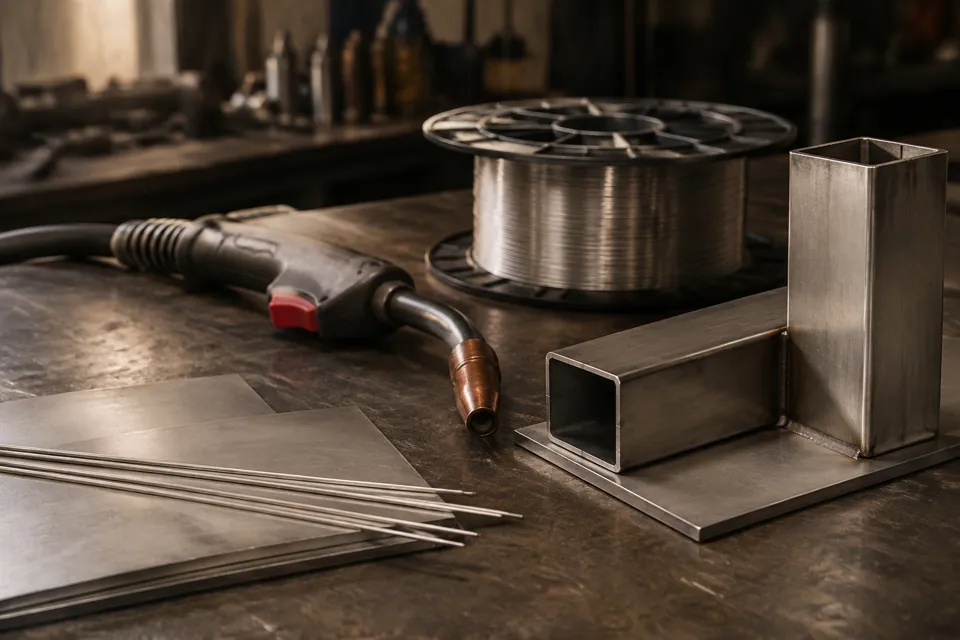
Choosing the wrong shielding gas for stainless steel is one of the fastest ways to ruin an otherwise good weld. The gas mixture affects arc stability, corrosion resistance, weld appearance, and whether the chromium oxide layer stays intact.
The standard gas for MIG welding stainless steel is a tri-mix blend: 90% helium, 7.5% argon, and 2.5% CO₂ — commonly called “Trimix” or “HeliStar.” For most shop and fabrication work, a simpler 98% argon / 2% CO₂ mix also works well and is more widely available. Pure CO₂ and standard C25 (75/25 argon/CO₂) used for mild steel should be avoided — the excess carbon degrades stainless steel’s corrosion resistance.
Why Shielding Gas Matters More with Stainless Steel
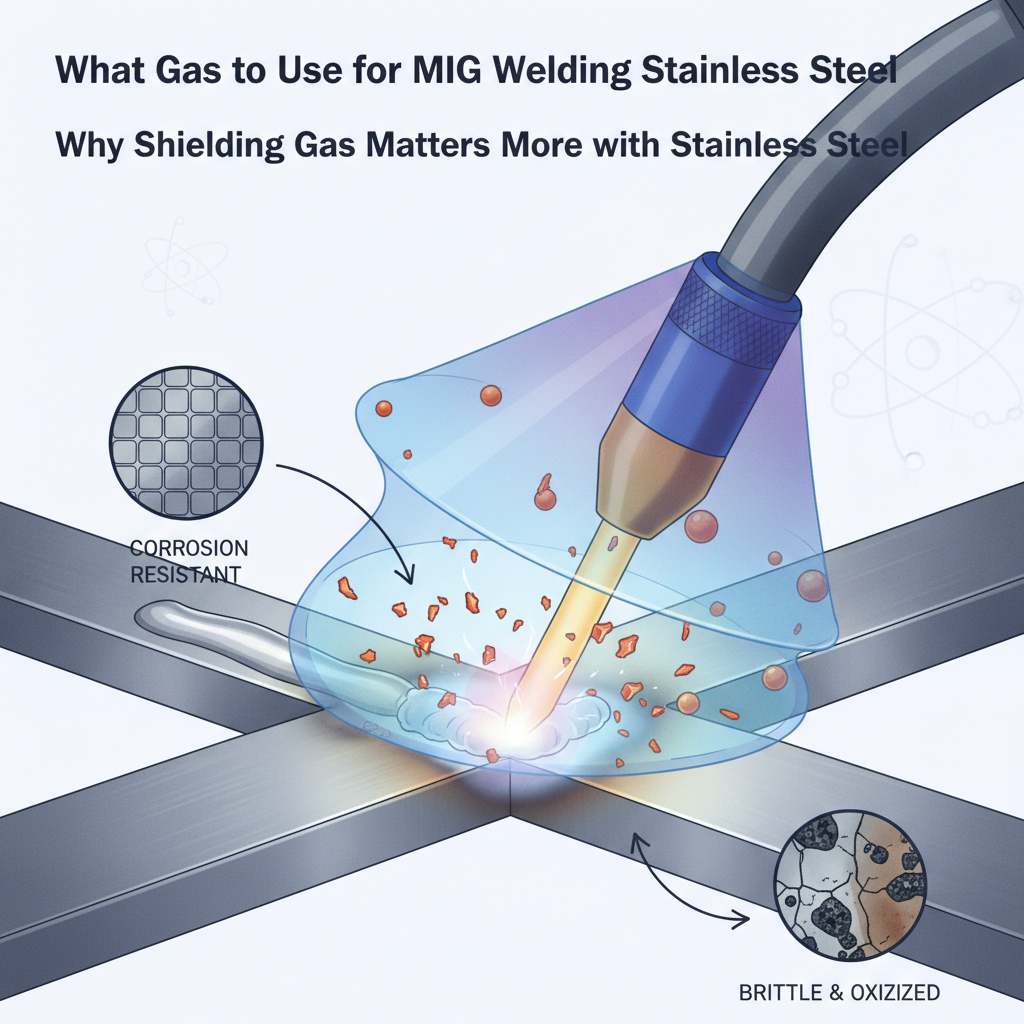
Stainless steel gets its corrosion resistance from chromium — typically at least 10.5% by weight. When you weld it, that chromium is vulnerable to oxidation and carbide precipitation if the gas mix isn’t right.
Using a gas with too much CO₂ or oxygen introduces excess carbon into the weld pool. This causes what welders call sensitization — a process where chromium carbides form along grain boundaries, pulling chromium away from the surface and creating weak points where rust can develop.
That’s why the gas rules for stainless are stricter than for mild steel. It’s not just about weld appearance. It’s about preserving the material’s fundamental properties.
The Two Main Gas Options for Stainless MIG Welding
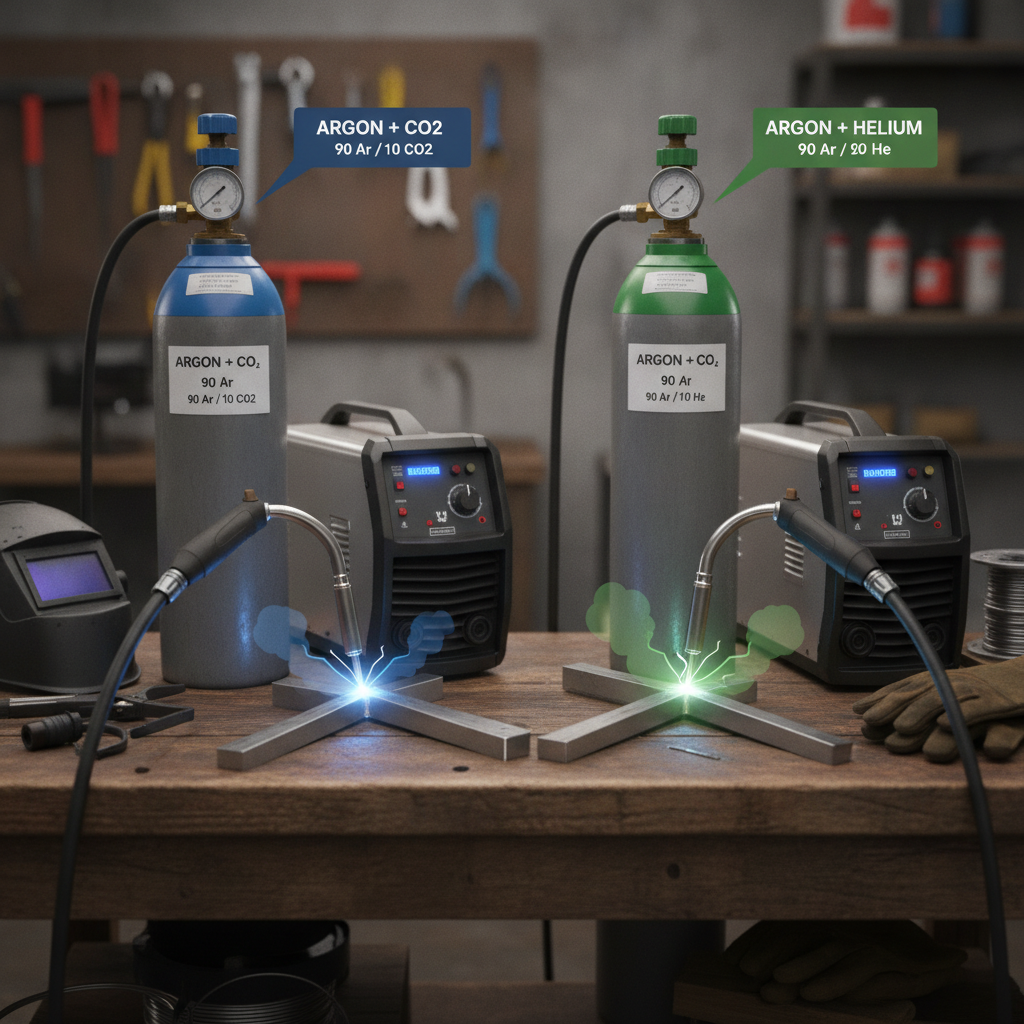
98% Argon / 2% CO₂ (C2 Mix)
This is the go-to choice for most welders working with stainless. It’s widely stocked at welding supply stores, affordable, and produces clean welds with minimal discoloration.
The 2% CO₂ content helps stabilize the arc without introducing enough carbon to cause sensitization. Weld bead appearance is generally smooth, and spatter is low.
Best for: General fabrication, food-grade equipment, handrails, brackets, automotive trim, and everyday shop work.
90% Helium / 7.5% Argon / 2.5% CO₂ (Tri-Mix)
The helium in this blend increases arc energy and heat input, which improves fusion and travel speed — especially on thicker stainless material. The higher heat also helps reduce the risk of lack-of-fusion defects.
Tri-mix produces excellent weld quality and a cleaner bead profile, but it costs more and isn’t always available at every supplier. Some shops keep it on hand for critical structural applications.
Best for: Thicker stainless (3/16″ and above), structural welds, pressure vessels, and applications where penetration and fusion quality are critical.
| Gas Mix | Composition | Best Use | Notes |
|---|---|---|---|
| C2 Argon Mix | 98% Ar / 2% CO₂ | General stainless fab | Widely available, affordable |
| Tri-Mix | 90% He / 7.5% Ar / 2.5% CO₂ | Thick material, structural | Better penetration, higher cost |
| 100% Argon | 100% Ar | TIG welding (not MIG) | Poor arc stability for MIG |
| C25 | 75% Ar / 25% CO₂ | Mild steel only | Damages stainless corrosion resistance |
| 100% CO₂ | 100% CO₂ | Mild steel only | Not suitable for stainless |
What Happens If You Use the Wrong Gas
Using C25 or straight CO₂ on stainless steel is a common mistake, usually because a welder switches from mild steel work without changing the cylinder.
In the short term, the weld may look acceptable. But the excess CO₂ causes carbide precipitation along the heat-affected zone. The result is a weld that looks solid but corrodes prematurely — especially problematic in food service equipment, marine applications, or outdoor structures.
Another issue is excessive oxidation and discoloration. Stainless welded with the wrong gas will show heavy sugaring on the back side of the weld and dark, rough bead surfaces that require significant cleanup.
If you’re unsure about why stainless steel is harder to weld correctly than it looks, the sensitivity to heat and gas contamination is a big part of the answer.
Flow Rate and Pressure Settings
Gas selection matters, but so does delivery. Running the gas at the wrong flow rate causes porosity even if the mix itself is correct.
For most stainless MIG work:
- Flow rate: 20–30 CFH (cubic feet per hour)
- Nozzle-to-work distance: ½” to ¾”
- Cup/nozzle size: Larger nozzles help maintain consistent coverage
Drafty environments require higher flow rates — sometimes up to 35 CFH. Welding outdoors with any air movement makes shielding gas coverage unreliable regardless of mix, which is one reason stainless MIG is better suited to shop or sheltered environments.
For a more detailed look at MIG welding gas pressure settings for different applications, proper regulator setup plays a larger role than most beginners expect.
Gas Choices by Stainless Steel Grade
Most common stainless grades weld similarly from a gas standpoint, but there are a few nuances worth knowing.
304 stainless steel is the most commonly welded grade. Both C2 and tri-mix work well. MIG welding 304 stainless steel with 98/2 argon/CO₂ produces consistent results for most fabrication applications.
316 stainless steel is used in marine and chemical environments where extra corrosion resistance matters. Tri-mix is preferred here because of the higher nickel and molybdenum content — the material benefits from the additional heat and penetration the helium provides.
409 and 430 ferritic stainless steels are common in automotive exhaust applications and are more forgiving with gas selection, though C2 mix remains the safer choice.
For exhaust work specifically, the choice between TIG and MIG for welding exhausts often comes down to access and joint configuration, not just gas.
Practical Tips for Cleaner Stainless MIG Welds
Even with the right gas, stainless MIG has a few quirks that catch welders off guard.
- Keep the tungsten clean — if you’re TIG welding alongside MIG, contamination transfers easily between setups
- Use dedicated stainless wire brushes — a carbon steel brush introduces iron contamination that promotes rust
- Don’t drag the gun — a slight push angle (5–10°) improves shielding coverage and reduces porosity
- Watch your heat input — stainless conducts heat poorly compared to mild steel, so it warps more easily; keep passes short and allow cooling between them
- Clean the base metal — acetone or a dedicated stainless cleaner removes oils and surface contamination that cause porosity regardless of gas quality
Getting your MIG welding stainless steel settings dialed in correctly — voltage, wire feed speed, and travel speed — matters just as much as the gas you’re running.
For welders who use the Lincoln Electric SuperArc L-56 or similar ER308L stainless wire, pairing it with a 98/2 argon/CO₂ blend is the most reliable starting point for general work.
FAQ
Can I use 100% argon for MIG welding stainless steel?
Pure argon provides poor arc stability for MIG welding stainless. Without a reactive component like CO₂, the arc tends to wander and produce irregular bead profiles. It’s the correct gas for TIG welding stainless, but not for MIG. Always use a mix with a small percentage of CO₂ for better arc performance in MIG applications.
What’s the minimum CO₂ percentage safe for stainless steel MIG welding?
Staying at or below 2–3% CO₂ is the generally accepted safe range for stainless. At these levels, the arc stabilizes without causing significant carbide precipitation or sensitization. Once CO₂ rises above about 5%, the risk to the material’s corrosion resistance increases noticeably, particularly in the heat-affected zone.
Is tri-mix gas worth the extra cost for home welding?
For most home shop work on thin stainless — handrails, decorative pieces, brackets — 98/2 argon/CO₂ performs well and is significantly cheaper. Tri-mix makes a real difference on thicker material or critical structural joints where penetration and fusion quality are more demanding. For occasional hobby use, the standard C2 blend is the practical choice.
Can I use the same gas for stainless as I use for mild steel?
No. The C25 mix (75% argon / 25% CO₂) commonly used for mild steel contains too much CO₂ for stainless welding. It will cause sensitization in the heat-affected zone, degrading corrosion resistance over time. Always switch to a stainless-rated gas mix when changing materials.
What gas do professional welders use for MIG welding stainless in food-grade applications?
Food-grade and sanitary stainless applications — dairy equipment, food processing lines, pharmaceutical fittings — often require full penetration, smooth inside bead surfaces, and zero corrosion. Professional welders in these environments frequently use tri-mix or back-purge with argon on the root side while MIG welding the exterior with C2 mix to protect the inside of the joint from oxidation.
Does gas choice affect the color of the weld bead on stainless?
Yes. The right gas mix keeps discoloration minimal — a light gold or straw color indicates acceptable heat and good shielding. Heavy blue, grey, or black coloration signals oxidation, which usually points to insufficient gas coverage, wrong gas mix, or excessive heat input. Light discoloration can be cleaned with a dedicated stainless passivation product.
What flow rate should I use when MIG welding stainless steel?
A flow rate between 20–30 CFH is standard for most stainless MIG work in a sheltered environment. Outdoors or in drafty conditions, increase to 30–35 CFH and consider using a wind barrier. Too low a flow rate causes porosity; too high can create turbulence that draws atmospheric air into the shielding zone.
For most stainless MIG welding, 98% argon / 2% CO₂ is the practical standard — it’s available, affordable, and delivers reliable results across common grades and thicknesses. Reserve tri-mix for thicker material or critical structural applications where the extra penetration and heat input genuinely matter. Whatever mix you use, keep flow rates consistent, use clean stainless-specific consumables, and verify your settings on scrap before committing to the final workpiece.