
How Each Process Actually Works
Same Machine, Different Process
The Two Types of Flux Core Wire
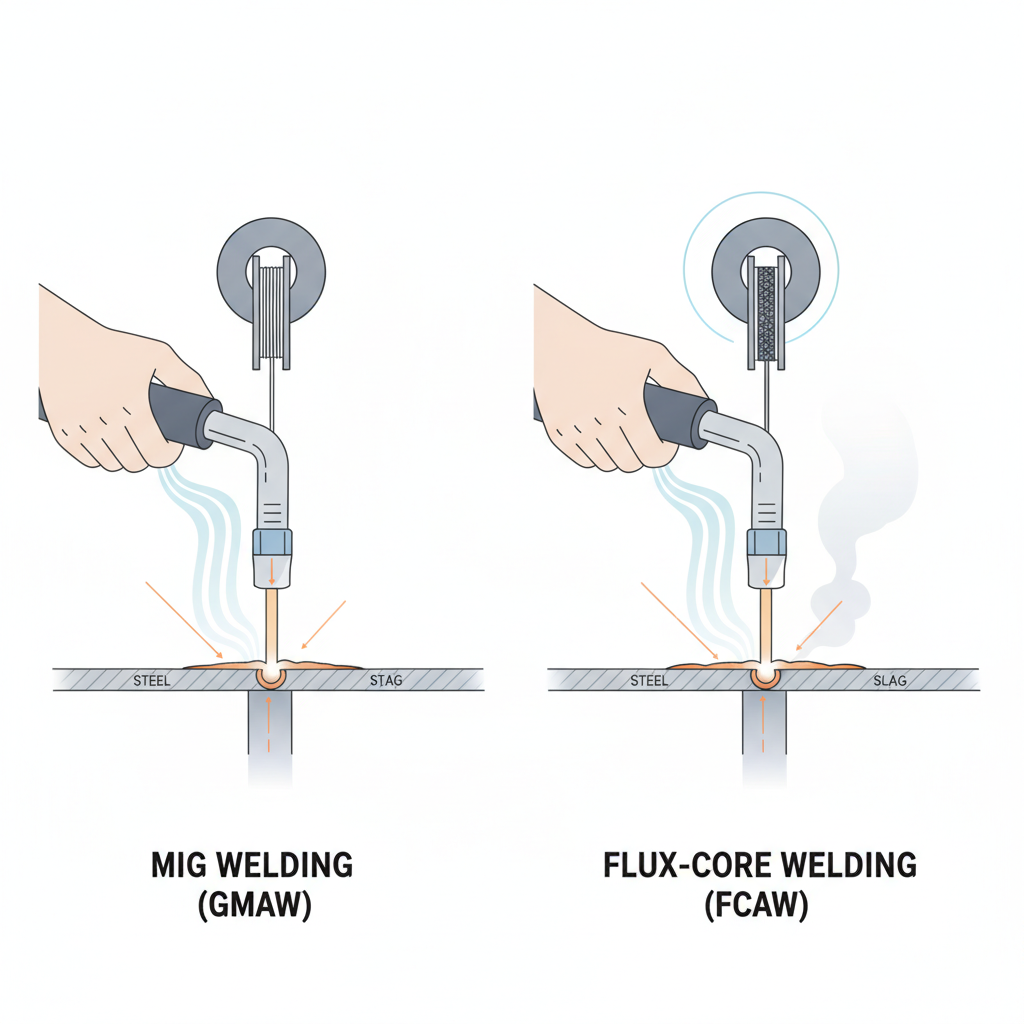
Not all flux core wire behaves the same way. There are two distinct variations, and mixing them up causes real problems. Self-shielded flux core (FCAW-S): The wire generates all of its own shielding from the flux core. No gas cylinder needed. This is the type most beginners encounter — it’s what you’re running when someone says “gasless MIG welding.” It’s ideal for outdoor work and portability. Understanding whether flux core needs a shielding gas matters here because self-shielded wire changes polarity requirements and technique compared to solid wire. Dual-shield flux core (FCAW-G): This wire uses both an internal flux core and an external shielding gas. It produces cleaner, stronger welds than self-shielded flux core and is the preferred choice in professional and structural welding environments. Most home welders and hobbyists are running self-shielded flux core. Most production welding shops running flux core are using dual-shield.Why People Call Flux Core “Gasless MIG”
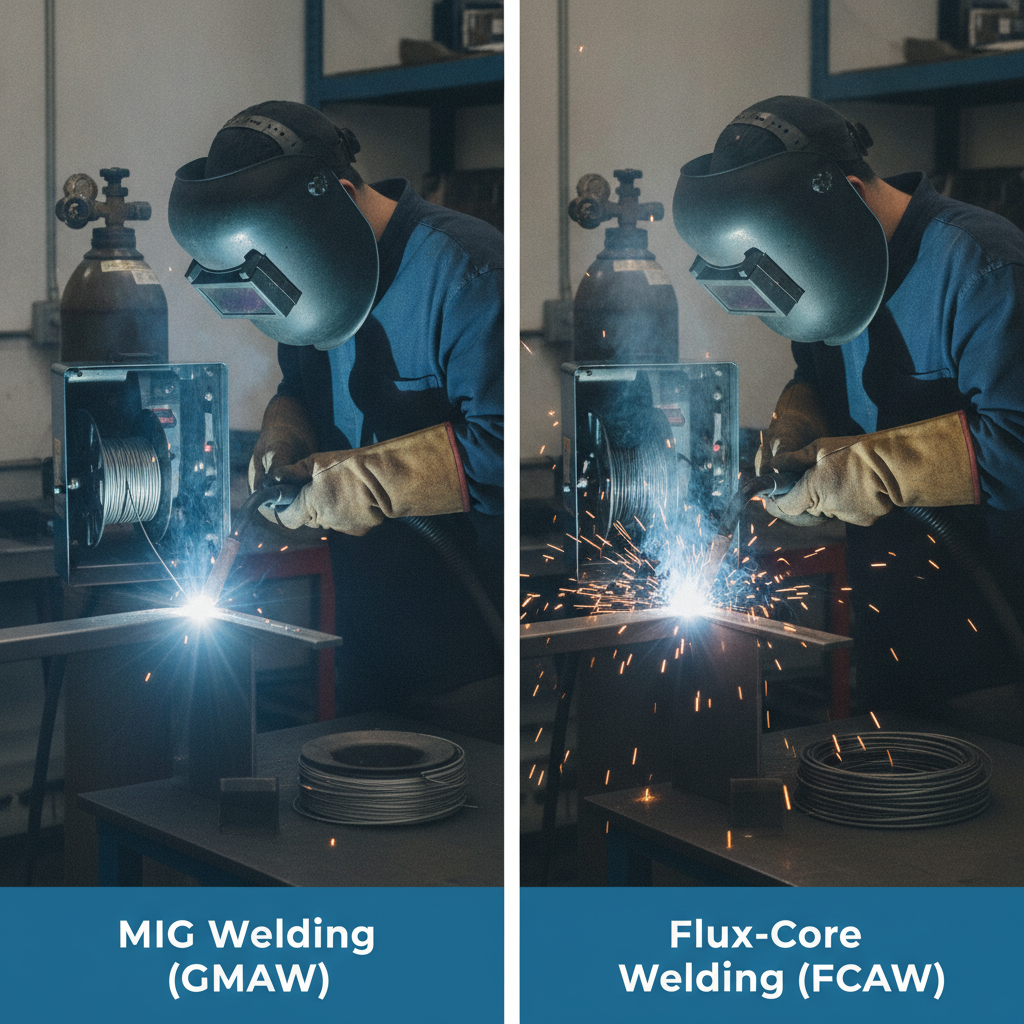
The term “gasless MIG” is technically inaccurate but practically understandable. Self-shielded flux core runs on a wire-feed machine, uses the same torch style as MIG, and doesn’t require a gas bottle. For someone shopping for a welder or watching a YouTube tutorial, calling it gasless MIG makes sense in context. In practice, the welding community uses MIG as a catch-all term for wire-feed welding, even when the process is technically FCAW. Manufacturers lean into this — machines are often marketed as “MIG/flux core welders” even though MIG and flux core are separate processes operating on shared hardware. For most garage and home welding projects, the distinction matters when it affects technique and results, not just terminology.When to Use Each Process
Use solid wire MIG welding when: – You’re welding clean, thinner metal (auto body, sheet metal, light fabrication) – You want cleaner, more cosmetically appealing welds – You’re working indoors with good ventilation – Post-weld cleanup needs to be minimal Use flux core welding when: – You’re welding outdoors or in windy conditions – The base metal has mill scale, rust, or light surface contamination – You need deeper penetration on thicker steel – You want a portable setup without a gas cylinder Flux core welding is particularly well-suited for structural repairs, farm equipment, and heavy outdoor fabrication where shielding gas would be impractical.Polarity Is Not Optional
One of the most common mistakes when switching between MIG and self-shielded flux core is forgetting to swap polarity. MIG welding runs DCEP (direct current electrode positive). Most self-shielded flux core wire runs DCEN (direct current electrode negative). Running self-shielded flux core on DCEP polarity produces poor fusion, excessive spatter, and weak welds. It’s a frustrating mistake that’s easy to miss if you’re not checking the setup. The polarity swap is typically made at the wire drive housing inside the machine — not at an external switch. Always check the wire manufacturer’s spec sheet. Some wires deviate from the standard.Technique Differences Worth Knowing
The gun angle and travel direction also differ between the two processes. MIG welding generally allows both push and pull techniques depending on the joint. Flux core welding typically requires a drag (pull) technique — moving the gun away from the weld pool — to keep the slag ahead of the arc from contaminating the bead. Getting the push versus pull technique right in flux core directly affects bead quality, fusion, and slag inclusion. It’s one of the first technique adjustments beginners need to make when moving from solid wire MIG to flux core. Flux core also produces slag that needs to be chipped and wire-brushed off after each pass. MIG welding leaves no slag. For multi-pass welds, that cleanup step between passes is non-negotiable with flux core.Setting Up for Flux Core vs. MIG
Dialing in the right wire speed and voltage matters in both processes, but flux core tends to be less forgiving when settings are off. Porosity, excessive spatter, and weld cracking often trace back to voltage or wire feed speed being out of range for the wire diameter and material thickness. Using a reliable flux core MIG welding settings chart as a starting reference saves a lot of trial and error, especially when you’re switching wire types or changing material thickness. If you’re just getting started with a dual-process machine, the YESWELDER MIG-205DS Pro is a practical example of a welder that handles both solid wire MIG and flux core on the same unit, with polarity switching made accessible to beginners.FAQ
Can I use flux core wire in a MIG welder? Yes. Most wire-feed MIG welders support flux core wire, provided you switch to the correct polarity (usually DCEN for self-shielded flux core), adjust the drive roll to a knurled type for tubular wire, and remove the gas nozzle from the gun tip. Always verify that your machine’s amperage range matches the wire diameter you’re using. Is flux core welding stronger than MIG welding? Not categorically. Properly executed MIG welds and flux core welds can both meet structural strength requirements. Flux core tends to offer deeper penetration on thicker material, which can be an advantage on dirty or heavy steel. For thinner material in clean conditions, solid wire MIG typically produces more consistent, higher-quality welds. Why does flux core welding produce more spatter than MIG? The flux combustion process inside the wire arc generates more turbulence at the weld pool compared to the cleaner, gas-shielded arc of MIG welding. Higher wire feed speeds and voltage settings also contribute. Anti-spatter spray helps with cleanup, but some spatter is inherent to self-shielded flux core. Do I need to clean flux core slag between passes? Yes, always. Slag left between passes causes slag inclusions, which are a structural weld defect. Chip the slag with a chipping hammer, then wire brush the bead clean before running the next pass. This is one of the main workflow differences compared to MIG welding, which produces no slag. What wire diameter should a beginner use for flux core? For general home and hobbyist welding on mild steel up to 3/16 inch, .030-inch or .035-inch self-shielded flux core wire is the most practical starting point. Thicker wire requires more amperage than many entry-level machines can provide, and thinner wire can be tricky to dial in without some experience. Is dual-shield flux core better than self-shielded flux core? For weld quality and mechanical properties, dual-shield flux core generally outperforms self-shielded wire. It produces lower spatter, better bead appearance, and stronger welds. However, it requires a shielding gas cylinder, making it less portable. Most professional applications involving structural steel use dual-shield; most hobbyist and outdoor welding uses self-shielded. Can you weld outdoors with a MIG welder? Technically yes, but wind is a serious problem. Even a light breeze can disrupt the shielding gas envelope and cause porosity in solid wire MIG welds. In practice, outdoor welding almost always favors self-shielded flux core because it doesn’t rely on an external gas shield that can be blown away.Flux core and MIG welding share a platform but operate differently in ways that matter — wire type, shielding method, polarity, technique, and cleanup all change between the two. For most home welders, understanding those differences makes switching between processes straightforward rather than confusing. The machine stays the same; the setup and technique adapt to the job.