Choosing the wrong shielding gas for aluminium MIG welding is one of the most common reasons welds fail — even when the technique is correct. The gas isn’t just a background detail. It directly controls arc stability, weld quality, and porosity.
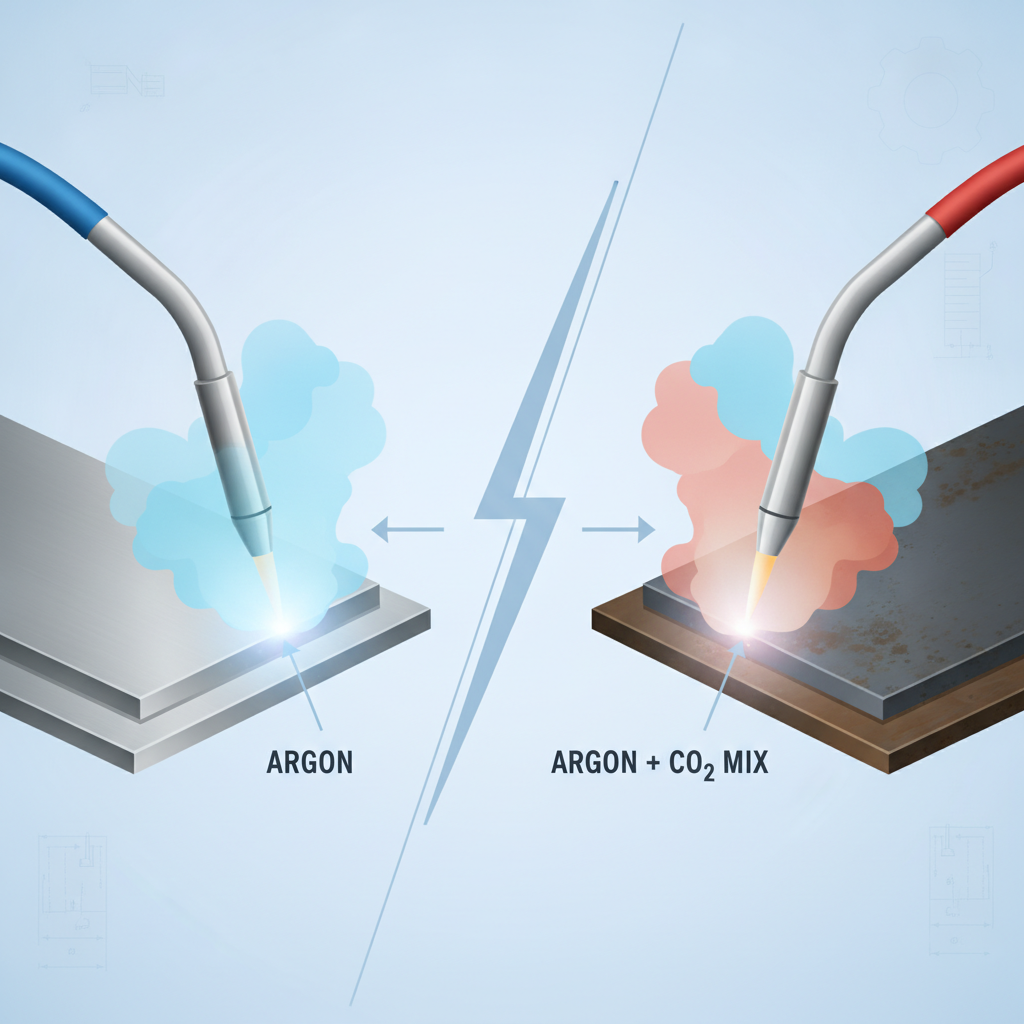
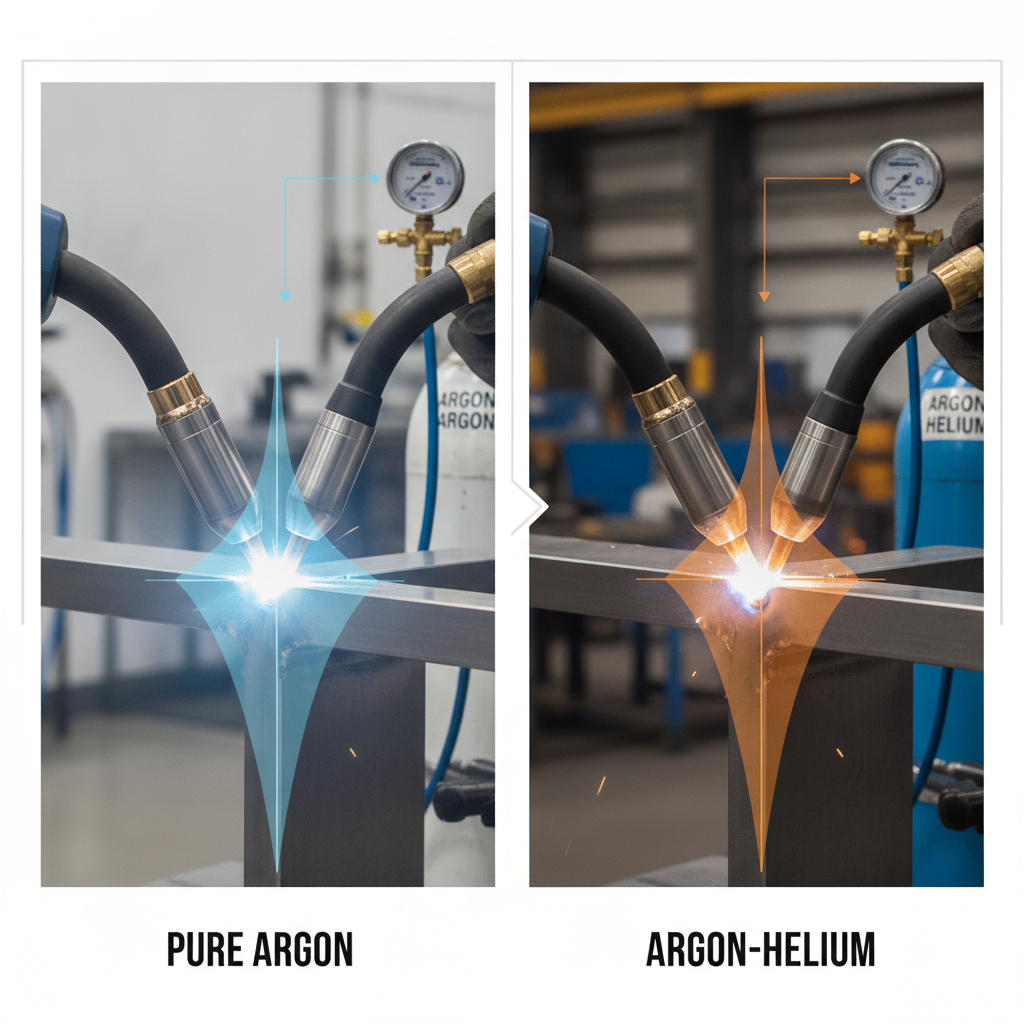
The correct gas for aluminium MIG welding is pure argon (100% Ar). Argon provides the stable, smooth arc aluminium requires and protects the weld pool from atmospheric contamination. For thicker aluminium sections above approximately 25mm, an argon-helium mix (typically 75% Ar / 25% He or 50/50) can improve penetration and travel speed. CO₂ and argon-CO₂ mixes used for mild steel are not suitable for aluminium.
Why Aluminium Needs a Different Gas Than Steel
Aluminium behaves nothing like mild steel during welding. Its oxide layer melts at roughly 2050°C while the base metal beneath melts at only 660°C. This means the arc must break through that oxide layer without causing immediate burn-through.
Pure argon achieves this through a process called cathodic cleaning. The argon arc produces positive ions that physically blast away the aluminium oxide layer as welding progresses. CO₂, which works well for steel, creates an oxidising atmosphere that actively interferes with this cleaning action and causes severe porosity.
Using a CO₂ blend on aluminium will almost always produce a porous, contaminated weld — even with correct technique. Choosing the correct MIG shielding gas is as important as your wire selection or machine settings.
Pure Argon vs Argon-Helium: When Each Makes Sense
For most aluminium MIG welding, pure argon is the right choice. It’s cost-effective, widely available, and handles everything from thin sheet metal to medium-thickness structural work without complications.
Argon-helium mixtures add heat energy to the arc. Helium has higher thermal conductivity than argon, which means it transfers more heat into the base metal per unit of time. This translates to deeper penetration and faster travel speeds on thicker material.
| Gas | Typical Use | Penetration | Arc Stability | Cost |
|—|—|—|—|—|
| 100% Argon | All general aluminium MIG | Moderate | Excellent | Lower |
| 75% Ar / 25% He | Thicker sections, higher productivity | Good | Good | Higher |
| 50% Ar / 50% He | Heavy plate, industrial applications | Deep | Moderate | Higher |
| 100% Helium | Rarely used for MIG | Very deep | Poor | Highest |
In practice, most hobbyists and small fabrication shops will never need helium mixes. Pure argon covers the vast majority of aluminium work up to around 20–25mm thickness. Argon-helium becomes genuinely useful in production environments where throughput matters or when welding thicker marine-grade aluminium plate.
Flow Rate Settings for Aluminium MIG
Getting the flow rate right matters almost as much as the gas itself. Too low and the shielding coverage breaks down, causing porosity. Too high and turbulence pulls atmospheric air into the weld zone — which causes exactly the same problem.
For aluminium MIG welding, a flow rate of 15–20 litres per minute (LPM) is the typical starting range. Some situations call for slightly higher rates:
– Drafty environments or outdoor work — increase to 20–25 LPM
– Using a spool gun with a longer torch body — may need 18–22 LPM
– Tight joints or confined areas — standard 15–20 LPM is usually sufficient
Check your regulator gauge before each session. Aluminium welding is sensitive to shielding inconsistency, and even a partially empty cylinder can cause flow rate drops that introduce porosity mid-weld. For a more detailed breakdown, understanding the correct gas flow rate for MIG welding will help you dial in the right number for your setup.
Spool Gun vs Standard MIG Torch and Gas Delivery
Aluminium wire is soft and prone to bird-nesting when fed through a standard MIG torch with a long liner. Most shops use a spool gun to solve this — and the gas setup stays essentially the same.
Whether you’re using a spool gun or a standard push-pull system, the gas type doesn’t change. Pure argon remains the correct choice. However, spool gun setups sometimes require slight adjustments to flow rate because the torch geometry differs from a standard MIG gun.
If you’re running a spool gun for aluminium MIG welding, make sure the gas hose connections are sealed properly. Even a small leak at a quick-connect fitting can introduce enough air contamination to cause persistent porosity that’s difficult to diagnose.
Getting the Full Settings Picture
Gas selection is just one part of the equation. Once you have your pure argon connected and flowing correctly, voltage, wire speed, and travel angle also need to be dialled in for the specific aluminium alloy and thickness you’re working with.
Aluminium typically requires higher wire feed speeds than steel at comparable thicknesses because of its thermal properties. Using a complete aluminium MIG welding settings chart alongside your gas setup will give you a reliable starting point for both thin sheet and heavier sections.
Common Gas-Related Problems and Their Causes
Porosity is the most visible sign of gas issues in aluminium MIG welding. It appears as small pits or holes on the weld surface or inside the bead when cross-sectioned.
Diagnosing the most likely cause:
– Scattered porosity throughout the weld — usually insufficient gas coverage, too-low flow rate, or a contaminated gas supply
– Porosity at weld starts and stops — gas pre-flow or post-flow timing is off; check regulator and torch settings
– Linear porosity along the bead — drafts or turbulence disrupting shielding; check for leaks or increase flow rate slightly
– Consistent porosity despite correct flow — check the cylinder for moisture contamination; aluminium is highly sensitive to hydrogen from moisture
– Rough, spitting arc — wrong gas type; confirm pure argon, not a CO₂ blend
One real-world issue that’s easy to overlook: moisture in the gas line. If a cylinder has been stored in a cold environment and then brought into a warm shop, condensation can form internally. Purging the line for a few seconds before welding helps eliminate this.
FAQ
Can you use CO₂ for aluminium MIG welding?
No. CO₂ creates an oxidising atmosphere that prevents proper cathodic cleaning of the aluminium oxide layer. It causes severe porosity, poor fusion, and an unstable arc. Even small percentages of CO₂ in a mix are problematic for aluminium. Always use pure argon or an argon-helium blend specifically intended for aluminium.
Can you use the same gas for aluminium as for steel?
Not if you’re using C25 (75% argon / 25% CO₂), which is the most common steel MIG gas. The CO₂ content makes it unsuitable for aluminium. If you’re welding both materials, you’ll need separate cylinders — pure argon for aluminium and your preferred mix for steel.
What argon purity do you need for aluminium MIG welding?
Use welding-grade argon with a purity of 99.995% or higher. Industrial-grade argon at lower purity levels can introduce trace contaminants that cause porosity in aluminium, which is more moisture and contamination sensitive than steel. Most suppliers of welding gases automatically supply the correct grade.
Does helium in the gas mix actually improve aluminium welds?
For most applications below 20mm thickness, the difference is marginal. Helium increases penetration and heat input, which helps with thick sections and improves productivity in production environments. For garage fabrication or repair work, the added cost of helium blends rarely justifies the improvement over pure argon.
Why is my aluminium weld still porous even with pure argon?
Porosity in aluminium despite correct gas is usually caused by surface contamination on the base metal (oil, moisture, or oxide), contaminated filler wire, a leak in the gas line, or insufficient pre-weld cleaning. Aluminium must be cleaned with a dedicated stainless steel brush (never one used on steel) and wiped with acetone immediately before welding.
What is the best gas regulator for aluminium MIG welding?
Use a quality argon-rated two-stage regulator. A single-stage regulator can cause output pressure to drop as the cylinder empties, which leads to inconsistent flow rates and porosity. The Miller Electric 0349464 Argon CO2 Regulator and similar welding-specific regulators are well-regarded for providing stable flow throughout the cylinder’s life.
Can I weld aluminium MIG without gas using flux core wire?
There is no commercially reliable flux core aluminium MIG wire available for standard MIG welding. Aluminium MIG welding always requires gas shielding with a solid aluminium wire such as ER4043 or ER5356. Attempting to run aluminium without gas shielding will produce unacceptable results.
Practical Takeaway
For almost every aluminium MIG welding job, pure argon at 15–20 LPM is the correct and complete answer. Argon-helium blends are a legitimate upgrade for thicker material or high-production work, but they’re rarely necessary for typical fabrication and repair tasks. Start with your gas right, clean the base metal thoroughly, and confirm your flow rate before striking an arc — those three steps eliminate the majority of gas-related weld failures.