
MIG welding involves live electrical current, metal contact, and often cramped or sweaty working conditions. It’s a fair question to ask whether touching the wrong thing at the wrong moment could seriously hurt you — or worse.
Yes, you can get electrocuted MIG welding, but it’s uncommon when you follow proper safety practices. MIG welders typically operate at low open-circuit voltages (20–40V DC), which is generally not lethal under dry conditions. The real danger comes from secondary voltage shock in specific circumstances — wet environments, damaged equipment, or poor grounding — where even low voltages can become fatal.
How MIG Welding Electricity Actually Works
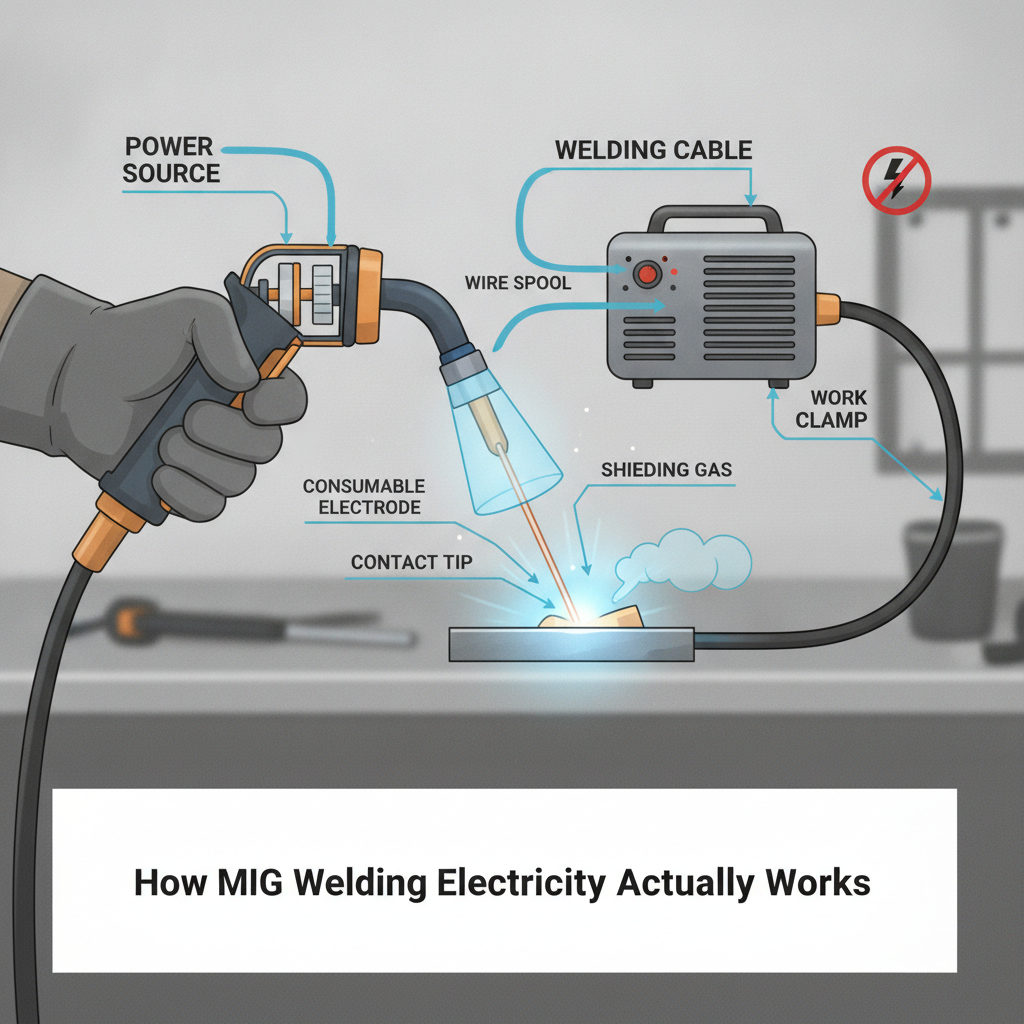
MIG welders convert standard household or industrial power into a lower-voltage, higher-amperage output. The voltage that flows through the welding circuit during actual welding is relatively low — typically between 17 and 32 volts depending on the settings and material.
The open-circuit voltage (OCV) is the voltage present when the welder is on but not actively welding. For most MIG machines, this sits between 20 and 40 volts DC. That’s considerably lower than the 120V or 240V running through the wall outlet.
However, amperage is what causes tissue damage. A MIG welder can push 100–250+ amps through the welding circuit. If that current passes through your body — even briefly — the consequences can be severe.
When Electrocution Risk Becomes Real
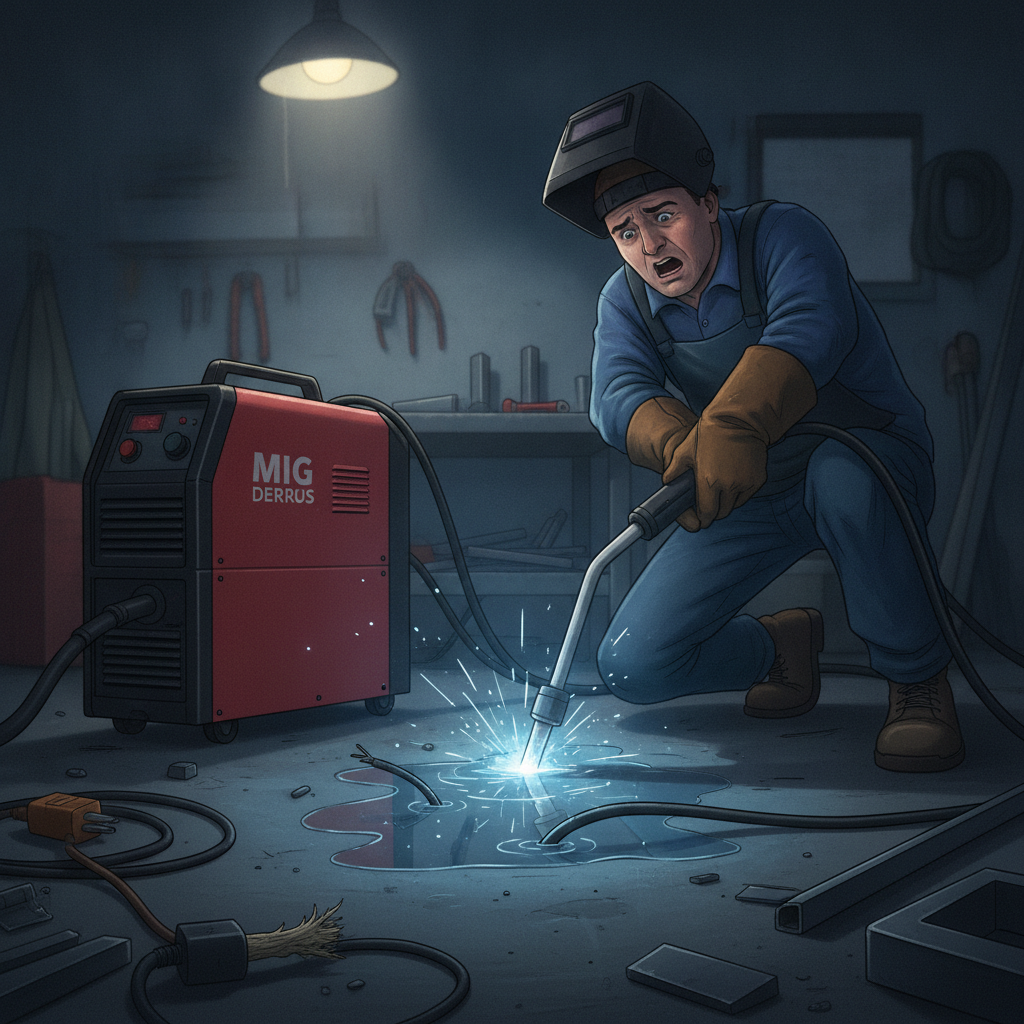
Most everyday MIG welding accidents don’t involve electrocution. But several specific conditions dramatically raise the risk.
Wet or sweaty skin is the biggest factor. Dry skin has significantly higher electrical resistance, which limits current flow through the body. Wet skin can reduce resistance from roughly 100,000 ohms (dry) to as low as 1,000 ohms — a 100-fold change that turns a survivable shock into a potentially fatal one.
Damaged or worn equipment is the second major hazard. A gun cable with cracked insulation, a frayed MIG torch, or a worn electrode holder can expose live conductors to bare hands.
Other high-risk situations include:
- Welding in confined spaces where your body contacts metal surfaces on multiple points
- Using improperly grounded equipment
- Working on live or energized workpieces
- Worn welding gloves with holes or moisture inside
The Difference Between Primary and Secondary Shock
There are two distinct shock hazards in a welding environment.
Secondary shock occurs when contact is made with the welding output circuit — the wire, the gun, the workpiece. This is the circuit welders interact with directly. At 20–40V OCV, it’s survivable under most conditions, but dangerous when wet, fatigued, or in confined contact.
Primary shock is contact with the full input voltage — 120V or 240V from the wall supply. This is far more dangerous and typically occurs when someone tampers with the machine’s internal wiring, uses a damaged power cord, or works on an improperly maintained unit. Primary shock is the scenario most associated with serious injury or death.
| Shock Type | Voltage Level | Source | Risk Level |
|---|---|---|---|
| Secondary | 20–40V DC (OCV) | Welding output circuit | Moderate (high in wet conditions) |
| Primary | 120V / 240V AC | Wall supply / internal | Severe to fatal |
What Actually Happens to Your Body
At low voltages with dry skin, you may feel nothing or a minor tingle. At higher current levels or with wet contact, the effects escalate quickly.
- 1–5 mA: Slight tingle, threshold of perception
- 10–20 mA: Muscle contraction, possible inability to release grip (“let-go threshold”)
- 50–150 mA: Respiratory arrest, severe pain, potentially fatal
- Over 200 mA: Cardiac fibrillation becomes likely
The dangerous part about MIG welding isn’t the voltage alone — it’s that enough current can flow at low voltages when skin resistance is reduced. A 30V shock through wet skin can push enough current to cause muscle lock or cardiac issues.
Practical Safety Measures That Actually Matter
Preventing electrocution in a MIG welding environment doesn’t require complicated procedures. It comes down to consistent habits.
Equipment checks before every session:
- Inspect the MIG torch cable and gun for cracked or worn insulation
- Check the work clamp and cable for damage
- Verify the ground connection is secure and making clean metal-to-metal contact
- Confirm the power cord is undamaged before plugging in
Personal protection:
- Always wear dry welding gloves — inspect them for holes or moisture before use
- Wear dry leather boots with rubber soles
- Avoid welding while perspiring heavily in a position where your body contacts bare metal
- Never drape the welding cable across your shoulders or around your body
Environment and setup:
- Ensure proper equipment grounding per the machine’s manual
- Avoid welding in rain, standing water, or highly humid confined spaces without proper precautions
- Position the work clamp as close to the weld area as practical to keep stray current paths short
Machines like the Lincoln Electric Easy MIG 180 include built-in protection features, but no machine eliminates risk when basic safety practices are ignored.
Grounding: The Overlooked Safety Factor
Poor grounding is responsible for a significant number of electrical incidents in welding. When the work clamp isn’t making solid contact — due to rust, paint, scale, or a loose connection — current seeks alternate paths back to the machine. Your body can become part of that path if you’re touching the workpiece and another grounded surface simultaneously.
Always clamp to clean, bare metal as close to the weld as possible. Avoid clamping to painted surfaces, thin sheet edges that may have poor contact, or areas far removed from the actual weld zone.
Common Mistakes That Increase Shock Risk
Even experienced welders develop habits that quietly raise their exposure to electrical hazard.
- Welding with wet gloves — moisture is the single fastest way to turn a low-voltage shock into a serious one
- Ignoring frayed cable insulation — a common issue on heavily used torch cables that gets overlooked during busy workflows
- Working on energized metal — occasionally welding near or on structures with active electrical connections
- Skipping the equipment inspection — especially true when grabbing a machine that someone else used last
- Trusting grounding without checking it — an assumption that the work clamp is secure when it’s actually sitting on a painted surface
FAQ
Is MIG welding more dangerous electrically than stick welding?
Stick welding (SMAW) typically has a higher open-circuit voltage — often 50–80V AC or DC compared to 20–40V for MIG. This makes stick welding statistically higher risk for secondary shock in similar conditions. That said, both processes are safe when proper PPE and equipment practices are followed. The process itself matters less than the working conditions and user habits.
Can you get electrocuted if the welder is on but you’re not actively welding?
Yes, but the risk is lower. When the trigger isn’t pressed, the welding circuit is still live at open-circuit voltage (OCV). Touching the bare wire, contact tip, or workpiece while the machine is energized can still cause a shock — particularly if your skin is wet or you’re making contact across two points in the circuit simultaneously.
Is it safe to MIG weld in the rain or outdoors in wet conditions?
Welding in rain or standing water creates serious electrocution risk and should be avoided. Wet conditions dramatically reduce skin resistance and can introduce water into equipment, creating dangerous short circuits or shock paths that wouldn’t exist under dry conditions. Covered, dry outdoor environments with proper grounding are acceptable; open exposure to rain is not.
What should I do if I receive a shock while MIG welding?
Stop welding immediately and turn the machine off. If the shock was minor with no symptoms, inspect your equipment before resuming. If any persistent numbness, chest pain, irregular heartbeat, or disorientation follows — even briefly — seek medical evaluation. Cardiac arrhythmia from electrical shock can develop after apparent recovery and should not be dismissed.
Does wearing a welding helmet protect against electrocution?
A welding helmet provides critical eye and face protection against UV radiation, sparks, and spatter — but it offers no meaningful electrical insulation. Protection against shock comes from dry insulating gloves, rubber-soled footwear, and avoiding simultaneous contact with live conductors and grounded surfaces.
Can a faulty welding machine electrocute you without touching the wire?
Yes. If the machine has internal insulation failure, a damaged power cord, or a fault that bridges primary voltage to the case or external components, touching the outer housing of the machine itself can result in primary shock at full line voltage. Regular inspection and proper maintenance of the machine’s chassis grounding helps prevent this.
How does confined space welding increase electrocution risk?
In a confined metal space — inside a tank, pipe, or vessel — your body is often in constant contact with conductive surfaces. If any part of the welding circuit contacts your body at the same time, current has an easy return path through you. Ventilation is also compromised in confined spaces, increasing fatigue and sweating, both of which reduce skin resistance.
The Bottom Line
MIG welding is electrically safe when the equipment is properly maintained and basic precautions are followed consistently. The voltage levels in a typical MIG circuit are low enough that dry-skin contact under normal conditions rarely causes serious injury. What makes it dangerous is the combination of wet conditions, damaged insulation, poor grounding, and inattention — factors that are all preventable. Dry gloves, solid grounding, and a quick equipment check before every session cover the vast majority of electrical risk.