
You’re set up in the garage, your MIG welder is ready to go, but the power outlet is on the other side of the room. Grabbing a standard extension cord seems like the obvious fix — but it’s not always that simple.
Yes, you can use an extension cord with a MIG welder, but only if it meets specific requirements. The cord must be rated for the welder’s amperage draw, use the correct gauge wire (typically 10 AWG or heavier for 240V machines), and be as short as practical. Using an undersized or too-long extension cord causes voltage drop, overheating, and poor weld quality — and can damage your welder or create a fire hazard.
Why Extension Cord Selection Matters for Welders
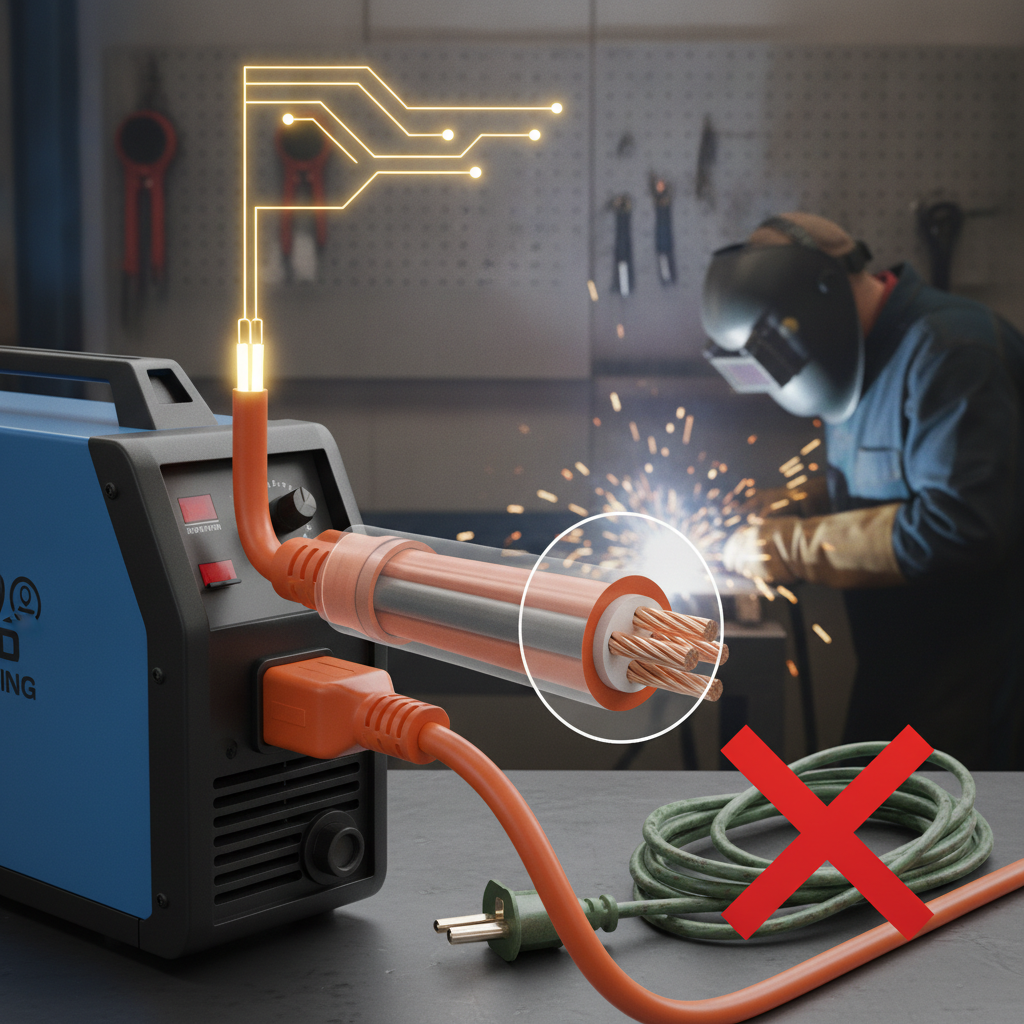
MIG welders are high-demand electrical loads. Even a compact 140-amp hobby welder pulls significantly more current from the wall than most household appliances.
When a cord is too thin or too long, resistance increases and voltage drops before it reaches the welder. The machine compensates by drawing more current, which strains both the cord and the welder’s internal components.
In practice, a voltage drop of even 5–10 volts can cause noticeable arc instability, inconsistent wire feed, and weaker welds. It can also trigger thermal shutdowns or shorten the duty cycle.
The Wire Gauge Rule: What Size Extension Cord Do You Need?
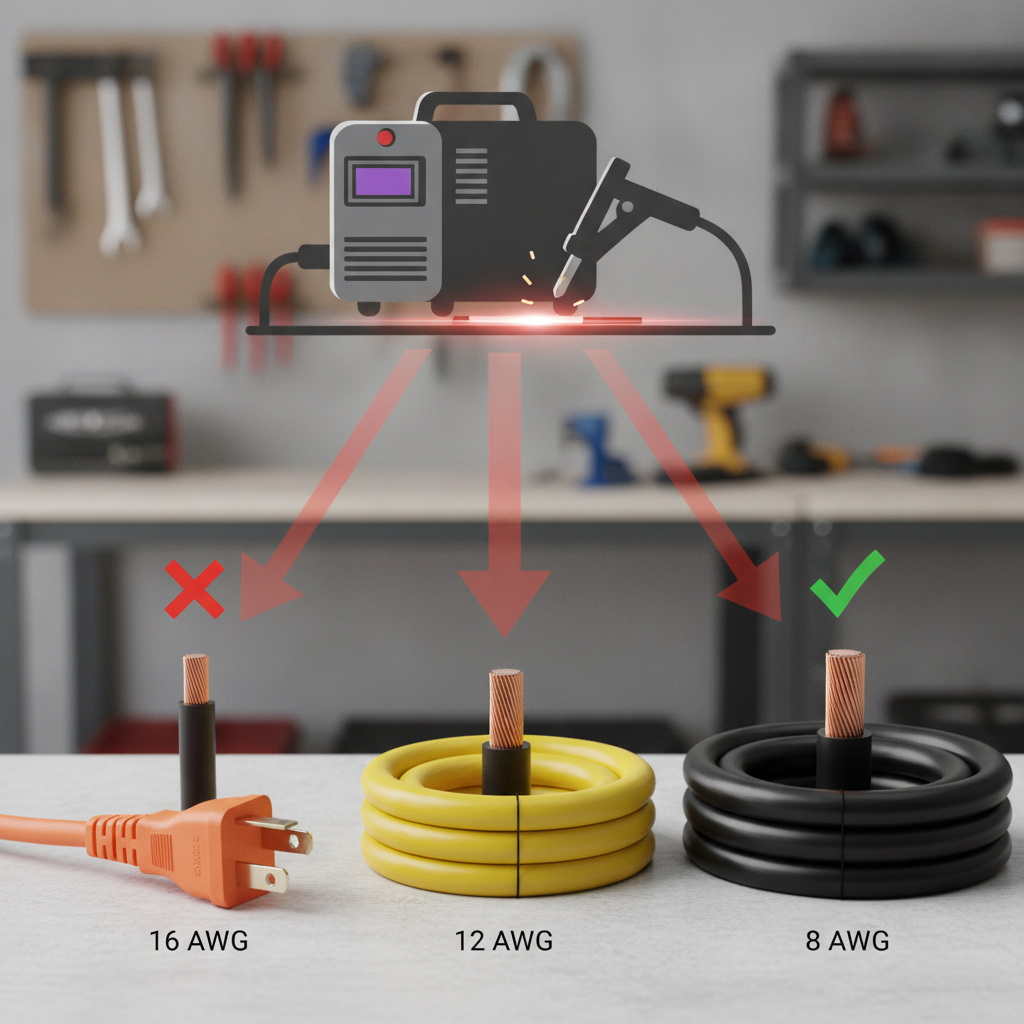
Wire gauge is the most critical factor. In North American AWG sizing, lower numbers mean thicker wire — and thicker wire handles more current with less resistance.
Here’s a general reference for MIG welder extension cord sizing:
| Welder Input Voltage | Typical Input Amperage | Max Cord Length | Recommended Gauge |
|---|---|---|---|
| 120V (small flux-core or MIG) | 15–20A | Up to 25 ft | 12 AWG |
| 120V | 15–20A | 25–50 ft | 10 AWG |
| 240V | 30–50A | Up to 25 ft | 10 AWG |
| 240V | 30–50A | 25–50 ft | 8 AWG |
| 240V | 50A+ | Any length | 6 AWG or direct wiring |
Always check your welder’s actual input amperage on the rating plate before selecting a cord. Don’t rely on output amperage — a 200-amp output welder typically draws 20–30 amps from a 240V circuit, not 200.
120V vs. 240V Extension Cords: Different Rules Apply
The rules aren’t the same for both voltages, and confusing them is a common mistake.
120V MIG welders (like the Lincoln Electric Weld-Pak 140 HD) are more forgiving with extension cords because they draw less current. A good-quality 10 AWG, 25-foot extension cord is usually sufficient for workshop use. Avoid using lightweight 16 AWG or 14 AWG cords — these are designed for lamps and small appliances, not power tools.
240V MIG welders are far more demanding. These machines require heavy-duty cords with the correct plug type (NEMA 6-30 or 6-50 are common). Standard household extension cords will not work and can be genuinely dangerous. A 50-foot run on a 240V, 30A circuit requires an 8 AWG cord at minimum.
For larger machines running at 50 amps or more, running an extension cord becomes impractical. The cord required would be extremely heavy, expensive, and difficult to handle safely. Permanent wiring is the better solution.
Cord Length and Voltage Drop
Length and gauge work together. A 10 AWG cord at 10 feet behaves very differently from a 10 AWG cord at 100 feet.
As a practical rule:
- Keep extension cords as short as possible. Every additional foot adds resistance.
- Never coil an extension cord during use. A coiled cord builds heat rapidly under load and can cause the insulation to fail.
- 50 feet is usually the realistic maximum for welding applications, and only with appropriately heavy wire gauge.
Beyond 50 feet, voltage drop becomes difficult to manage without moving to impractically heavy cable. At that point, repositioning the welder or adding a dedicated outlet makes more sense.
Signs You’re Using the Wrong Extension Cord
Most users don’t notice the problem immediately — but the welder tells you something is wrong if you know what to look for.
Watch for these warning signs:
- Warm or hot cord during welding — the cord is undersized for the load
- Tripped breakers or blown fuses — current demand is exceeding safe limits
- Erratic arc or weak penetration — voltage is dropping under load
- Welder shutting off mid-use — thermal protection is activating due to strain
- Burn smell or discolored plug — serious warning; stop immediately
If the cord feels warm to the touch after a short welding session, replace it with a heavier gauge. A cord that runs hot is losing energy as heat, not delivering power to your welder.
Outdoor Use and GFCI Considerations
Using a MIG welder outdoors with an extension cord introduces additional concerns.
Extension cords used outdoors must be rated for outdoor use (look for “W” in the cord designation, such as SJTW or STW). Standard indoor cords can degrade quickly when exposed to moisture, UV light, or temperature changes.
GFCI (Ground Fault Circuit Interrupter) outlets are required in many outdoor and garage circuits. Most MIG welders will trip a GFCI outlet under normal operation because of how their internal electronics draw power during startup and arc initiation. If your outdoor circuit is GFCI-protected, this is worth checking before you set up.
Some welders tolerate GFCI circuits fine; others don’t. Check your welder’s manual for guidance.
What to Look for When Buying a Welder Extension Cord
If you need to purchase a heavy-duty extension cord for welding, look for these specifics:
- Correct AWG rating for your welder’s input amperage and cord length
- Correct amperage rating on the cord itself (clearly labeled)
- Correct plug type matching your welder’s plug (NEMA 5-15, 6-30, 6-50, etc.)
- Outdoor rating if used outside or in a damp environment
- Heavy-gauge rubber or flexible jacket that won’t crack in cold temperatures
The Southwire 2589SW0002 Extension Cord is a commonly recommended option for heavier-duty 240V applications, built with 10 AWG conductors and a durable jacket suited for shop environments. For lighter 120V machines, a quality 10 AWG contractor-grade cord works well in most situations.
FAQ
Can I use a 100-foot extension cord with a MIG welder?
Generally, no. At 100 feet, voltage drop becomes severe enough to cause real problems with weld quality and machine performance, even with relatively heavy wire gauge. For most 240V welders, 50 feet is the practical maximum. If you regularly need power that far away, adding a dedicated outlet is the safer and more reliable solution.
What happens if I use a regular household extension cord with a welder?
A standard household extension cord — typically 14 or 16 AWG — cannot safely handle the current a MIG welder draws. The cord will overheat, potentially melt its insulation, trip breakers, damage the welder’s internal components, or in the worst case, cause a fire. Always use a cord rated for the actual load.
Does using an extension cord void my welder’s warranty?
It depends on the manufacturer. Some warranties specifically exclude damage caused by improper power supply, which can include undersized extension cords. Using a properly rated cord that maintains the required input voltage generally doesn’t create warranty issues, but check your documentation if this is a concern.
Can I use an extension cord with a 220V or 240V MIG welder?
Yes, but it requires a heavy-duty cord rated for 240V use with the correct amperage capacity and plug configuration. Standard household extension cords are 120V only. For 240V welders pulling 30–50 amps, you need 8–10 AWG wire with a matching NEMA 6-30 or 6-50 connector. Keep the cord as short as practical.
How do I know if my extension cord is causing problems with my welder?
The most common signs are a warm or hot cord during use, inconsistent arc behavior, the welder shutting down unexpectedly, or breakers tripping. If your welds look different when using an extension cord compared to a direct connection, the cord is likely causing voltage drop. Test by plugging directly into the wall outlet and comparing performance.
Is it safe to weld outdoors using an extension cord in wet conditions?
Only if the cord is specifically rated for outdoor and wet locations. Look for an “W” designation in the cord’s jacket rating (SJTW, SOW, etc.). Never use an indoor-rated cord outdoors or in damp conditions — moisture intrusion into an energized cord is a serious shock hazard. Keep connections off the ground and protected from water pooling.
Can a too-long extension cord damage my MIG welder permanently?
Prolonged use with a severely undersized or too-long cord can cause damage. The welder’s transformer and power electronics experience sustained stress from low voltage and high current draw. Over time, this accelerates wear on internal components. Repeated thermal shutdowns are a warning sign that the machine is being pushed beyond safe operating conditions.
The bottom line is simple: extension cords and MIG welders can work together, but only when the cord is genuinely up to the job. Match the gauge to your welder’s input amperage, keep the length reasonable, and never assume a cord is safe just because it physically fits. When in doubt, go heavier — an oversized cord causes no harm, while an undersized one creates real risks.