
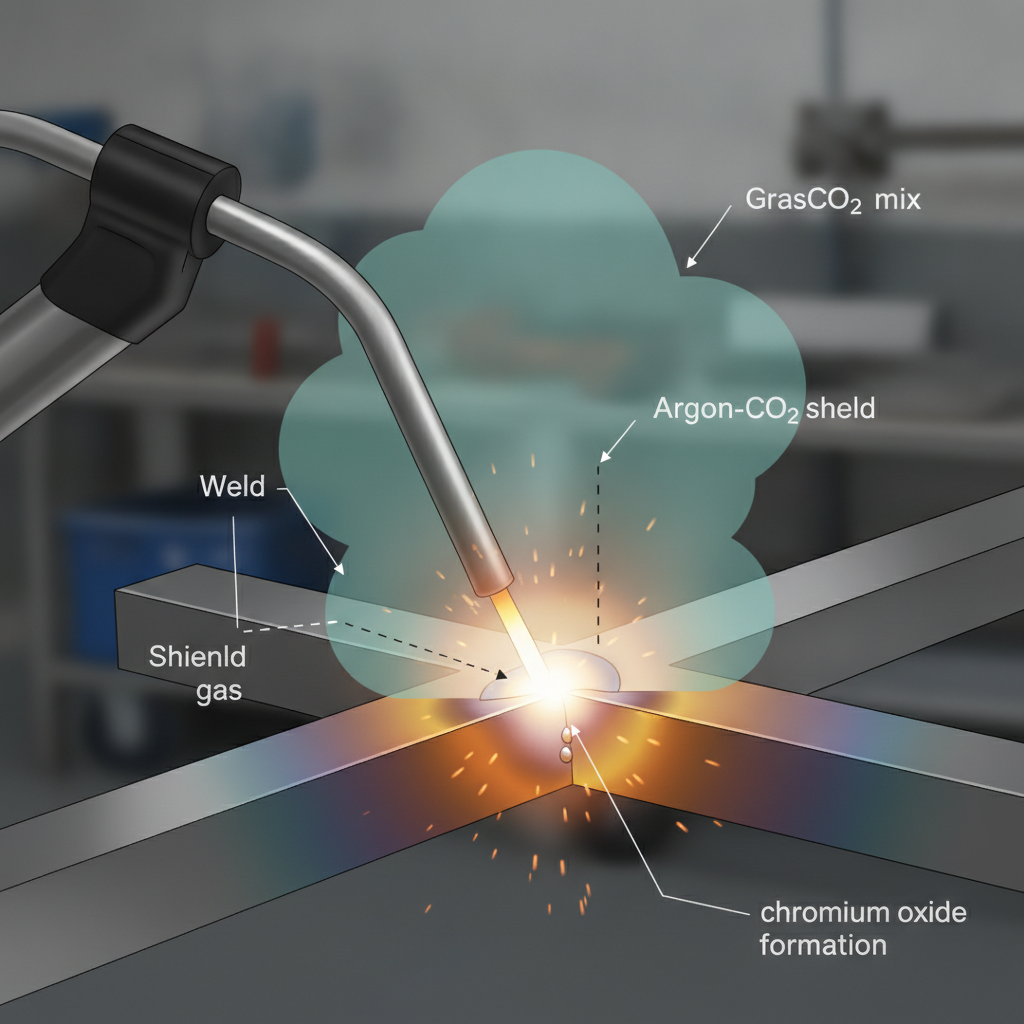
Why Stainless Steel Behaves Differently in a MIG Welder
Equipment and Consumables You’ll Need
Machine Settings for MIG Welding Stainless Steel
Settings vary by material thickness, but a few general principles always apply: – Run lower voltage than you would for mild steel of the same thickness – Use faster travel speed to reduce heat input – Keep wire stick-out short — around ¾” maximum – Maintain a slight push angle (10–15°) rather than dragging Here’s a starting point for common stainless thicknesses: | Material Thickness | Wire Diameter | Voltage | Wire Feed Speed | |—|—|—|—| | 18 gauge (0.048″) | 0.023″ | 16–17V | 180–220 IPM | | 16 gauge (0.060″) | 0.023″–0.030″ | 17–18V | 200–250 IPM | | 14 gauge (0.075″) | 0.030″ | 18–19V | 230–270 IPM | | 1/8″ (0.125″) | 0.030″–0.035″ | 19–21V | 250–300 IPM | | 3/16″ (0.188″) | 0.035″ | 20–22V | 280–340 IPM | These are starting reference points. Always run a test bead on scrap before welding the actual workpiece. For more detailed stainless MIG settings, including real-world adjustments for different joint types, the article on MIG welding stainless steel settings goes deeper into dialing in parameters.How to Weld Stainless Steel with a MIG Welder — Step by Step
Step 1: Prepare the Metal
Clean the base metal with acetone and a lint-free rag to remove oils, fingerprints, and residue. Then use a stainless-dedicated wire brush or flap disc to remove any surface scale or oxidation. Even a small amount of contamination can compromise corrosion resistance and weld quality.Step 2: Set Up Your Shielding Gas
Connect your tri-mix bottle, set flow rate to 20–25 CFH (cubic feet per hour), and check for leaks at the regulator and hose connections. Too little gas flow causes porosity. Too much creates turbulence and pulls in atmospheric contamination.Step 3: Install the Wire
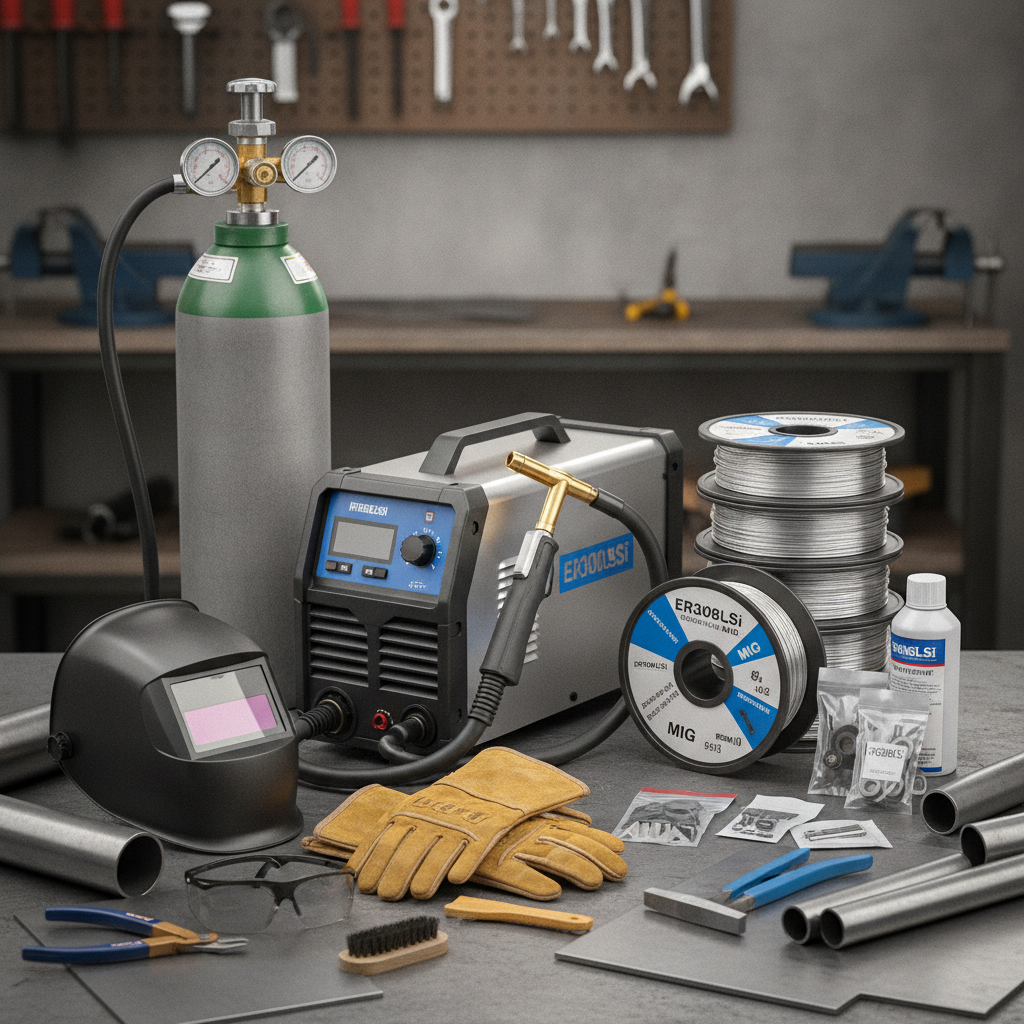
Feed your ER308L or ER316L wire through the liner. Stainless wire is stiffer than mild steel wire, so verify the drive rolls are set correctly — enough tension to feed smoothly, but not so tight the wire gets crushed. Use knurled or V-groove drive rolls rated for solid wire.Step 4: Dial In Settings and Run a Test Bead
Set voltage and wire feed speed according to your material thickness. Run a short test bead on scrap stainless of the same gauge. Inspect the bead: it should be smooth, slightly convex, with minimal spatter and a light gold or straw-colored heat tint. A gray or black tint indicates too much heat or poor gas coverage.Step 5: Tack the Workpiece
Use small tack welds spaced every 2–4 inches to hold the joint before running full beads. This controls distortion. Clamp the workpiece firmly — stainless warps faster than mild steel when heat isn’t managed.Step 6: Weld with Controlled Heat Input
Maintain a consistent travel speed — move faster than you would on mild steel. Keep your torch angle steady, stick-out short, and watch the puddle, not the arc. Use stitch welding (short beads with cool-down pauses) on thin sections to prevent heat buildup.Step 7: Allow Controlled Cooling
Let the weld cool naturally. Never quench stainless in water — rapid cooling can cause warping and affect the metallurgical properties of the weld zone.Step 8: Clean the Finished Weld
Brush with a stainless wire brush to remove light oxidation. For welds that require full corrosion resistance, use a stainless steel passivation solution or citric acid-based cleaner to restore the chromium oxide layer.Common Problems and How to Fix Them
Weld is porous or spongy-looking Usually a shielding gas problem. Check flow rate, verify connections for leaks, and confirm you’re using tri-mix or C2 — not C25. Excessive discoloration or black oxidation Heat input is too high or gas coverage is insufficient. Increase travel speed, reduce voltage slightly, or increase gas flow. Wire birdnesting at the drive rolls Wire is feeding too fast against resistance, or the drive roll tension is too high for stainless wire. Check the liner for kinks and reduce drive roll pressure slightly. Warping or distortion Move faster, use tack welds more frequently, and allow cooling between passes. Backstep welding — welding in the opposite direction of your overall travel — also helps manage distortion on longer seams. Weld cracking Typically hot cracking caused by too much heat with an incorrect filler. Confirm you’re using ER308L or ER316L, not a carbon steel wire. If you’re dealing with thin sections that keep burning through, MIG welding thin metal without burning through covers techniques that apply directly to thin stainless sheet work.MIG vs. TIG for Stainless Steel — Quick Comparison
Both processes work on stainless. Your choice depends on the application and available equipment. | Factor | MIG Welding | TIG Welding | |—|—|—| | Speed | Faster | Slower | | Appearance | Good | Excellent | | Thin material control | Moderate | Superior | | Skill requirement | Lower | Higher | | Equipment cost | Lower | Higher | | Distortion risk | Moderate | Lower | MIG is practical for fabrication work, repairs, and structural stainless joints where speed matters. TIG is the preferred choice for visible joints, food-grade equipment, and thin-gauge sheet where aesthetics and heat control are critical.Working with 304 Stainless Specifically
304 stainless is the most common grade you’ll encounter — exhaust components, kitchen fabrication, brackets, and structural tubing. It welds well with ER308L wire and standard tri-mix gas. The main challenge with 304 is its tendency to warp on thinner sections and its sensitivity to heat tint. For in-depth coverage of 304-specific technique and settings, the article on MIG welding 304 stainless steel walks through joint-specific adjustments in detail.FAQ
What wire do I use to MIG weld stainless steel? Use ER308L wire for 304-grade stainless steel — the most common grade in fabrication and repair work. For 316-grade stainless, especially in marine or chemical environments, use ER316L. The “L” designation means low carbon content, which reduces the risk of sensitization and carbide precipitation along weld boundaries. Both wires are available in 0.023″, 0.030″, and 0.035″ diameters. Can I MIG weld stainless steel with C25 shielding gas? Technically you can run an arc, but the results will be poor. C25 (75% Ar / 25% CO₂) causes heavy oxidation, rough bead profile, and excessive spatter on stainless. It also degrades corrosion resistance at the weld zone. Use tri-mix (90% He / 7.5% Ar / 2.5% CO₂) for best results, or C2 (98% Ar / 2% CO₂) as an acceptable alternative. Why does my stainless steel weld turn black? Black discoloration indicates excessive heat input or inadequate shielding gas coverage. A correctly welded stainless joint should show a light straw or golden color — sometimes blue on slightly hotter sections. Increase your travel speed, confirm gas flow is 20–25 CFH, and check for leaks in your hose connections. Do I need a special MIG welder to weld stainless steel? No special welder is required. Any MIG welder with adjustable voltage and wire feed speed can weld stainless. The key differences are the wire type, shielding gas, and dedicated stainless tools. A welder capable of running solid wire with gas shielding — as opposed to flux-core only — is the main requirement. Can I MIG weld stainless steel exhaust pipes? Yes, and MIG is commonly used for exhaust fabrication and repair. Exhaust pipe is typically 304 or 409 stainless. Use ER308L wire, tri-mix gas, and keep heat input low to avoid warping thin-wall tubing. Stitch welding in short passes with cool-down intervals between beads helps prevent distortion and burn-through on thin-walled pipe. How do I prevent stainless steel from warping when MIG welding? Use tack welds spaced closely before running full beads. Move at a faster travel speed than mild steel to reduce dwell time. Allow natural cooling between passes — never force-cool with water. Backstep welding and alternating weld directions on longer seams also reduces distortion significantly. Is flux-core wire an option for MIG welding stainless steel? Stainless flux-core wire exists, mainly in larger industrial diameters, but it’s uncommon and expensive for small shop use. For most applications, solid stainless wire with tri-mix gas produces cleaner, stronger results with better corrosion resistance and is easier to source. Flux-core stainless is mainly used in production environments where shielding gas isn’t practical.Getting stainless right with a MIG welder comes down to three things: the correct wire, the right shielding gas, and disciplined heat control. Once those are in order, the process is more straightforward than its reputation suggests. Start with clean metal, run test beads before committing to the actual joint, and move faster than you think you need to.