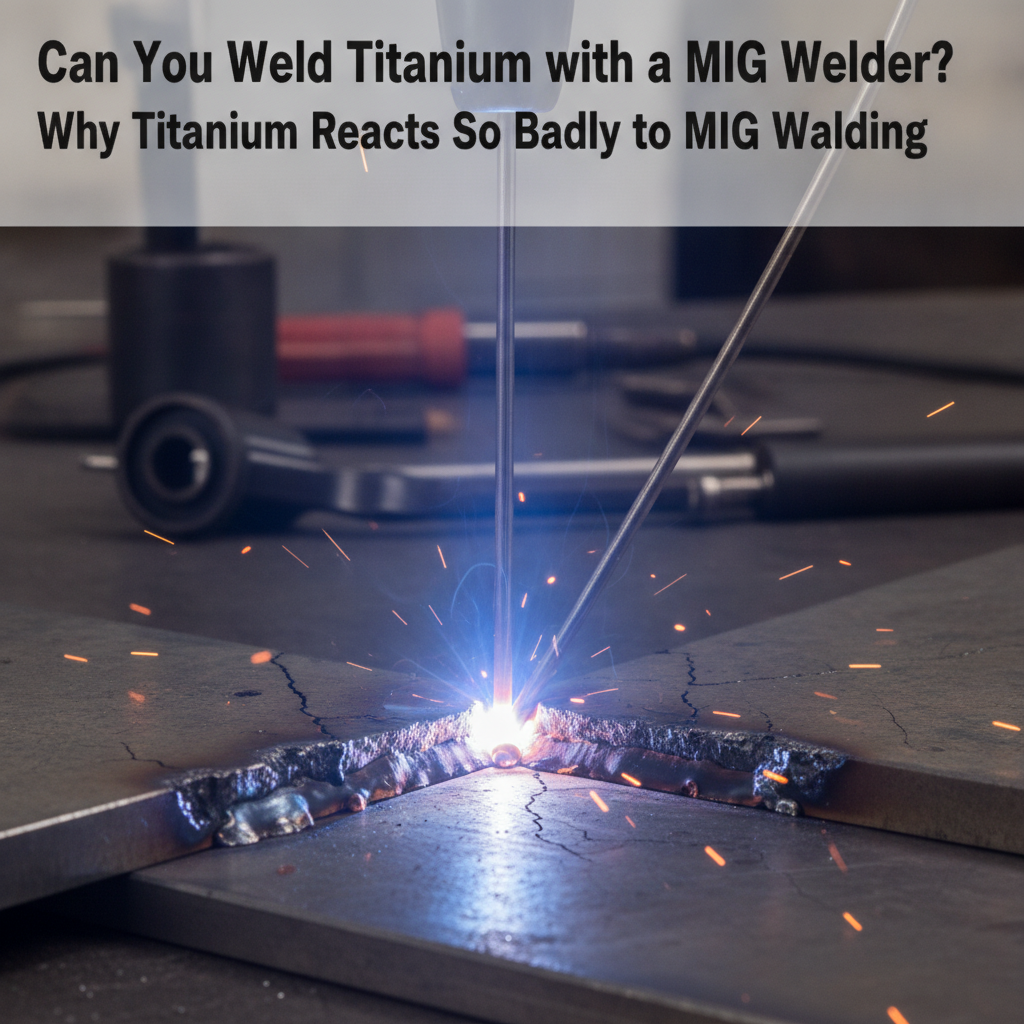
Titanium comes up a lot in aerospace fabrication, motorsports, and custom exhaust work. It’s strong, lightweight, and corrosion-resistant — but it has a reputation for being difficult to weld. If you’re sitting in front of a MIG welder wondering whether you can run a bead on titanium with it, the answer matters before you strike an arc.
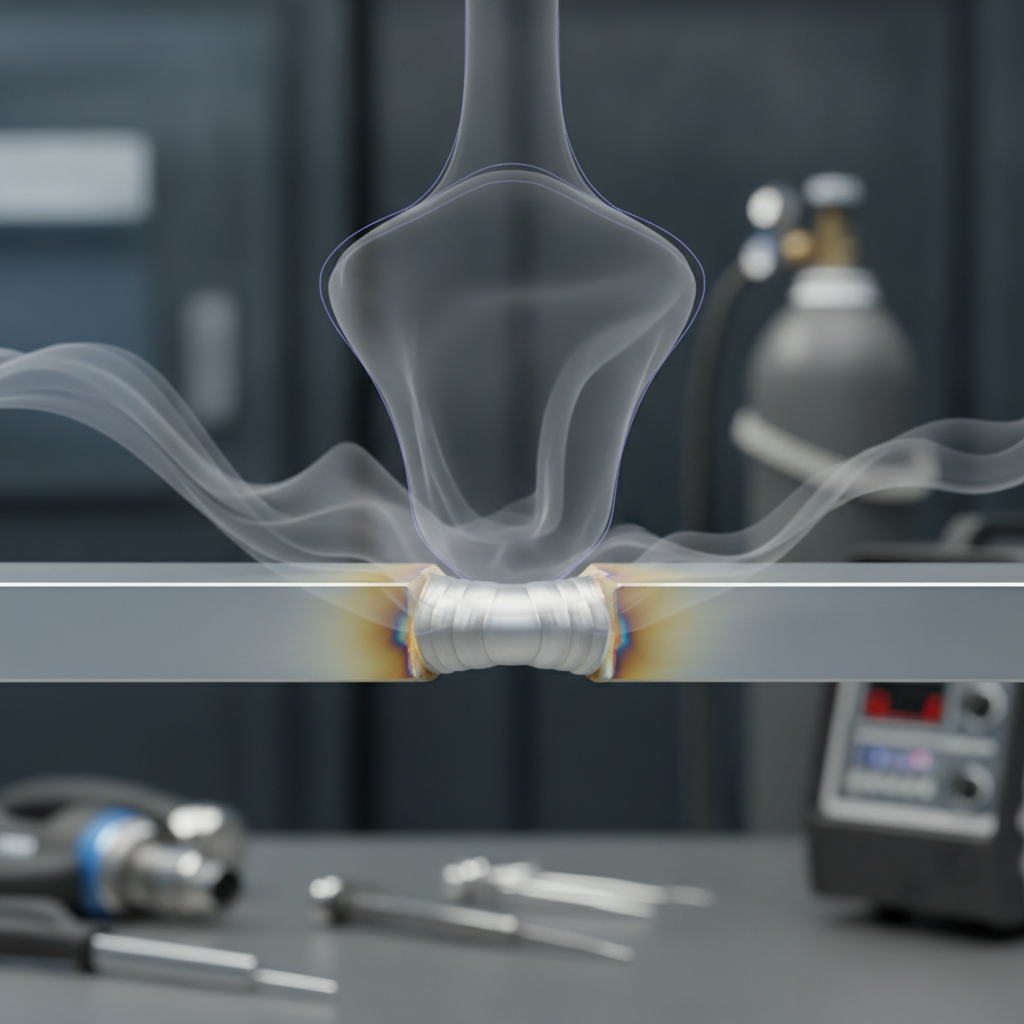
No, you cannot reliably weld titanium with a standard MIG welder. Titanium requires complete shielding from oxygen, nitrogen, and hydrogen during the entire weld cycle — including the cooling phase. MIG welding cannot provide this level of protection. The correct process is TIG welding (GTAW) with 100% pure argon shielding, along with a trailing shield and back purging to protect the weld zone until it cools below approximately 427°C (800°F).
Why Titanium Reacts So Badly to MIG Welding
Titanium is an extremely reactive metal at elevated temperatures. Above roughly 427°C, it begins absorbing oxygen, nitrogen, and hydrogen from the surrounding atmosphere. This isn’t a minor inconvenience — it fundamentally destroys the weld.
Contaminated titanium welds become brittle, porous, and structurally weak. The metal that’s normally prized for its strength-to-weight ratio becomes prone to cracking under stress. You’d be creating a part that looks welded but isn’t trustworthy.
MIG welding uses a shielding gas — typically 75% argon / 25% CO₂ (C25) or 100% CO₂ — that flows from the nozzle to protect the molten puddle. The problem is that this protection only covers the immediate weld area while it’s being deposited. There’s no trailing gas coverage, no back purge, and CO₂-based mixtures introduce carbon and oxygen directly into the weld environment. For steel, that’s manageable. For titanium, it’s catastrophic.
Even the wire feed process itself creates issues. MIG wire feeds through open air and doesn’t carry the purity needed for titanium deposition. The result would be severe contamination, visible as a dark, sooty, or discolored bead — which in titanium welding is a clear sign of a failed weld.
What a Properly Shielded Titanium Weld Actually Looks Like
Color is one of the most reliable indicators of weld quality when working with titanium. Experienced fabricators use bead color as a real-time contamination test:
| Bead Color | What It Means |
|—|—|
| Bright silver | Perfect — full shielding, no contamination |
| Light gold / straw | Acceptable — minor surface oxidation only |
| Dark gold / brown | Marginal — borderline contamination |
| Blue / purple | Significant contamination — structurally suspect |
| Gray / white / chalky | Severe contamination — weld is unusable |
A MIG weld on titanium would almost certainly produce a gray, chalky, or heavily oxidized result. Structural integrity would be compromised regardless of visual appearance on the surface.
TIG welding (also called GTAW) is the industry-standard process for titanium. It provides precise heat control, uses a non-consumable tungsten electrode, and allows for complete gas shielding that MIG simply cannot replicate.
To weld titanium correctly with TIG, three shielding zones are required:
1. Primary torch shielding — Pure argon delivered through the TIG torch cup, ideally a large gas lens setup (size 8–12 cup) for maximum coverage
2. Trailing shield — A secondary argon shield attached behind the torch that follows the bead and protects the cooling weld
3. Back purge — Argon introduced behind the weld joint to protect the back side of the weld from oxidation during the entire weld and cool-down period
The argon used must be welding-grade pure argon (99.999% purity, also called “5-nines argon”). Standard mixed shielding gases used in MIG welding are incompatible.
Filler rod selection is typically commercially pure titanium (ERTi-1 or ERTi-2) or grade-matched to the base metal. The rod must be kept inside the argon envelope at all times — pulling it out into open air even momentarily introduces contamination.
Could Any Special Setup Make MIG Work on Titanium?
In theory, a fully enclosed inert-gas chamber (glove box) could allow MIG welding of titanium because the entire environment would be purged with argon. Some research and aerospace facilities use this approach. However, this is highly specialized equipment, not accessible to most fabricators, and TIG remains the dominant process even in controlled environments because of its superior precision.
In a standard shop or garage, there is no practical modification that makes a conventional MIG setup suitable for titanium. Swapping to pure argon shielding gas alone doesn’t solve the trailing coverage problem or the wire-feed contamination risk.
Comparing Welding Processes for Titanium
| Process | Suitable for Titanium? | Why |
|—|—|—|
| MIG (GMAW) | No | Insufficient shielding coverage, wrong gas mixtures |
| Stick (SMAW) | No | Flux introduces contamination, no gas purity control |
| Flux-core (FCAW) | No | Flux and CO₂ incompatible with titanium |
| TIG (GTAW) | Yes | Full argon shielding, precise heat control |
| Plasma arc (PAW) | Conditionally | Requires full argon shielding setup similar to TIG |
| Electron beam | Yes (specialized) | Used in aerospace, vacuum environment |
| Laser welding | Yes (specialized) | Requires precise inert gas shielding |
For almost all real-world fabrication — exhaust systems, bicycle frames, motorcycle components, aerospace brackets — TIG welding with proper argon shielding is the only practical and reliable answer.
Common Mistakes When Attempting to Weld Titanium
Even fabricators who switch to TIG frequently run into problems with titanium early on. These are the most common errors:
– Skipping the back purge — The back side of the weld oxidizes without purging, leading to brittleness even when the face looks clean
– Using contaminated filler rod — Filler exposed to air, moisture, or handled without gloves introduces hydrogen and surface contaminants
– Removing the torch too quickly — Argon post-flow must continue until the weld drops below 427°C; cutting it short causes oxidation during cooling
– Using the wrong tungsten — Pure tungsten or thoriated tungsten are both used; cerium or lanthanum-doped tungsten works well at lower amperages typical of thin titanium
– Insufficient cup size — Small cups don’t provide enough gas coverage; most titanium TIG setups use a #8 or larger gas lens cup with 15–20 CFH argon flow
If you’re working on thinner titanium sections, controlling heat input is critical. Understanding how to manage heat on thin metal translates directly to preventing warping and burn-through on thin titanium sheet, even though TIG is the required process.
Setting Up Argon for TIG Welding Titanium
Getting the gas setup right is half the battle. Here’s what a proper argon configuration looks like for titanium TIG:
– Shielding gas: 100% argon, 99.999% purity minimum
– Primary flow rate: 15–25 CFH depending on cup size and joint geometry
– Trailing shield flow: 10–20 CFH, directed to cover the weld for at least 3–4 inches behind the torch
– Back purge flow: Low volume (5–10 CFH) to fill and maintain positive pressure inside the purge cavity without turbulence
– Post-flow time: Set welder post-flow to 10–15 seconds minimum; extend manually for thicker sections
Proper understanding of welding gas pressure and flow settings is useful background, even though TIG and MIG have different specific requirements.
FAQ
Can you use a MIG welder with pure argon to weld titanium?
Switching to 100% argon on a MIG welder improves shielding chemistry but doesn’t solve the fundamental problem. MIG still lacks trailing gas coverage and back purge capability. The cooling weld and back side of the joint remain exposed to atmosphere, causing contamination. Pure argon alone doesn’t make MIG welding of titanium viable.
What happens if you try to MIG weld titanium anyway?
The weld will be heavily contaminated. Titanium absorbs oxygen, nitrogen, and hydrogen rapidly above 427°C, making the weld zone brittle and porous. The bead will likely appear chalky white, gray, or discolored. The resulting joint would have severely reduced strength and would be unsuitable for any structural or load-bearing application.
Is TIG welding titanium difficult to learn?
Titanium TIG welding requires more setup discipline than welding steel or aluminum, but the actual technique isn’t dramatically more complex for an experienced TIG welder. The learning curve is mostly about gas coverage, cleanliness, and patience during cool-down. Absolute cleanliness of the base metal, filler, and work area is non-negotiable.
Can you weld titanium to steel or other metals?
Titanium is generally not compatible with direct fusion welding to steel, aluminum, or most other metals because of intermetallic compound formation at the joint. Dissimilar metal welding of titanium typically requires specialized techniques like explosion bonding, friction welding, or the use of transition inserts — not standard fusion welding processes.
What grade of titanium is most commonly welded?
Commercially pure titanium grades (Grade 1 and Grade 2) are the most weldable. Grade 5 titanium (Ti-6Al-4V) is also widely welded in aerospace and motorsport but requires tighter heat control and more rigorous shielding due to its alloying elements. Higher-strength titanium alloys vary in weldability and may require post-weld heat treatment.
Do I need a special TIG welder to weld titanium?
Not necessarily a special machine, but your TIG welder needs reliable post-flow control and a stable DC arc. Most quality DC TIG welders handle titanium fine. What matters more than the machine is the torch setup, gas lens, cup size, and external shielding accessories like a trailing shield. The YESWELDER 205A Multi-Process Welder, for example, includes DC TIG capability that provides the control needed for titanium work.
Why is titanium welding so common in exhaust fabrication if it’s so demanding?
Titanium exhaust systems are popular in motorsports because titanium offers exceptional strength, low weight, and heat resistance. Fabricators who work with titanium regularly build proper argon purge fixtures into their workflow. It becomes routine once the setup is established. The difficulty is front-loaded in setting up correct gas shielding — the welding itself follows familiar TIG technique.
The Bottom Line
MIG welding titanium isn’t a matter of settings or gas adjustment — it’s the wrong process for the material. Titanium’s sensitivity to atmospheric contamination during and after welding demands shielding that MIG fundamentally cannot provide. TIG welding with pure argon, a trailing shield, and back purging is the correct approach, and it’s the standard across aerospace, motorsport, and precision fabrication for good reason. If you’re serious about welding titanium, investing in a capable DC TIG setup and learning proper argon shielding technique is the only path to welds that are actually worth making.