You’ve got a tank of pure argon sitting in your shop — maybe leftover from TIG welding — and you’re wondering if you can just hook it up to your MIG welder and get to work. It’s a reasonable question.
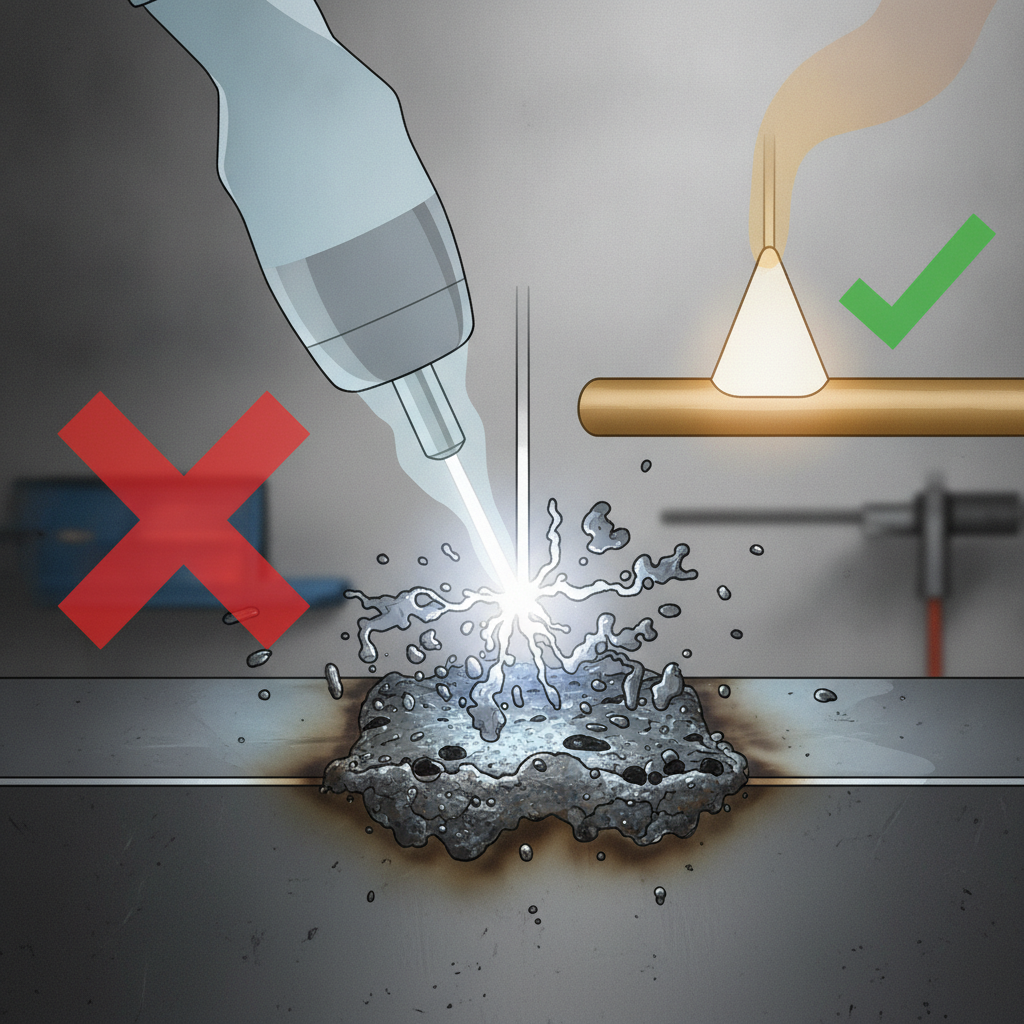
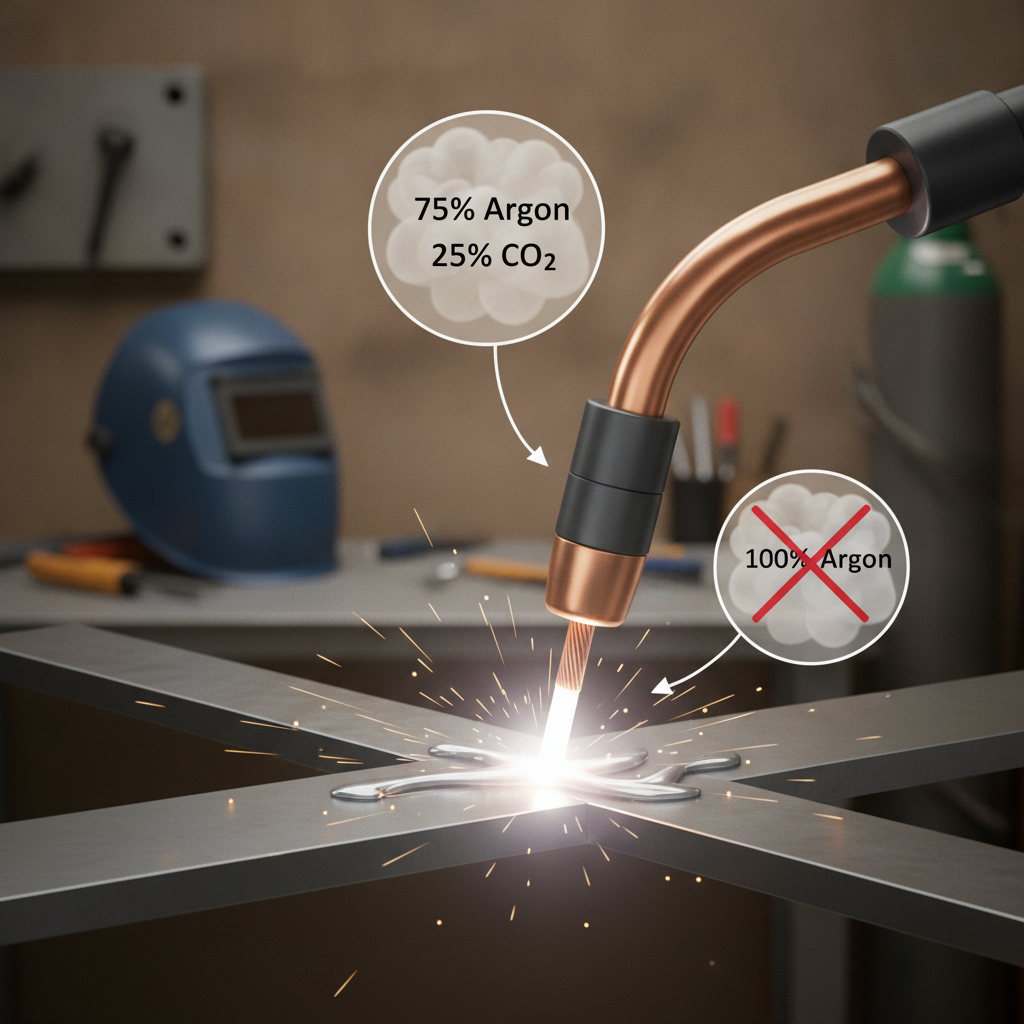
Technically, you can strike an arc with 100% argon on a MIG welder, but it’s not recommended for welding steel. Pure argon produces an unstable, erratic arc on mild steel that results in poor fusion, excessive spatter, and narrow, ropy beads. It works acceptably for aluminum MIG welding, but for steel — including mild steel and stainless — a mixed gas or CO₂ is the right choice.
Why Pure Argon Doesn’t Work Well on Steel
The problem comes down to arc behavior and heat transfer.
Argon is a noble gas with low thermal conductivity. When used alone on steel, it creates a very narrow, concentrated arc that doesn’t spread heat evenly across the weld pool. The result is a “finger” penetration profile — deep in the center but shallow on the sides — which increases the risk of incomplete fusion along the toes of the weld.
The arc also becomes noticeably unstable. You’ll hear more popping and sputtering than the smooth crackle of a properly shielded MIG weld. Spatter increases significantly, and the bead typically comes out narrow, convex, and poorly tied in at the edges.
In practice, welders who’ve accidentally tried 100% argon on steel describe it as almost impossible to dial in, no matter how much they adjust voltage or wire speed.
What Gas Actually Works for MIG Welding Steel
The standard shielding gas for mild steel MIG welding is a blend of 75% argon and 25% CO₂, commonly called C25. This mixture gives you the arc stability and low spatter of argon combined with the improved penetration and heat input of CO₂.
CO₂ — sometimes called C100 — can also be used alone. It’s cheaper and produces deeper penetration, but generates more spatter and a slightly rougher bead appearance. For structural work where appearance matters less, it gets the job done.
For stainless steel MIG welding, the standard gas is a tri-mix: typically 90% helium, 8% argon, and 2% CO₂. Pure argon on stainless produces similar issues to steel — poor wetting, inconsistent arc, and marginal fusion. You can find a breakdown of these combinations in this MIG welding shielding gas selection guide.
| Material | Recommended Gas | 100% Argon Result |
|—|—|—|
| Mild Steel | 75% Ar / 25% CO₂ (C25) | Poor arc, excessive spatter, bad fusion |
| Stainless Steel | 98% Ar / 2% CO₂ or tri-mix | Unstable arc, poor wetting |
| Aluminum | 100% Argon | Works well — standard practice |
The One Case Where 100% Argon Is Correct: Aluminum
Aluminum is the exception. When MIG welding aluminum, 100% argon is actually the standard shielding gas. Aluminum requires a soft, stable arc, and the concentrated heat profile of pure argon works in its favor.
Adding CO₂ to an aluminum MIG setup would oxidize the weld pool and cause porosity. Helium can be blended in for extra heat on thicker aluminum sections, but pure argon handles most aluminum MIG applications well, including common setups using a spool gun with ER4043 or ER5356 wire.
If you’re dialing in aluminum MIG welding settings, pure argon at 20–25 CFH is the starting point for shielding gas flow.
Common Situations Where This Mistake Happens
Several real-world scenarios lead welders to try 100% argon on steel:
– Shared gas supply — A shop runs TIG welding on one machine and MIG on another. The argon bottle gets grabbed by mistake.
– Leftover argon — Someone finishes a TIG project and figures they’ll “use up” the argon tank on MIG work before buying a new mixed gas bottle.
– Misinformation — Some online sources vaguely suggest argon works for MIG welding without specifying it’s only for aluminum.
If you’ve been getting unusually bad welds — high spatter, poor bead profile, arc instability — always check your gas mixture first. It’s one of the most overlooked variables in MIG troubleshooting.
What Happens to the Weld Quality Specifically
Running 100% argon on mild steel typically produces these visible defects:
– High, convex bead profile — The weld doesn’t flatten and wet out properly
– Excessive spatter — Small metal droplets scattered across the surrounding base metal
– Lack of fusion at the toes — The edges of the weld don’t blend smoothly into the base metal
– Porosity in some cases — Irregular gas coverage can allow atmospheric contamination
– Inconsistent arc — Difficult to maintain a steady puddle regardless of settings
These aren’t just cosmetic issues. Poor fusion is a structural problem, especially on load-bearing welds. Even if a bead looks passable on the surface, the underlying fusion may be insufficient.
Gas Flow Rate Still Matters
Even with the correct shielding gas, flow rate affects weld quality. Too low and you get atmospheric contamination and porosity. Too high and turbulence pulls outside air into the shielding zone, causing similar problems.
For most indoor MIG welding on steel, a flow rate between 15–25 CFH (cubic feet per hour) is typical. Outdoor work or welding near drafts may require higher flow or physical wind protection. Getting this right is just as important as having the correct gas blend — if you’re unsure where to start, this breakdown of how much gas flow MIG welding actually needs covers the numbers clearly.
FAQ
Can you use 100% argon for MIG welding mild steel in an emergency?
You can strike an arc, but the results will be poor. Expect excessive spatter, bad fusion, and a narrow, convex bead that doesn’t tie in properly at the edges. It’s not a reliable workaround. For anything structural or that needs to hold load, using the wrong gas is a real safety concern. Get the correct C25 blend before welding.
What is the best gas mixture for MIG welding steel?
For mild steel, 75% argon / 25% CO₂ (C25) is the most widely used general-purpose blend. It produces a stable arc, low spatter, and good penetration with a clean bead appearance. For heavier sections where deep penetration matters more than appearance, straight CO₂ is a practical alternative.
Can you MIG weld aluminum with argon/CO₂ mix?
No. CO₂ oxidizes aluminum and causes porosity and poor fusion. Aluminum MIG welding requires 100% argon shielding gas. This is one of the few applications where pure argon is not only acceptable but required. Using a C25 mix on aluminum will produce defective welds.
Why does pure argon cause spatter on steel during MIG welding?
Pure argon creates an unstable cathode spot on steel surfaces. Unlike TIG welding where the arc behavior is different, MIG welding on steel relies on slightly reactive gases like CO₂ to stabilize the arc and improve metal transfer. Without that reactivity, the arc wanders and the metal transfer becomes erratic.
Is 100% CO₂ better than C25 for MIG welding?
It depends on the application. CO₂ is cheaper and produces deeper penetration, making it useful for thicker structural steel. C25 gives smoother metal transfer, less spatter, and cleaner bead appearance. For general fabrication and thinner material, C25 is usually the better choice. For heavy structural work where appearance is secondary, CO₂ is a cost-effective option.
Does the brand of argon gas matter for welding?
The gas composition matters more than the brand. Industrial-grade argon at 99.995% purity is standard for welding and suitable regardless of supplier. What matters is verifying the mixture percentage when buying blended gas — always confirm the CO₂ percentage on the label or certificate of analysis.
Can you use 100% argon with flux core wire on steel?
No. Flux core wire (FCAW) is specifically designed to work with CO₂-based gas or no external shielding at all (self-shielded FCAW). Using 100% argon with flux core disrupts the shielding chemistry and produces poor results. Always check the wire manufacturer’s recommendations for compatible shielding gases.
Final Thoughts
Pure argon has one job in MIG welding: aluminum. For steel, it causes more problems than it solves, and no amount of voltage or wire speed adjustment will fully compensate for the wrong shielding gas. If your arc feels inconsistent or your beads look convex and rough, always check the gas before blaming technique or machine settings — it’s a faster fix than most people expect.