
Most dissimilar metals can be welded together with proper preparation and technique. Steel to stainless steel, aluminum to steel, and copper to steel are common combinations that require specific filler materials and welding processes. The key factors are thermal expansion differences, metallurgical compatibility, and choosing the right filler metal to bridge the gap between different base materials.
Welding different types of metals together involves unique challenges that necessitate careful planning and the appropriate techniques. Understanding which metals can be successfully joined and which combinations to avoid is essential for creating strong, durable welds that won’t fail over time.
This guide provides a comprehensive welding dissimilar metals chart along with practical advice on techniques, filler materials, and common problems you’ll encounter when working with mixed metal combinations.
Welding Dissimilar Metals Compatibility Chart
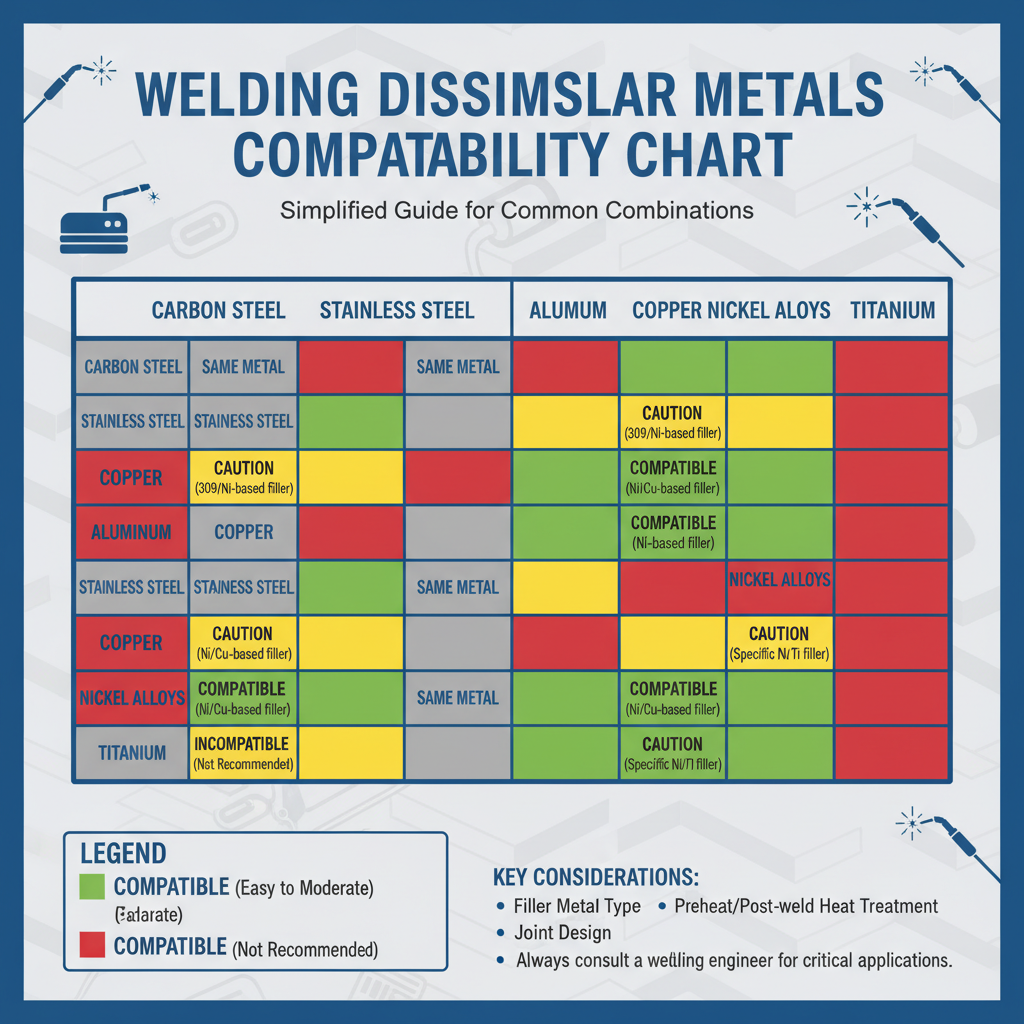
Understanding which metals work well together saves time and prevents costly failures. Here’s a practical compatibility reference:
For those interested in specialized welding methods, exploring pipeline welding techniques can provide valuable insights into handling various metal types effectively.
Highly Compatible Combinations:
- Carbon steel to low-alloy steel
- Stainless steel 304 to 316
- Aluminum 6061 to 6063
- Copper to brass
Moderately Compatible (Requires Special Techniques):
- Carbon steel to stainless steel
- Aluminum to magnesium
- Inconel to stainless steel
- Titanium to stainless steel
Challenging Combinations:
- Aluminum to steel
- Copper to aluminum
- Cast iron to steel
- Titanium to aluminum
Generally Incompatible:
- Aluminum to copper (direct welding)
- Zinc-coated metals to most others
- Lead-bearing materials to structural metals
Critical Factors That Determine Weld Success
Several metallurgical and physical properties determine whether two dissimilar metals can be successfully welded together.
Thermal Expansion Rates create the biggest challenge. When metals expand and contract at different rates during heating and cooling, internal stresses develop that can crack the weld or base materials. Steel expands about 12 parts per million per degree Celsius, while aluminum expands at 23 parts per million.
Melting Point Differences require careful heat management. Aluminum melts at 1,220°F while steel melts around 2,500°F. This means you must control heat input precisely to avoid burning through the lower-melting material.
Chemical Compatibility determines whether the metals will form brittle intermetallic compounds. Some combinations create hard, crack-prone zones that weaken the joint over time.
Steel to Stainless Steel Welding Techniques
This combination appears in many industrial applications and responds well to proper technique. The main challenge involves preventing carbon migration from the steel into the stainless steel, which reduces corrosion resistance.
Use ER309L or ER312 filler metal for most applications. These high-chromium, high-nickel fillers create a buffer zone that accommodates the different expansion rates and chemical compositions.
Process Selection: GMAW (MIG) or GTAW (TIG) work best. Stick welding is possible but requires more skill to control heat input properly.
TIG welding tips provide valuable guidance on controlling heat input and achieving precise welds, which is crucial when working with dissimilar metals like steel and stainless steel.
Joint Preparation: Bevel the stainless steel side more than the carbon steel side. This places more filler metal on the stainless side, reducing dilution from the carbon steel.
Aluminum to Steel Joining Methods
Direct fusion welding of aluminum to steel creates brittle intermetallic compounds that crack easily. Successful joining requires alternative approaches.
One effective alternative to direct fusion welding is explosion welding, a process that creates strong metallurgical bonds without melting the base metals.
Explosion Welding creates a mechanical bond without melting either material. This process uses controlled explosives to force the metals together at high velocity.
Friction Stir Welding generates heat through mechanical friction rather than an arc. The solid-state process avoids the formation of brittle compounds.
Transition Inserts provide an intermediate material that’s compatible with both base metals. Aluminum-steel transition pieces are commercially available for structural applications.
Brazing and Soldering use lower temperatures and filler metals that wet both surfaces without creating intermetallic zones.
Copper Alloy Welding Considerations
Copper and its alloys present unique challenges due to high thermal conductivity and sensitivity to contamination.
Preheating Requirements: Copper conducts heat so rapidly that preheating to 200-400°F is often necessary to maintain a stable arc and proper penetration.
Shielding Gas Selection: Pure argon works for thin sections, but helium or argon-helium mixtures provide better heat input for thicker materials.
Filler Metal Matching: Use ERCu for pure copper, ERCuSi-A for copper-silicon alloys, and ERCuAl-A2 for aluminum bronze applications.
Contamination Control: Copper is extremely sensitive to sulfur, phosphorus, and lead contamination. Clean base materials thoroughly and use high-purity filler metals.
Common Problems and Solutions
Hot Cracking occurs when thermal stresses exceed the material’s strength during cooling. This problem is especially common with high-carbon steels and some aluminum alloys.
Solution: Use lower heat input, preheat when appropriate, and select filler metals with better crack resistance. Post-weld heat treatment can relieve residual stresses.
Cold Cracking develops hours or days after welding when hydrogen diffuses into high-strength zones. This affects hardenable steels most severely.
Solution: Use low-hydrogen processes and consumables. Maintain interpass temperatures above 200°F and consider post-weld heat treatment.
Lack of Fusion happens when the arc doesn’t adequately melt both base materials. This creates weak spots that can fail under load.
Solution: Increase heat input, improve joint access, and ensure proper electrode angles. Clean joint surfaces thoroughly before welding.
Filler Metal Selection Guidelines
Choosing the right filler metal is crucial for dissimilar metal welding success. The filler must be compatible with both base materials while providing adequate mechanical properties.
Overmatching Strategy: Select filler metals stronger than the weaker base material. This ensures the weld won’t be the failure point.
Chemical Bridge Approach: Use filler compositions that gradually transition between the two base metal chemistries. This reduces the formation of brittle zones.
Dilution Considerations: Account for how much base metal melts into the weld pool. High dilution can change the weld metal composition significantly.
Service Environment: Consider temperature, corrosion, and mechanical loading when selecting filler metals. What works in one application may fail in another.
Frequently Asked Questions
Can you weld aluminum to steel directly?
Direct fusion welding of aluminum to steel creates brittle intermetallic compounds that crack easily. Use explosion welding, friction stir welding, or transition inserts instead.
What filler metal should I use for carbon steel to stainless steel?
ER309L or ER312 filler metals work best for most applications. These provide good strength and corrosion resistance while accommodating thermal expansion differences.
Why do dissimilar metal welds crack more often?
Different thermal expansion rates create internal stresses during heating and cooling cycles. These stresses can exceed the material’s strength, causing cracks to form.
Is preheating necessary for dissimilar metal welding?
Preheating helps reduce thermal stress and improves weldability for many combinations. Copper alloys almost always require preheating due to high thermal conductivity.
Can you weld cast iron to steel?
Yes, but it requires careful technique. Use nickel-based filler metals, control heat input carefully, and consider preheating to reduce thermal shock.
What’s the biggest mistake when welding dissimilar metals?
Using the wrong filler metal is the most common error. Always research the specific combination and select fillers designed for dissimilar metal applications.
How do you prevent galvanic corrosion in dissimilar metal welds?
Use filler metals that create a gradual transition between the base materials. Consider protective coatings or cathodic protection for critical applications.
Final Thoughts
Successfully welding dissimilar metals requires understanding the fundamental differences between materials and selecting appropriate techniques to overcome these challenges. The compatibility chart provides a starting point, but each application demands careful consideration of service conditions, joint design, and welding procedures.
Field experience shows that taking time to properly prepare joints, select correct filler metals, and control heat input prevents most problems. When direct welding isn’t feasible, alternative joining methods like brazing or mechanical fastening often provide reliable solutions.
Remember that dissimilar metal welding is both an art and a science. Start with proven combinations and techniques, then gradually expand your capabilities as you gain experience with more challenging material pairings.