Knowing whether your weld is actually good — or just looks okay — is one of the most practical skills you can develop as a welder. A bead that looks clean on the surface can still be weak underneath, and a slightly rough bead can be perfectly solid.
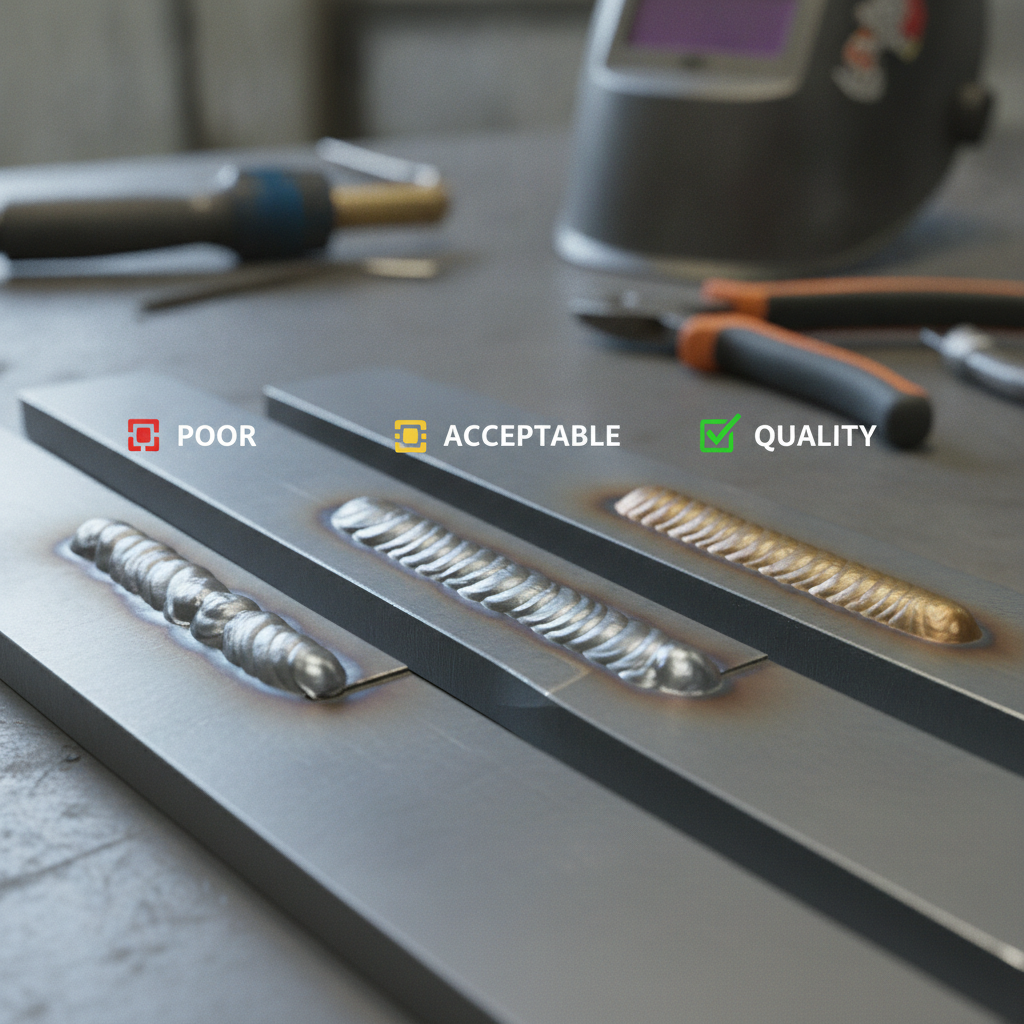
A good MIG weld has a consistent, uniform bead with even width, smooth ripples, and good fusion into the base metal on both sides. The profile should be slightly convex or nearly flat — not too tall, not undercut. There should be no porosity, cracks, spatter, or gaps. The color typically ranges from bright silver to light gold, indicating proper heat and shielding gas coverage.
The Visual Characteristics of a Quality MIG Weld
When you look at a well-executed MIG weld, several things stand out immediately.
Bead consistency is the first thing to assess. The width should remain steady from start to finish, with no dramatic narrowing or widening. Inconsistent width usually signals travel speed problems or an unstable arc.
Ripple pattern tells you a lot about technique. Good welds have evenly spaced ripples that look almost like overlapping coins or fish scales. The spacing reflects a steady travel speed and smooth torch motion.
Tie-in at the toes is critical. The weld should blend smoothly into the base metal on both edges — called the toes of the weld. Abrupt edges, undercutting, or areas where the bead sits high without fusing properly are signs of either too much heat or too little.
Weld Profile: Height, Width, and Flatness
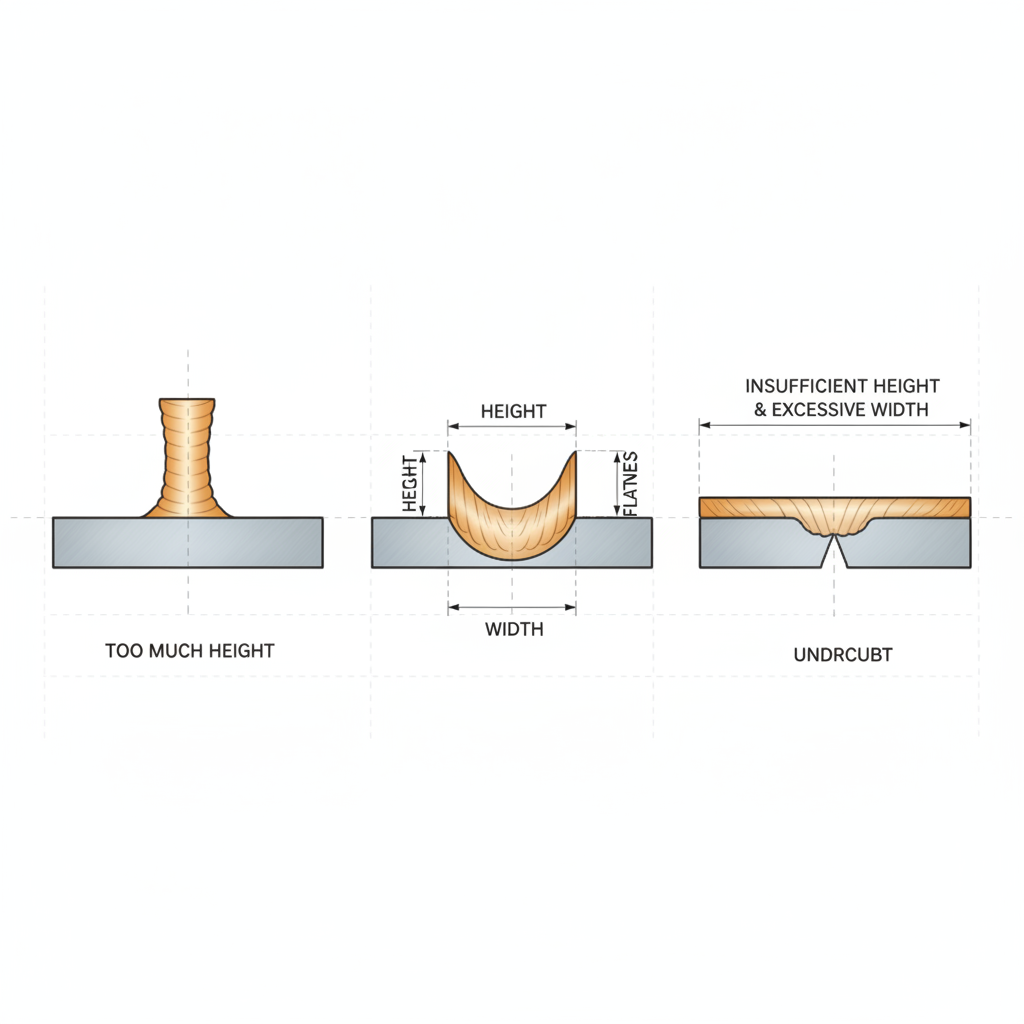
The profile — how the bead looks from the side — matters structurally, not just visually.
A good MIG weld should be:
– Slightly convex to nearly flat — a gentle crown is acceptable; a tall, narrow bead is not
– Wide enough to bridge the joint with full fusion on both sides
– Not undercut — the base metal next to the toes shouldn’t be eaten away
A bead that sits too high (excessive convexity) concentrates stress at the toes and can crack under load. A bead that’s too flat or concave may lack sufficient throat thickness. If you want to understand how profile relates to structural requirements, learning how to determine proper weld size will help you connect visual appearance with actual strength requirements.
Color and Surface Appearance
Weld color gives you immediate feedback on shielding gas performance and heat input.
| Color | What It Indicates |
|—|—|
| Bright silver / light straw | Excellent — proper shielding and heat |
| Gold or light blue | Acceptable — slightly high heat or minor gas coverage variation |
| Dark blue / purple | Elevated heat, borderline shielding coverage |
| Black or sooty | Poor shielding gas coverage or contamination |
| Rough and bubbly | Porosity — likely gas flow issue or contamination |
Bright, shiny silver with a slight straw tint is typically what you’re aiming for on mild steel with 75/25 argon/CO₂ shielding gas. Black or sooty beads almost always point to a gas flow problem — either too little coverage or a draft disrupting the shielding envelope. Getting your shielding gas flow rate right is one of the most overlooked factors in weld appearance.
What Good Fusion Actually Means
Appearance on the surface is only part of the story. A weld can look great and still have poor fusion underneath.
True fusion means the filler metal has melted and bonded with the base metal — not just sat on top of it. Signs of good fusion visually include:
– Smooth, gradual transition from the weld toe into the base metal
– No cold lapping (where the bead appears to rest on the surface without actually penetrating)
– Even discoloration in the heat-affected zone (HAZ) on both sides of the joint
Cold lapping is especially common when wire speed is too high relative to voltage, or when travel speed is excessive. The arc doesn’t have enough dwell time to properly melt the base material.
Common Defects and What They Look Like
Recognizing a bad weld is just as important as knowing what a good one looks like.
Porosity — Small pits or holes scattered across or within the bead. Usually caused by contamination (rust, oil, moisture) or inadequate shielding gas coverage.
Undercut — A groove or depression along the weld toe where the base metal has been melted away but not filled. Caused by excessive heat, too-fast travel speed, or incorrect torch angle.
Overlap / Cold Lap — The bead rolls over onto the base metal without fusing into it. Caused by too little heat or too-slow wire speed.
Excessive Spatter — Droplets of filler metal scattered around the weld zone. Often caused by incorrect polarity, contamination, or poor voltage-to-wire-speed ratio.
Cracks — Visible splits in the weld or heat-affected zone. Can indicate excessive heat, improper filler material, or rapid cooling.
Burn-Through — A hole in the base metal. Common on thin material with too much heat. Avoiding burn-through on thin gauge steel requires specific adjustments to technique and settings.
Getting a good-looking weld is largely a settings problem before it becomes a technique problem.
Voltage controls penetration and bead width. Too low and the bead piles up; too high and you get excessive spatter, undercutting, or burn-through. Wire feed speed controls deposition rate and arc stability. These two need to be balanced.
A practical reference for dialing in voltage and wire speed based on material thickness is a MIG welding wire speed and voltage chart — it gives you a reliable starting point before you fine-tune by ear and eye.
Travel speed also directly affects bead appearance. Moving too fast produces a narrow, ropey bead with poor fusion. Too slow creates a wide, convex bead with excess buildup and possible burn-through. The sweet spot produces an even ripple pattern at a pace that feels controlled but not rushed.
If you want flatter-looking beads, techniques for getting MIG welds to lay flat cover the specific adjustments that make a noticeable difference.
Good MIG Weld: Quick Reference
| Feature | Good Weld | Problem Weld |
|—|—|—|
| Bead width | Consistent, even | Narrow in spots, wide in others |
| Ripple pattern | Even, coin-stack appearance | Irregular or absent |
| Profile | Slightly convex to flat | Too tall, concave, or uneven |
| Toes | Smooth fusion into base metal | Undercut, overlap, or cold lapping |
| Color | Silver to light gold/straw | Black, sooty, or dark blue |
| Surface | Smooth, minimal spatter | Porous, rough, or cracked |
| Spatter | Minimal | Excessive droplets on base metal |
FAQ
What is the ideal MIG weld bead shape?
The ideal MIG weld bead is slightly convex and consistently wide, with a smooth ripple pattern and clean tie-in at the toes. It shouldn’t be too tall — excessive convexity creates stress concentration points. A flat or gently rounded profile with full sidewall fusion is the target for most structural and fabrication work.
Why does my MIG weld look like a pile of BBs?
A ropey, ball-stacked bead usually means your wire speed is too high relative to your voltage, or your travel speed is too fast. The arc isn’t maintaining a stable puddle, so the wire deposits without proper fusion. Try increasing voltage slightly, reducing wire speed, or slowing down your travel to give the puddle time to flow.
Why is my MIG weld black and sooty?
A sooty, black bead is almost always a shielding gas issue. The most common causes are a flow rate that’s too low, a gas leak in the hose or fitting, a blocked nozzle, or welding in a draft that’s blowing the gas away from the puddle. Check your connections, clean the nozzle, and verify flow at the regulator.
Can a MIG weld look good but still be weak?
Yes. Cold lapping — where the bead sits on top of the base metal without fusing into it — can look acceptable on the surface while being structurally poor. Excessive convexity can also produce a visually neat bead that concentrates stress at the toes. Visual inspection alone isn’t sufficient for structural welds; proper settings and technique are what ensure real penetration.
How do I know if my MIG weld has good penetration?
Full penetration on a butt joint shows up as a slight root bead visible on the back side of the material. On fillet welds, penetration is harder to judge visually — it depends on correct settings, technique, and joint fit-up. Running a test bead on scrap and cutting it cross-section to examine the profile is the most reliable way to verify penetration before welding a real part.
What does a good MIG weld sound like when it’s running?
A well-tuned MIG weld produces a steady, consistent crackling sound — often compared to bacon frying. The arc should sound smooth and continuous, not spitting, popping, or stuttering. Irregular sounds indicate instability, which usually points to incorrect wire speed, voltage, or a contact tip or liner that needs attention.
Does spatter always mean a bad weld?
Not necessarily, but excessive spatter is a reliable sign that something is off. Mild steel MIG welding with 75/25 gas at proper settings should produce very little spatter. Heavy spatter typically indicates incorrect polarity, wrong gas mixture, contamination on the base metal, or settings that are out of balance. Cleaning the nozzle and rechecking your setup usually helps significantly.
The Honest Bottom Line
A good MIG weld is consistent, smooth, and properly fused — not just visually clean. The bead profile, toe tie-in, color, and ripple pattern all give you useful feedback about what’s happening at the arc. Learn to read these signs, and your welds will improve faster than any other approach. Settings get you most of the way there; technique and observation do the rest.