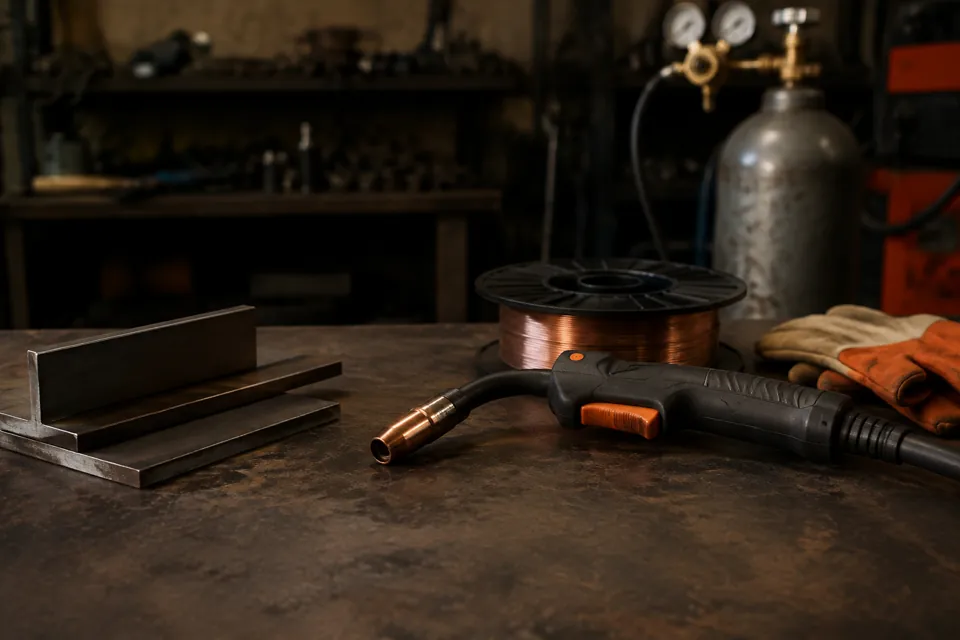
Choosing the wrong shielding gas is one of the most common reasons MIG welds turn out porous, spattered, or structurally weak. The gas you use directly affects arc stability, penetration depth, bead appearance, and overall weld quality.
MIG welding uses shielding gases to protect the molten weld pool from atmospheric contamination. The most common gases are pure CO₂ (carbon dioxide), pure Argon, and blended mixtures such as 75% Argon / 25% CO₂ (C25). The right choice depends on the base metal — mild steel, stainless steel, or aluminum — as well as the desired weld quality and cost.
Why Shielding Gas Matters in MIG Welding
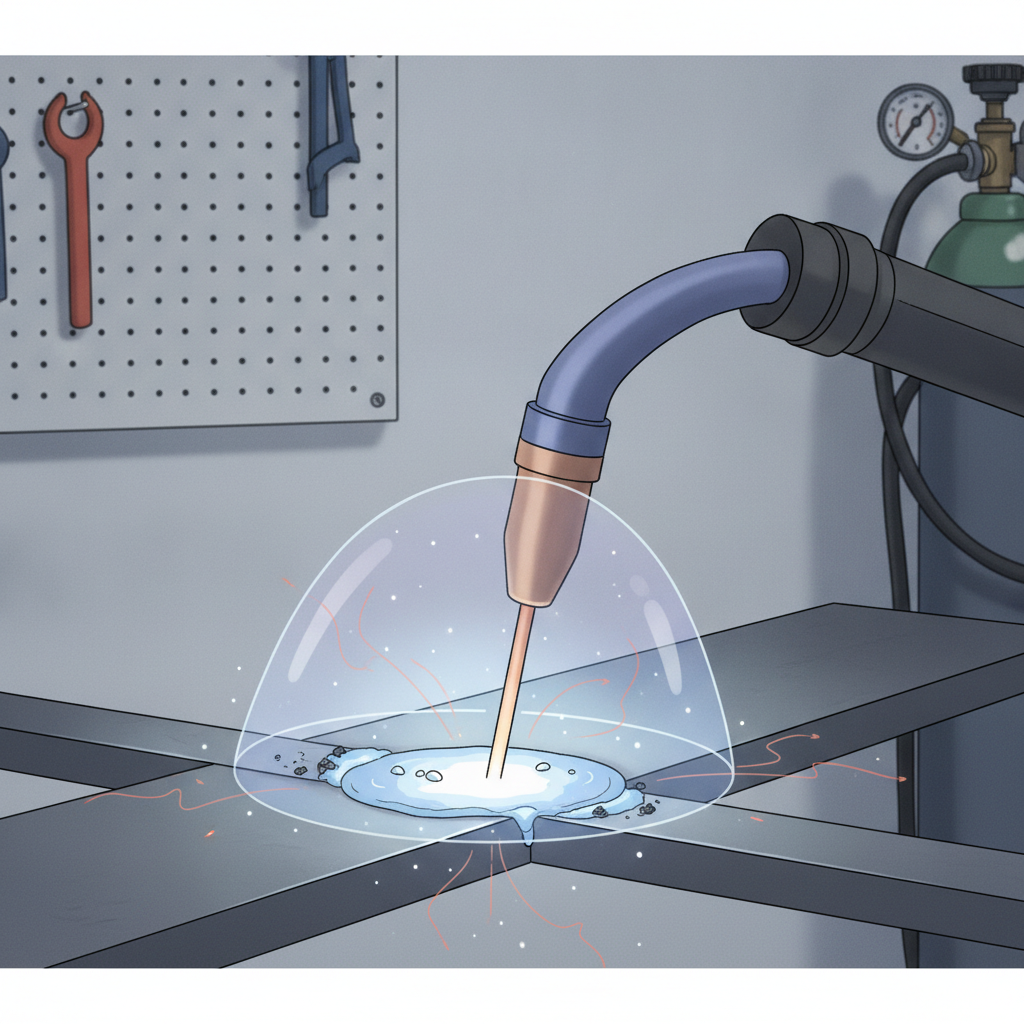
When metal melts during welding, it becomes highly reactive. Oxygen and nitrogen in the surrounding air will attack the weld pool, causing porosity, oxidation, and weakened joints.
Shielding gas creates a protective envelope around the arc and molten metal, displacing atmospheric gases before they can contaminate the weld. Without it — or with the wrong type — even a technically skilled welder will produce poor results.
The shielding gas also influences how the arc behaves. Some gases produce a wider, hotter arc. Others tighten the arc and reduce spatter. These properties matter depending on what you’re welding and the finish quality you need.
The Main MIG Welding Gases Explained

Carbon Dioxide (CO₂)
Pure CO₂ is the most affordable MIG welding gas and works well for basic mild steel applications. It produces deep penetration and a vigorous, somewhat aggressive arc.
The tradeoff is increased spatter compared to argon-based blends. Post-weld cleanup takes more time, and the arc can feel less stable. For structural work or rough fabrication where cosmetics aren’t a priority, pure CO₂ is a practical and cost-effective option.
It’s worth noting that CO₂ is a reactive gas, not a true inert gas — which is why some prefer the more technically accurate term GMAW (Gas Metal Arc Welding) over MIG (Metal Inert Gas).
Argon (Ar)
Pure argon is an inert gas that produces a smooth, stable arc with minimal spatter. It’s the standard choice for MIG welding aluminum and is also used for TIG welding.
However, pure argon is not recommended for mild steel in standard MIG welding. On steel, it produces inconsistent arc behavior, poor fusion, and an uneven bead profile. It performs best with non-ferrous metals like aluminum, copper, and magnesium.
Argon / CO₂ Blends
Blended gases are the most popular choice for everyday MIG welding. They combine the arc stability and low spatter of argon with the penetration and cost efficiency of CO₂.
The most widely used blend is 75% Argon / 25% CO₂, commonly called C25. This mixture delivers a clean arc, good penetration on mild steel, and noticeably less spatter than pure CO₂. It’s the go-to choice for most hobbyists and professionals welding mild steel.
Other common blends include 80/20 and 90/10 argon/CO₂ ratios, which are used when a cleaner bead with less spatter is needed — often in automotive or structural fabrication. For a deeper look at how these options compare, the best gas for MIG welding mild steel breakdown covers the performance differences in practical terms.
Argon / CO₂ / Oxygen Tri-Mix (for Stainless Steel)
Welding stainless steel requires a different approach. The standard tri-mix for stainless MIG welding is 90% Helium / 7.5% Argon / 2.5% CO₂, though a simpler and more commonly available mix is 98% Argon / 2% CO₂.
The small addition of CO₂ or oxygen improves arc stability and wetting without causing excessive oxidation on the chromium content of the stainless steel. Using too much CO₂ or pure CO₂ on stainless steel causes carbide precipitation, which degrades corrosion resistance near the weld zone.
Helium (He)
Helium isn’t commonly used in standard MIG welding, but it appears in specialty applications. It produces a hotter arc with faster travel speeds and deeper penetration.
Pure helium is expensive and less stable than argon. It’s typically blended with argon or CO₂ for applications requiring higher heat input — such as thicker aluminum sections or high-production environments. Most hobbyists and smaller shops rarely encounter it.
Gas Selection by Base Metal
| Base Metal | Recommended Gas | Notes |
|---|---|---|
| Mild Steel | 75% Ar / 25% CO₂ (C25) | Best balance of quality and cost |
| Mild Steel (budget) | 100% CO₂ | More spatter, deep penetration |
| Stainless Steel | 98% Ar / 2% CO₂ | Minimizes carbide precipitation |
| Aluminum | 100% Argon | Pure argon is required |
| Aluminum (thick) | Ar / He blend | Helium adds heat for better fusion |
| Thin Sheet Metal | 90% Ar / 10% CO₂ | Reduced burn-through risk |
This table covers the most common applications. For a full reference across all welding processes, the complete shielding gas selection guide is worth bookmarking.
Gasless MIG Welding: No Shielding Gas Required
Flux-core welding is a variation of MIG welding that uses a hollow wire filled with flux compounds. When the wire burns, the flux generates its own shielding, eliminating the need for an external gas cylinder.
This makes flux-core welding practical outdoors or in windy conditions where gas shielding would be blown away. The Lincoln Electric Weld-Pak 140 HD and similar machines support both gas and gasless (flux-core) modes.
The tradeoff is more spatter, more cleanup, and generally a rougher bead profile compared to gas-shielded MIG. Flux-core is popular for structural steel, repair work, and farm equipment — situations where portability and wind resistance matter more than weld appearance.
Getting Gas Flow Rate Right
Selecting the correct gas is only part of the equation. Flow rate — measured in liters per minute (LPM) or cubic feet per hour (CFH) — must also be set correctly.
Too little flow and atmospheric contamination sneaks in. Too much flow creates turbulence that actually pulls air into the shielding zone — the opposite of what you want.
For standard indoor MIG welding, a flow rate between 10–15 LPM (20–30 CFH) is typical for most applications. Windy environments or larger nozzles may require slightly higher rates. The correct MIG welding gas pressure settings article goes into detail on how to dial this in properly.
Common Gas-Related Welding Problems
Even with the right gas selected, setup issues can cause problems. Here are the most frequently encountered ones:
Porosity (small holes in the weld)
- Likely cause: Gas contamination, too-low flow rate, or a leak in the gas line
- Fix: Check hose connections, increase flow rate, inspect the regulator
Excessive spatter
- Likely cause: Wrong gas mixture (too much CO₂ or reactive gas), incorrect voltage
- Fix: Switch to a higher argon blend, adjust voltage and wire speed
Inconsistent arc
- Likely cause: Using pure argon on steel, fluctuating gas pressure, or a clogged nozzle
- Fix: Switch to an appropriate gas blend, clean or replace the nozzle
Weld oxidation on stainless steel
- Likely cause: Using high CO₂ content gas on stainless steel
- Fix: Switch to 98% Ar / 2% CO₂ or a dedicated stainless tri-mix
FAQ
Can I use pure argon for MIG welding steel?
Pure argon is not suitable for MIG welding steel. On ferrous metals, it creates an unstable arc, poor fusion, and an irregular bead. Pure argon is reserved for MIG welding aluminum or non-ferrous metals. For steel, use C25 (75% Ar / 25% CO₂) or pure CO₂ depending on the quality you need.
What is the difference between C25 and pure CO₂ for MIG welding?
C25 (75% Argon / 25% CO₂) provides a smoother arc, less spatter, and a cleaner bead — making it better for visible or structural welds. Pure CO₂ is cheaper and delivers deeper penetration but generates significantly more spatter and requires more post-weld cleanup. Most welders prefer C25 for general work.
What gas is used for MIG welding stainless steel?
The most accessible option is 98% Argon / 2% CO₂. This blend provides arc stability without causing excessive carbide precipitation in the heat-affected zone. Some shops use a tri-mix of helium, argon, and CO₂ for better wetting action. Avoid high CO₂ concentrations on stainless steel, as they degrade corrosion resistance.
Does wind affect MIG shielding gas?
Yes, significantly. Even light wind can disperse the shielding gas envelope, leading to porosity and contamination. Outdoors MIG welding with shielding gas is unreliable. In those conditions, switching to flux-core wire is far more practical. If you must use gas outdoors, block the wind with a shield and increase flow rate slightly.
What gas do I need for MIG welding aluminum?
Pure 100% argon is the standard gas for MIG welding aluminum. It produces a stable arc and clean welds on aluminum alloys. For thicker sections where more heat input is needed, a helium/argon blend is used. Do not use CO₂ with aluminum — it will oxidize the surface and produce defective welds.
Is it safe to weld with MIG shielding gases indoors?
Argon and CO₂ are both asphyxiation hazards in enclosed spaces because they displace oxygen without any smell or warning sign. Adequate ventilation is essential. The health risks associated with MIG welding go beyond just the gas — fumes and UV exposure are also concerns worth understanding.
Can I use the same gas for MIG and TIG welding?
Pure argon works for both processes, so there’s overlap if you’re welding aluminum. However, TIG welding steel also uses pure argon, while MIG welding steel performs better with an argon/CO₂ blend. They’re compatible gases but not always interchangeable based on the application.
The type of shielding gas you choose shapes everything about the weld — from arc behavior and spatter levels to final strength and corrosion resistance. For most mild steel work, C25 is the practical default. Aluminum needs pure argon. Stainless steel needs a low-CO₂ blend. Getting the gas right from the start removes one of the most common variables that cause welds to fail.