
Picking up a welder for the first time — or switching to a new process — and realizing you’re not sure about polarity or current type is more common than most welders admit. Getting it wrong won’t always produce an obvious failure, but it will affect penetration, arc stability, and overall weld quality.
Mild steel is most commonly welded using direct current (DC). The specific polarity depends on the process: MIG welding uses DC electrode positive (DCEP), most stick electrodes for mild steel — such as E6013 and E7018 — also run on DCEP, while TIG welding mild steel uses DCEN (DC electrode negative). Flux-core welding varies: gas-shielded flux-core wire typically runs on DCEP, while self-shielded flux-core wire often requires DCEN. Alternating current (AC) can work with certain stick electrodes like the E6011, but DC is generally preferred for mild steel because it produces a more stable arc.
DC vs. AC: What Actually Changes at the Arc
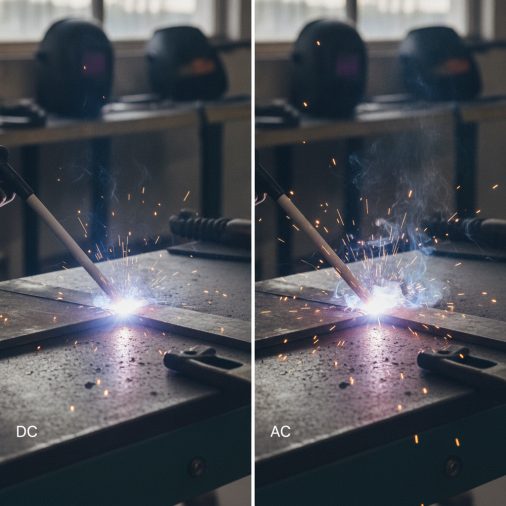
Direct current flows in one direction, which creates a consistent, stable arc. That stability makes it easier to control penetration, reduce spatter, and maintain a smooth bead profile — especially for beginners learning to read the puddle.
Alternating current reverses direction roughly 50 to 60 times per second depending on the power supply frequency. This reversal introduces a brief arc extinction point with each cycle, which can cause the arc to feel slightly rough or erratic compared to DC. For mild steel, that disadvantage is real, even if experienced welders can compensate with technique.
AC does have practical uses — it works well for certain electrodes, helps reduce arc blow on magnetic or thick workpieces, and is standard for TIG welding aluminum due to its oxide-cleaning action. But for everyday mild steel work, DC is the practical default across all major processes.
Polarity Matters as Much as Current Type
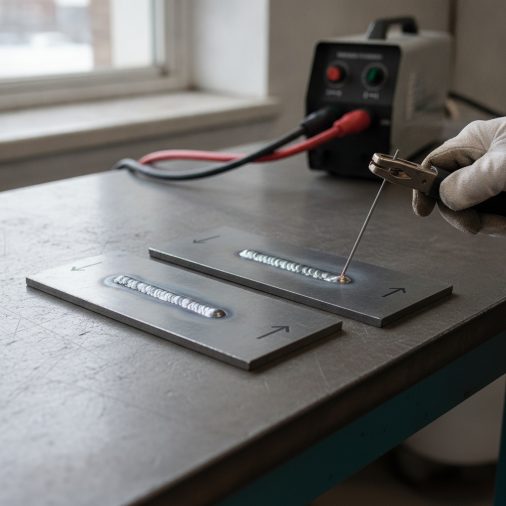
Current type alone doesn’t tell the whole story. With DC, polarity determines which part of the circuit carries the majority of the heat — and that affects penetration depth, deposition rate, and electrode performance.
– DCEP (DC electrode positive / reverse polarity): The electrode or wire is connected to the positive terminal. Approximately two-thirds of the arc heat concentrates at the workpiece. This produces deeper penetration and is the standard polarity for MIG welding mild steel and most common stick electrodes.
– DCEN (DC electrode negative / straight polarity): The electrode connects to the negative terminal. More heat concentrates at the electrode tip. TIG welding mild steel uses DCEN to protect the tungsten and deliver heat efficiently into the base metal.
Swapping polarity by mistake is a real workshop error. Running a MIG welder on DCEN, for example, typically produces a harsh, unstable arc with excessive spatter and poor fusion. Before blaming wire, gas, or settings, checking polarity is always worth a moment.
Current Requirements by Welding Process
Each welding process has a preferred current type and polarity for mild steel. The table below summarizes the standard setup:
| Process | Current Type | Polarity | Common Electrodes / Wire |
|---|---|---|---|
| MIG (GMAW) | DC | DCEP | ER70S-6, ER70S-3 |
| Stick (SMAW) | DC (preferred) or AC | DCEP (most rods) | E6013, E7018, E6011 |
| TIG (GTAW) | DC | DCEN | ER70S-2, ER70S-6 |
| Gas-shielded flux-core (FCAW-G) | DC | DCEP | E71T-1C, E71T-9C |
| Self-shielded flux-core (FCAW-S) | DC | DCEN | E71T-11, E71T-GS |
Always confirm polarity requirements on the electrode or wire packaging, or in the manufacturer’s data sheet. Not all flux-core wires follow the same convention, and running a wire on the wrong polarity can produce a weld that looks acceptable but lacks proper fusion.
Stick Electrode Selection and Current Compatibility
The electrode classification gives you the current information you need. For mild steel stick welding, the most frequently used rods are:
– E6013: Runs well on AC or DC, produces a soft arc, light penetration, and is forgiving for beginners.
– E6011: Designed for AC and DC, suitable for rusty or dirty metal, good for field repairs. The E6011 is one of the few general-purpose mild steel rods that performs reliably on AC.
– E6010: Requires DCEP. Known for deep penetration and a forceful arc. Commonly used for pipeline and root-pass work where burn-through capability matters.
– E7018: Requires DCEP (some machines support AC with this rod, but DC is preferred). Low-hydrogen electrode for stronger welds and reduced cracking risk.
Trying to run an E6010 on AC will result in a stubborn, erratic arc that is difficult to maintain. The rod classification exists for a reason, and current compatibility is part of that specification.
Machine Type and Available Current
Not every welder produces both AC and DC. Knowing what your machine outputs is a practical starting point before adjusting anything else.
– Transformer-based stick welders: Many older or entry-level transformer welders output AC only. They can run E6011 and E6013 on mild steel adequately, but they cannot run E6010 effectively.
– Inverter welders: Most modern inverter-based machines output DC, and many offer switchable polarity. Machines such as the Lincoln Electric POWER MIG 210 MP or the Miller Multimatic 215 cover multiple processes with DC output and polarity switching, making them adaptable for MIG, TIG, and stick work on mild steel.
– AC/DC TIG welders: Machines that output both AC and DC — such as the ESAB Rebel EMP 205ic AC/DC — are designed for TIG welding aluminum (AC) and steel (DC) from the same unit.
For most mild steel work in a home workshop or small fabrication shop, a DC-capable inverter welder covers all common processes.
Shielding Gas Pairing for MIG and Flux-Core
Current type and polarity work alongside shielding gas selection, not independently. For MIG welding mild steel on DCEP, the standard shielding gas options are:
– 75% argon / 25% CO₂ (C25): The most widely used mix for mild steel MIG welding. Produces a smooth arc, low spatter, and good bead appearance.
– 100% CO₂: More affordable, increases penetration, and produces a stiffer arc with more spatter. Acceptable for structural and production work where appearance is less critical.
The choice of gas affects how the arc behaves at a given amperage and voltage, so switching gas mixes often requires a settings adjustment. For a detailed look at how these gases affect arc characteristics, the article on choosing the best shielding gas for MIG welding mild steel covers the comparison in practical terms.
Self-shielded flux-core wire does not require external shielding gas. The flux within the wire generates its own shielding. This makes it practical for outdoor work where wind would disturb gas coverage, though the DCEN polarity requirement is often overlooked by welders switching from MIG.
Safety and Setup Before Striking an Arc
Working with arc welding equipment involves electrical hazards, UV radiation, fumes, and heat. Before welding mild steel with any process:
– Wear a welding helmet with an appropriate shade — typically shade 9 to 11 for MIG and stick, shade 8 to 10 for light TIG work.
– Use welding gloves and flame-resistant clothing.
– Ensure adequate ventilation. Mild steel fumes contain iron oxide and manganese. Welding coated or plated mild steel introduces additional hazards.
– Remove combustible materials from the work area.
– Check ground clamp connection. A loose or poor ground affects arc quality and can create electrical hazards.
– Confirm polarity before welding. On many inverter machines, polarity is changed by swapping the torch or electrode lead and work lead connections at the machine terminals — not through a panel switch.
Checking machine polarity takes about 30 seconds and can prevent a frustrating troubleshooting session later.
Frequently Asked Questions
Does it matter whether I use AC or DC when welding mild steel with a stick welder?
DC generally produces a more stable arc on mild steel, which makes electrode control easier and reduces spatter. AC works with compatible electrodes like the E6011 and E6013, and it can reduce arc blow on heavily magnetized or thick steel. For most workshop and home welding situations, DC is the preferred choice when the machine supports it.
Why does my MIG welder produce heavy spatter and a rough arc even with correct gas and wire?
Incorrect polarity is one of the most overlooked causes of this problem. MIG welding mild steel should run on DCEP. If the machine is set to DCEN — or if the torch lead and work lead are swapped — the arc becomes unstable and spatter increases significantly. Check polarity at the machine terminals before adjusting voltage or wire-feed speed.
Can I TIG weld mild steel with AC current?
AC TIG is designed for aluminum, not mild steel. Welding mild steel with AC TIG produces a rough, inconsistent arc and can cause tungsten contamination. Mild steel TIG welding requires DCEN, which concentrates heat at the base metal while protecting the tungsten electrode and maintaining a clean, controllable arc.
What polarity does self-shielded flux-core wire use on mild steel?
Most self-shielded flux-core wires for mild steel, such as E71T-11 and E71T-GS, require DCEN. This is the opposite of MIG and gas-shielded flux-core wire, which use DCEP. Running self-shielded wire on DCEP typically produces a poor arc with excess spatter and incomplete fusion. Always check the wire manufacturer’s data sheet to confirm polarity before welding.
Is DCEP or DCEN better for welding thick mild steel?
DCEP concentrates more heat at the base metal and produces deeper penetration, which makes it the standard choice for welding thicker mild steel sections with MIG or stick processes. DCEN delivers more heat to the electrode and is used specifically for TIG and certain flux-core applications. Penetration requirements, process, and electrode type all influence which polarity is correct.
Why does the E6010 electrode refuse to run properly on my welder?
The E6010 requires DCEP and will not perform correctly on AC. If your machine is a transformer-based AC-only welder, the E6010 is not compatible. Switch to an E6011, which is designed to run on both AC and DC and produces similar penetration characteristics. If your machine is DC-capable, confirm polarity is set to DCEP before using E6010.
Does current type affect weld strength on mild steel?
Current type and polarity affect fusion, penetration, and arc stability — all of which influence the actual weld quality. A weld made with incorrect polarity may appear acceptable visually but have inadequate fusion at the root or sidewalls. For structural or load-bearing mild steel work, correct current setup and verified polarity are part of producing a weld that performs under load, not just one that looks clean.
Polarity is one of the most quietly influential variables in mild steel welding. A correctly set current type and polarity won’t guarantee a perfect weld on its own, but the wrong setup can undermine good wire, clean metal, and careful technique. For mild steel, DC is the practical standard — DCEP for MIG and most stick work, DCEN for TIG and many self-shielded flux-core applications. When a weld suddenly starts behaving differently than expected, checking polarity before adjusting amperage or voltage is always the right first step.