
Why Polarity Matters in MIG Welding
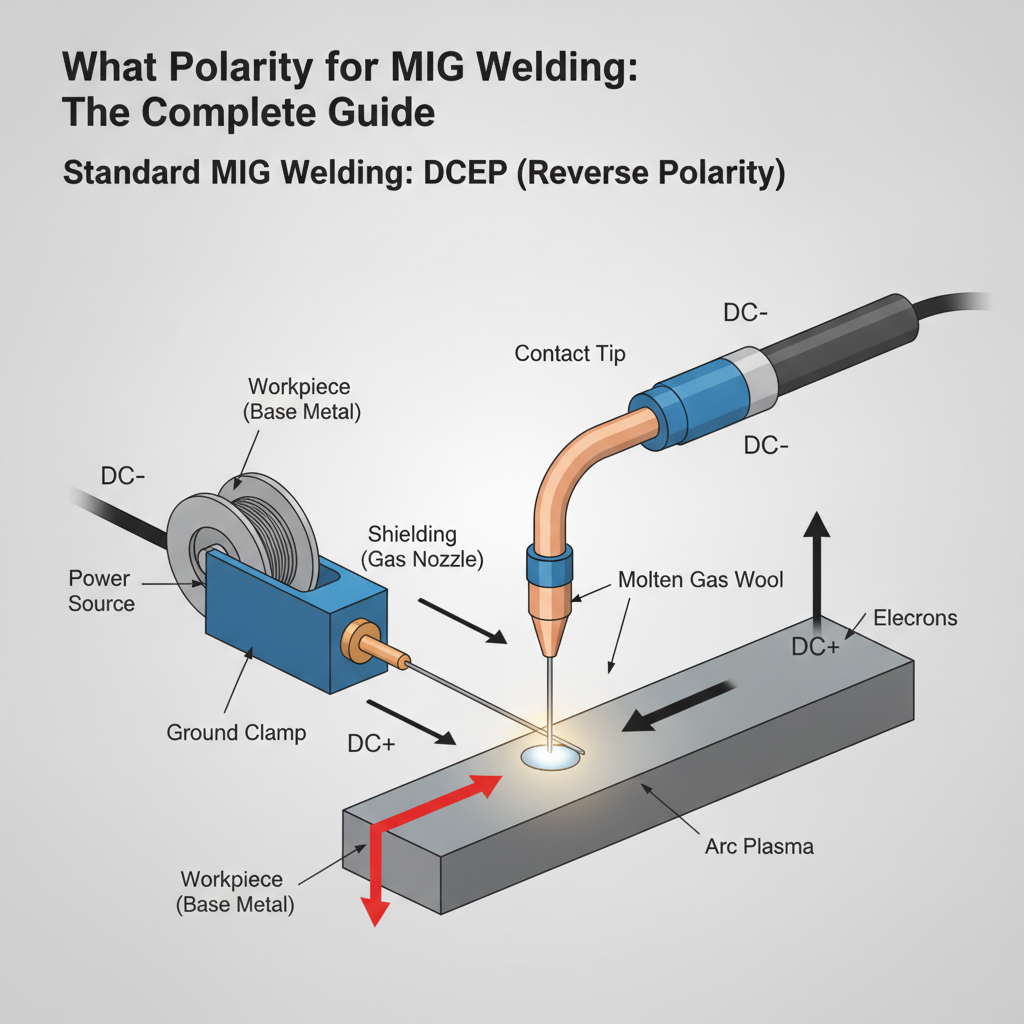
Standard MIG Welding: DCEP (Reverse Polarity)
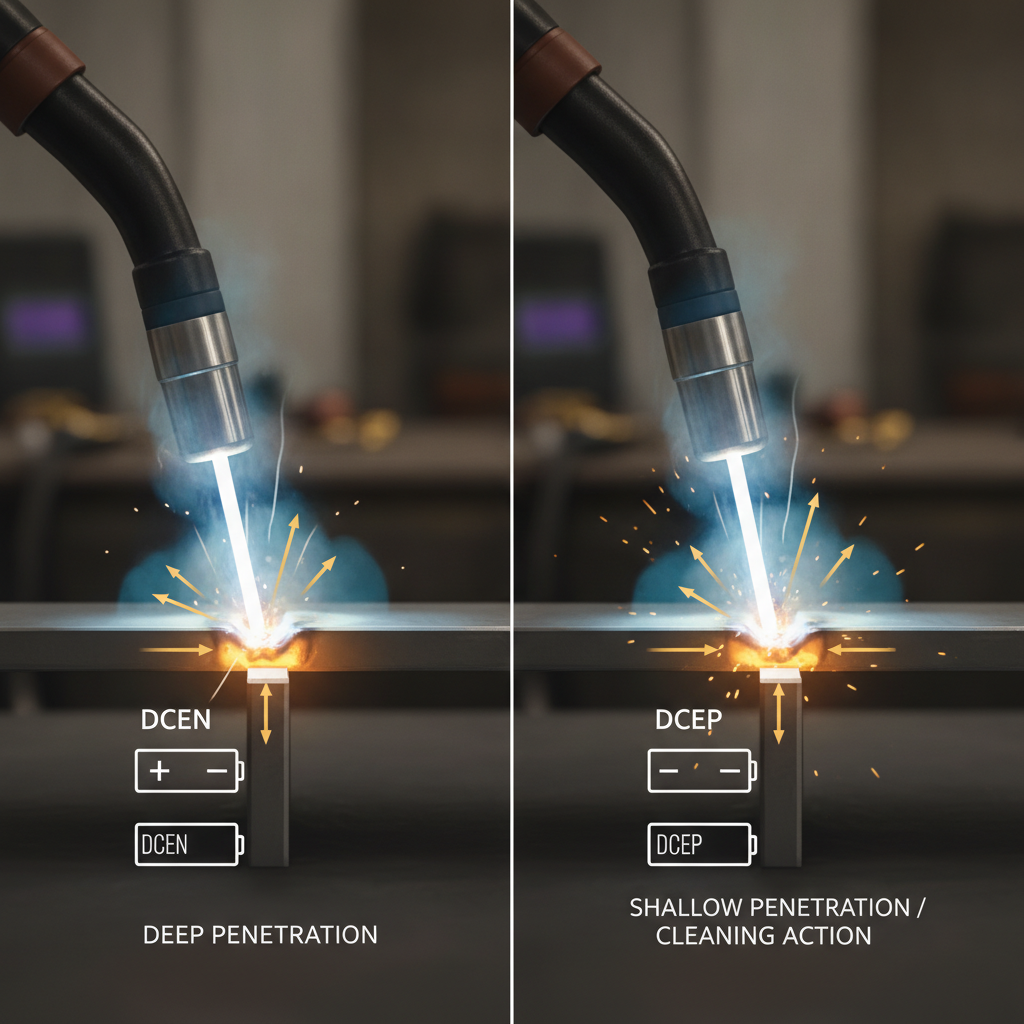
Flux Core MIG Welding: When to Use DCEN
Self-shielded flux core wire — the kind that works without an external shielding gas — typically requires DCEN (straight polarity). The flux inside the wire is formulated to generate its own shielding when the current flows from workpiece to electrode, so the polarity must be set accordingly. If you run self-shielded flux core on DCEP, the flux chemistry doesn’t activate correctly. You’ll usually see heavy spatter, poor shielding, and a rough, porous weld. The difference is immediately noticeable in the sound and feel of the arc. Gas-shielded flux core wire (FCAW-G) is a different story — most of these wires are designed for DCEP, just like solid wire. Always check the wire spool or manufacturer’s data sheet for the specific wire you’re running. A practical reference point: the Lincoln Electric Innershield NR-211-MP is a widely used self-shielded flux core wire that specifically calls for DCEN. Running it on DCEP produces noticeably worse results. If you need specific settings to pair with the correct polarity, a flux core MIG welding settings chart can help you dial in voltage and wire speed alongside polarity.Polarity Quick Reference
| Wire Type | Shielding Method | Correct Polarity | |—|—|—| | Solid wire (mild steel) | External gas (C25, CO₂) | DCEP (+) | | Solid wire (stainless steel) | External gas (tri-mix or C2) | DCEP (+) | | Solid wire (aluminum) | External gas (pure argon) | DCEP (+) | | Self-shielded flux core | No gas (self-shielded) | DCEN (−) | | Gas-shielded flux core | External gas | DCEP (+) |How to Change Polarity on a MIG Welder
Most MIG welders have clearly labeled terminals inside the wire feed compartment. Changing polarity is straightforward: 1. Turn the machine completely off and unplug it from power. 2. Open the wire feed cover panel — the polarity connections are usually inside. 3. Locate the two terminals labeled + and −. 4. Swap the torch lead and the work clamp lead between terminals. 5. Close the panel and restore power. Some machines, like the Hobart Handler 140, use a polarity changeover lead inside the drive compartment with a simple plug that swaps between terminals. Others require loosening bolts and physically moving the cable lugs. Check your manual if the connection type isn’t obvious. Never change polarity with the machine powered on or mid-weld. The arc will do the polarity swapping for you — just not in a way you want.What Happens When Polarity Is Wrong
A mismatched polarity setup is one of the most common causes of weld quality problems that seem impossible to diagnose. The machine may look set up correctly, the gas may be flowing, and settings may be close — but the weld just refuses to behave. Common symptoms of incorrect polarity: – Erratic, popping arc that won’t stabilize regardless of voltage or wire speed adjustments – Excessive spatter coating the nozzle and surrounding base metal – Wire stubbing into the puddle instead of flowing smoothly – Porous or rough weld surface even with proper gas coverage – Shallow penetration on material that should easily fuse at the current settings If you’re troubleshooting a MIG welder that just won’t cooperate, polarity should be one of the first things checked — before adjusting drive rollers, cleaning the contact tip, or blaming the wire. For a broader look at diagnosing weld quality issues, a systematic approach to troubleshooting common MIG welding problems covers most of the root causes welders typically encounter.Polarity and AC vs. DC Welding
MIG welding always uses DC — direct current. AC (alternating current) is generally not suitable for MIG because the constantly reversing current destabilizes the arc and makes consistent metal transfer nearly impossible. DC current flows in one direction, which allows for a stable arc and controlled heat input. DCEP and DCEN are simply the two configurations of that DC circuit — the difference is which direction current flows through the electrode and workpiece. Some stick (SMAW) and TIG welding processes do use AC, particularly for welding aluminum with TIG where the alternating current provides oxide cleaning action. But in MIG welding, that’s handled differently through shielding gas selection and wire composition, not AC polarity. Understanding whether MIG welding uses DCEP or DCEN in more detail can help clarify the relationship between current direction and arc behavior for different wire types.FAQ
Can I run solid wire MIG on DCEN? Technically the arc will strike and the wire will melt, but weld quality will be significantly worse. Solid wire on DCEN produces an unstable arc, heavy spatter, and poor fusion into the base metal. Heat concentrates at the wire rather than the workpiece, so penetration is shallow. This is not a usable setup for production or structural welds. Why do some flux core wires use DCEP and others use DCEN? The difference comes down to flux chemistry. Self-shielded flux core wires contain compounds designed to generate shielding gases and slag when current flows from workpiece to electrode (DCEN). Gas-shielded flux core wires rely on external shielding gas and are formulated for DCEP, similar to solid wire. Always check the manufacturer’s wire specification sheet — running the wrong polarity for a specific wire will produce poor results. How do I know what polarity my MIG welder is currently set to? Open the wire compartment door and trace the torch lead (gun cable) to the terminal inside the machine. If it connects to the positive (+) terminal, the machine is set to DCEP. If it connects to the negative (−) terminal, it’s DCEN. The work clamp should connect to the opposite terminal. Some machines also have a label or diagram inside the door showing the correct configuration. Does polarity affect welding thin sheet metal differently than thick plate? Polarity affects heat distribution regardless of material thickness, but it becomes more critical on thin metal where burn-through is a risk. On thin sheet, correct DCEP polarity with dialed-in settings allows controlled penetration. Incorrect polarity on thin material tends to produce erratic arcs that are difficult to control, which increases the risk of burn-through and poor fusion simultaneously — a particularly frustrating combination. Does wire diameter change polarity requirements? Wire diameter does not change polarity requirements. A 0.023″, 0.030″, or 0.035″ solid wire all require DCEP. Thinner wires operate at lower amperage and voltage settings, but the polarity rule stays the same. The distinction is always between wire type (solid vs. flux core, self-shielded vs. gas-shielded), not wire diameter. What polarity is used for aluminum MIG welding? Aluminum MIG welding with solid wire uses DCEP, the same as steel. The wire (typically ER4043 or ER5356) connects to the positive terminal, and the work clamp to negative. Pure argon shielding gas is required, and settings differ significantly from steel, but polarity remains DCEP. Spool guns are commonly used for aluminum to prevent the soft wire from birdnesting in standard drive systems. Can wrong polarity damage my welder? Running the wrong polarity won’t typically damage the machine itself, but it can cause excessive heat buildup in the torch, accelerated contact tip wear, and drive roll slippage from wire stubbing. Over time, the repeated arc instability from incorrect polarity creates more mechanical stress on the wire feed system than normal operation. It’s more of a performance and consumable issue than a machine damage risk.Getting polarity right is one of the simplest adjustments that has one of the biggest impacts on weld quality. For solid wire with shielding gas, set DCEP. For self-shielded flux core, set DCEN. When in doubt, check the wire manufacturer’s specification — it’s printed on the spool label or available on their data sheet, and it will always tell you exactly what polarity that wire requires.