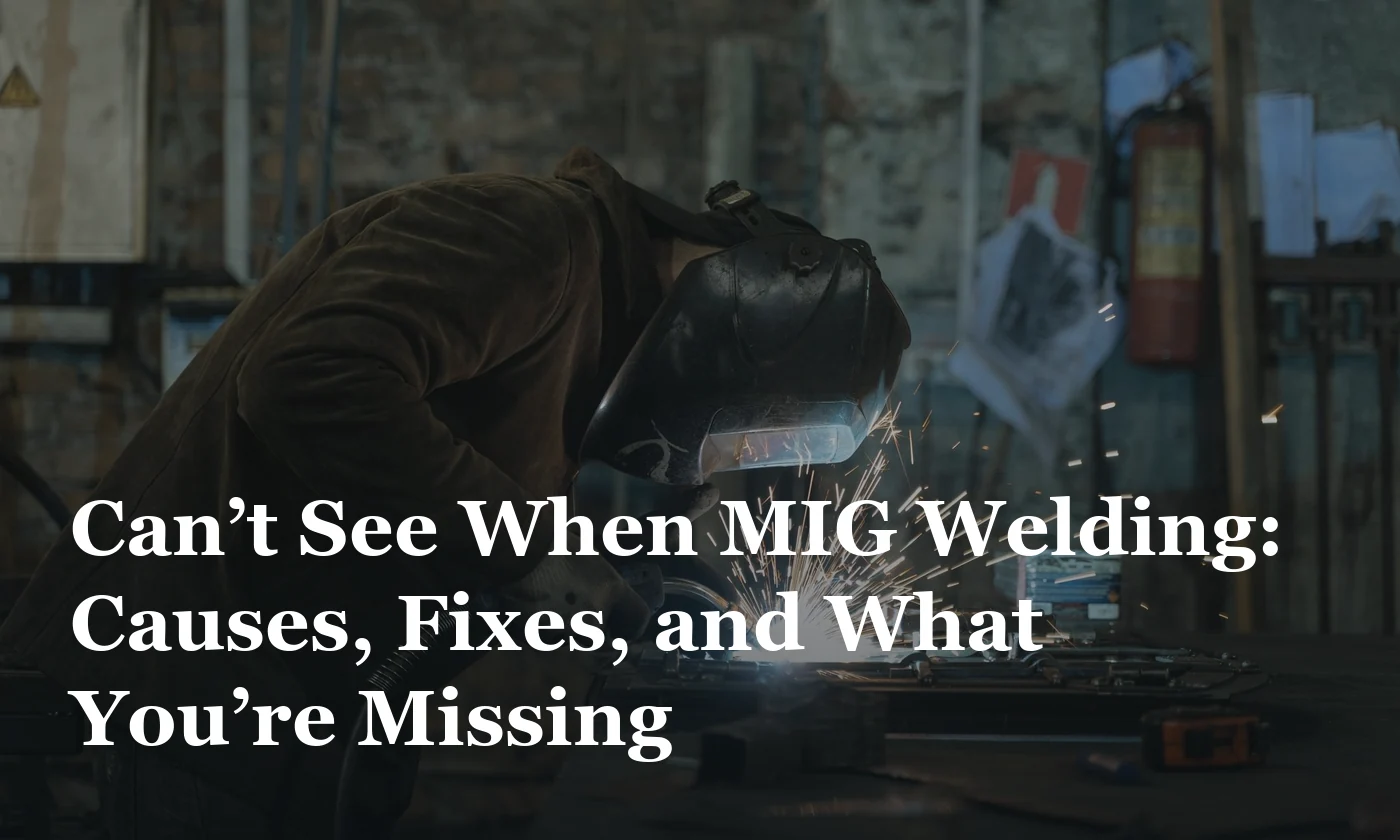
Poor visibility during MIG welding is one of the most frustrating problems beginners and even experienced welders deal with. Whether the arc looks too dark, too bright, or the puddle is completely obscured, it directly affects weld quality and safety.
The most common reasons you can‘t see when MIG welding are an incorrectly shaded auto-darkening helmet, excessive spatter or smoke blocking your view, wrong torch angle, or poor positioning relative to the weld puddle. Fixing visibility usually involves adjusting your helmet shade setting, repositioning your body, improving ventilation, and optimizing your wire speed and voltage settings.
Why Visibility Matters More Than Most Beginners Realize
Watching the weld puddle in real time is how you control the bead. If you can’t see the puddle, you’re welding blind — and that almost always results in porosity, undercut, incomplete fusion, or an inconsistent bead profile.
Experienced welders constantly monitor puddle width, color, and fluidity as they move. Losing that visual feedback even briefly usually shows up in the finished weld.
The Most Common Reasons You Can’t See the Puddle
There’s rarely just one cause. In most cases, visibility problems come from a combination of factors happening at the same time.
Helmet shade set too dark or too light
Auto-darkening helmets have adjustable shade settings, typically ranging from shade 9 to shade 13. Most MIG welding at standard amperage falls between shade 10 and shade 11. If your shade is set to 13, the arc will look dim and the puddle will be nearly impossible to read.
Going too light has the opposite problem — the arc becomes blinding and washing out all detail.
Helmet reaction time set incorrectly
Auto-darkening helmets have a switching speed that controls how fast the lens darkens when the arc strikes. Low-quality helmets or a slow sensitivity setting can cause a brief flash before the lens darkens, making your eyes instinctively close or look away at the moment the arc starts.
Smoke and fume interference
Heavy smoke, especially when welding galvanized steel, zinc-coated material, or heavily contaminated base metal, creates a visual barrier between your eyes and the puddle. Even mild smoke can scatter light enough to blur the arc.
Poor torch angle and work angle
Holding the torch at an exaggerated drag angle or pushing the wire too steeply into the joint creates spatter and blocks your line of sight to the puddle. The torch itself can physically block your view depending on where your head is positioned.
Body and head positioning
Most new welders position their body for physical comfort rather than visual access. Crouching over the work at the wrong angle means you’re looking at the back of the torch handle rather than down the line of the weld.
Dirty or scratched helmet lens
The outer protective lens on auto-darkening helmets takes constant spatter abuse. A heavily pitted or scratched outer lens diffuses light and degrades the clarity of everything you see through it. Replacement outer lenses are inexpensive and often overlooked.
How to Fix Visibility Problems Step by Step
- Set your shade correctly. Start at shade 10 for most MIG applications under 200A. Go to shade 11 only if the arc is still too bright. Avoid shade 12 or 13 unless you’re running high-amperage work above 250A.
- Check sensitivity and delay settings. Set sensitivity to match your environment — lower sensitivity in bright shops to prevent false triggers, higher sensitivity in dimmer environments. Keep the delay setting at its minimum comfortable level so the lens clears quickly after you stop welding.
- Replace your outer lens if it’s pitted. This is an underrated fix. A fresh outer lens alone can dramatically improve how clearly you see the arc and puddle.
- Reposition your head, not just your hands. Get your helmet visor as close to the work as practical. Tilt your head so you’re looking directly down the weld line, not across it. You should be able to see the leading edge of the puddle and the joint ahead of it simultaneously.
- Correct your torch angle. A 10–15 degree drag angle (torch slightly tilted away from travel direction) is standard for MIG. Excessive angles beyond 25–30 degrees block your puddle view and increase spatter.
- Improve ventilation to reduce smoke. A simple shop fan positioned to pull smoke away from your face — not blow it across the arc — makes a significant difference in visual clarity.
- Clean your base metal. Mill scale, rust, paint, and coatings all produce smoke and spatter. Grinding or wire brushing the weld zone before you start keeps smoke to a minimum.
Helmet Selection and Why It Affects Visibility So Much
Not all auto-darkening helmets provide equal optical clarity. Helmets are rated by optical clarity on a scale of 1/1/1/1 being the best and 1/2/3/2 being noticeably inferior. The four numbers represent optical clarity, diffusion of light, variations in luminous transmittance, and angle dependence.
Cheaper helmets with lower ratings produce a slightly blurry, greenish, or distorted view that makes puddle reading genuinely difficult — especially for beginners who aren’t sure what they’re looking for yet.
The Lincoln Electric Viking 3350 is a well-regarded helmet that uses a 1/1/1/1 optical clarity rating and a wide viewing area, which makes it significantly easier to track the puddle, especially in tight joint positions. Helmets at this clarity level cost more but are worth it if visibility is your persistent problem.
Wire Speed, Voltage, and How Machine Settings Affect Visibility
Incorrect machine settings don’t just affect weld quality — they affect how clearly you can see what you’re doing.
- Wire speed too high causes a stubby, spattering arc that throws debris across the lens and creates so much light scatter that the puddle gets lost.
- Voltage too low for a given wire speed causes the arc to go unstable and pop, creating flash events that cause your eyes to flinch.
- Proper arc stability creates a clean, consistent bright cone that’s actually easier to track.
A well-tuned MIG arc has a smooth, consistent crackling sound — not popping or sputtering. If the arc sounds rough, visibility will be rough too.
Welding Position and Joint Access
Some positions are inherently harder to see in than others.
| Position | Visibility Challenge | Common Fix |
|---|---|---|
| Flat (1F/1G) | Usually easiest | Standard torch angle works |
| Horizontal (2F/2G) | Puddle sags, torch blocks sightline | Lower torch entry angle |
| Vertical up (3F/3G) | Arc and puddle can drip toward face | Move head slightly to the side |
| Overhead (4F/4G) | Everything works against you | Helmet position and spatter protection critical |
| Inside corner (fillet) | Torch physically blocks view | Short-circuit transfer at lower settings helps |
Adjusting your body position relative to the joint — not just the torch angle — is often the single fastest improvement a welder can make to visibility.
FAQ
Why does my auto-darkening helmet go dark but I still can’t see the puddle clearly?
The shade setting is likely too high, or the optical clarity of the lens is low. Try dropping to shade 10 and check whether the outer protective lens is scratched or pitted. A 1/1/1/1 rated lens will show the puddle far more clearly than budget-rated alternatives.
Is it normal to lose sight of the puddle at the start of a weld?
Briefly, yes — especially when the arc first strikes on cold metal and produces a flash of light. Once the puddle establishes, you should be able to track it clearly. If you can’t see it at all after the first second, the issue is typically shade setting, smoke, or head positioning.
Why does my MIG weld look fine but the bead is uneven?
Uneven beads without obvious visible problems often come from intermittent visibility loss. The welder unconsciously speeds up or slows down when they lose puddle tracking. Improving helmet clarity and arc stability usually smooths the bead out significantly.
Does welding wire type affect visibility?
Yes, to some degree. Flux-core wire (FCAW) produces noticeably more smoke and spatter than solid wire with shielding gas, making puddle visibility harder. If you’re running a flux-core setup and struggling with visibility, this is a real contributing factor — proper ventilation becomes even more important.
Can tinted safety glasses under a welding helmet help or hurt visibility?
Tinted or colored safety glasses worn under an auto-darkening helmet add unnecessary shade, making the puddle harder to see. Use clear safety glasses under your helmet as secondary eye protection — not tinted ones.
Why do some welders tilt their head to the side while welding?
Tilting slightly to one side moves the torch handle out of the direct line of sight to the puddle. It’s a common technique for fillet welds in horizontal or overhead positions where the torch body would otherwise block the view down the joint.
How close should I hold the MIG torch to get a clear view of the puddle?
Most MIG welding uses a contact-tip-to-work distance (CTWD) of 3/8 inch to 5/8 inch for solid wire. Keeping CTWD in this range maintains a stable arc that’s easier to see and track. A CTWD that’s too long increases voltage, produces a diffuse arc, and makes the puddle harder to define visually.
Getting Visibility Right Saves More Than It Costs
Visibility problems in MIG welding almost always have a practical fix. In most cases, adjusting the helmet shade, cleaning or replacing the outer lens, repositioning your body relative to the joint, and dialing in machine settings will resolve the issue without buying new equipment.
The one exception is a genuinely poor-quality helmet — budget lenses with low optical ratings create a visual blur that no amount of technique fixes. Investing in a helmet with proper optical clarity is a one-time change that improves every weld you make from that point forward.