
Understanding the electrical requirements of welding equipment is crucial for safe operation and optimal performance. The Full Load Amperage (FLA) chart provides essential information about power consumption, helping welders select appropriate electrical circuits and prevent equipment damage. This guide explains how to read FLA charts, calculate power requirements, and apply this knowledge to real welding scenarios.
Quick Answer
FLA (Full Load Amperage) represents the maximum current a welding machine draws under normal operating conditions. This rating appears on equipment nameplates and specification charts, typically ranging from 15-200 amps depending on machine size and type. FLA determines the minimum circuit breaker size, wire gauge, and electrical supply requirements needed for safe operation.
What FLA Means for Welding Equipment
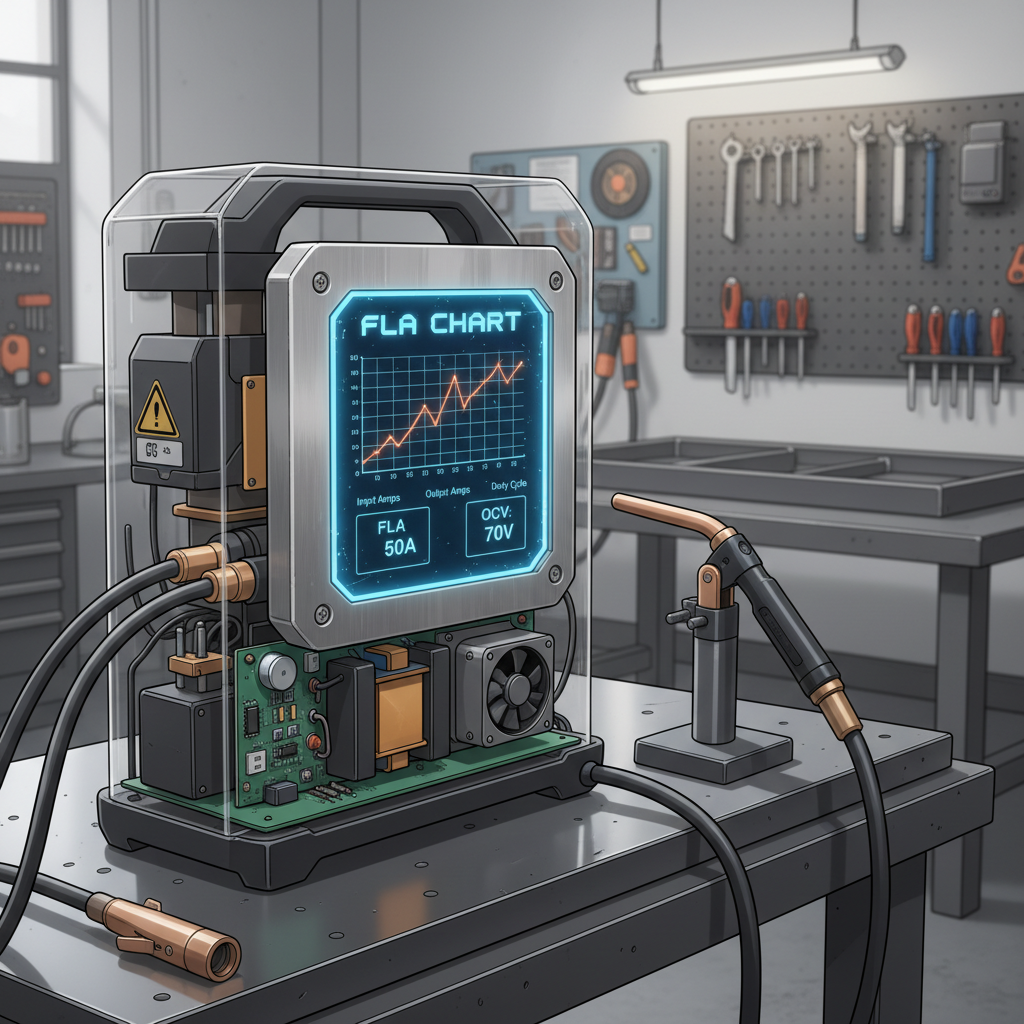
Full Load Amperage indicates the electrical current your welding machine consumes when operating at maximum rated output. Unlike the welding output current that flows through your electrode, FLA measures the input power drawn from your electrical supply.
This distinction matters because welding machines are not 100% efficient. A 200-amp stick welder might have an FLA rating of 48 amps, meaning it draws 48 amps from your electrical panel while delivering 200 amps of welding current.
The FLA rating assumes continuous operation at maximum settings. In practice, most welding applications use lower settings and intermittent operation, resulting in lower actual current draw.
Reading Welding Machine FLA Charts
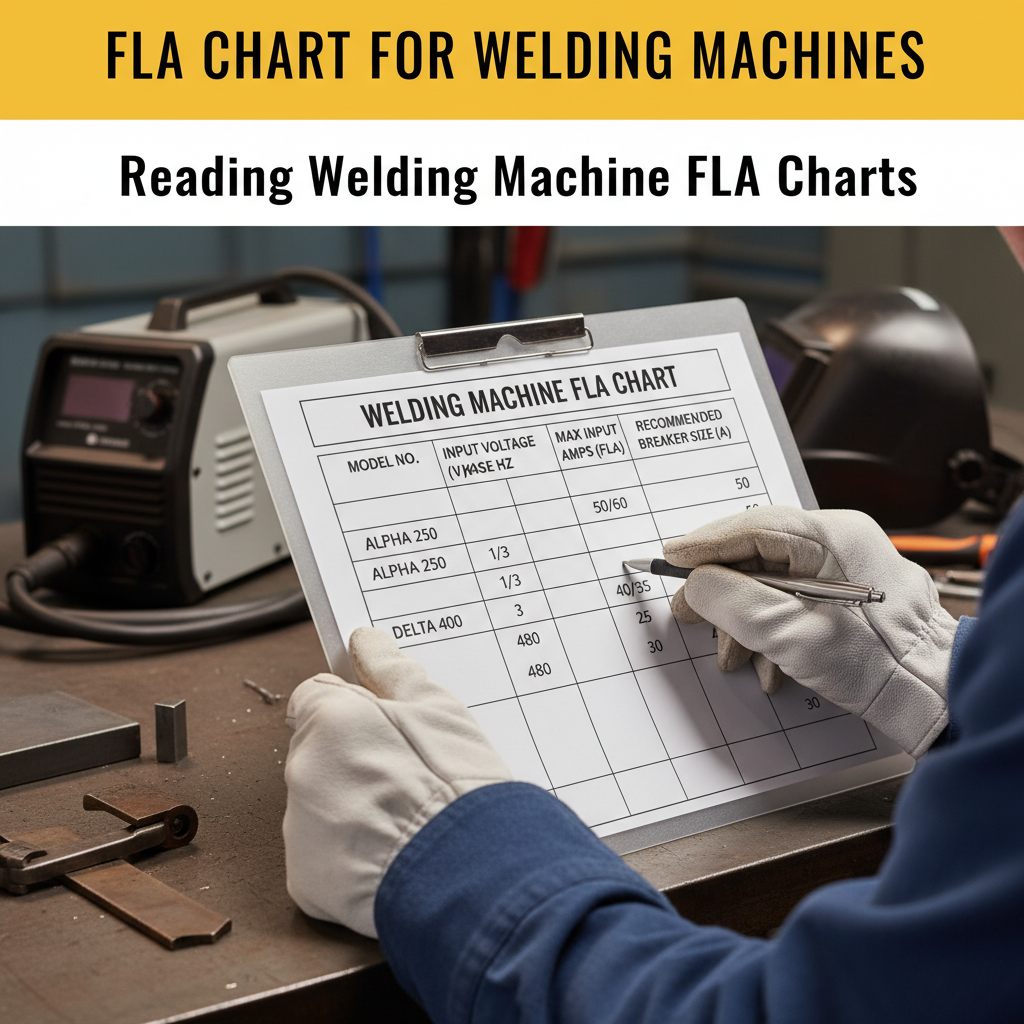
FLA charts organize electrical specifications by machine type, input voltage, and output capacity. These charts typically include several key columns:
Machine Model lists specific welding equipment with corresponding electrical ratings. Input Voltage shows whether the machine operates on 120V, 240V, or 480V power supplies. Output Amperage indicates the maximum welding current the machine can produce.
Full Load Amperage provides the maximum input current draw. Duty Cycle shows the percentage of time the machine can operate at maximum output without overheating, usually expressed as a percentage over a 10-minute period.
Phase Requirements indicate whether the machine needs single-phase or three-phase power. Frequency specifies 50Hz or 60Hz operation requirements.
Calculating Circuit Requirements from FLA
The FLA rating determines your electrical installation requirements. Circuit breakers must be sized at 125% of the FLA rating according to electrical codes. For a welding machine with 40 amps FLA, you need a minimum 50-amp breaker.
Wire sizing follows similar calculations. The conductor must handle 125% of FLA continuously. A 40-amp FLA machine requires wire rated for at least 50 amps continuous duty.
Distance from the electrical panel affects wire size requirements. Longer runs need larger conductors to compensate for voltage drop. Field experience shows that voltage drops exceeding 5% can cause poor welding performance and equipment damage.
Common FLA Ratings by Machine Type
Portable stick welders typically range from 15-60 amps FLA for 120V units and 20-80 amps for 240V models. These machines suit light fabrication and repair work in shops with standard electrical service.
Industrial stick welders often require 60-150 amps FLA, providing higher output for heavy-duty applications. Three-phase units in this category offer better efficiency and smoother power delivery.
TIG welders generally have lower FLA ratings relative to their output capacity due to more efficient inverter designs. A 200-amp TIG machine might draw only 35-45 amps FLA.
MIG welders vary widely based on wire feed mechanisms and output requirements. Small 120V units draw 15-25 amps FLA, while industrial 480V models can exceed 100 amps FLA.
Electrical Safety Considerations
Proper electrical installation prevents equipment damage and safety hazards. The FLA rating ensures adequate circuit protection without nuisance tripping during normal operation.
Undersized circuits cause voltage drops that reduce welding performance. Low voltage conditions force the machine to draw higher current, potentially exceeding safe operating limits.
Ground fault protection becomes critical in welding environments. GFCI devices must be rated appropriately for the FLA to avoid false tripping while maintaining safety protection.
A common issue technicians encounter is connecting multiple welding machines to shared circuits. Each machine’s FLA must be considered when calculating total circuit loading.
Duty Cycle Impact on Power Requirements
Duty cycle ratings directly relate to FLA specifications. A machine rated for 200 amps at 60% duty cycle can operate at full output for 6 minutes out of every 10-minute period.
During the 4-minute rest period, the machine draws minimal current for cooling fans and control circuits. This intermittent operation reduces average power consumption below the FLA rating.
In practice, most welding applications operate well below maximum duty cycle requirements. Typical fabrication work involves short welds with natural cooling periods between joints.
Understanding duty cycle helps optimize electrical installations. Multiple welding stations rarely operate simultaneously at maximum output, allowing some diversity in electrical loading calculations.
Troubleshooting FLA-Related Issues
Circuit breakers that trip frequently during welding often indicate undersized electrical supply. Compare the breaker rating to 125% of the machine’s FLA to verify adequate capacity.
Poor welding performance with adequate machine settings may result from voltage drop issues. Measure voltage at the machine input terminals under load to identify supply problems.
Overheating protection that activates prematurely sometimes indicates electrical supply issues rather than machine problems. Insufficient voltage forces the machine to draw excessive current, generating heat.
Extension cords create additional voltage drop that compounds electrical supply problems. Calculate the total circuit length including permanent wiring and temporary extensions when sizing conductors.
Selecting Machines Based on Available Power
Existing electrical service limits your welding machine options. A 100-amp electrical panel cannot safely supply a machine with 90 amps FLA due to other connected loads.
Three-phase power provides significant advantages for high-output welding equipment. The same welding capacity typically requires 30-40% less current with three-phase supply compared to single-phase.
Inverter-based welding machines offer improved efficiency compared to traditional transformer designs. Modern inverters often provide 20-30% lower FLA ratings for equivalent welding output.
Consider future expansion when selecting electrical service for welding shops. Installing adequate electrical capacity initially costs less than upgrading later.
Frequently Asked Questions
What’s the difference between FLA and welding output current?
FLA measures the electrical current drawn from your power supply, while welding output current flows through your electrode. A 200-amp welder might only draw 50 amps FLA from your electrical panel due to the machine’s internal transformer design.
Can I use a smaller circuit breaker than 125% of FLA?
No, electrical codes require circuit protection at minimum 125% of FLA for continuous duty loads. Using smaller breakers creates safety hazards and code violations that may void equipment warranties.
Why does my welding machine trip the breaker during startup?
Welding machines draw higher inrush current during startup, sometimes 2-3 times the FLA rating. This momentary surge is normal, but undersized circuits or weak electrical supply can cause nuisance tripping.
How does voltage affect FLA ratings?
Higher voltage operation typically reduces FLA requirements for the same welding output. A machine drawing 80 amps FLA on 240V might only draw 40 amps FLA when connected to 480V supply.
Can multiple welding machines share the same circuit?
Yes, but the circuit must be sized for the combined FLA of all connected machines. Consider diversity factors if the machines won’t operate simultaneously at maximum output.
What happens if I exceed the FLA rating?
Exceeding FLA ratings can damage the welding machine’s internal components, trip circuit protection, or create fire hazards. Always ensure adequate electrical supply for your equipment’s requirements.
Do inverter welders have different FLA characteristics?
Inverter welders typically have lower FLA ratings than traditional transformer machines for equivalent output. They also draw power more efficiently and generate less heat during operation.
Key Points for Safe Welding Operations
FLA charts provide the foundation for proper electrical installation of welding equipment. These specifications ensure adequate power supply, appropriate circuit protection, and safe operating conditions.
Always verify electrical requirements before installing new welding equipment. Inadequate electrical supply compromises welding quality and creates safety hazards that can damage expensive equipment.
Modern inverter technology offers significant advantages in power efficiency and electrical requirements. When upgrading welding equipment, consider these improvements in your electrical planning.
Professional electrical installation pays dividends in equipment reliability and operator safety. Consult qualified electricians for complex installations or when working with high-power welding systems.