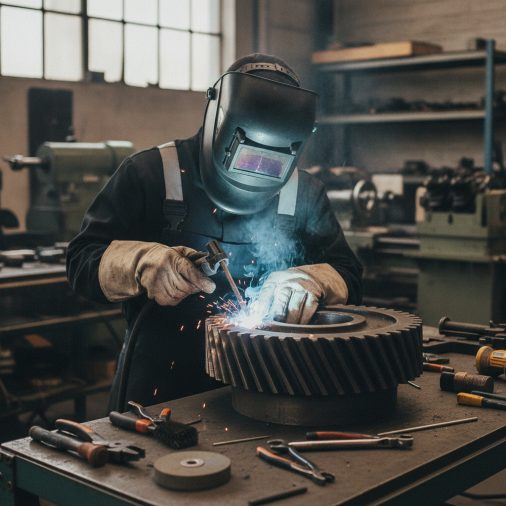
Maintenance and repair welding sits in an interesting spot in the industry. It covers a wide range of work — from patching cracked equipment frames to rebuilding worn machinery components — and the pay reflects that variety. If you’re considering this path, the hourly rate depends on where you work, what certifications you hold, and the complexity of the equipment you’re maintaining.
Maintenance and repair welders in the United States typically earn between $18 and $35 per hour, with experienced specialists in industrial or manufacturing settings often reaching $40 or more. The Bureau of Labor Statistics (BLS) places the median hourly wage for welders, cutters, solderers, and brazers broadly around $22–$24, but maintenance-focused roles in heavy industry, manufacturing plants, and pipeline facilities frequently pay above that median. Entry-level positions in smaller shops or general repair facilities tend to start closer to $18–$22 per hour.
What Maintenance and Repair Welding Actually Involves
This isn’t a single job description. Maintenance and repair welders work across a broad spectrum of environments, each with different skill demands and pay scales.
Common settings include:
– Manufacturing plants — repairing conveyor systems, press frames, and production equipment
– Mining and heavy equipment — welding worn bucket teeth, undercarriage components, and structural frames
– Paper mills, refineries, and chemical plants — maintenance welding on structural steel, piping, and process equipment
– Agriculture and construction equipment dealers — repairing tractors, loaders, and attachments
– Fleet maintenance facilities — welding on trucks, trailers, and utility vehicles
The processes most commonly used in these roles include SMAW (stick welding), GMAW (MIG welding), and FCAW (flux-core arc welding). Some specialized maintenance roles require GTAW (TIG welding), particularly when working on stainless steel piping or aluminum components. The more processes a welder can perform confidently, the stronger their negotiating position on pay.
Hourly Pay by Experience Level
Experience matters significantly in maintenance welding. A first-year welder working at a general repair shop earns a very different wage than a journeyman welder maintaining critical production equipment in an automotive plant.
Experience Level
Typical Hourly Range
Entry-level (0–2 years)
$18 – $22 per hour
Mid-level (3–7 years)
$22 – $30 per hour
Experienced (8+ years)
$30 – $40 per hour
Specialist / Senior
$40 – $55+ per hour
These ranges are approximate and reflect general industry data. Actual wages vary by employer, location, union status, and the specific equipment or materials involved. Welders working under union agreements often receive wages at the higher end of these bands, along with benefits that raise the total compensation package considerably.
The industry you work in has a direct effect on hourly pay. Maintenance welding in a food processing plant pays differently than maintenance welding in an oil refinery, even if both roles involve repairing structural steel.
Industries known for stronger maintenance welder compensation include:
– Oil, gas, and petrochemical — facilities maintenance often involves pipe welding and pressure vessel repair, which demand certified welders and pay accordingly
– Automotive manufacturing — high-volume production environments require skilled maintenance welders to minimize downtime
– Aerospace and defense — maintenance roles here often require strict procedure compliance and pay a premium for that
– Shipbuilding and marine — maintenance welders working on vessels deal with complex alloys and confined space work
Lower-paying maintenance roles tend to appear in small equipment repair shops, general fabrication facilities, and agricultural repair services, though these can still provide strong starting experience.
For a broader picture of how different welder specializations compare on pay, the full breakdown of what welders actually make covers multiple sectors in useful detail.
Certifications That Raise Hourly Pay
Certifications from the American Welding Society (AWS) directly influence earning potential in maintenance and repair roles. Employers in industrial settings frequently require or prefer certified welders because maintenance welding often involves structurally important components.
Certifications that commonly increase pay in this field:
– AWS Certified Welder (CW) — demonstrates proficiency in a specific process and position
– AWS Certified Welding Inspector (CWI) — relevant for welders who move into quality oversight roles
– ASME and API qualifications — required for pressure vessel and piping maintenance in refineries and power plants
– State or employer-specific procedure qualifications — required for safety-critical maintenance work
A welder who can pass procedure qualification tests for multiple processes — for example, qualifying on both stick and TIG for structural and pipe applications — becomes considerably more valuable to industrial maintenance employers. That added versatility regularly translates to $3–$8 more per hour compared to a single-process welder in the same facility.
Geographic Location and Cost of Living
Location significantly shifts the hourly rate. States with strong manufacturing bases, active oil and gas sectors, or large industrial facilities tend to pay maintenance welders more.
States where maintenance welders typically earn on the higher end:
– Alaska, Wyoming, and North Dakota (energy sector)
– Texas and Louisiana (petrochemical and refinery work)
– Washington, California, and Michigan (aerospace, tech, and automotive manufacturing)
In states with lower industrial density or lower costs of living, the same experience level might earn $4–$8 less per hour. That doesn’t necessarily mean lower take-home value when adjusted for local living costs, but it does affect gross hourly wages.
Union membership also plays a strong geographic role. Unionized maintenance welders in states with active building trades or industrial unions often receive wage scales, health benefits, and pension contributions that significantly exceed non-union rates. If you’re researching what certified welders earn per hour by region, that context helps clarify the geographic differences.
Overtime, Shift Differentials, and Total Compensation
Hourly base pay is only part of the picture for maintenance welders. Many industrial maintenance positions involve shift work, weekend coverage, or on-call availability — all of which can meaningfully increase weekly earnings.
Factors that raise total compensation above base hourly rate:
– Overtime — maintenance welding in production environments regularly involves overtime at 1.5x the base rate
– Shift differential — evening and night shift work typically adds $1–$3 per hour
– Hazard pay — confined space, elevated, or high-temperature work may include additional pay
– Benefits packages — health insurance, retirement contributions, and paid leave add value that doesn’t appear in the hourly rate
A maintenance welder earning $26 per hour base but regularly working 50-hour weeks with night-shift differential may effectively earn considerably more than a $30-per-hour position that rarely exceeds 40 hours.
FAQ
What is the average annual salary for a maintenance and repair welder?
Based on typical hourly rates and standard full-time schedules, maintenance and repair welders generally earn between $37,000 and $72,000 annually. Experienced welders in industrial or unionized roles can exceed $80,000 per year when overtime, shift premiums, and benefits are factored in. The BLS median for the broader welder category provides a general baseline, but maintenance-specific roles in heavy industry tend to sit above that figure.
Do maintenance welders need certifications to get hired?
Certifications are not always mandatory for entry-level maintenance roles, but they become increasingly important in industrial settings. Oil refineries, chemical plants, power generation facilities, and aerospace maintenance environments typically require procedure qualifications or AWS certifications. Even in less regulated environments, holding a certification demonstrates competency and often justifies a higher starting wage during negotiations.
How does maintenance welding pay compare to structural or pipeline welding?
Pipeline welding generally pays higher than most maintenance welding roles, particularly for cross-country pipeline work. Structural welding pay varies widely depending on project type and location. Maintenance welding tends to offer more consistent year-round employment compared to the project-based nature of pipeline and some structural work, which can offset the wage difference when total annual income is considered. For pipeline pay specifics, pipeline welder hourly rates vary considerably by region and employer.
Can a maintenance welder increase their hourly rate without changing employers?
Yes. The most reliable ways to increase pay within the same employer include qualifying in additional welding processes, passing procedure qualification tests, taking on inspection or lead responsibilities, and developing skills in related trades such as pipefitting, millwright work, or electrical maintenance. Employers dealing with skilled trade shortages are often willing to negotiate higher rates for versatile maintenance welders who reduce reliance on outside contractors.
What welding processes should a maintenance welder know to maximize earnings?
SMAW, GMAW, and FCAW cover the majority of industrial maintenance work on mild steel and structural components. Adding GTAW capability significantly expands opportunities in stainless steel piping, food-grade equipment, and aerospace maintenance. For facilities that handle aluminum components, TIG welding on aluminum is a valuable skill. A maintenance welder proficient in three or more processes can reasonably expect to negotiate toward the upper range of their experience tier.
Is maintenance welding physically demanding compared to shop fabrication?
Maintenance welding is often more physically demanding than standard shop fabrication because the work comes to you rather than being set up conveniently. Welders regularly work in confined spaces, overhead positions, awkward access points, and hot or noisy environments. This physical difficulty is part of why experienced maintenance welders in industrial facilities command higher pay. It also reinforces why proper PPE — including appropriate respiratory protection, hearing protection, and fall protection where required — is essential in these environments.
Does union membership significantly affect maintenance welder pay?
Union membership typically raises total compensation substantially. In addition to higher base hourly rates, union maintenance welders usually receive negotiated wage scales, employer-funded health insurance, defined-benefit pension plans, and paid leave. The specific advantage depends on the union and the collective bargaining agreement in effect. In general, unionized maintenance welders in heavy industry often earn 15–30% more in total compensation than comparable non-union positions in the same sector.
The Realistic Range and What Moves the Needle
Maintenance and repair welding is a stable and genuinely skilled trade. The realistic hourly range sits between $18 and $40 for the majority of positions, with industrial specialists and certified welders in high-demand sectors pushing beyond that. Geographic location, industry type, certification level, and process versatility are the four factors that move the needle most.
Entry-level welders should focus on developing multi-process skills early and pursue AWS certification as soon as their experience supports it. That combination consistently opens doors to better-paying maintenance roles in manufacturing, energy, and heavy industry — where strong welders who can work reliably under difficult conditions are always in demand.