
Welding cable ampacity depends on wire gauge, duty cycle, and ambient temperature. For example, 2 AWG cable handles 200 amps at 60% duty cycle, while 4/0 AWG supports 400 amps. Always match cable capacity to your welder’s maximum output and expected duty cycle to prevent overheating and ensure optimal performance.
Choosing the right welding cable size is critical for safe, efficient welding operations. The wrong cable can overheat, cause voltage drops, or create dangerous conditions. This guide provides comprehensive ampacity charts and practical guidance to help you select the correct welding cable for your specific applications.
Understanding Welding Cable Ampacity Ratings
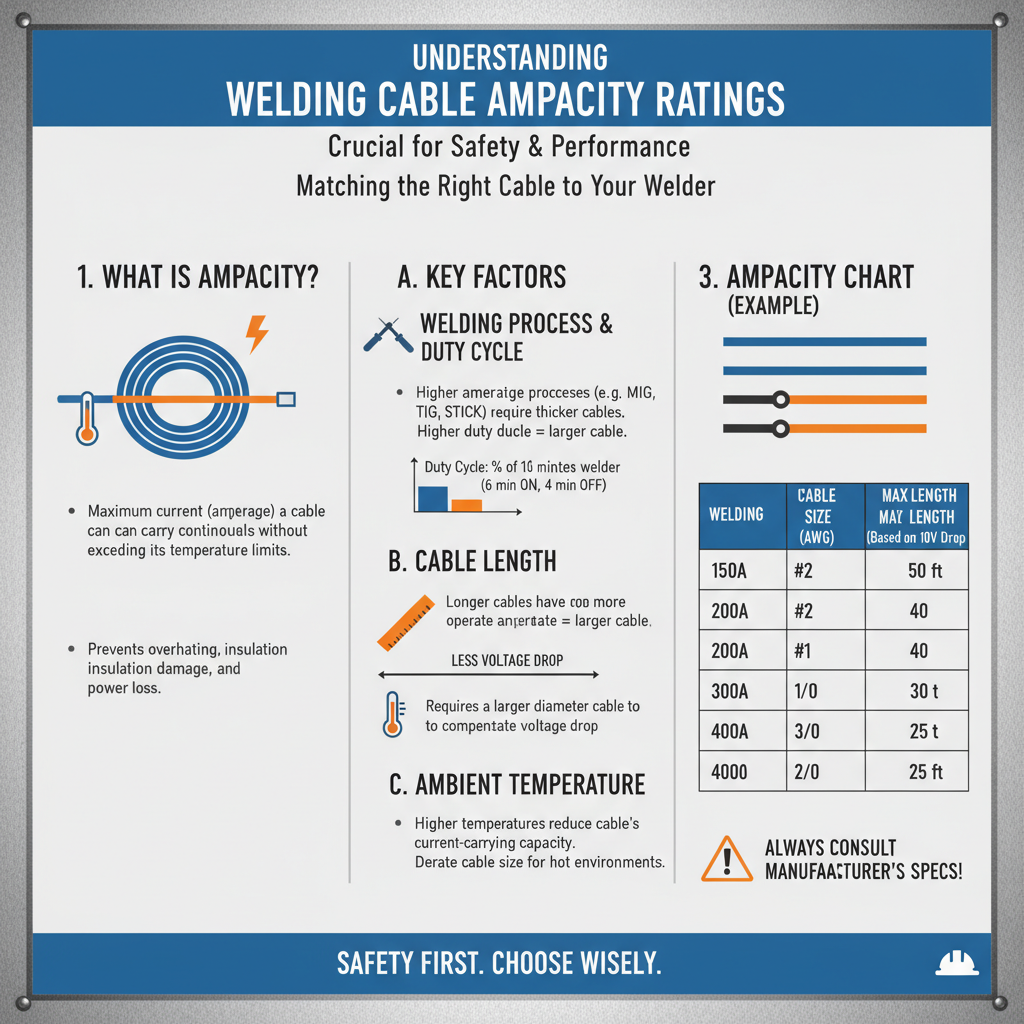
Ampacity refers to the maximum current a cable can safely carry without exceeding its temperature rating. Welding cables differ from standard electrical wire because they handle high currents for extended periods during welding operations.
The ampacity rating considers several factors. Cable insulation type affects heat tolerance. EPDM rubber insulation typically handles higher temperatures than PVC. Ambient temperature also matters since cables operate in hot welding environments.
Duty cycle significantly impacts ampacity requirements. A 60% duty cycle means the welder operates 6 minutes out of every 10-minute period. Higher duty cycles require cables with greater ampacity to handle sustained current flow.
Standard Welding Cable Ampacity Chart
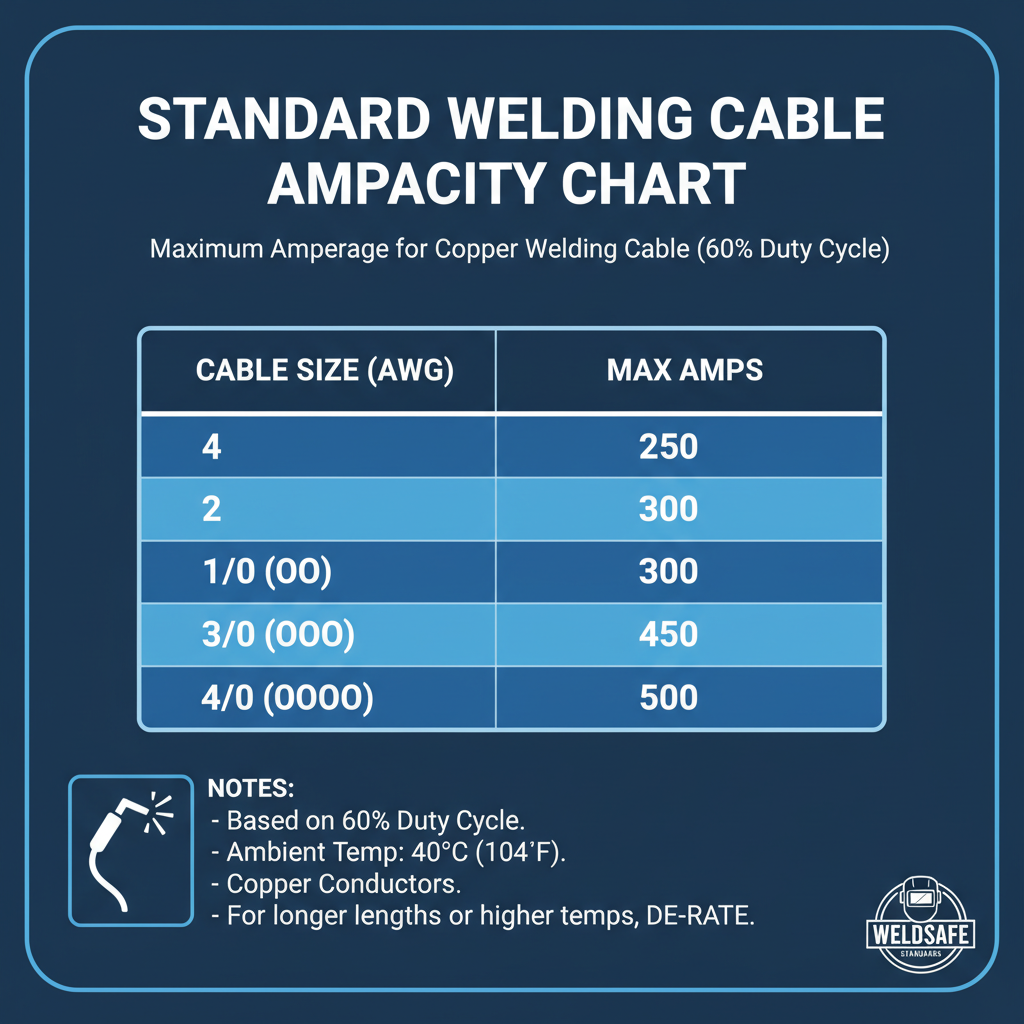
Here’s the industry-standard ampacity chart for welding cables at different duty cycles:
At 60% Duty Cycle (Standard Rating):
– 6 AWG: 75 amps
– 4 AWG: 95 amps
– 2 AWG: 130 amps
– 1 AWG: 150 amps
– 1/0 AWG: 170 amps
– 2/0 AWG: 195 amps
– 3/0 AWG: 225 amps
– 4/0 AWG: 260 amps
At 100% Duty Cycle (Continuous Operation):
– 6 AWG: 55 amps
– 4 AWG: 70 amps
– 2 AWG: 95 amps
– 1 AWG: 110 amps
– 1/0 AWG: 125 amps
– 2/0 AWG: 145 amps
– 3/0 AWG: 165 amps
– 4/0 AWG: 195 amps
These ratings assume 75°C insulation and 30°C ambient temperature. Higher ambient temperatures require derating the ampacity.
Temperature Derating Factors Behind Welding Cable Ampacity Chart
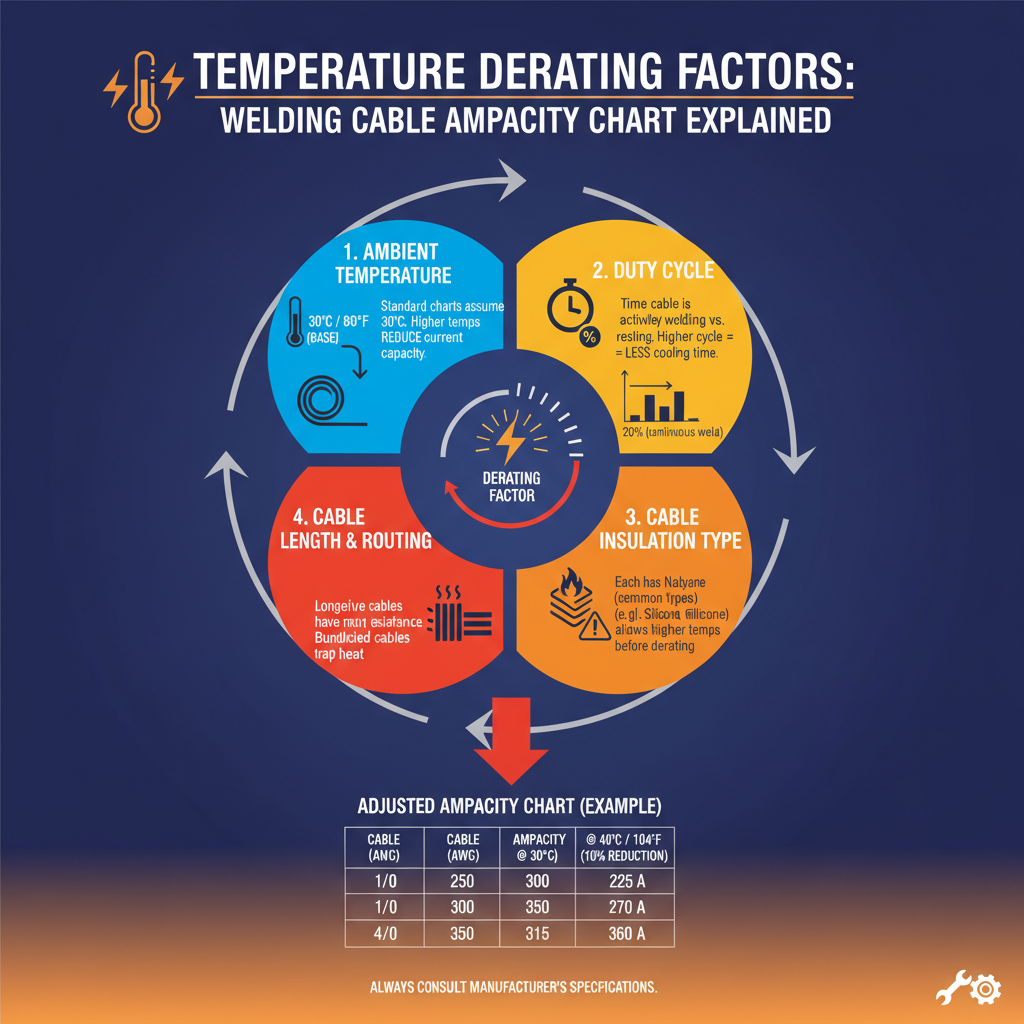
Welding environments often exceed standard temperature assumptions. When ambient temperature rises above 30°C (86°F), you must apply derating factors to prevent cable overheating.
Temperature Derating Multipliers:
– 31-40°C (88-104°F): Multiply ampacity by 0.91
– 41-50°C (106-122°F): Multiply ampacity by 0.82
– 51-60°C (124-140°F): Multiply ampacity by 0.71
– 61-70°C (142-158°F): Multiply ampacity by 0.58
For example, if you’re using 2/0 AWG cable (195 amps at 60% duty cycle) in a 45°C environment, the derated ampacity becomes 195 × 0.82 = 160 amps.
Field experience shows that many welding operations occur in hot conditions. Always measure actual ambient temperature rather than assuming standard conditions.
Cable Length and Voltage Drop Considerations
Longer cables create voltage drops that reduce welding performance. While ampacity determines safe current capacity, voltage drop affects arc quality and penetration.
Recommended Maximum Cable Lengths:
– 100 amps: 50 feet maximum for 2 AWG
– 200 amps: 50 feet maximum for 1/0 AWG
– 300 amps: 50 feet maximum for 3/0 AWG
– 400 amps: 50 feet maximum for 4/0 AWG
Voltage drop increases with cable length and current. A 3% voltage drop is generally acceptable, but some precision welding requires less than 2%.
In practice, many welders use oversized cables for longer runs. This approach reduces voltage drop and provides additional safety margin for ampacity.
Selecting Cable Size for Different Welding Processes
Different welding processes have varying current requirements and duty cycles. MIG welding typically operates at higher duty cycles than stick welding.
Stick Welding (SMAW):
Most stick welding occurs at 20-40% duty cycle. Standard ampacity ratings provide adequate safety margin. A 200-amp stick welder typically works well with 2/0 AWG cable.
MIG Welding (GMAW):
MIG welding often requires 60-80% duty cycles. Use cables rated for at least 60% duty cycle, or consider 100% duty cycle ratings for production welding.
TIG Welding (GTAW):
TIG welding generally operates at lower currents but may require extended periods. Cable sizing follows standard ampacity charts, but consider longer cable runs for mobility.
Common Cable Sizing Mistakes
Undersizing cables creates multiple problems. Overheated cables degrade quickly and pose fire risks. Voltage drop reduces arc performance and can damage welding equipment.
A common issue technicians encounter is using household electrical wire instead of welding cable. Standard THHN wire lacks the flexibility and strand count needed for welding applications.
Another frequent mistake involves ignoring ambient temperature. Welding in hot shops or outdoor summer conditions requires larger cables than indoor winter welding.
Some welders assume duty cycle ratings don’t matter for occasional use. However, even brief periods of overcurrent can damage cables and create safety hazards.
Cable Construction and Insulation Types
Welding cable construction affects both ampacity and durability. Fine-strand copper provides flexibility and reduces heat buildup compared to coarse-strand wire.
EPDM Rubber Insulation:
Handles temperatures up to 105°C and resists oil, ozone, and abrasion. Most professional welding cables use EPDM insulation for superior performance.
PVC Insulation:
Less expensive but limited to 75°C operation. Suitable for light-duty applications but not recommended for heavy industrial use.
Neoprene Insulation:
Offers excellent chemical resistance and moderate temperature rating. Often used in harsh environments where chemical exposure occurs.
The jacket material also matters. Some cables include additional protective layers for abrasion resistance in demanding applications.
Safety Considerations and Code Requirements
National Electrical Code (NEC) Article 630 covers welding equipment requirements. Local codes may impose additional restrictions on cable sizing and installation.
Always verify that cable ampacity exceeds the welder’s maximum output current. Include safety margin for unexpected conditions or equipment variations.
Proper cable termination prevents overheating at connections. Loose connections create resistance and heat buildup that can exceed the cable’s temperature rating.
Regular cable inspection identifies damage before failures occur. Look for cuts, abrasion, or heat damage that reduces ampacity or creates safety hazards.
Frequently Asked Questions
What happens if I use undersized welding cable?
Undersized cable overheats, causing insulation damage and potential fire hazards. You’ll also experience voltage drop that reduces welding performance and may damage your equipment.
Can I use regular electrical wire for welding applications?
No, standard electrical wire lacks the flexibility and fine-strand construction needed for welding. It will overheat and fail quickly under welding loads.
How do I calculate cable size for long runs?
Use ampacity charts for current capacity, then check voltage drop calculations. You may need larger cable to minimize voltage drop even if ampacity requirements are met.
Does cable coiling affect ampacity?
Yes, tightly coiled cables trap heat and reduce effective ampacity. Keep cables as straight as possible during operation and avoid tight coils.
What’s the difference between 60% and 100% duty cycle ratings?
60% duty cycle assumes 6 minutes of operation per 10-minute period. 100% duty cycle means continuous operation. Continuous use requires larger cables.
How often should welding cables be replaced?
Replace cables when insulation shows cracking, cuts, or heat damage. High-quality cables in normal use typically last 3-5 years with proper care.
Can I splice welding cables to extend length?
Splicing is possible but reduces reliability and increases resistance. Use proper welding cable splices rated for the full current, or preferably use single continuous cables.
Final Thoughts
Proper welding cable sizing ensures safe operation and optimal welding performance. Use the ampacity charts as starting points, but always consider your specific conditions including ambient temperature, duty cycle, and cable length. When in doubt, choose the next larger cable size for additional safety margin. Regular inspection and proper handling extend cable life and maintain safe working conditions.