
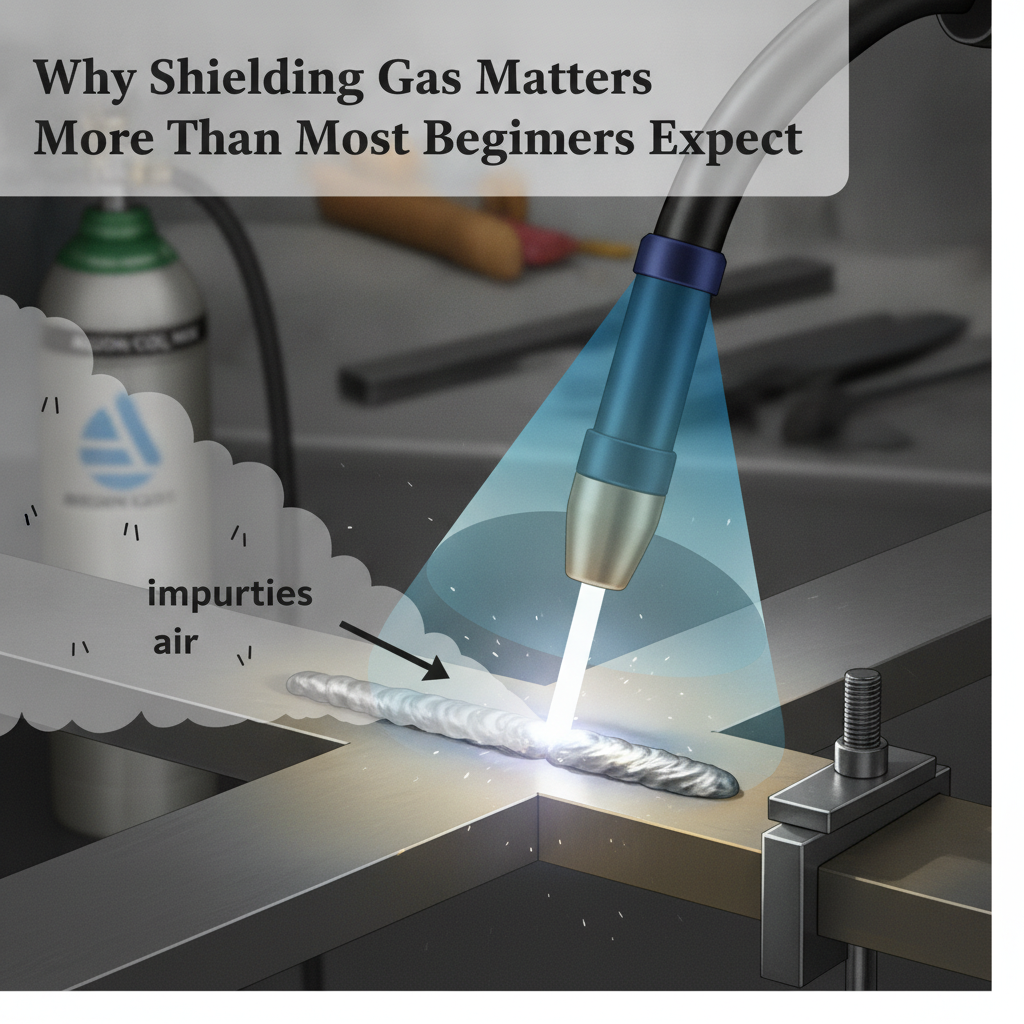
Why Shielding Gas Matters More Than Most Beginners Expect
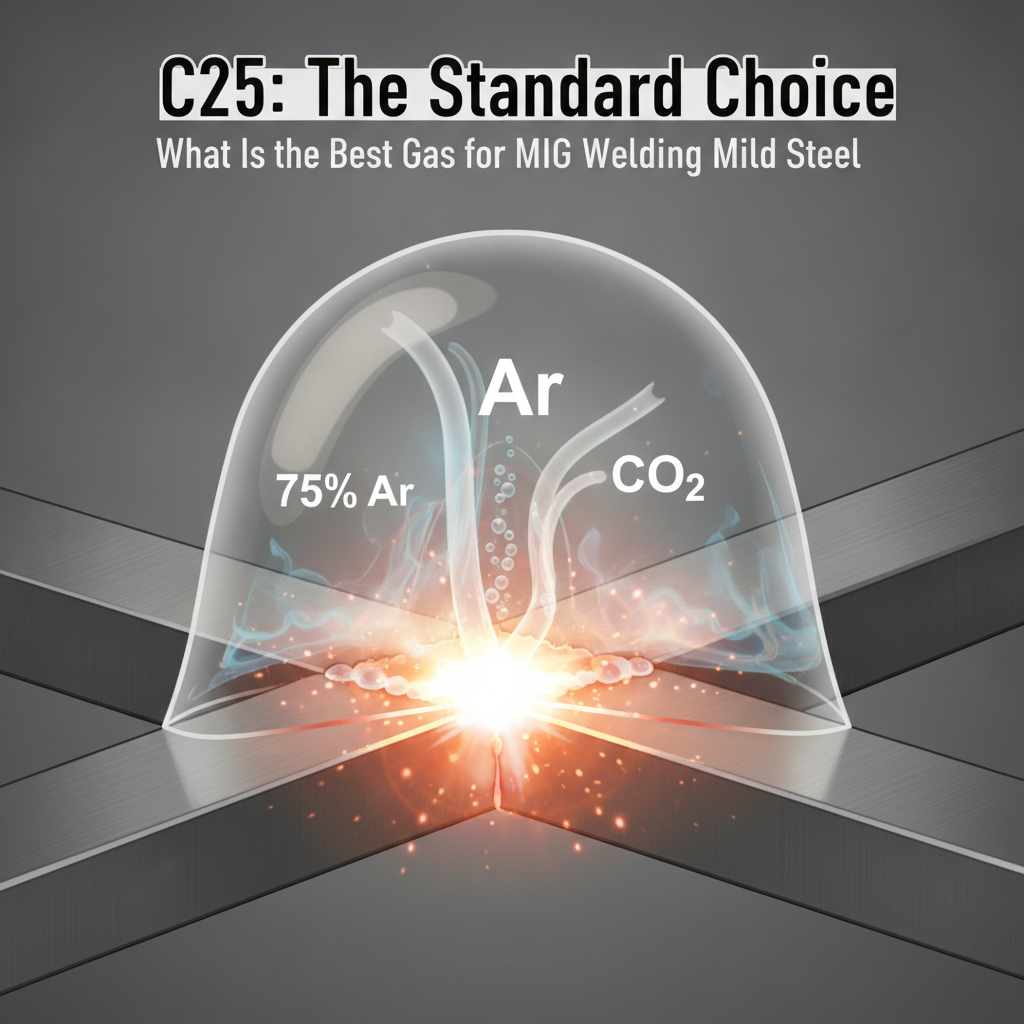
C25 (75% Argon / 25% CO₂): The Standard Choice
100% CO₂: Deeper Penetration at Lower Cost
Pure CO₂ is the other common choice for mild steel. It runs hotter than C25, produces deeper penetration, and costs significantly less per cylinder fill because CO₂ is abundant and inexpensive. The trade-off is real, though. Pure CO₂ produces noticeably more spatter, the arc feels rougher and less controlled, and bead appearance is generally less refined than with C25. It also doesn’t support true spray transfer — the arc operates in globular transfer mode at higher settings, which is harder to control cleanly. When pure CO₂ makes sense: – Heavy plate work where maximum penetration matters – Production environments where gas cost is a significant factor – Structural or industrial welding where appearance is secondary to strength – Outdoors or in drafty conditions — CO₂ is denser than argon mixes and holds its shield slightly better in light air movement For hobbyists and small shop welders doing general fabrication, the extra spatter cleanup from CO₂ usually outweighs the cost savings. C25 is almost always the better everyday choice.How Different Gas Mixes Compare for Mild Steel
| Gas Mix | Arc Stability | Spatter | Penetration | Appearance | Best Use Case | |—|—|—|—|—|—| | 75% Ar / 25% CO₂ (C25) | Excellent | Low | Good | Clean, smooth | General fabrication, auto, hobby | | 100% CO₂ | Moderate | High | Deep | Rougher | Heavy plate, structural, industrial | | 80% Ar / 20% CO₂ (C20) | Very Good | Low-Medium | Good | Clean | Similar to C25, slightly smoother arc | | 90% Ar / 10% CO₂ (C10) | Excellent | Very Low | Moderate | Very clean | Thin gauge, automotive body work | | 100% Argon | Poor | Very Low | Shallow | N/A | Not recommended for steel | Note: 100% argon is designed for aluminum and non-ferrous metals. Using it on mild steel produces an erratic arc, poor fusion, and undercut. Choosing the right gas for different MIG welding applications makes a significant difference in weld quality across all material types.Does CO₂ Percentage Affect Your Results?
Yes, and more than most beginners realize. Higher CO₂ content increases heat input and oxidizing action at the weld pool. This deepens penetration but also increases spatter and makes the arc feel less forgiving. Lower CO₂ content — say, 10% — smooths the arc dramatically and reduces spatter to almost nothing. But the weld pool becomes less fluid and penetration decreases slightly, which can cause cold laps on thicker material if settings aren’t adjusted. The 25% CO₂ level in C25 hits a practical middle ground. It’s hot enough for solid fusion on typical mild steel thicknesses, smooth enough to produce clean welds without excessive cleanup, and forgiving enough that minor technique variation doesn’t ruin the bead.Flow Rate: Getting the Gas Coverage Right
Even with the right gas mix, incorrect flow rate causes problems. Too low, and you get porosity from atmospheric contamination. Too high, and turbulence at the nozzle actually pulls air into the shielding zone — a common mistake beginners make when they assume more gas means better coverage. For most mild steel MIG work indoors: – Standard range: 15–25 CFH (cubic feet per hour) or roughly 7–12 L/min – Thinner material / short-circuit transfer: Stay toward the lower end – Heavier plate or larger nozzle diameter: Upper end of range Getting the correct litres per minute for MIG welding is one of the most overlooked factors affecting weld quality, particularly for beginners setting up a new machine. Outdoors or in windy conditions, flow rate needs to increase, though at some point a gas lens, wind shield, or backing gas becomes a better solution than just cranking the regulator up.Common Mistakes When Selecting or Using Shielding Gas
Using 100% argon on steel. It happens. Argon alone doesn’t wet out properly on steel, the arc jumps around, and fusion is inconsistent. If welds look right on paper but the bead keeps lifting at the edges, check whether the cylinder got mixed up. Running too high a flow rate. Cranking the gas up to 30–35 CFH or beyond to “improve” the weld often makes things worse. Turbulence at the nozzle creates an air-entraining venturi effect that pulls contamination directly into the weld. Welding over mill scale without preparation. CO₂-based mixes tolerate mill scale better than argon-heavy blends, but neither forgives it completely. Wire brushing or grinding the base metal before welding still matters. Confusing C25 availability. In some regions, the same blend may be sold under different names — C25, 75/25, or “Welding Mix.” Check the actual gas percentages on the label rather than relying on a trade name. You can also refer to a detailed breakdown of MIG welding gas pressure settings to confirm your regulator and flow rate are matched correctly for your cylinder type and hose setup.How Wire Choice Pairs with Your Gas
The most common wire for mild steel MIG welding is ER70S-6. It has higher silicon and manganese content than ER70S-3, which helps it run cleanly even on slightly contaminated or mill-scaled base metal. ER70S-6 works well with both C25 and pure CO₂. The deoxidizers in the wire compensate for the more oxidizing environment created by CO₂, keeping the weld pool clean and reducing porosity risk. For thin gauge automotive work where ER70S-6 is paired with C10 or similar low-CO₂ blends, the smoother arc and reduced burn-through risk are worth the extra attention to material prep. Wire diameter and voltage both need adjustment when working thin, and a reliable MIG welding wire speed and voltage chart takes the guesswork out of dialing in settings across different steel thicknesses.FAQ
Can I use argon alone for MIG welding mild steel? No. Pure argon is not suitable for MIG welding steel. It causes an unstable arc, poor weld pool wetting, and inconsistent fusion. Argon works well for aluminum and some non-ferrous metals, but steel requires at least some CO₂ or oxygen content in the shielding gas to maintain a stable arc and proper fusion characteristics. Is C25 the same as 75/25 welding gas? Yes, C25 and 75/25 refer to the same mix — 75% argon and 25% CO₂. The naming convention varies by supplier and region. Always verify the actual gas percentages on the cylinder label rather than relying on a trade name, since some suppliers label blends differently. What gas do auto body shops use for MIG welding thin steel? Most automotive body shops use either C25 or a leaner blend like C10 (90% argon / 10% CO₂) for thin gauge sheet metal. The lower CO₂ percentage reduces heat input and helps prevent burn-through on 18–22 gauge panels. Some shops prefer C25 as a universal mix that handles both body panels and heavier repairs. Does the shielding gas affect MIG welding spatter levels? Directly. Higher CO₂ content increases spatter because CO₂ promotes a more turbulent arc and globular transfer mode. Argon-rich mixes like C25 produce noticeably less spatter. If you’re spending significant time grinding spatter off finished welds, switching from pure CO₂ to C25 typically reduces cleanup time substantially. What flow rate should I use for C25 gas indoors? For indoor MIG welding with C25, a flow rate of 15–20 CFH (approximately 7–9 L/min) covers most situations. Heavier plate work or larger contact-to-work distances may need up to 25 CFH. Avoid the instinct to run higher — turbulent flow from excessive gas pressure can introduce porosity by disturbing the shielding envelope around the weld pool. Can I switch between C25 and CO₂ using the same regulator? You can use a CO₂ regulator with a C25 blend if it fits the cylinder connection, but CO₂ and argon-mix cylinders typically use different valve fittings in North America. CO₂ uses a CGA-320 fitting while argon/mix cylinders use a CGA-580. Using the correct regulator for the gas type avoids both fitting issues and inaccurate flow readings. Is tri-mix gas worth using for mild steel? Tri-mix blends — typically argon, CO₂, and helium or oxygen — are generally more useful for stainless steel or specialty applications than for standard mild steel. For everyday mild steel fabrication, C25 already delivers an excellent balance of performance. Tri-mix gases are harder to source, cost more, and the performance difference on mild steel isn’t significant enough to justify the switch for most welders.For mild steel MIG welding, C25 is the right default in almost every shop situation. It handles a wide material thickness range, keeps spatter low, and produces welds that look professional without extra cleanup. Pure CO₂ has a legitimate place in industrial and heavy fabrication environments, but for general purpose work, the cost savings rarely justify the trade-offs. Start with C25, dial in your flow rate correctly, and the gas side of the equation takes care of itself.