
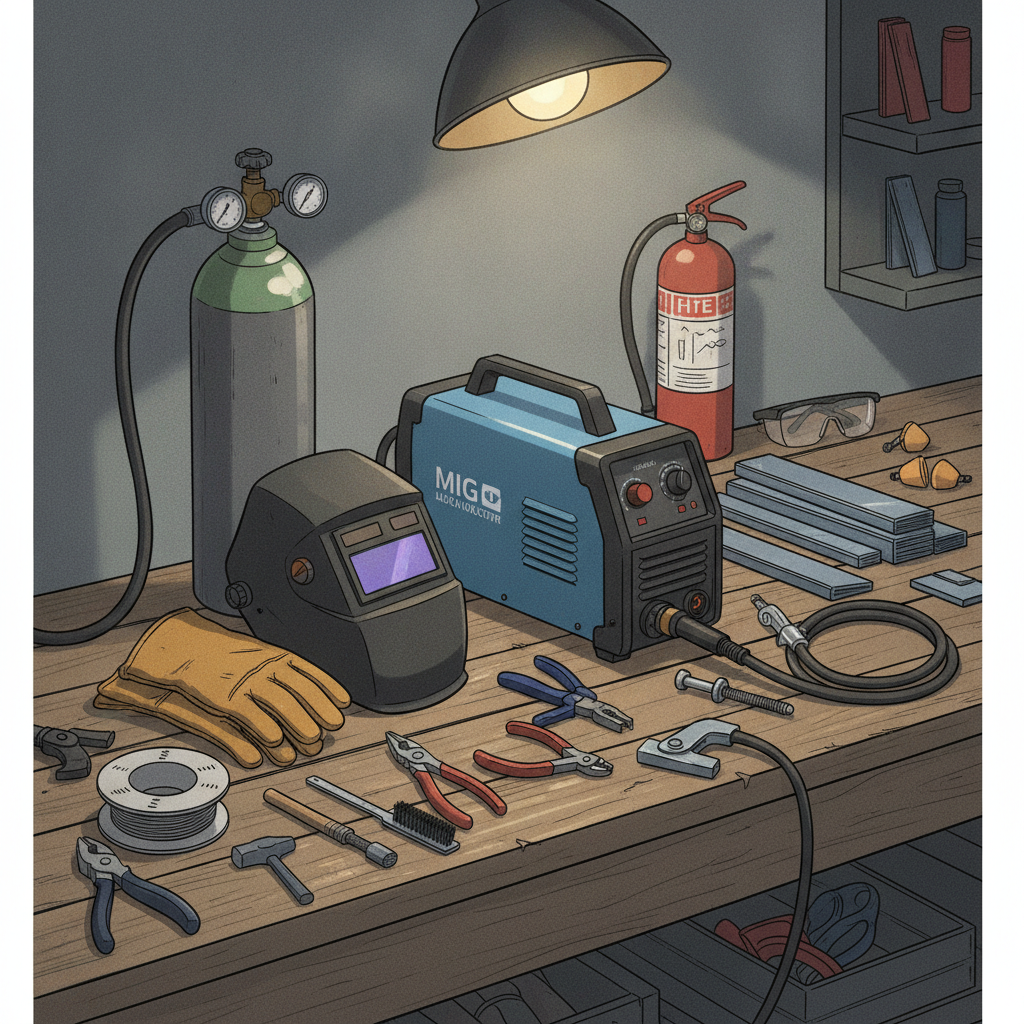
What You’ll Need Before You Start
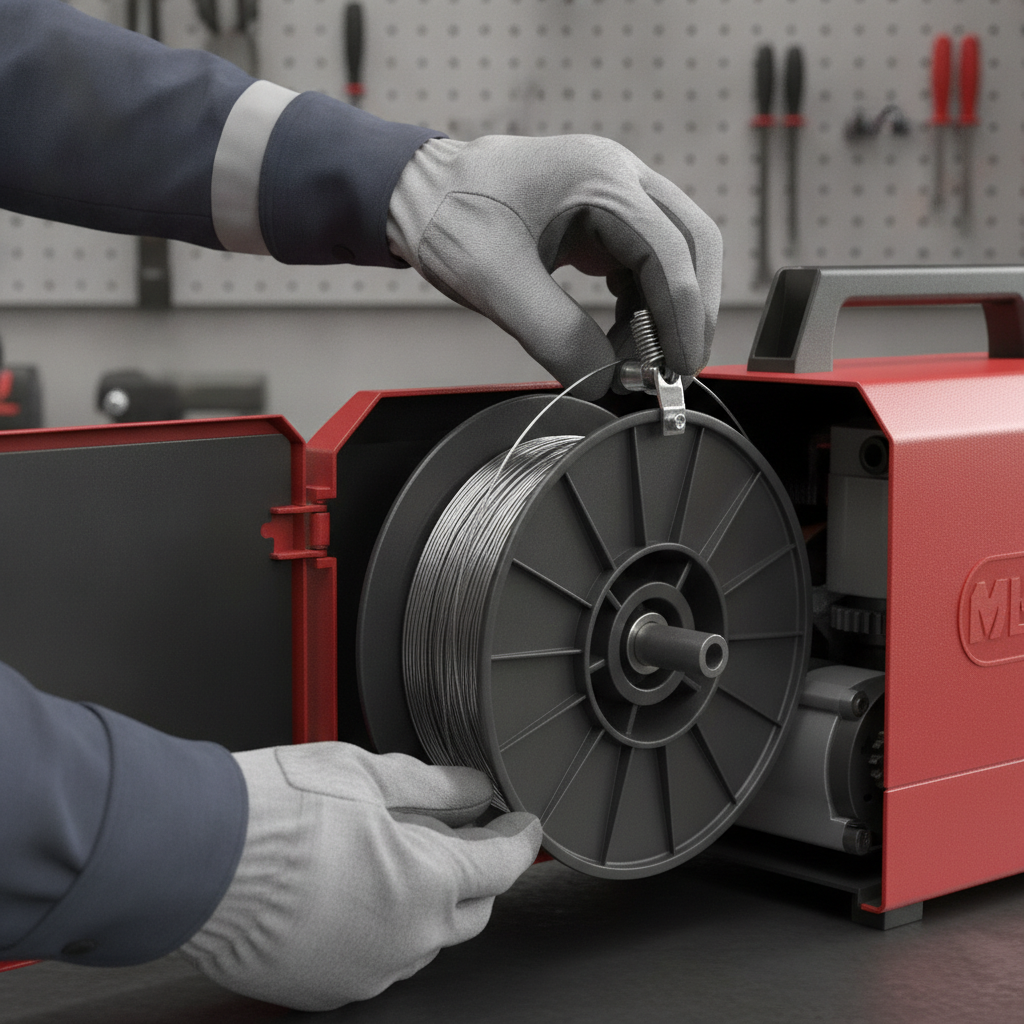
Installing the Wire Spool
Threading the Wire Through the Gun
This step trips up a lot of beginners, but it’s straightforward once you’ve done it once. 1. Straighten the gun cable out as much as possible before threading — curves in the liner make it harder for the wire to feed through cleanly. 2. Release the tension arm on the drive roll assembly. 3. Feed the wire from the spool manually through the inlet guide, over the drive roll groove, and into the gun liner. 4. Push the wire through until it extends about 1–2 inches past the contact tip. 5. Clip a new contact tip onto the wire if needed — contact tip size must match wire diameter exactly. 6. Re-engage the tension arm with moderate pressure. Too much tension crushes soft wire (like aluminum); too little causes slipping. With the tension arm re-engaged, press the trigger on the gun briefly to run the wire through. It should feed smoothly without hesitating or kinking.Connecting the Shielding Gas
Shielding gas protects the weld pool from oxygen and nitrogen contamination. Without it, the weld turns porous and weak. 1. Attach the regulator to the gas cylinder valve — turn it clockwise until snug. 2. Connect the regulator hose to the gas inlet on the back or side of the welder. 3. Open the cylinder valve slowly (full open for most setups). 4. Set the flow rate on the regulator. For most mild steel work, 15–20 liters per minute (LPM) is the standard starting range. Getting the shielding gas flow rate right matters more than most beginners realize — both too little and too much gas create weld defects. For outdoor or drafty environments, you may need to increase flow slightly or reconsider whether gas-shielded MIG is practical. Setting up a MIG welder without gas using flux core wire is a reliable alternative when working outside.Setting Polarity
MIG welding with solid wire and shielding gas requires DCEP — Direct Current Electrode Positive. This means the gun (electrode) connects to the positive terminal and the work clamp connects to negative. Inside the welder, you’ll find two terminals labeled “+” and “−”. The gun cable connects to “+”. The work clamp cable connects to “−”. If you switch to flux core wire, polarity typically reverses to DCEN (electrode negative). Check the wire manufacturer’s specifications. Running the wrong polarity produces an erratic arc, excessive spatter, and poor penetration — and it’s one of the most overlooked setup mistakes. Understanding DCEP vs DCEN in MIG welding helps you avoid this issue across different wire types.Dialing In Voltage and Wire Feed Speed
These two settings control weld quality more than anything else. Most machines provide a reference chart on the inside panel — use it as your starting point, not a guaranteed setting.General Settings Reference for Mild Steel (ER70S-6, 0.030″ wire)
| Material Thickness | Voltage | Wire Feed Speed | |—|—|—| | 18 gauge (1.2mm) | 15–16V | 150–175 IPM | | 16 gauge (1.6mm) | 16–17V | 175–200 IPM | | 3/16″ (4.8mm) | 18–20V | 250–300 IPM | | 1/4″ (6.4mm) | 20–22V | 300–350 IPM | In practice, always run a test bead on scrap metal before welding your actual workpiece. A correct setting sounds like steady bacon frying — not popping, not stuttering. If the bead sits high and ropy, increase voltage or reduce wire speed. If you’re burning through, lower voltage and wire speed. The balance between the two is what creates a flat, smooth bead with good fusion.Attaching the Work Clamp and Preparing the Surface
Clamp the ground cable as close to the weld area as possible — not across the shop on a random piece of metal. A poor ground causes arc instability and spatter. Clean the base metal before welding. Mill scale, rust, paint, and galvanized coatings all contaminate the weld. A flap disc or angle grinder handles mill scale quickly. Bare, shiny metal produces far better welds than anything you force through contaminated surfaces.Common Setup Mistakes to Avoid
These are the issues most frequently encountered when setting up a MIG welder for the first time: – Wrong contact tip size — causes wire stubbing and erratic feeding – Spool hub too loose — wire overruns and tangles inside the machine – Gun liner kinked or too long — causes wire feed resistance and birdnesting – Gas flow too low — results in porosity and a bubbly weld surface – Incorrect polarity — produces a rough, sputtery arc with poor penetration – Poor ground connection — creates inconsistent arc starts and spatter If your welds aren’t looking right even after setup, troubleshooting common MIG welding problems by symptom is the fastest way to isolate the cause.Push vs. Pull: Gun Angle Matters Too
Once the machine is set up, gun technique affects the final result. For MIG welding with shielding gas, pushing the gun (leading the puddle) generally produces a flatter, cleaner bead with better gas coverage. Pulling is more common with flux core wire where you want to see the puddle. Hold the gun at roughly 10–15 degrees from vertical, and maintain a consistent contact-tip-to-work distance of about 3/8″ to 1/2″. Changing that distance mid-weld changes the effective voltage — something most beginners don’t realize until they start paying attention to consistency.FAQ
What shielding gas should I use for MIG welding mild steel? The most common choice is C25 — a mix of 75% Argon and 25% CO₂. It produces a stable arc, low spatter, and a clean bead profile. Pure CO₂ is cheaper and gives deeper penetration but produces more spatter. For beginners working on general fabrication or automotive repairs, C25 is the practical standard and widely available from welding supply shops. Why does my MIG wire keep jamming or bird-nesting? Bird-nesting — where wire bunches up inside the drive housing — is usually caused by a blockage or restriction in the gun liner, a contact tip clogged with spatter, a worn drive roll, or drive roll tension that’s too high. Check the liner for kinks, clear or replace the contact tip, and slightly reduce the tension arm pressure. A dirty or undersized liner is the most common culprit in older machines. How do I know if my MIG welder settings are correct? Run a test bead on scrap material of the same thickness as your actual workpiece. The arc should sound like steady, consistent frying — not popping or crackling. The finished bead should be flat with slight rippling on both sides, roughly equal in width to the wire diameter times four to six. If it’s humped or irregular, adjust voltage or wire speed in small increments. Can I MIG weld without shielding gas? Yes, using flux core wire (FCAW). Flux core wire contains shielding compounds inside the wire itself, eliminating the need for an external gas cylinder. It’s practical outdoors where wind disperses shielding gas. The tradeoff is more spatter, a slag layer to clean off, and slightly rougher bead appearance. Polarity also changes — most self-shielded flux core wire runs on DCEN rather than DCEP. What wire diameter should a beginner start with? For most beginner projects involving light steel (18 gauge to 1/4″), 0.030″ ER70S-6 wire is the most versatile starting point. It’s forgiving across a wide voltage range and feeds reliably on most consumer-grade machines. If you’re working on thin sheet metal under 18 gauge, stepping down to 0.023″ gives better control and reduces burn-through risk. How far should the wire stick out from the contact tip? Aim for 3/8″ to 1/2″ of wire stickout during welding. This is called contact-tip-to-work distance (CTWD). Shorter stickout increases heat and penetration; longer stickout reduces it and increases spatter. Maintaining consistent stickout throughout a pass is one of the most effective ways to keep your bead uniform, especially for beginners developing hand stability. Do I need to change anything when welding thicker metal? Yes. Thicker material requires higher voltage, faster wire feed, and often multiple passes. For single-pass welds, preheat helps on material over 3/8″ thick. Joint preparation also matters more — bevel the edges on thicker stock to allow the arc to penetrate fully. Most light-duty 120V machines top out around 3/16″ in a single pass; 240V machines handle 3/8″ and beyond.Getting a MIG welder set up correctly the first time eliminates most of the frustration beginners experience. The machine isn’t complicated — it’s a wire feeder and a power source, and once the gas is flowing, polarity is right, and settings match your material, the arc does exactly what it’s supposed to. Start with scrap metal, listen to the arc, and adjust from there.