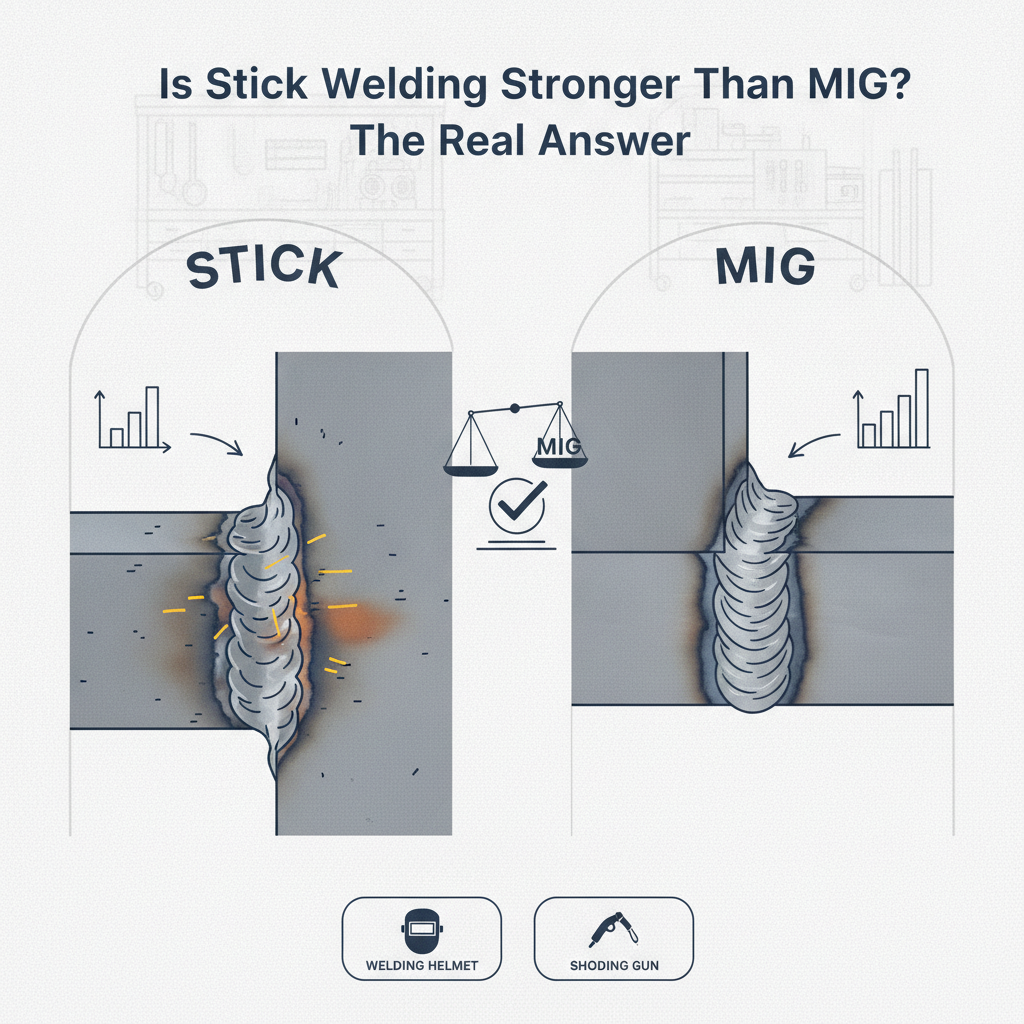
Choosing between stick and MIG welding often comes down to one question: which process actually produces stronger welds? It’s a fair concern, especially when structural integrity or safety is on the line.
Neither process is inherently stronger than the other when used correctly. Weld strength depends primarily on the filler metal’s tensile strength, proper joint preparation, and technique — not the process itself. A properly executed stick weld using a 7018 electrode and a properly executed MIG weld using ER70S-6 wire will both meet or exceed the tensile strength of most mild steel base materials.
That said, there are real-world differences between the two processes that affect weld quality in practical situations. Those differences are worth understanding before you pick up an electrode holder or a MIG gun.
What Actually Determines Weld Strength
Weld strength isn’t about the machine or the process. It’s about the quality of the fusion between the filler and base metals, and the mechanical properties of the deposited material.
Three things matter most:
– Tensile strength of the filler metal — The electrode or wire classification tells you this directly
– Penetration depth — How deeply the weld fuses into the base metal
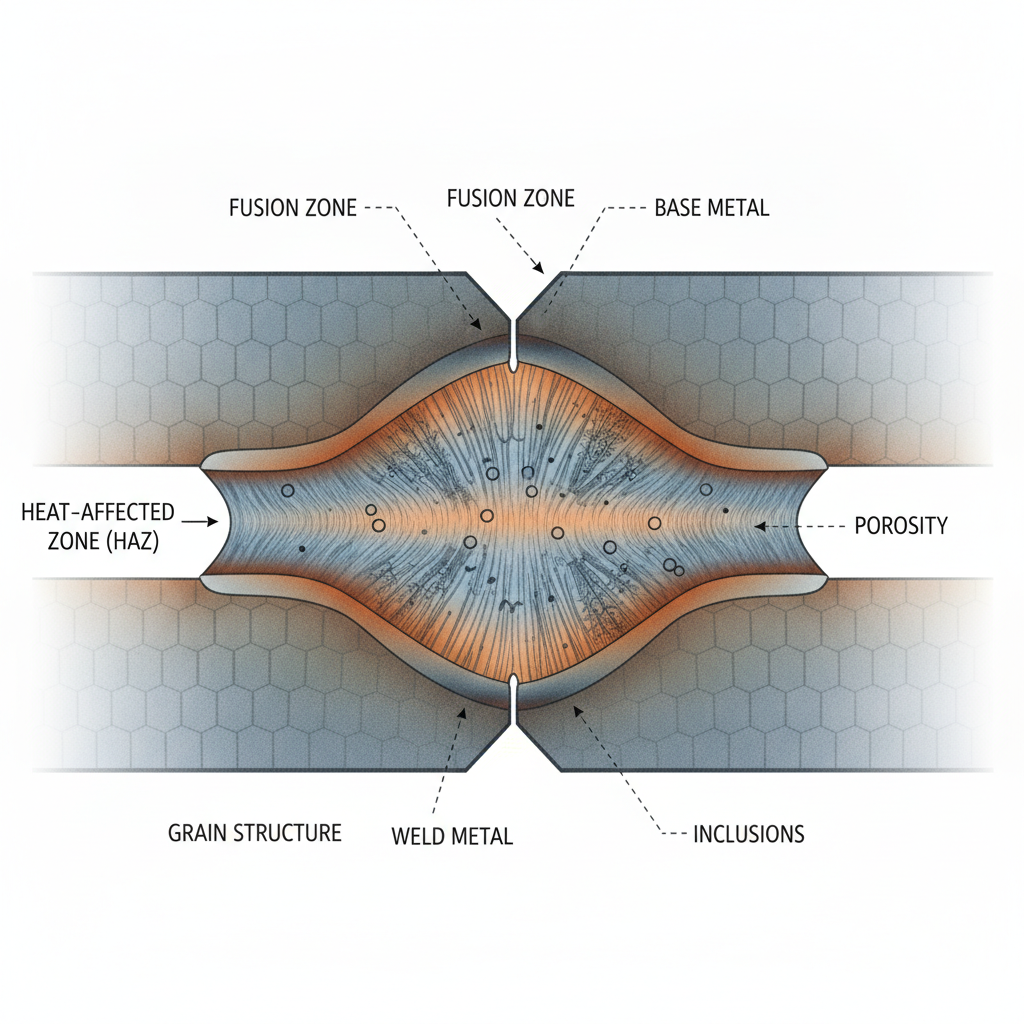
– Defect level — Porosity, slag inclusions, undercut, and lack of fusion all weaken welds regardless of process
Both stick (SMAW) and MIG (GMAW) are capable of producing welds that meet or exceed base metal strength in mild steel. The difference shows up in the conditions where each process performs reliably.
Filler Metal Strength: Stick vs. MIG Side by Side
The electrode or wire classification system tells you the minimum tensile strength of the deposited weld metal.
| Process | Common Filler | Tensile Strength | Yield Strength |
|——–|————–|—————–|—————|
| Stick (SMAW) | E6013 | 62,000 PSI | 50,000 PSI |
| Stick (SMAW) | E7018 | 70,000 PSI | 58,000 PSI |
| Stick (SMAW) | E7024 | 70,000 PSI | 58,000 PSI |
| MIG (GMAW) | ER70S-3 | 70,000 PSI | 58,000 PSI |
| MIG (GMAW) | ER70S-6 | 70,000 PSI | 68,000 PSI |
At equivalent classifications, the numbers are essentially the same. A 7018 stick electrode and ER70S-6 MIG wire both deposit weld metal rated at 70,000 PSI tensile strength. The “70” in both designations means exactly that.
Where selection matters: if you’re using an E6013 rod on a structural joint that calls for 70,000 PSI minimum, you’re underspecifying — regardless of how clean the bead looks.
Where Stick Welding Has a Real Advantage
Stick welding genuinely outperforms MIG in specific situations, and those situations are common in field work, outdoor welding, and dirty material scenarios.
Penetration on thicker material. Stick welding typically achieves deeper penetration, particularly on heavier plate. The arc characteristics of SMAW drive more heat into the base metal, which improves fusion on thicker sections.
Dirty, rusty, or painted metal. The flux coating on stick electrodes generates its own shielding and cleaning action. MIG shielding gas gets displaced by wind or surface contamination, causing porosity. Stick handles real-world dirty steel far better.
Outdoor and site work. Wind destroys MIG shielding gas coverage. Stick welding requires no external gas supply and works reliably in wind, rain (with precautions), and remote locations.
Vertical and overhead on thick sections. Experienced stick welders can run high-quality structural welds in all positions on heavy material. The 7018 welding rod is a standard choice for structural and pressure vessel work precisely because of its consistent mechanical properties in all positions.
Where MIG Welding Has a Real Advantage
MIG doesn’t lag behind on strength, but it pulls ahead on efficiency, thin material, and controlled production environments.
Thin gauge metal. MIG is significantly easier to control on sheet metal and thin tube. Stick on thin material is prone to burn-through, and the electrode manipulation required demands considerable skill. For anything under 3/16 inch, MIG is more forgiving.
Speed and productivity. MIG deposits weld metal faster with less spatter and no slag removal. For production welding or repetitive joints, this matters operationally even if it doesn’t affect tensile strength.
Lower skill floor for decent results. A beginner can produce structurally adequate MIG welds with less practice time than stick requires. That doesn’t mean the welds are better — it means consistent results are easier to achieve at entry level. If you’re considering building a home welding setup, a MIG welder often makes the learning process less frustrating.
Consistent wire chemistry. MIG wire quality control tends to be very consistent, which reduces variability in deposited weld metal properties across a production run.
The Condition That Changes Everything: Joint Preparation
In practice, the single biggest factor separating a strong weld from a weak one isn’t the process — it’s joint preparation and fit-up.
A perfectly dialed MIG weld on a poorly fitted joint with a 1/4-inch gap and mill scale left on the surface will consistently fail before a stick weld with proper joint prep on the same material.
This is why professional weld inspectors focus heavily on:
– Surface cleanliness
– Correct joint geometry (bevel angle, root gap, root face)
– Preheat on thicker or higher-carbon materials
– Post-weld inspection for surface defects
Both processes reward preparation equally and punish shortcuts equally.
Structural Welding Standards: What Codes Actually Say
AWS D1.1 (Structural Welding Code — Steel) and similar structural codes qualify both SMAW and GMAW processes for structural applications. Neither is considered inherently stronger or more reliable than the other at the code level.
What the codes do specify is:
– Minimum filler metal classification for the application
– Pre-qualified joint designs
– Welder qualification requirements
– Inspection and testing requirements
When a welding procedure is properly qualified under AWS D1.1, a stick weld and a MIG weld with equivalent filler classifications must meet the same minimum mechanical properties. The process is secondary to the procedure and the welder’s qualification.
Common Misconceptions Worth Correcting
“Stick welds are always stronger.” Not true. This belief often comes from stick’s association with heavy structural work, but the process itself doesn’t add strength. The filler metal and technique do.
“MIG is just for hobbyists.” Incorrect. MIG welding is used extensively in structural fabrication, shipbuilding, automotive manufacturing, and pressure vessel work. It’s a fully code-qualified process.
“More heat means stronger welds.” More heat means deeper penetration, but excessive heat causes distortion, grain coarsening in the heat-affected zone, and increased residual stress — all of which can reduce joint performance.
“Bigger weld bead = stronger weld.” A larger bead doesn’t compensate for lack of fusion at the root. Undersized welds are a problem, but oversized welds add cost without proportional strength benefit.
Stick vs. MIG: Which to Use for Your Application
| Application | Better Choice | Why |
|————|————–|—–|
| Structural steel, heavy plate | Either (stick preferred outdoors) | Stick handles site conditions; both meet code |
| Sheet metal, thin tube | MIG | Less risk of burn-through |
| Outdoor / field repair | Stick | No shielding gas dependency |
| Rusty or dirty steel | Stick | Flux provides cleaning action |
| Production fabrication | MIG | Speed and consistency |
| Vertical / overhead (thick) | Stick (E7018) | Better control on heavy section |
| Home shop / hobby | MIG | Easier to learn, versatile |
| Pipe welding (structural) | Stick or TIG | Code requirements often specify process |
For a beginner working in a garage on mild steel projects, the Lincoln Electric Weld-Pak 140 HD is a common MIG option that handles most light structural work adequately. For outdoor or farm repair work where rust and wind are realities, a stick setup with E7018 or E6011 electrodes is more reliable regardless of operator skill.
FAQ
Does stick welding penetrate deeper than MIG?
Generally, yes — particularly on thicker material and without short-circuit transfer mode. Stick welding’s arc characteristics tend to push more heat into the base metal, resulting in deeper fusion. However, MIG in spray transfer mode can match or exceed stick penetration on heavier plate. Penetration is also affected by amperage, travel speed, and joint design, not just the process.
Can MIG welding be used for structural applications?
Yes. MIG welding is fully qualified under AWS D1.1 and other structural codes for steel fabrication. The process must be used with a qualified welding procedure, appropriate filler metal classification, and by a qualified welder. Many bridges, buildings, and industrial structures include MIG welds that meet the same standards as stick welds.
Is stick or MIG better for welding thick steel plate?
Both can weld thick plate effectively. Stick is often preferred for outdoor structural work and site conditions. MIG in spray transfer or pulsed spray mode is used for heavy plate in shop environments where shielding gas can be maintained. The key on thick plate with either process is adequate preheat and multi-pass technique to ensure complete fusion.
Why do structural codes often specify stick welding for critical joints?
Tradition, welder qualification prevalence, and the process’s independence from external gas supply play a role. In some applications, stick electrodes — particularly low-hydrogen types like E7018 — have a long track record of producing reliable welds in field conditions where MIG shielding gas coverage cannot be guaranteed. It’s about reliability in context, not inherent superiority.
Does flux core welding fall between stick and MIG in strength?
Flux-core arc welding (FCAW) uses a continuously fed tubular wire with internal flux, giving it some properties of both processes. Self-shielded flux core (FCAW-S) works outdoors without external gas and achieves good penetration on thicker material. Gas-shielded flux core (FCAW-G) is widely used in structural fabrication. Both variants can produce welds meeting the same tensile strength specifications as stick or solid wire MIG at equivalent classifications.
Is a 7018 rod stronger than MIG wire?
An E7018 electrode and ER70S-6 wire both produce weld metal rated at a minimum of 70,000 PSI tensile strength — so they’re equivalent in that regard. The E7018’s low-hydrogen coating reduces the risk of hydrogen-induced cracking on higher-carbon steels, which is one reason it’s specified for critical structural work. That’s a weld quality benefit, not a raw strength advantage.
Which process is better for a beginner learning to weld?
MIG is generally easier for beginners to learn on flat and horizontal positions because wire feed and shielding gas are automated, letting the learner focus on travel speed and distance. Stick requires managing electrode angle, arc length, and feed rate simultaneously, which has a steeper learning curve. That said, stick is more versatile in field conditions and teaches fundamentals that transfer well to other processes.
The Bottom Line
Stick and MIG welding are equally capable of producing strong, code-compliant welds when the right filler metal is chosen and proper technique is applied. The process that produces stronger welds in your specific situation is the one that’s better matched to your material condition, environment, and skill level. Outdoors on dirty steel, stick wins on reliability. In a controlled shop on thin material, MIG wins on efficiency and control. Strength is the result of good procedure — not the process name on the machine.