
Stainless steel exhaust systems are common on performance builds, diesel trucks, and custom fabrications. They resist corrosion and handle heat better than mild steel. But when it comes time to repair or fabricate one, a lot of welders hit trouble fast.
MIG welding stainless exhaust is absolutely doable, but it requires the right wire, the correct shielding gas (tri-mix or 98% Argon/2% CO₂), and carefully dialed settings to avoid warping, discoloration, and poor corrosion resistance. Using standard C25 gas or mild steel wire will compromise the weld quality and eventually cause the joint to fail.
Why Stainless Exhaust Welding Isn’t the Same as Mild Steel
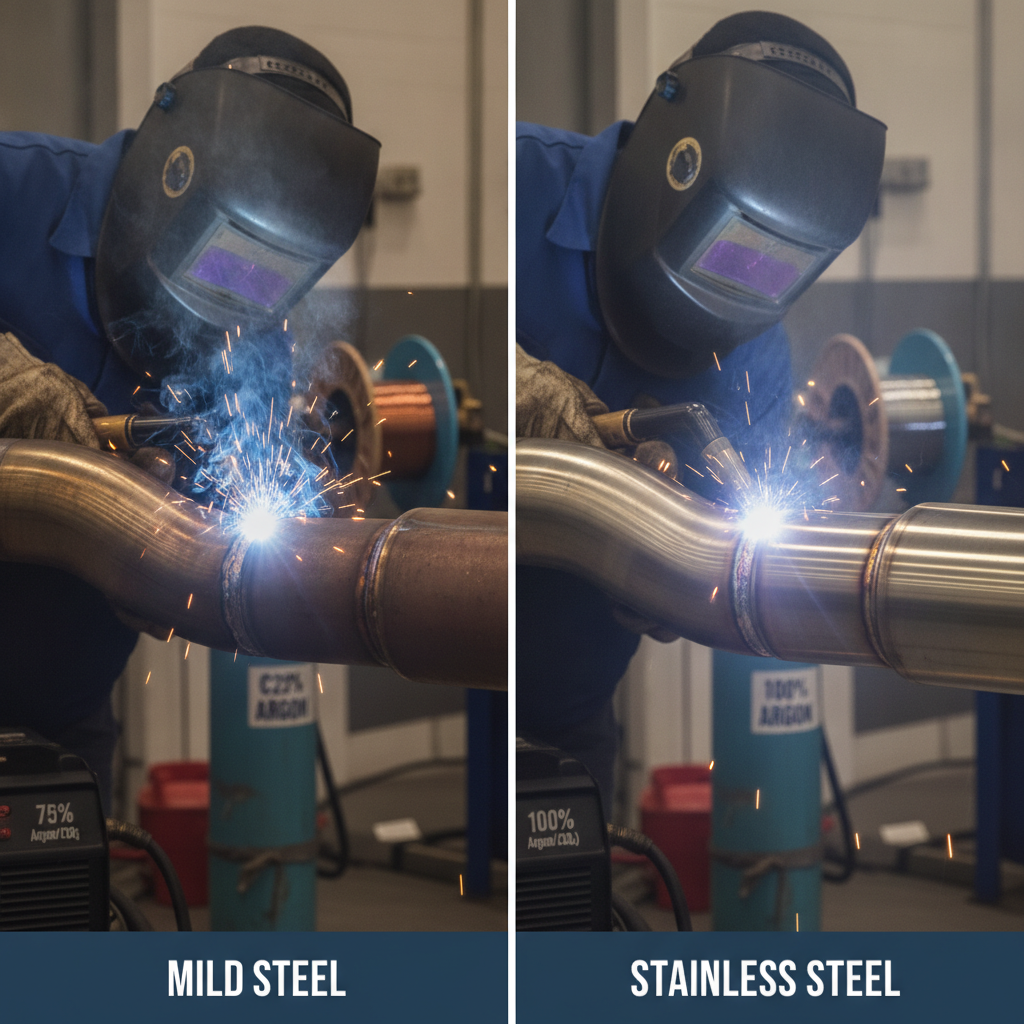
Stainless steel conducts heat differently than mild steel — it actually holds heat longer and distributes it more slowly. That creates two immediate problems: warping and carbide precipitation.
Carbide precipitation happens when stainless is held at temperatures between roughly 800°F and 1500°F for too long. Chromium carbides form at the grain boundaries, which strips the material of its corrosion resistance right at the weld zone. On an exhaust system that sees constant heat cycling, that’s a real problem.
The low thermal conductivity of stainless also means heat builds up quickly in one spot. Move too slowly or linger on the puddle, and you’ll get excessive discoloration and warping, even on thicker sections.
Choosing the Right Wire for Stainless Exhaust
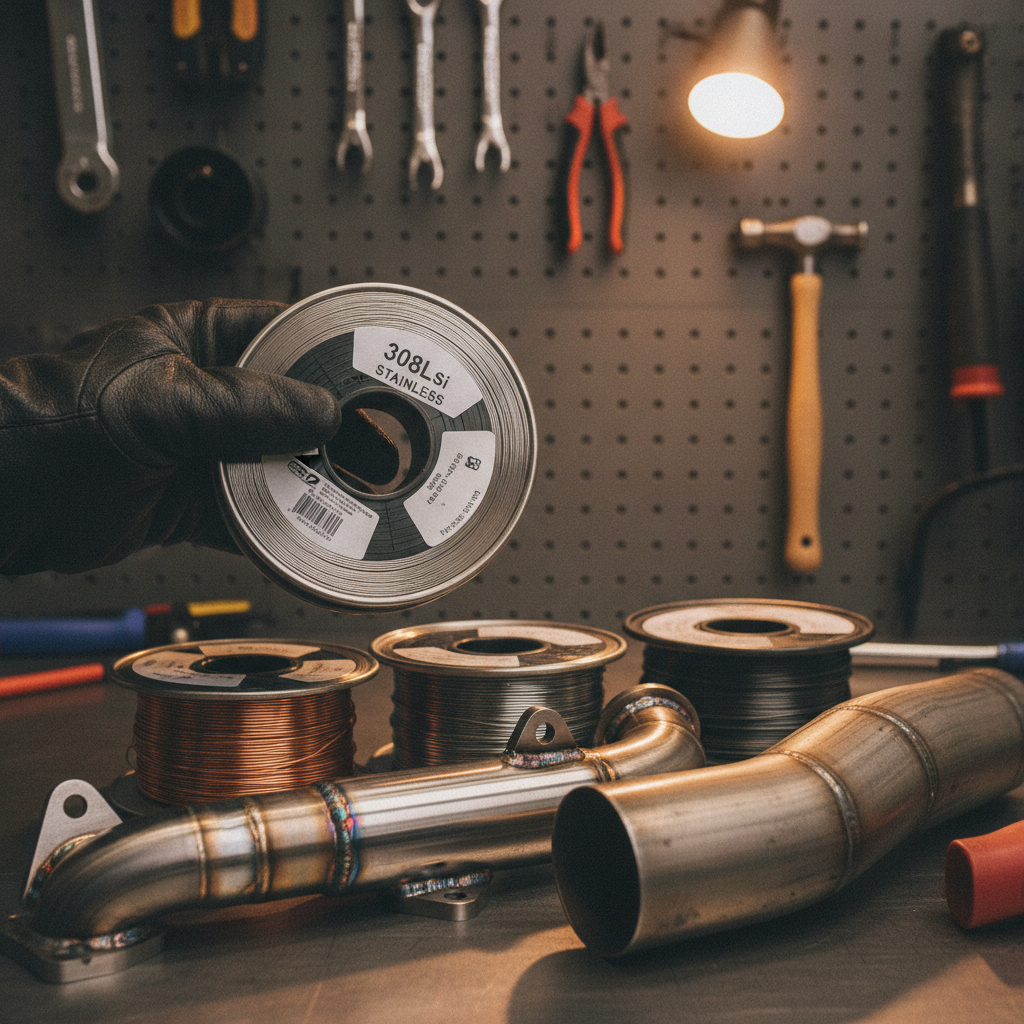
Wire selection directly affects the strength, corrosion resistance, and appearance of the finished weld. For most stainless exhaust work, two wire grades cover the majority of situations.
ER308L is the standard choice when welding 304 stainless steel, which is the most common grade used in aftermarket and custom exhaust systems. The “L” designation means low carbon, which helps minimize carbide precipitation.
ER309L is used when welding stainless to mild steel — for example, when connecting a stainless mid-pipe to a factory mild steel section. It’s formulated to bridge the metallurgical gap between the two materials.
ER316L is worth considering for marine or high-corrosion environments, but for typical road exhaust applications, ER308L is usually sufficient.
Wire diameter matters too. For exhaust tubing in the 16–18 gauge range, 0.023″ or 0.030″ wire gives you better control over heat input than 0.035″. Thinner wire at lower settings is the right direction when working with thin-wall stainless pipe.
If you’re working with 304 stainless specifically, the article on MIG welding 304 stainless steel joints goes deeper into material behavior and bead technique.
Shielding Gas: This Is Where Most Mistakes Happen
Using the wrong gas on stainless is probably the single most common mistake. C25 (75% Argon / 25% CO₂) works well on mild steel, but it causes excessive oxidation on stainless. You’ll end up with a rough, heavily oxidized weld that lacks corrosion resistance.
For MIG welding stainless exhaust, you need one of these two options:
| Gas Mix | Best For | Notes |
|---|---|---|
| 98% Argon / 2% CO₂ | General stainless MIG welding | Best balance of arc stability and weld appearance |
| Tri-Mix (90% He / 7.5% Ar / 2.5% CO₂) | Thicker stainless, production work | Better penetration and faster travel speed |
| 100% Argon | Not recommended for MIG stainless | Unstable arc, poor fusion |
For most garage and shop exhaust repairs, 98% Argon / 2% CO₂ (sometimes labeled C2 or 98/2) is the practical go-to. Tri-mix gives a flatter bead and better penetration but costs more and isn’t always necessary for thin exhaust tubing.
Flow rate typically runs 15–20 CFH indoors. In a drafty shop or outdoors, you may need to push toward 20–25 CFH to maintain adequate shielding coverage.
MIG Settings for Stainless Exhaust Tubing
Stainless runs hotter for a given voltage setting compared to mild steel, so your instinct to increase power should be resisted. Start lower than you think you need to.
Here’s a general starting point for common exhaust tubing gauges:
| Material Thickness | Wire Diameter | Voltage | Wire Speed (IPM) |
|---|---|---|---|
| 18 gauge (0.048″) | 0.023″ | 14–16V | 180–220 |
| 16 gauge (0.060″) | 0.023″–0.030″ | 15–17V | 200–250 |
| 14 gauge (0.075″) | 0.030″ | 16–18V | 220–280 |
| 1/8″ (0.125″) | 0.030″–0.035″ | 17–19V | 250–320 |
These are starting references. Dial in on scrap material first. The bead should sound like a steady frying sizzle — not a crackle, not a loud pop.
For a more detailed settings reference, the MIG welding stainless steel settings guide covers voltage, wire speed, and common adjustments in practical detail.
Technique That Keeps Stainless Exhaust Looking and Performing Right
Heat management is the core skill. Every technique choice you make should be aimed at minimizing total heat input while maintaining fusion.
Travel speed: Move faster than you would on mild steel. Stainless holds heat, so a slow bead means a hotter HAZ (heat-affected zone) and more discoloration.
Stringer beads over weave: On thin exhaust pipe, run tight stringers rather than weaving. Weaving increases heat input and widens the HAZ unnecessarily.
Tack welding sequence: Tack every 1–2 inches before running a full bead. On round exhaust tubing, use an opposing-tack pattern to distribute heat evenly and control distortion.
Skip welding: On longer seams, weld in short segments and alternate positions rather than welding continuously from one end to the other. Let the metal cool between segments.
Back-purging: On performance exhaust or high-quality fabrication work, purging the inside of the pipe with argon while welding prevents oxidation on the root side of the weld. Even a simple argon purge using a balloon method significantly improves internal weld quality.
Because exhaust pipe walls are thin, controlling heat input on thin-wall material is directly applicable here — the same burn-through risks apply to stainless tubing.
TIG vs. MIG for Stainless Exhaust — Which Is Actually Better?
In professional exhaust fabrication shops, TIG welding is the standard. It produces cleaner beads, better control over heat input, and superior aesthetics. The “rainbow” colored TIG welds you see on performance systems are a combination of technique, purging, and controlled heat.
That said, MIG on stainless exhaust is a completely legitimate option, especially for repairs, patch work, or when TIG equipment isn’t available. A well-executed MIG weld with proper wire and gas will be structurally sound and perform well under exhaust heat cycles.
The honest trade-off is this:
- TIG: Cleaner appearance, less distortion, better for thin-wall precision work, slower process
- MIG: Faster, more accessible, adequate strength, slightly more heat input, less refined appearance
For a daily driver repair or a budget build, MIG is the practical choice. For a show car or high-performance application where bead appearance and heat resistance matter, TIG is worth the effort. If you’re still deciding which process fits your exhaust work, the breakdown on whether exhaust welding uses TIG or MIG covers the trade-offs in detail.
Common Problems When MIG Welding Stainless Exhaust
Excessive discoloration (sugaring): Heavy blue, grey, or black oxidation on or around the weld usually means too much heat, too slow a travel speed, or inadequate shielding gas coverage. Check your gas flow rate and speed up your travel.
Porosity: Small holes or pits in the weld surface typically point to contamination. Stainless must be cleaned with a dedicated stainless wire brush — never use a brush that’s been on mild or galvanized steel. Acetone wipe-down before welding helps significantly.
Warping or distortion: The pipe curves or pulls out of alignment. This almost always comes from excessive heat buildup. Use skip welding, tack more frequently, and let the pipe cool between passes.
Cold lap or lack of fusion: The weld sits on top of the base metal rather than fusing into it. This happens when voltage is too low or travel speed is too fast. Slow down slightly and increase voltage in small increments.
Contamination from wrong brush or tools: Always dedicate stainless prep tools to stainless only. Cross-contamination from mild steel particles embeds in the surface and causes rust spots post-weld.
FAQ
Can I use standard C25 gas to MIG weld stainless exhaust?
Technically the arc will strike and you’ll get a weld, but C25 causes significant oxidation on stainless steel. The weld will look rough, develop an oxide-heavy surface layer, and lose corrosion resistance at the joint. For stainless exhaust, always use 98% Argon/2% CO₂ or tri-mix gas. Using the wrong gas is one of the most common reasons stainless welds fail prematurely.
What wire should I use for MIG welding 304 stainless exhaust?
ER308L is the correct choice for 304 stainless exhaust tubing. The low-carbon designation helps prevent carbide precipitation, which degrades corrosion resistance in the weld zone. Use 0.023″ or 0.030″ diameter for typical exhaust tubing gauges. Avoid ER70S mild steel wire — it will not provide adequate corrosion resistance and will fail in an exhaust environment.
How do I prevent warping when MIG welding stainless exhaust pipe?
Use frequent tack welds before running full beads, apply skip welding technique on longer seams, and avoid continuous welding passes that build up excessive heat in one area. Let sections cool between welds. Clamping the pipe securely before welding also reduces movement. Stainless distorts more easily than mild steel, so managing heat input is the most important variable to control.
Do I need to back-purge stainless exhaust when MIG welding?
For garage repairs or budget builds, back-purging is optional but beneficial. Without purging, the inside of the pipe will oxidize during welding — this is called “sugaring” and it weakens the root of the weld. For performance exhaust, high-quality fabrication, or any application where internal flow and strength matter, purging the pipe interior with argon during welding is worth the extra setup.
Can a beginner MIG weld stainless exhaust at home?
Yes, with the right setup. The main requirements are correct wire (ER308L), correct gas (98/2 Argon/CO₂), low heat settings, and clean metal. Practicing on matching scrap material first is essential. The biggest mistake beginners make is using mild steel settings and gas on stainless. If you’re new to welding stainless, reviewing tips for welding stainless at home will help you avoid the most common setup errors before you start.
What’s the difference between ER308L and ER309L for exhaust welding?
ER308L is designed for welding stainless to stainless (specifically 304 grade). ER309L is formulated for welding stainless steel to carbon or mild steel — for example, joining a stainless section to a factory mild steel pipe. Using ER309L on stainless-to-stainless joints isn’t wrong but is unnecessary. Using ER308L on stainless-to-mild-steel joints can lead to cracking from the metallurgical mismatch.
Why does my stainless exhaust weld turn black or grey?
Heavy grey or black discoloration usually means overheating or poor shielding gas coverage. If the gas mix is correct, check that your flow rate is adequate and that there are no drafts disrupting coverage at the weld zone. Slower travel speed and excess heat input also produce heavy oxidation. A light golden or blue tint is normal on stainless welds — black is a sign something needs adjusting.
MIG welding stainless exhaust comes down to three non-negotiable fundamentals: the right wire, the right gas, and deliberate heat management. Get those three right and the process is manageable even in a home shop. Where most welds fail is in using convenient mild steel settings on a material that genuinely requires a different approach. The Lincoln Electric Weld-Pak 140 and similar mid-range MIG machines handle stainless exhaust work well once they’re set up correctly — the machine isn’t usually the problem, the consumables and technique are. Treat stainless as its own discipline, not a variation on mild steel, and your results will be considerably better from the first bead.