
Steel welding requires precise parameter settings to achieve strong, reliable joints. This comprehensive guide covers welding charts for different steel types, helping you select the correct amperage, voltage, and wire feed speeds for your projects.
You’ll learn how to read welding parameter charts, understand the differences between carbon steel and stainless steel settings, and avoid common mistakes that lead to poor weld quality. Whether you’re working with thin sheet metal or thick structural steel, this guide provides the technical data you need.
Quick Parameter Reference
Steel welding parameters depend on material thickness, welding process, and steel type. For 1/8-inch mild steel using MIG welding: use 18-22 volts, 130-150 amps, and 200-250 IPM wire feed speed. Thicker materials require proportionally higher settings.
Understanding Steel Welding Charts
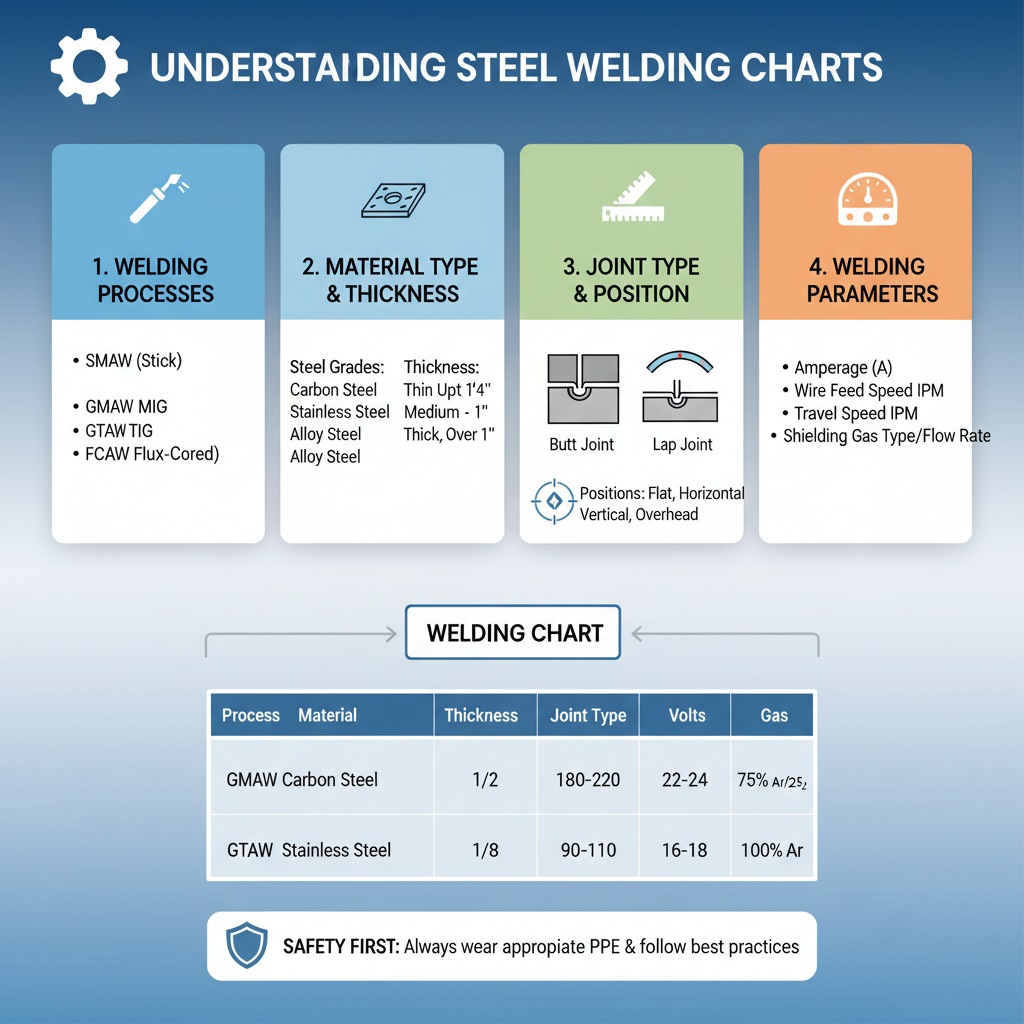
Welding charts serve as reference guides that match material specifications with optimal welding parameters. These charts eliminate guesswork by providing tested settings for different steel thicknesses and joint configurations.
Professional welders rely on these charts because they represent thousands of hours of testing and real-world application. The charts account for heat input requirements, penetration needs, and distortion control across various steel grades.
Most welding charts, including the welding defects chart, organize information by material thickness, welding position, and joint type. This systematic approach ensures consistent results regardless of project complexity.
MIG Welding Parameters for Carbon Steel
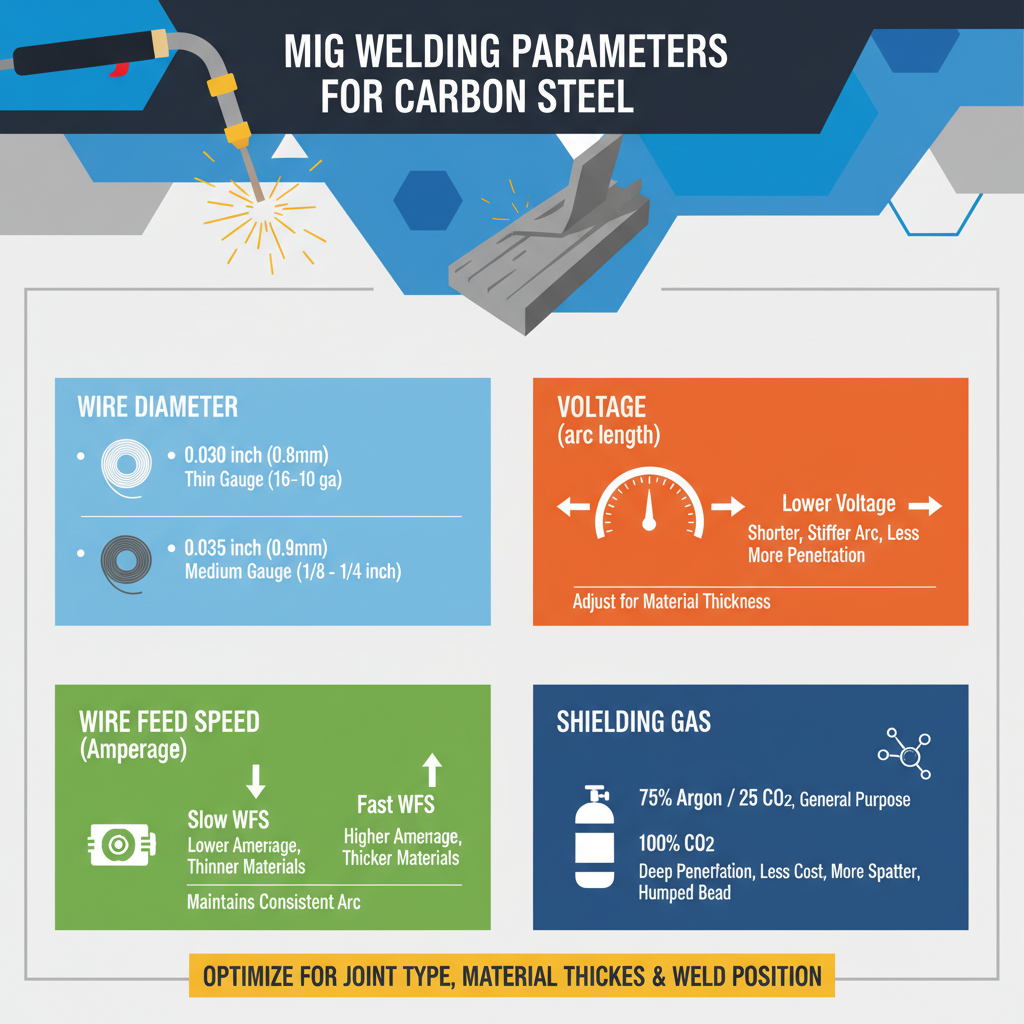
Carbon steel represents the most common welding application in fabrication shops. The following parameters work for flat position welding using .035-inch solid wire with 75% argon/25% CO2 shielding gas.
Thin Steel (16-14 gauge):
– Voltage: 16-18 volts
– Amperage: 80-110 amps
– Wire feed speed: 150-200 IPM
– Travel speed: 12-15 IPM
Medium Steel (1/8 to 3/16 inch):
– Voltage: 18-22 volts
– Amperage: 130-180 amps
– Wire feed speed: 200-280 IPM
– Travel speed: 8-12 IPM
Thick Steel (1/4 to 3/8 inch):
– Voltage: 22-26 volts
– Amperage: 180-250 amps
– Wire feed speed: 280-350 IPM
– Travel speed: 6-10 IPM
Field experience shows that starting at the lower end of these ranges prevents burn-through on the first pass. You can increase parameters as needed based on penetration requirements.
Stick Welding Settings for Structural Steel
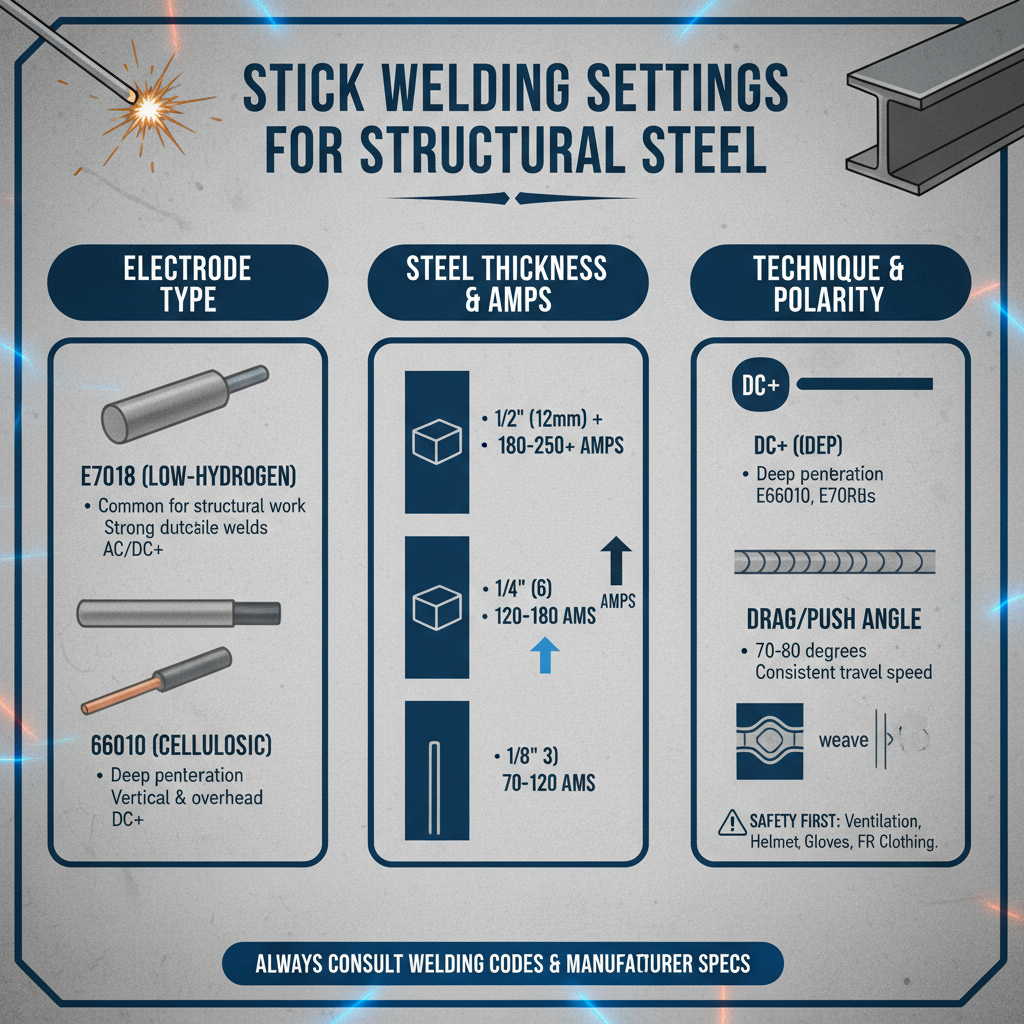
Stick welding remains the preferred method for structural steel applications due to its deep penetration and all-position capability. These settings apply to E7018 electrodes in flat and horizontal positions.
3/32-inch electrode (thin sections):
– Amperage: 70-90 amps
– Suitable for: 1/8 to 3/16-inch steel
– Root pass capability: Yes
1/8-inch electrode (general purpose):
– Amperage: 90-130 amps
– Suitable for: 3/16 to 1/4-inch steel
– Most versatile size for field work
5/32-inch electrode (heavy sections):
– Amperage: 120-160 amps
– Suitable for: 1/4-inch and thicker steel
– High deposition rate for fill passes
3/16-inch electrode (production welding):
– Amperage: 140-180 amps
– Suitable for: 3/8-inch and thicker steel
– Maximum productivity on thick sections
A common issue technicians encounter is using too high amperage on the root pass, which causes burn-through. Start with lower settings and increase amperage for fill and cap passes.
TIG Welding Charts for Precision Work
TIG welding provides superior control for critical applications and thin materials. These parameters use pure argon shielding gas and 2% thoriated tungsten electrodes.
Thin Steel (20-16 gauge):
– Amperage: 30-60 amps
– Tungsten size: 1/16 inch
– Filler rod: .045 inch
– Gas flow: 15-20 CFH
Medium Steel (1/8 to 3/16 inch):
– Amperage: 60-120 amps
– Tungsten size: 3/32 inch
– Filler rod: 1/16 inch
– Gas flow: 20-25 CFH
Thick Steel (1/4 inch and up):
– Amperage: 120-200 amps
– Tungsten size: 1/8 inch
– Filler rod: 3/32 inch
– Gas flow: 25-30 CFH
TIG welding requires precise heat control to prevent distortion. In practice, many welders use foot pedal control to vary amperage throughout the weld cycle.
Stainless Steel Parameter Adjustments
Stainless steel conducts heat differently than carbon steel, requiring modified welding parameters. The lower thermal conductivity means heat builds up quickly, potentially causing distortion or burn-through.
MIG welding stainless steel adjustments:
– Reduce amperage by 10-15% compared to carbon steel
– Use tri-mix shielding gas (90% helium, 7.5% argon, 2.5% CO2)
– Increase travel speed by 20-30%
– Use stainless steel filler wire matching base metal grade
TIG welding stainless considerations:
– Reduce amperage by 20-25% from carbon steel settings
– Use pure argon shielding gas
– Employ back purging for critical applications
– Control interpass temperature below 350°F
The key difference in stainless welding is managing heat input to preserve corrosion resistance and prevent carbide precipitation.
Joint Configuration Impact on Parameters
Different joint designs require parameter modifications to ensure proper penetration and fusion. The joint geometry affects how heat flows through the material during welding.
Butt joints allow maximum penetration with standard parameters. The open root provides access for full penetration welding on thicker sections.
Fillet joints require 10-15% higher amperage due to the corner configuration that acts as a heat sink. The two perpendicular surfaces draw heat away from the weld zone more rapidly.
Lap joints need careful parameter control to prevent burn-through of the top sheet while ensuring fusion to the bottom plate. Reduce amperage by 10-20% and focus on proper electrode angle.
T-joints present similar challenges to fillet welds but often require preheating on thick sections to prevent cracking in the base of the tee.
Position Welding Modifications
Welding position significantly affects parameter selection due to gravity’s influence on the molten weld pool. Each position requires specific adjustments for optimal results.
Flat position allows maximum parameters and fastest travel speeds. The weld pool is supported by the base metal, enabling high deposition rates.
Horizontal position requires 10-15% amperage reduction to prevent sagging. Slightly faster travel speeds help control pool size and shape.
Vertical position demands the most significant parameter changes. Reduce amperage by 20-25% and use a weaving technique to control the molten pool against gravity.
Overhead position presents the greatest challenge. Use 25-30% lower amperage with fast travel speeds to minimize molten metal dripping.
Professional welders often use smaller diameter electrodes or wire for out-of-position work to improve control and reduce heat input.
Common Parameter Selection Mistakes
Incorrect parameter selection leads to defective welds and wasted materials. Understanding these common errors helps prevent costly rework and safety issues.
Excessive amperage causes burn-through, excessive spatter, and poor bead appearance. The weld pool becomes too fluid to control effectively, especially on thin materials.
Insufficient amperage results in lack of fusion, cold lap, and poor penetration. The arc struggles to melt the base metal adequately, creating weak joints.
Wrong wire feed speed in MIG welding creates either stubbing (too slow) or excessive spatter (too fast). The wire feed must match the amperage setting for stable arc characteristics.
Improper shielding gas flow affects arc stability and weld quality. Too little flow allows atmospheric contamination, while excessive flow creates turbulence that draws in contaminants.
Field experience shows that starting with conservative parameters and gradually increasing settings produces better results than beginning with aggressive settings.
Frequently Asked Questions
What amperage should I use for 1/4-inch steel with stick welding?
Use 120-160 amps with a 5/32-inch E7018 electrode for 1/4-inch steel. Start at 130 amps and adjust based on penetration requirements and welding position.
How do I adjust MIG settings when welding thin sheet metal?
Reduce voltage to 16-18 volts and amperage to 80-110 amps for thin steel. Use .030-inch wire and increase travel speed to prevent burn-through.
Why do my welds lack penetration even with high amperage?
Lack of penetration often results from incorrect electrode angle, too fast travel speed, or contaminated base metal. Check your technique before increasing amperage further.
Can I use the same parameters for stainless steel as carbon steel?
No, stainless steel requires 10-25% lower amperage settings due to different thermal properties. Also change to appropriate filler metals and shielding gases.
What’s the difference between spray transfer and short circuit MIG settings?
Spray transfer requires higher voltage (24+ volts) and amperage (180+ amps) with argon-rich shielding gas. Short circuit uses lower settings with CO2 or mixed gases.
How does welding position affect my parameter selection?
Reduce amperage by 10-30% for out-of-position welding. Vertical and overhead positions require the most significant reductions to control the molten pool against gravity.
Should I preheat thick steel sections before welding?
Preheat steel thicker than 1 inch to 200-400°F depending on carbon content and ambient temperature. This reduces cooling rates and prevents cracking in heat-affected zones.
Final Thoughts
Welding parameter charts provide the foundation for consistent, high-quality steel welding across all processes and applications. These reference guides eliminate guesswork while ensuring proper fusion, penetration, and mechanical properties in finished welds.
Remember that charts serve as starting points rather than absolute rules. Material condition, joint fit-up, and environmental factors may require parameter adjustments from chart recommendations. Developing the skill to read the weld pool and adjust parameters accordingly separates competent welders from beginners.
Keep welding charts accessible in your workspace and document any successful parameter modifications for future reference. This practice builds a personal database of proven settings for your specific equipment and applications, ultimately improving both productivity and weld quality.