
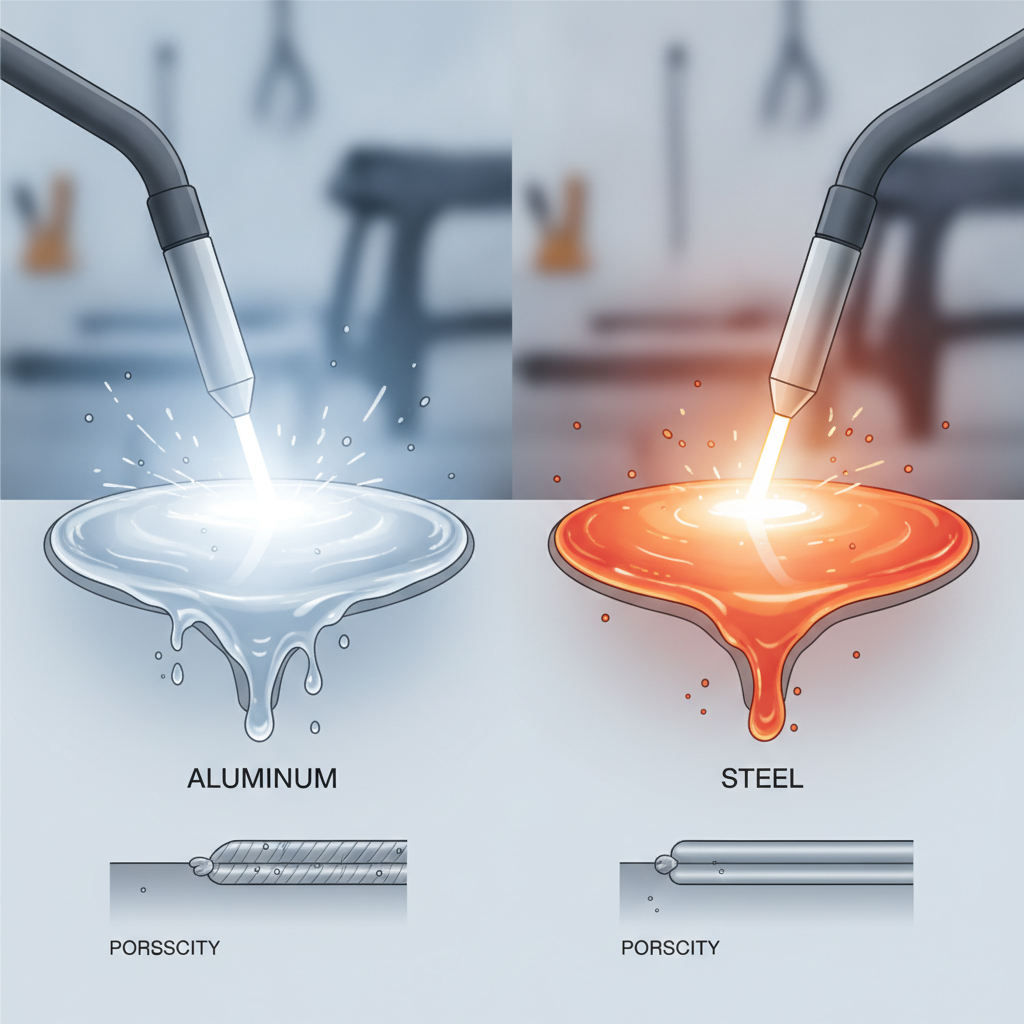
Why Aluminium Behaves So Differently from Steel
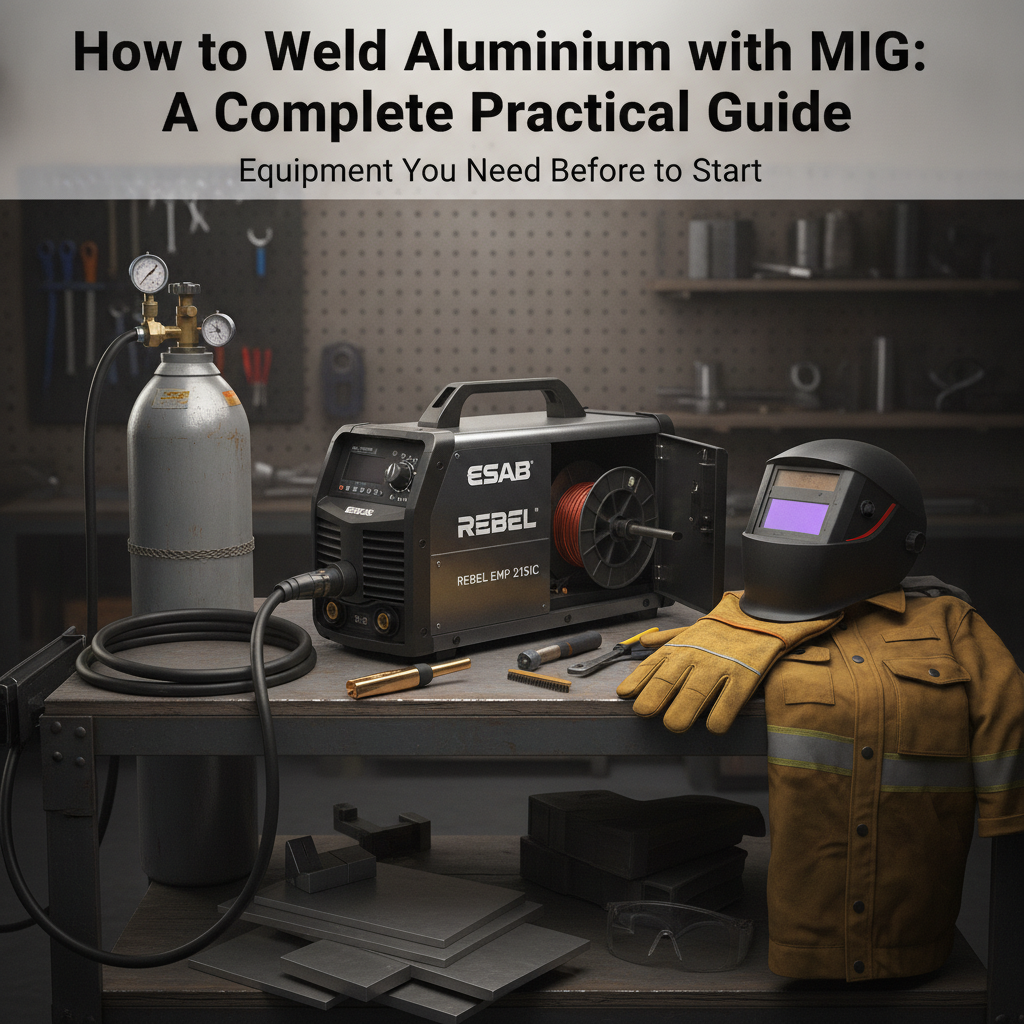
Equipment You Need Before You Start
Cleaning and Prep: The Step Most People Rush
Poor cleaning is the number one cause of porosity and contamination in aluminium welds. Step 1 — Degrease first. Use acetone or a dedicated aluminium cleaner to remove oil, grease, and surface contamination. Wipe in one direction only — don’t scrub back and forth with the same cloth. Step 2 — Remove the oxide layer. Use a stainless steel wire brush dedicated only to aluminium. Using the same brush you’ve used on steel will contaminate the aluminium with iron particles. Brush in one direction along the weld joint. Step 3 — Weld as soon as possible. Aluminium begins forming a new oxide layer almost immediately after cleaning. Weld within a few minutes of cleaning where possible. Step 4 — Check fit-up. Tight fit-up is more important with aluminium than steel because the fluid weld pool will fall through gaps easily.MIG Settings for Aluminium: A Practical Reference
Aluminium requires significantly more wire feed speed and voltage than equivalent steel work. Starting points vary by material thickness. | Material Thickness | Voltage (V) | Wire Feed Speed (IPM) | Gas Flow Rate | |—|—|—|—| | 1.6mm (1/16″) | 17–18 V | 180–220 IPM | 14–16 L/min | | 3mm (1/8″) | 19–21 V | 220–280 IPM | 15–17 L/min | | 4.5mm (3/16″) | 21–23 V | 280–340 IPM | 16–18 L/min | | 6mm (1/4″) | 23–26 V | 340–400 IPM | 17–19 L/min | These are starting points. Always run a test bead on scrap before welding the actual workpiece. For a more complete reference, the aluminium MIG welding settings chart with wire feed and voltage guidance goes into greater detail across a wider range of thicknesses.Step-by-Step: How to MIG Weld Aluminium
1. Set up the spool gun with the correct aluminium wire (ER4043 or ER5356) and a clean Teflon liner if using a standard gun setup. 2. Connect 100% argon and set flow rate between 14–18 L/min depending on conditions. Outdoors or in drafty areas, go toward the higher end. 3. Set polarity to DCEP and dial in voltage and wire feed speed based on your material thickness using the table above. 4. Clean and prep the joint as described — degrease, wire brush, weld promptly. 5. Preheat thicker sections (above 6mm) if possible. A quick pass with a propane torch helps avoid cold starts and porosity. Don’t overheat — just warm to around 65–90°C. 6. Use a push technique. Unlike steel where you can push or drag, aluminium almost always responds better to pushing the gun away from the weld puddle. This keeps the shielding gas flowing over fresh weld metal and prevents oxidation. 7. Maintain a travel angle of 5–15 degrees from vertical. Too steep an angle reduces gas coverage. 8. Move steadily and consistently. Aluminium punishes hesitation. A slow, uneven pass creates cold laps or excess buildup. 9. Don’t stop mid-bead if you can avoid it. Stopping and restarting on aluminium creates visible overlaps and potential porosity at the restart point. 10. Let it cool naturally. Quenching aluminium welds in water can cause distortion or cracking. Let the part air cool.Common Problems and How to Fix Them
Porosity (small holes in the weld) Usually caused by contamination or inadequate gas coverage. Reclean the base metal, check gas flow, and inspect the nozzle for spatter blocking gas flow. Moisture in the base metal or wire can also cause this. Wire bird-nesting at the drive rolls The wire is jamming somewhere between the drive rolls and the weld pool. Switch to a spool gun, reduce drive roll pressure slightly, and check that you’re using the correct U-groove drive rolls for aluminium. Standard V-groove rolls crush soft aluminium wire. Burn-through on thin sections You’re putting too much heat in. Reduce voltage, increase travel speed, or consider pulsed MIG if your machine supports it. Techniques to prevent burn-through on thin metal can apply here even when the material is aluminium. Cold laps or lack of fusion Insufficient heat or too fast a travel speed. The weld is sitting on top of the base metal rather than fusing into it. Slow down slightly and increase voltage incrementally. Inconsistent bead appearance Often caused by variable wire feed speed from a standard gun. A spool gun typically resolves this immediately. Erratic arc Check that the contact tip is the correct size for aluminium wire. Aluminium expands significantly when heated, so a tip that fits cold may be too tight when warm. Use tips sized 0.1mm larger than the wire.Spool Gun vs Push-Pull: Which Do You Actually Need?
| Feature | Spool Gun | Push-Pull System | |—|—|—| | Feed path length | Very short (wire spool at gun) | Medium to long with assist motor | | Best for | Shorter cable runs, general shop use | Larger machines, longer reach | | Ease of setup | Simple | More complex | | Wire sizes supported | 0.9mm–1.2mm typically | 0.9mm–1.6mm typically | | Cost | Lower | Higher | | Typical use case | Home shop, automotive, fabrication | Industrial, production welding | For most home shop and small fabrication work, a spool gun is the more practical choice. The Hobart SpoolRunner 200 is a well-regarded option that mounts on compatible Hobart machines and handles 0.9mm and 1.2mm aluminium wire reliably.FAQ
Can I MIG weld aluminium with a standard MIG gun? Technically yes, but it’s very difficult in practice. Standard steel liners create too much friction for soft aluminium wire, causing frequent bird-nesting and feed stoppages. A Teflon liner improves things, but a spool gun is the most reliable solution for consistent aluminium welding. What’s the difference between ER4043 and ER5356 aluminium wire? ER4043 has silicon added, making the weld pool more fluid and easier to control. It’s better for general fabrication, automotive parts, and castings. ER5356 is stronger and more suitable for structural work, marine applications, and anything exposed to salt water. ER4043 is the better starting point for most beginners. Do I need to preheat aluminium before MIG welding? For material under 6mm, preheat is usually unnecessary. On thicker sections or cold environments, a light preheat to 65–90°C helps avoid porosity and cold starts. Don’t overheat — aluminium loses strength rapidly above 150°C and won’t show visual warning signs the way steel does. Why does my aluminium weld look black and sooty? Black, sooty deposits around the weld usually indicate oxidation from inadequate shielding gas coverage. Check your gas flow rate, inspect the nozzle for blockage, and make sure you’re using 100% argon rather than a mixed gas. Contaminated base metal can also contribute to this appearance. Can I use flux core wire to weld aluminium? Standard flux core wire does not work on aluminium. There are some specialised aluminium brazing rods for torch work, but genuine MIG flux core wire for aluminium welding isn’t a practical option for structural welds. If you’ve seen claims about welding aluminium with flux core wire, it’s worth understanding the limitations before attempting it. How do I stop aluminium from warping when welding? Use tack welds at regular intervals before running full beads. Clamp the work firmly and weld in short, alternating sequences rather than one long continuous pass. Aluminium expands and contracts significantly, so managing heat input through technique is more effective than relying on fixturing alone. Is MIG or TIG better for welding aluminium? TIG welding aluminium produces cleaner, more precise welds and handles thin material better. MIG welding is faster, requires less skill to pick up, and works well on material 3mm and above. For production work or thicker structural aluminium, MIG is often the practical choice. For thin sheet, precision parts, or cosmetically critical work, TIG is the better option.Getting aluminium MIG welding right comes down to three things: proper equipment (spool gun, 100% argon, correct wire), thorough cleaning, and consistent technique. Rush any of those and the weld will show it. Take the time to dial in your settings on scrap first, and the process becomes far more predictable than its reputation suggests.